App maintenance isn't a cost center — it's the difference between a product that compounds in value over time and one that quietly becomes a liability.
What Are App Maintenance Services — and Do You Really Need Them?

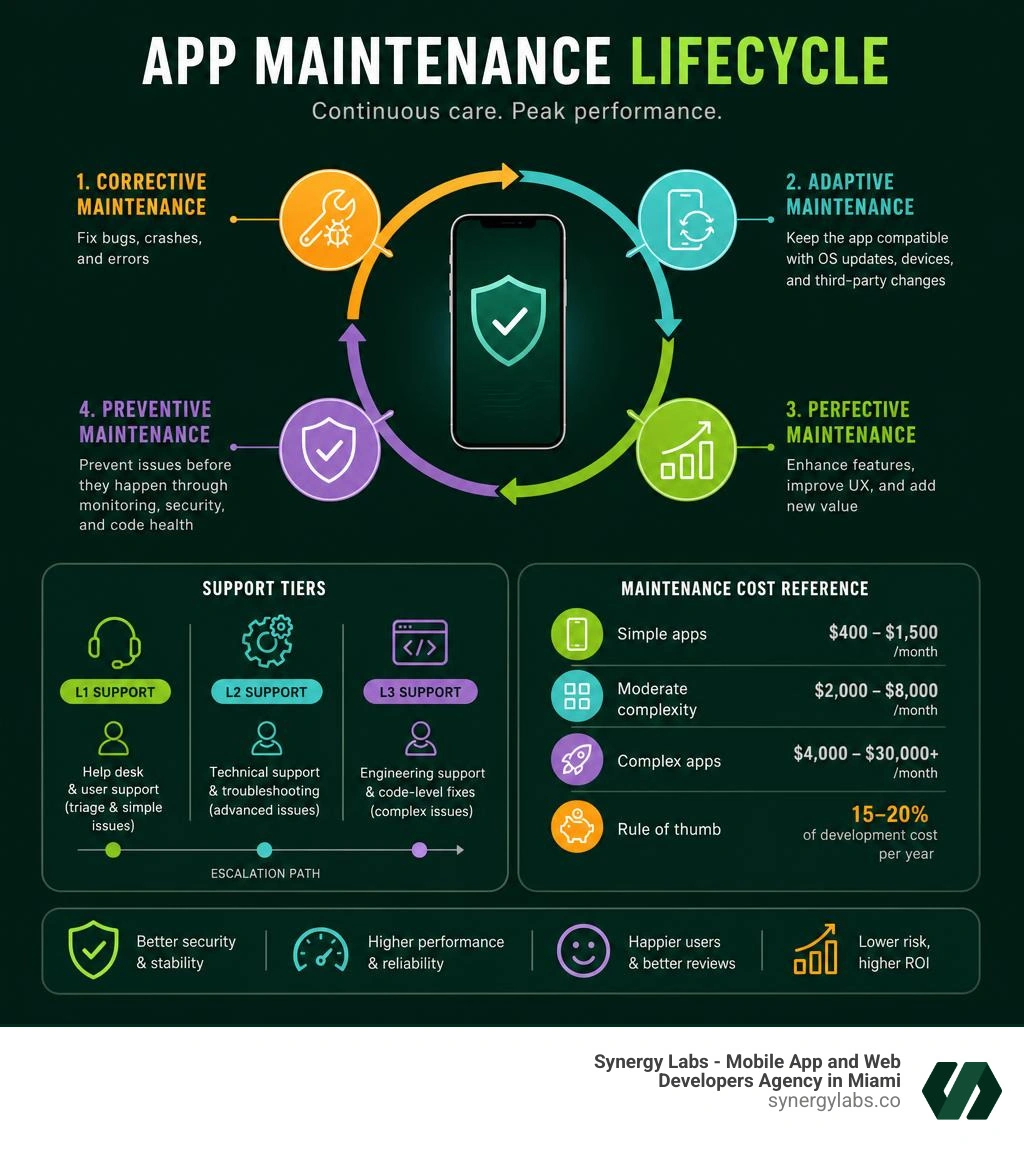
App maintenance services are ongoing technical support and development activities that keep a mobile app secure, compatible, and performing well after launch. They cover everything from bug fixes and OS updates to security patches, performance tuning, and feature improvements.
Here's what app maintenance services typically include:
- Corrective maintenance — fixing bugs, crashes, and errors
- Adaptive maintenance — updating the app for new iOS/Android versions and devices
- Perfective maintenance — adding features and improving the user experience
- Preventive maintenance — proactive security audits, code refactoring, and performance monitoring
- L1/L2/L3 support — tiered technical support from help desk to code-level engineering
- App store compliance — ensuring the app meets current Apple and Google Play policies
- Third-party integration upkeep — keeping APIs, SDKs, and payment gateways working
Quick cost reference:
- Simple apps: $400–$1,500/month
- Moderate complexity: $2,000–$8,000/month
- Complex apps: $4,000–$30,000+/month
- Rule of thumb: budget 15–20% of your original development cost per year
Most founders treat app maintenance as an afterthought — until something breaks in production, users start leaving bad reviews, or the app gets pulled from the App Store. At that point, the cost of not maintaining is far higher than the cost of doing it right.
At Synergy Labs, we've helped startups and growing businesses deliver and maintain mobile apps across industries — and app maintenance services are a core part of how we keep products healthy long after launch. With hands-on experience managing post-launch support for apps ranging from social platforms to fintech tools, we know exactly where apps break down and how to prevent it.
Quick look at app maintenance services:
Why Investing in Professional App Maintenance Services is Non-Negotiable in 2026
Building an app is like buying a car. You wouldn't drive a brand-new vehicle off the lot and assume you never have to change the oil, rotate the tires, or check the brakes. Yet, many businesses treat mobile applications as one-and-done projects.
In 2026, the mobile ecosystem is more dynamic than ever. Operating systems update constantly, security threats become more sophisticated by the hour, and user expectations for speed and seamless design are at an all-time high. Failing to invest in professional app maintenance services is a fast track to obsolescence.
One of the most immediate risks of neglecting your app is store delisting. In Q2 2024 alone, around 1.1 million apps were delisted or taken off the major app stores for failing to meet compliance requirements—including incompatibility with newer OS versions. If your app does not target the latest API levels required by Google Play or Apple, it becomes invisible to new users.
Beyond store compliance, professional maintenance directly impacts your bottom line through user retention and performance optimization. Studies show that partnering with a professional maintenance team can lead to:
- 90% faster issue resolution when bugs do arise
- 40% fewer app crashes in production
- 30% improvement in app store ratings from happy users
- 60% longer overall app lifespan
When you keep your app running smoothly, you protect your user acquisition investment. It is significantly cheaper to retain an existing user with a high-performing app than it is to acquire a new one after a crash-induced uninstallation. To keep your product scaling efficiently, it is essential to avoid common pitfalls that growing companies frequently make during their post-launch phases.
Whether you are targeting users in Miami FL, San Francisco CA, London UK, or Dubai UAE, local and international compliance standards require your digital products to remain secure and updated. If you are operating in regions with localized tech guidelines, checking out specialized agencies such as those offering mobile app maintenance services in Saudi Arabia 2026 or looking into app maintenance services in Doha can provide additional geographic context.
The Four Core Types of Mobile App Maintenance
To manage an app effectively, maintenance cannot be a generic, reactive scramble. We categorize our app maintenance services into four distinct engineering disciplines. Each type addresses a specific aspect of the app's health, ensuring we cover everything from immediate emergency hotfixes to long-term architectural scalability.
Understanding these categories helps you structure your budget and align your product roadmap with the reality of custom mobile software development.
Corrective Maintenance: Fixing Bugs and Resolving Crashes
Corrective maintenance is the reactive side of support. No matter how thoroughly an app is tested before launch, real-world usage will inevitably expose edge cases, logic conflicts, and device-specific quirks.
When a user experiences a crash, our team steps in to analyze the crash logs using tools like Firebase Crashlytics or Sentry. We isolate the root cause, run regression tests to ensure our fix doesn't break other features, and deploy hotfixes. Our goal is to achieve and maintain a 99.9% crash-free session rate, turning negative user feedback into opportunities for rapid product improvement.
Adaptive Maintenance: Keeping Up with OS Updates and Device Compatibility
The mobile landscape shifts beneath your app's feet. Every year, Apple releases a major iOS update and Google rolls out a new Android version. These updates regularly introduce breaking API changes, deprecate older libraries, and alter background processing rules.
Adaptive maintenance ensures your app remains fully compatible with these platform changes. It also covers optimizing layout rendering for new hardware releases—such as new screen sizes, camera notches, or chipset architectures. By tracking beta OS releases weeks in advance, we prevent Day-1 crashes when users update their phones. If you are coordinating these updates across specific regional hubs, resources like application support & maintenance services NYC or top maintenance and updates agencies in San Francisco, California highlight how critical platform adaptability is for high-density metropolitan user bases.
Perfective Maintenance: Evolving Features and User Experience
A successful app is a living product. Once your app is in the wild, you will gather invaluable data on user paths, feature adoption, and drop-off points. Perfective maintenance is the process of modifying existing features, optimizing UI/UX workflows, and adding minor enhancements based on this real-world feedback.
This type of maintenance is less about fixing what is broken and more about keeping your app competitive. Whether it is refining your checkout flow to reduce cart abandonment or redesigning a dashboard for better accessibility, perfective maintenance is key to scaling your mobile app development alongside your growing user base.
Preventive Maintenance: Proactive Security and Performance Optimization
Preventive maintenance is where we actively look for trouble before it finds your users. This involves conducting regular security vulnerability scans, performing code refactoring to reduce technical debt, and monitoring database query performance.
We actively track Common Vulnerabilities and Exposures (CVE) databases to ensure that none of your third-party SDKs or libraries have become security risks. By refactoring legacy code and optimizing server-side API latency, we prevent performance drift—ensuring your app remains fast, secure, and cheap to run as your database grows.
Understanding Support Levels: L1 vs. L2 vs. L3 Support
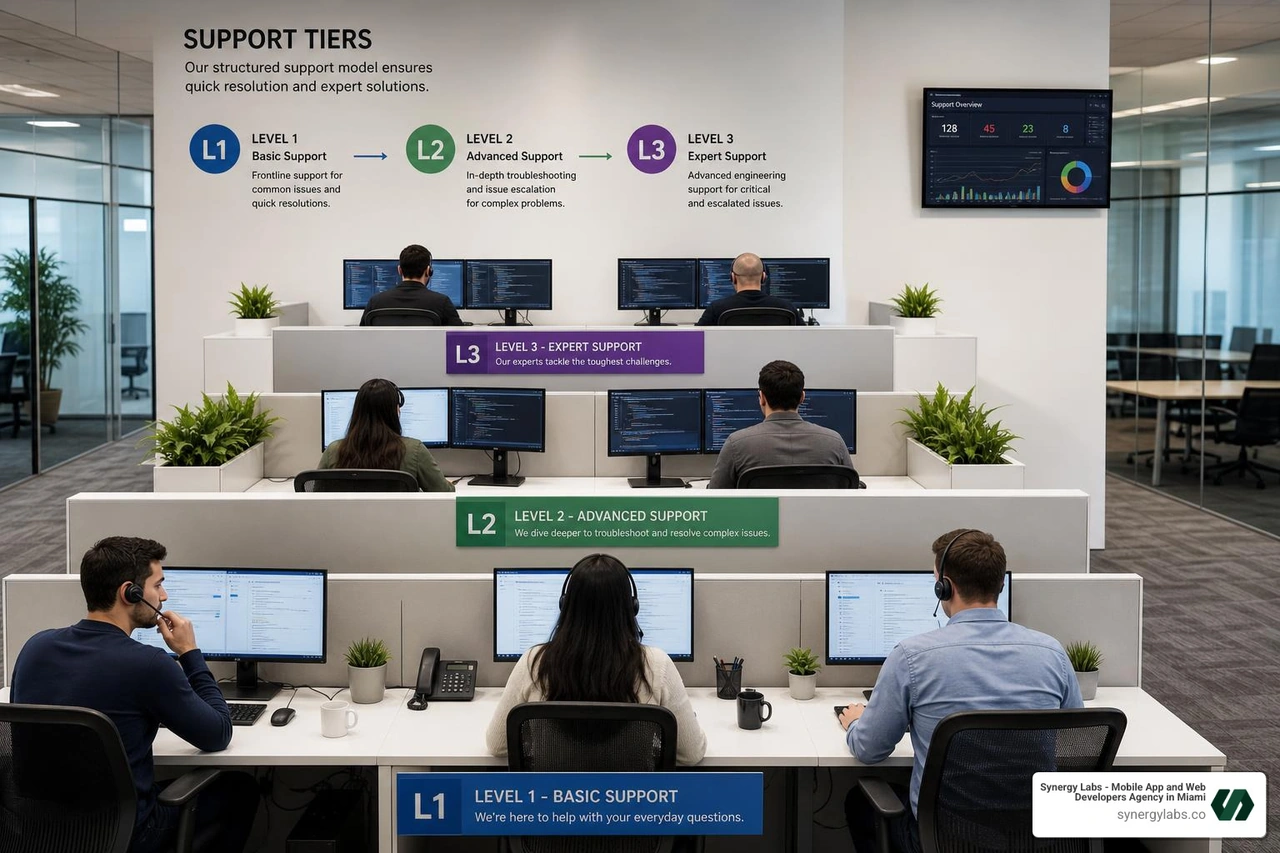
When you partner with a professional agency for app maintenance services, your support workflow is typically organized into tiers. This structured hierarchy ensures that simple user questions are handled quickly and cost-effectively, while complex technical issues are escalated to senior engineers without clogging up your development pipeline.
L1 Support: Basic User Assistance and Ticket Triage
L1 support is your front-line help desk. It is designed to handle basic, non-technical queries from end-users who might be having trouble logging in, resetting their passwords, or navigating the user interface.
L1 specialists focus on ticket logging, basic troubleshooting using pre-established scripts, and triaging issues. From a cost perspective, L1 support is highly transactional and efficient, typically ranging from $10.50 to $14.40 per ticket for end-user support (assuming a volume of 200–300 tickets per month with 24/7 coverage).
L2 Support: Configuration Fixes and Technical Troubleshooting
If an issue cannot be resolved by L1, it is escalated to L2 support. This tier handles more technical, system-level issues that do not require changing the actual codebase.
L2 engineers investigate application logs, run custom database queries, check server configurations, and handle minor system administration tasks. For example, if an API integration is failing due to an expired security token, L2 will identify and resolve it. L2 support typically costs around $33 per ticket (assuming 40–160 tickets per month under standard 8/5 coverage).
L3 Support: Code-Level Changes and Advanced Engineering
L3 support is the highest escalation level, managed by senior software engineers and architects. This tier is triggered when a bug requires actual code changes, database schema updates, or deep architectural refactoring.
L3 engineers write the patches, conduct rigorous regression testing, and manage the deployment of hotfixes to the App Store and Google Play. Because this level requires deep technical expertise and direct knowledge of your app's codebase, it is typically billed on a monthly retainer or time-and-materials basis.
The Financials: App Maintenance Costs and Pricing Factors
Budgeting for post-launch support is one of the most critical steps in ensuring your product's long-term survival. The yearly cost to maintain and support a mobile app is generally about 15–20% of its initial development cost. Over the app's entire lifetime, these ongoing operational costs can add up to as much as 90% of the total cost of ownership (TCO).
In the first year after deploying a mobile app, maintenance costs are typically at their highest—averaging 10–15% of the initial development cost—as the product adapts to real-world user behavior and resolves early post-launch bugs. In subsequent years, this cost stabilizes to around 8–10% annually for standard upkeep, assuming you are not building major new feature sets.
To put this into concrete numbers, monthly support and maintenance costs generally scale with the complexity of your application:
- Simple mobile apps: $400–$1,500 per month
- Moderate complexity apps: $2,000–$8,000 per month
- Complex, enterprise-grade apps: $4,000–$30,000+ per month
These budgets cover essential operational fees such as cloud hosting (ranging from $70 to $320/month depending on user traffic), third-party API commissions, push notification services, and developer account renewals. Understanding these baseline figures is crucial when reviewing the cost of enterprise-grade app development.
The Real Cost of Neglecting App Maintenance Services
While skipping out on a maintenance plan might save you money this month, it creates massive technical debt that will cost far more to resolve later. Outdated apps suffer from slow load times, frequent crashes, and unpatched security vulnerabilities.
This leads directly to user churn and negative app store reviews, destroying your brand equity. If you let your app sit without updates for a year, a simple OS update could break your core features completely, forcing you to pay for an expensive emergency rebuild. Calculating the ROI of enterprise app development quickly reveals that proactive, continuous maintenance is always the most cost-effective path.
Key Factors Influencing Maintenance Pricing
Several variables dictate where your app will fall on the pricing spectrum:
- App Complexity: Apps with real-time database sync, offline architectures, or complex backend workflows require more engineering hours to monitor and maintain.
- User Base Size: Larger user bases require more robust server scaling, database optimization, and higher tiers of L1/L2 customer support.
- Platform Selection: Maintaining separate native iOS and Android codebases is naturally more resource-intensive than maintaining a single cross-platform codebase built with React Native or Flutter.
- SLA Coverage: If your business model requires 24/7 monitoring with a guaranteed 1-hour response time for critical issues (P0), your monthly retainer will be higher than an 8/5 next-business-day arrangement.
Best Practices for Choosing a Maintenance Partner
Selecting the right partner to look after your digital product is just as important as choosing the team that built it. You need a partner who is proactive, highly communicative, and possesses full-stack technical capabilities.
To set yourself up for success, it helps to understand what to expect from a mobile app development agency during the transition from active development to long-term support.
How to Choose the Best Provider for App Maintenance Services
When evaluating potential service providers, look for teams that offer comprehensive, full-stack coverage across frontend, backend, and third-party integrations. They should have established Service Level Agreements (SLAs) that clearly define response times based on issue severity.
If you are a business operating in specific regions, look for partners with localized presences or deep familiarity with your regional tech hubs. For example, businesses in Texas often look for a software app maintenance company for Austin, TX, while those in New England might partner with a software app maintenance company for Hartford, CT.
Additionally, if your ecosystem includes complex web portals alongside your mobile apps, make sure your partner has experience in Web Application Support and Maintenance Services to avoid gaps between your web and mobile platforms.
KPIs and Reporting to Expect from Your Team
A professional maintenance team should provide complete transparency into your app's health and their daily activities. You should expect detailed monthly reports tracking key performance indicators (KPIs) such as:
- Crash-Free Session Rate: Target should always be above 99.5%.
- API Latency: Monitoring how fast your backend services respond to mobile requests (ideally under 200ms).
- Average Response & Resolution Time: How quickly tickets are triaged and resolved based on their SLA priority.
- Server Uptime: Ensuring your cloud hosting environment maintains a 99.9% or higher uptime.
Frequently Asked Questions about App Maintenance
How often should a mobile app be updated?
For optimal performance, we recommend pushing minor updates (such as bug fixes and performance tweaks) every 2 to 4 weeks. Major feature updates or design enhancements can be scheduled monthly or quarterly. Additionally, you must push compatibility updates immediately following major iOS and Android OS releases to ensure your app remains compliant.
What happens if an app is not maintained regularly?
Without regular maintenance, your app will quickly accumulate technical debt. It will experience rising crash rates, slow loading speeds, and security vulnerabilities. Over time, third-party APIs (like social logins or payment gateways) will deprecate, causing key features to stop working entirely. Eventually, the app will fail compatibility checks and be delisted from the App Store and Google Play.
Can a maintenance service support an app built by another developer?
Yes, professional agencies frequently take over maintenance for apps built by third-party vendors. The process begins with a comprehensive App Health Audit to analyze the existing codebase, identify outdated libraries, and assess security vulnerabilities. Once the baseline is established, the team will create a structured onboarding plan to transition support smoothly. This approach allows you to focus on scaling an app without rewriting everything.
Keeping Your Digital Product Fast, Secure, and Scale-Ready
Maintaining a mobile application in 2026 is not just about fixing things when they break; it is a strategic engineering discipline that protects your initial investment, keeps your users engaged, and ensures your business remains competitive.
At Synergy Labs, we specialize in providing end-to-end, proactive app maintenance services designed for long-term product success. We don't believe in leaving you in the dark after launch. Our unique operational model is built specifically to make ongoing support predictable, transparent, and highly efficient:
- In-Shore CTO with an Offshore Development Team: Get direct access to senior, strategic technical leadership right here in your time zone, backed by the cost-efficiency of our talented offshore developers.
- Fixed-Budget Model: No surprise bills or runaway hourly costs. We scope your maintenance needs clearly so you can plan your annual budget with total confidence.
- Milestone-Based Payments: You only pay as we deliver verified results, keeping our incentives perfectly aligned with your product's health and performance.
Whether your business is based in Miami FL, London UK, Dubai UAE, or any of our global locations, we are ready to help you future-proof your product.
Ready to keep your app running at its absolute best? Get started with Synergy Labs today and let's discuss how we can support your long-term growth.


.avif)

.avif)


