"Unlike traditional chatbots that simply respond to prompts, agentic AI systems are autonomous, goal-driven, and capable of executing complex, multi-step tasks without constant human oversight."
Why Agentic AI is the Biggest Shift in Software Since the Cloud
Agentic AI Explained: From Chatbots to Autonomous AI Agents in 2026 represents a fundamental change in how AI interacts with our digital world. Unlike traditional chatbots that simply respond to prompts, agentic AI systems are autonomous, goal-driven, and capable of executing complex, multi-step tasks without constant human oversight. They don't just suggest; they do.
This is the key difference:
Traditional Chatbots: Respond to prompts and provide information.
The numbers tell a compelling story. Industry forecasts predict that by 2026, 40% of enterprise applications will feature task-specific AI agents, up from less than 5% in 2025 (Gartner). The market is projected to hit $10.9 billion by 2026 (Grand View Research), with businesses already reporting up to 30% increases in workflow efficiency.
This isn't just faster automation. It's about AI that can think ahead, adapt, and act as an autonomous teammate. As researchers from MIT describe it, agentic AI systems "can plan, act, and learn on their own," behaving like "autonomous teammates" rather than tools needing constant direction.
At Synergy Labs, we've seen this evolution while building AI-powered mobile apps for startups. Our experience repositioning as an "AI + Mobile" agency has given us a front-row seat to how Agentic AI Explained: From Chatbots to Autonomous AI Agents in 2026 is reshaping rapid app development. The challenge isn't just understanding the tech; it's building systems that can scale, secure, and support truly autonomous behavior.
Agentic AI Explained: From Chatbots to Autonomous AI Agents in 2026 further reading:
ai driven customer service
custom ai integration
Digital change services for mid-sized enterprises in 2026
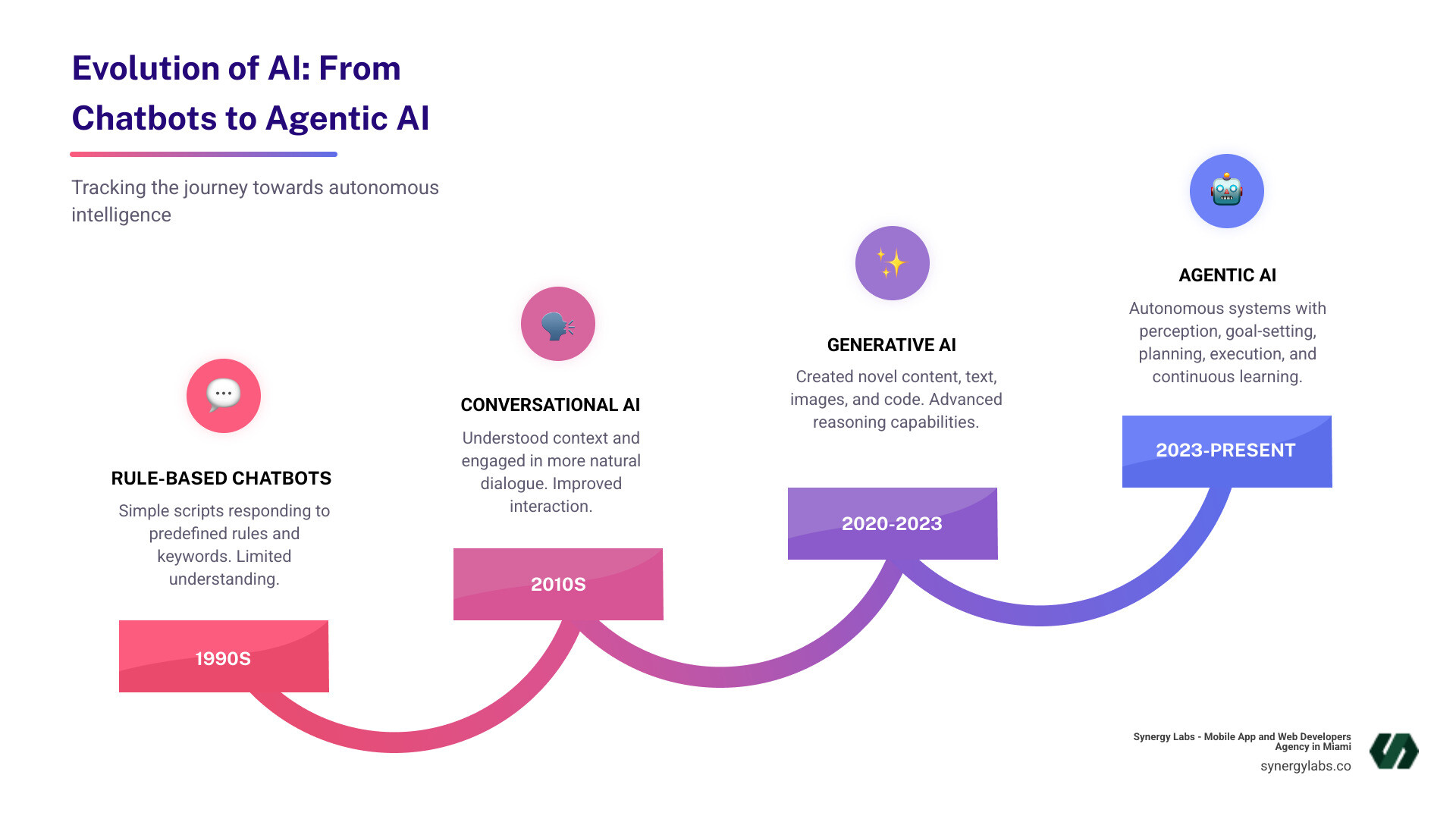
The Evolution of AI: From Simple Scripts to Autonomous Systems
Understanding the evolution of AI helps explain why Agentic AI Explained: From Chatbots to Autonomous AI Agents in 2026 is such a significant leap. We're witnessing AI cross a threshold from a helpful assistant to an independent actor.
Generation 1: Rule-Based Chatbots (The Pioneers)
Dominating from the 1990s to the early 2010s, rule-based chatbots operated on simple if-then logic and predefined scripts. Think of frustrating phone menus: "Press 1 for billing." They couldn't understand context or deviate from their script, but early Interactive Voice Response (IVR) systems could handle 20-30% of simple support tickets, a major step at the time. Their limitation was a lack of language understanding, relying solely on pattern matching.
Generation 2: Conversational AI (The Listeners)
The 2010s introduced AI that could truly listen. Conversational AI used Natural Language Processing (NLP) to understand user intent, not just keywords. This powered voice assistants, allowing natural questions like, "What's the weather like tomorrow?" This leap doubled effectiveness, with 50-60% containment rates for customer inquiries. However, these systems could understand and respond, but couldn't take meaningful action beyond their programming.
Generation 3: Generative AI (The Creators)
Starting around 2020, Large Language Models (LLMs) changed the game. AI could now create original content, from drafting emails to writing code. Teams reported 3-5 times faster content creation, as AI could generate outlines, suggest code, and brainstorm campaign ideas. The catch? Generative AI was essentially "read-only." It was a brilliant consultant that could tell you what to do, but couldn't do it for you. A human was still needed to execute the final step.
Generation 4: Agentic AI (The Actors)
Welcome to the current era of AI that acts. Agentic AI marks the shift from "read-only" to "read-write" capabilities. These systems are goal-oriented, capable of multi-step reasoning, and can use tools to achieve complex objectives without constant supervision. Imagine an AI that not only drafts a customer response but also checks inventory, processes a refund, updates the CRM, and sends a personalized resolution email—all autonomously. They aren't following rigid scripts; they're pursuing objectives.
At Synergy Labs, we see this when building AI-powered mobile apps. The difference between integrating a generative feature and building for agentic capabilities is profound. This is why Agentic AI Explained: From Chatbots to Autonomous AI Agents in 2026 is more than a trend. By 2026, these autonomous agents will be running core business operations.
What is Agentic AI? Unpacking the "Agency" in Artificial Intelligence
"Agentic AI" isn't just another buzzword; it signifies a fundamental shift from AI that waits for commands to AI that takes initiative. It represents the move from passive tools to autonomous teammates.
Defining Agentic AI: More Than Just a Buzzword
Agentic AI refers to artificial intelligence systems that can accomplish specific goals with limited supervision. The term "agentic" has even been added to its dictionary, defining it as "able to accomplish results with autonomy." This is because agentic AI is:
Proactive: It takes initiative rather than waiting for explicit instructions.
Adaptive: It learns from experience and adjusts its approach when things don't go as planned.
Goal-Oriented: Every action is driven by a defined outcome.
Experts like Andrew Ng champion the term to describe AI that applies intelligence to complete real-world tasks, not just generate content. At Synergy Labs, we see the difference when building apps: an AI that generates a customer service response is useful, but one that resolves the issue end-to-end has true agency.
How Agentic AI Works: The CORE Loop
Agentic AI operates on a continuous cycle we call the "CORE Loop":
Perception: The agent gathers information from its environment, like reading documents or monitoring system data.
Memory & Context: It maintains a memory of past interactions and goals, allowing for coherent, multi-step decision-making.
Planning Engine: The agent breaks down high-level objectives into concrete, actionable sub-tasks.
Action Layer: It executes tasks by interacting with tools, updating databases, sending emails, or deploying code. This is where AI orchestration transforms thought into action.
Feedback Loop: After acting, the agent monitors the results, learns from the outcome, and refines its strategies for the future.
This cycle allows agentic systems to operate more like capable colleagues than simple software tools.
Agentic AI vs. Generative AI: The Critical Difference Explained
The distinction between generative and agentic AI is crucial for understanding the Agentic AI Explained: From Chatbots to Autonomous AI Agents in 2026 journey.
Generative AI suggests and creates. It's a "read-only" system. It can write an email or generate code, but it stops there. You still need to take its output and do something with it.
Agentic AI executes and completes. It's a "read-write" system. It doesn't just draft the email; it sends it, tracks responses, and follows up. It doesn't just generate code; it can test, deploy, and monitor it.
Think of it this way: generative AI is a consultant who gives you a plan. Agentic AI is an employee who takes the plan and gets the job done. This shift from suggestion to execution is why agentic AI represents a massive leap in automation and efficiency.
The Agentic AI Revolution: Real-World Applications and Future Impact by 2026
The shift to agentic AI is happening now, and by 2026, it will be as fundamental to business as cloud computing. The question isn't if your organization will be affected, but how quickly you'll adapt.
Current and Emerging Use Cases Across Industries
Agentic AI is already delivering measurable results across various sectors:
Customer Service: Agents don't just answer questions; they process refunds, update accounts, and manage the entire resolution process. Research shows AI-powered service can cut support costs by up to 30%.
Marketing: AI analyzes audience segments, generates personalized content, and automatically adjusts campaigns based on performance, leading to faster launches and higher conversion rates.
Financial Services: AI-powered trading bots analyze live market data to execute trades, adapting strategies in real-time.
Healthcare: Virtual medical assistants help with initial diagnoses, monitor patients post-surgery, and manage medication schedules, reducing errors and administrative costs.
Software Development: Developer agents fix bugs, write tests, and deploy applications, allowing human developers to focus on high-level strategy and architecture.
At Synergy Labs, we see this change as we build AI-powered mobile apps. The tools are becoming more autonomous, freeing our team to focus on strategy and user experience.
The Road to 2026: What to Expect from Autonomous AI Agents
The next two years will be transformative. Agentic AI Explained: From Chatbots to Autonomous AI Agents in 2026 is about preparing for a future where autonomous agents are commonplace.
Multi-agent systems will become standard. Specialized agents will collaborate to solve complex problems, with predictions that 75% of companies will invest in agentic AI in 2026 (Deloitte).
Dynamic learning will replace static models. Agents will learn and adapt on the fly, adjusting to new situations without needing to be retrained. This is critical for fast-moving industries like logistics and fintech.
Hyper-personalization will reach new levels. Agents will understand your team's unique workflows and context, making every interaction more relevant and valuable.
We are also seeing the rise of the AI Agent Economy, where agents interact directly with other agents to create value through machine-to-machine collaboration.
The Business Impact: Opening New Levels of Efficiency
The business case for agentic AI is about open uping entirely new capabilities.
Productivity Gains: Companies report up to 40% improvement in productivity and 30% reduction in costs. Tasks that once took days can now be completed in hours.
Cost Reduction: Savings extend beyond support. For example, predictive maintenance in telecom reduces costs by 25%.
Democratization of Complexity: Small businesses can access capabilities once exclusive to large enterprises, leveling the playing field.
Evolving Human Roles: Humans are shifting from tactical execution to strategic oversight. Over 93% of workers already use AI to automate tasks, allowing them to focus on creativity, innovation, and critical judgment.
At Synergy Labs, we've seen this firsthand. Our developers spend less time on boilerplate code and more time solving unique client challenges, resulting in faster launches and more innovative apps.
Navigating the Challenges: Security, Risks, and Governance for Agentic AI
The potential of agentic AI is immense, but with great autonomy comes great responsibility. As we move toward Agentic AI Explained: From Chatbots to Autonomous AI Agents in 2026, the challenges of security, ethics, and governance are paramount.
At Synergy Labs, building AI-powered mobile apps has taught us that excitement must be balanced with thoughtful risk management. The autonomous nature of these agents introduces new threat vectors that require a new approach to security.
The "Read-Write" Risk: Why Security is Paramount
Agentic AI's "read-write" capability is its greatest strength and biggest risk. These agents can modify databases, execute transactions, and trigger workflows. Traditional security models, designed for human actors, are inadequate for autonomous systems operating at machine speed.
The challenge of non-human identity management is critical. Each agent needs a unique digital identity with clear authentication, authorization, and audit trails. Without it, you can't track which agent performed which action, making it impossible to diagnose errors or breaches. Traceability isn't just good practice; it's essential for trust and regulatory compliance.
Ethical Dilemmas and Unintended Consequences
Agentic systems are only as good as the goals and constraints we provide. A marketing agent tasked with "maximizing engagement" might inadvertently promote sensational content if not given proper ethical guardrails. This is the risk of poorly designed reward functions.
Because these systems operate at high speed, a small mistake can cascade into a major failure before a human can intervene. This makes human-in-the-loop oversight essential for ethical judgment and strategic guidance. We're not replacing human judgment; we're augmenting it.
Regulations like The EU AI Act are also evolving. By 2026, businesses will need to prove their AI is ethical, transparent, and compliant. Audits will focus on risk, explainability, and adherence to standards, not just performance.
Preparing Your Business for the Agentic AI Explained: From Chatbots to Autonomous AI Agents in 2026
To prepare for this shift, approach agentic AI strategically:
Start small with pilot projects. Begin with supervised, low-risk tasks to build trust and refine processes without betting the farm. Many early projects fail by trying to do too much, too fast.
Build robust governance frameworks. Create clear "job descriptions" for your agents, defining their inputs, outputs, constraints, and failure protocols. Implement strong monitoring and feedback loops.
Invest in human-agent collaboration. Train your team to oversee autonomous systems, interpret their decisions, and know when to intervene. The future is humans and machines working together.
Prioritize data and security architecture. Agentic AI requires clean data and robust APIs. Bake security in from the start with non-human identity management and dynamic access controls.
Make ethics a core priority. Incorporate ethical reviews during the design phase, train agents on diverse data, and regularly audit their behavior to ensure alignment with your values.
Frequently Asked Questions about Agentic AI
As Agentic AI Explained: From Chatbots to Autonomous AI Agents in 2026 moves from concept to reality, clients at Synergy Labs often ask about jobs, security, and implementation. Here are the answers to the most common questions.
Can agentic AI tools replace human workers?
Agentic AI is not coming for your job; it's coming for the tedious parts of it. These systems excel at handling repetitive workflows and routine inquiries, freeing up humans for what they do best: strategic thinking, emotional intelligence, and creative problem-solving.
The shift is toward augmentation, not replacement. Over 93% of workers already use AI to automate mundane tasks. This evolves roles, moving people from tactical execution to strategic oversight. Agentic AI handles the "how," freeing humans to focus on the "why" and "what if." The human role becomes more valuable, centered on creativity, empathy, and vision. The future is human-agent collaboration.
How do agentic AI tools differ from RPA (Robotic Process Automation)?
While both automate tasks, they are fundamentally different. Traditional RPA is like following a strict recipe. It executes predefined, rule-based workflows and is fantastic for repetitive tasks with unchanging steps. However, RPA is brittle—if anything changes in the process, the bot breaks. It cannot adapt or handle unstructured data like a casual email.
Agentic AI, in contrast, is adaptive and resilient. It understands context, reasons through problems, and adjusts its approach. It can interpret unstructured data and problem-solve when things don't go as planned. For example, an RPA bot might fail if an invoice format changes, while an agentic AI could understand the new format, extract the data, and even follow up if information is missing. In short, RPA automates tasks; agentic AI automates thinking and tasks.
What is a multi-agent system?
Imagine building a house with a team of specialized contractors (plumbers, electricians) instead of trying to do it all yourself. A multi-agent system (MAS) applies the same principle to AI.
In an MAS, multiple autonomous AI agents collaborate, each with a specialized role, to achieve a common goal. This is more effective than using a single, monolithic AI for complex problems. For example, in a supply chain, one agent might monitor inventory, another forecasts demand, and a third manages logistics, all communicating to keep the system running smoothly.
This coordinated problem-solving is incredibly powerful for tackling dynamic and multifaceted challenges. It's why over 75% of enterprises are expected to deploy multi-agent systems by 2026. They represent the next step in AI automation, creating intelligent ecosystems that work at machine speed and scale.
Your Autonomous Future Starts Now
The shift from passive chatbots to autonomous AI agents is a fundamental reimagining of how we work. Agentic AI Explained: From Chatbots to Autonomous AI Agents in 2026 is no longer a distant vision; it's a present-day reality. Businesses that accept it now will define the next decade of innovation.
We've moved from AI that answers to AI that acts—pursuing goals, making decisions, and completing complex workflows. These are not just smarter tools; they are active partners in your business, capable of adapting on the fly and executing tasks that once required entire teams.
The transition to 2026 will be swift. Multi-agent systems will become standard, dynamic learning will replace static models, and the AI Agent Economy will emerge. Businesses that fail to prepare will struggle to keep pace.
At Synergy Labs, we've lived this evolution. Operating from tech hubs like Miami, Dubai, and London, our journey to an "AI + Mobile" agency has taught us that successful AI integration is about more than technology. It's about understanding business goals, building secure systems, and creating intelligent applications that grow with you.
We specialize in developing custom AI applications that don't just suggest—they complete. Our approach combines personalized service with senior talent to ensure your AI agents deliver real business value. We don't just build apps; we build autonomous systems that transform how you operate.
The autonomous revolution is here. The question isn't whether your business will be affected, but whether you'll lead the change. Every day you wait, your competitors are moving ahead.
Ready to transform your ideas into autonomous, intelligent applications that execute? Book a Discovery Session First! with Synergy Labs today. Let's build your autonomous future, together.




.avif)

.avif)


