Replit's pricing isn't a flat subscription — it's a usage-based system where AI, deployments, and storage all draw from credits. Here's exactly what small businesses should expect to pay in 2026
Why Replit's Pricing is a Game-Changer for Small Businesses in 2026
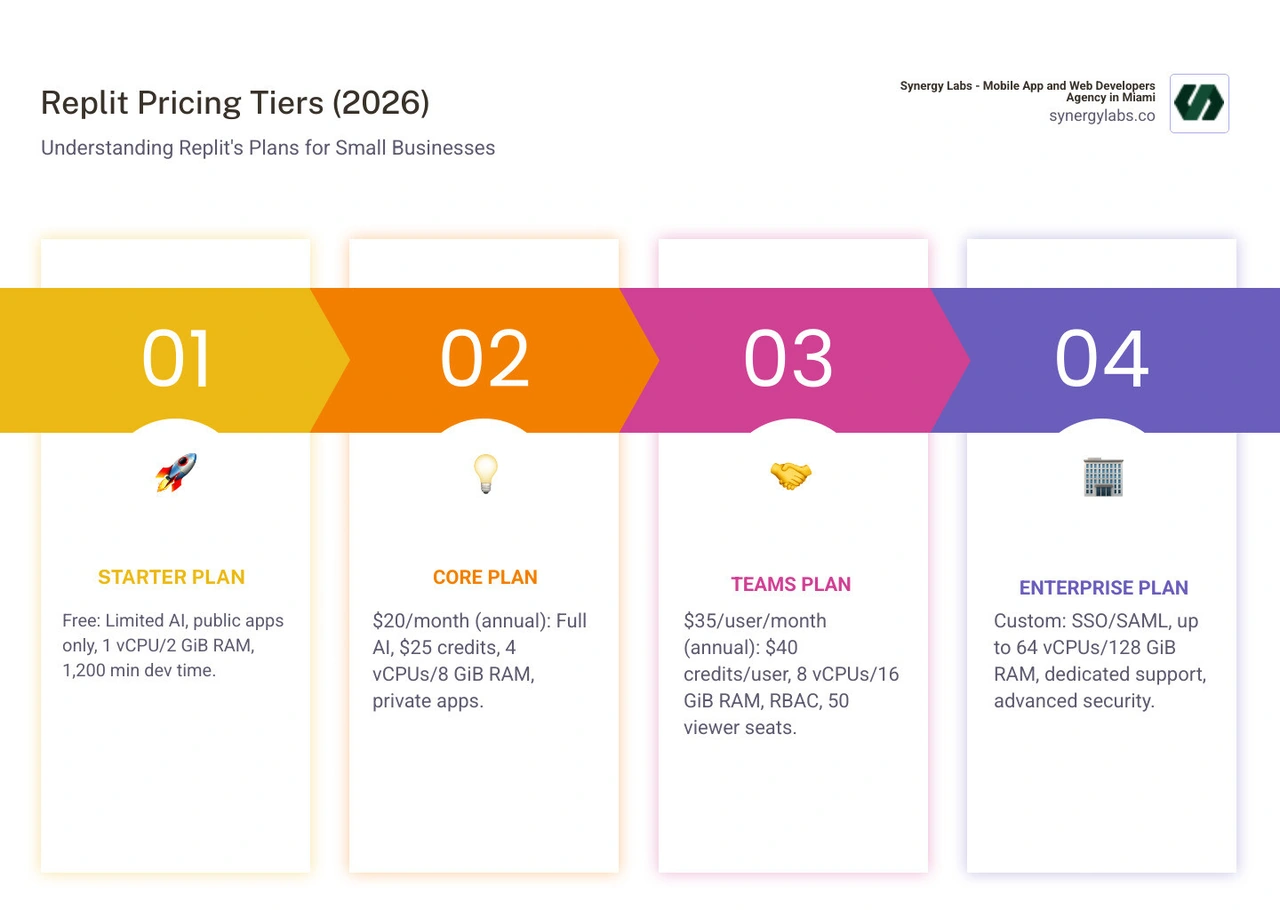
All About Replit Pricing in 2025: What Small Businesses Need to Know begins with Replit's hybrid pricing: a free Starter plan, a Core plan at $20/month (with $25 in usage credits), a Teams plan at $35/user/month, and custom Enterprise pricing. Beyond the base subscription, you pay for what you use—AI, deployments, and storage all consume credits, and overages can add up.
Quick Pricing Breakdown:
Starter (Free): Limited AI credits, public apps only, 1 vCPU/2 GiB RAM, 1,200 minutes development time
Core ($20/month annual): Full AI Agent access, $25 monthly credits, 4 vCPUs/8 GiB RAM, unlimited dev time, private apps
Teams ($35/user/month annual): Everything in Core plus $40 credits per user, 8 vCPUs/16 GiB RAM, role-based access, 50 viewer seats
Enterprise (Custom): SSO/SAML, up to 64 vCPUs/128 GiB RAM, dedicated support, advanced security
The real story is the credit system. Each plan includes monthly credits for AI, compute, and deployments. Once credits are depleted, you pay per-unit for additional usage, meaning your monthly cost can vary significantly based on platform use.
For small businesses, speed is currency in 2026. Replit offers browser-based development, instant deployment, and AI assistance without server management. The platform has evolved from a simple online editor to a comprehensive development environment trusted worldwide.
However, costs can be unpredictable. After Replit switched to effort-based pricing for its AI Agent in mid-2024, some users reported sudden cost spikes, with one seeing a $350 bill in a single day. The value is in "rapid prototyping"—but only if you understand what you're paying for.
At Synergy Labs, we help startups on tight budgets choose the right development platform. When evaluating All About Replit Pricing in 2025: What Small Businesses Need to Know, we help clients map usage, forecast costs, and decide if Replit's convenience outweighs its variable pricing or if a custom solution offers better long-term value. Our goal is to ensure you build fast, smart, and within budget.
Similar topics to All About Replit Pricing in 2025: What Small Businesses Need to Know:
Navigating Replit's pricing structure in 2026 can feel like choosing your adventure, but with a clear understanding of each tier, small businesses can find their perfect fit. From free experimentation to robust enterprise solutions, Replit offers a spectrum of options.
The Starter Plan: Your Free Gateway to the Replit Ecosystem
For those new to coding or businesses validating an idea without investment, the Starter plan is the perfect entry point. It provides everything needed to build, experiment, and publish a first project at no cost.
With the Starter plan, you get daily credits for Agent usage, which reset every day, ensuring you always have some AI assistance. You also receive monthly credits for cloud usage, which can be applied to essential services like databases and object storage. This plan includes a new faster Build Mode and allows for one free published app for 30 days.
It's important to understand the Starter Plan limitations. You're limited to 10 public development apps with temporary links, so privacy isn't an option. Compute resources are modest (1 vCPU, 2 GiB RAM, 1,200 dev minutes), making it ideal for learning or simple prototypes, not sustained performance. Advanced features like the Agent's Autonomous Mode or converting designs into full apps require an upgrade.
The Core Plan: The Sweet Spot for Solo Developers and Small Projects
When you're ready to build something more substantial, the Core plan is appealing. At $20/month (annually), it's the sweet spot for solo developers and small teams. We often see our clients in Miami and Austin use this for their initial MVPs.
The Core plan significantly boosts your capabilities. It includes full Replit Agent access and a generous $25 in monthly usage credits. This allows you to build and host both public and private apps, giving you the privacy needed for business projects. Your compute power jumps to 4 vCPUs and 8 GiB of RAM, offering 5x faster compute than the free tier. Plus, you get unlimited development time. Collaboration is supported with up to 3 collaborators, making it suitable for small teams.
For small businesses, the Core plan is a game-changer. It provides resources for rapid prototyping and MVPs without managing local environments. It also opens up advanced AI models. View Pricing details on Replit's site for a full comparison. It's ideal for SaaS founders or agencies in London or New York City looking to launch quickly.
The Teams and Enterprise Plans: Scaling Up with Collaboration and Security
As your business grows and needs more collaboration, performance, and security, Replit's Teams and Enterprise plans are the next step.
The Teams plan starts at $35/user/month when billed annually. This tier is built for collaborative development, offering everything in Core plus features crucial for team environments. Each user receives $40 in monthly usage credits. Compute resources are upgraded to 8 vCPUs and 16 GiB of RAM, and outbound data transfer capacity expands to 1,000 GiB. Key features include centralized billing, role-based access control (RBAC), and 50 Viewer seats to share progress with stakeholders. Private deployments are a core benefit, ensuring your applications remain secure.
For larger businesses or those with stringent requirements, the Enterprise plan offers custom pricing. It provides advanced security like SSO/SAML, SCIM, advanced privacy controls, and dedicated support. Plans can scale to 64 vCPUs/128 GiB RAM for demanding apps. While some features like VPC isolation are "coming soon," it's a robust foundation for organizations needing maximum control, like our clients in Riyadh or Doha.
Consider upgrading to Teams or Enterprise when your project becomes collaborative, security becomes paramount, or your app needs more compute resources than the Core plan offers.
The Hybrid Model: Navigating Subscriptions, Credits, and Potential "Hidden" Costs
Replit's pricing is a hybrid model combining subscriptions with usage-based billing. This flexibility adds complexity that businesses must understand to avoid unexpected charges. It’s like an old cell phone plan: go over your allowance, and it gets pricey.
Your subscription fee (for Core or Teams) covers a certain amount of usage via monthly credits. Once depleted, you switch to a pay-as-you-go model. This system ensures heavy users cover their resource costs, a common model in cloud services that demands careful monitoring. As Replit explained, they introduced Flexible Credits and Usage-Based Billing explained to offer greater control.
All About Replit Pricing in 2025: What Small Businesses Need to Know About AI Costs
One of the most significant areas where the hybrid model impacts small businesses is with AI features like Replit Ghostwriter and the Replit Agent. These tools leverage high-cost AI models. Each AI request has a real cost for Replit, which is why their AI pricing is subscription plus usage-based.
The "effort-based pricing model" for AI can lead to unpredictable usage, as each AI Agent action consumes credits. Users report credits depleting in days instead of weeks, with costs jumping 3-4x. One user even reported a $350 bill in a single day after the change.
Replit's CEO has acknowledged that AI costs can outrun revenue, highlighting the challenge of balancing innovation with sustainability. This underscores why Replit uses this model: to ensure the platform remains viable while offering cutting-edge AI.
For small businesses, AI can drastically accelerate development but requires careful management. Cost-effective prompt engineering is crucial. Writing clear, detailed prompts for the Replit Agent reduces wasted "effort" and credit consumption. Knowing when to stop the Agent if it's going in circles is also a vital cost-saving strategy.
Explaining Deployment and Other Usage-Based Charges
Beyond AI, several other actions on Replit consume credits and can contribute to your bill. Understanding these is key to managing costs.
Here's a list of common actions that consume credits:
Replit Agent Usage: As discussed, the AI Agent's "effort" consumes credits.
Extended Compute Time: Beyond your plan's included development time, additional compute minutes for your development environments will consume credits.
Database Operations: Interactions with Replit Database, especially advanced operations or large data transfers, will use credits.
Deployment Bandwidth: Outbound data transfer from your deployed applications (e.g., users downloading assets from your website) consumes credits.
Advanced App Storage Operations: Certain read/write operations or large storage volumes for your applications.
Autoscale Deployments: These consume compute units and requests based on traffic.
Reserved VM Deployments: While these have a predictable base fee, additional compute or specific configurations might consume credits.
Scheduled Deployments: Background tasks running on a schedule consume compute units.
Deployment costs are a significant factor. Replit offers various deployment types, each with its own billing model.
Autoscale Deployments are usage-based, so you only pay when your app serves requests. It goes idle after 15 minutes of inactivity, great for apps with variable traffic.
Reserved VM Deployments offer a predictable monthly cost for consistent workloads, providing dedicated resources.
Scheduled Deployments are perfect for background tasks or cron jobs, where you pay for compute units consumed during scheduled runs.
Static Deployments are free for hosting, with costs tied to outbound data transfer. Replit Core includes 100 GiB of static deployment transfer.
For a detailed breakdown, check Replit's Deployment pricing breakdown. Their interactive pricing calculator helps estimate costs. A small app with light traffic might cost $5-10/month in deployment fees, while a busy app could hit $50+.
Outbound data transfer is another area to watch. If your app serves many large files, those gigabytes add up. Similarly, storage and database operations will consume credits. Regularly monitoring your usage is essential for financial health.
Maximizing Value: Replit Use Cases and Limitations for Small Businesses
Replit is a powerful tool, particularly for small businesses. Its browser-based nature and integrated AI offer distinct advantages, but it's not a one-size-fits-all solution. Understanding where it shines and where its limitations lie is crucial for making informed decisions.
All About Replit Pricing in 2025: What Small Businesses Need to Know for Prototyping and Internal Tools
For many small businesses, Replit can be a true accelerator. Its core strengths align perfectly with the need for agility and efficiency.
Rapid Iteration and MVP Development: Replit lets you build and iterate quickly, going from idea to a working Minimum Viable Product (MVP) in record time with cloud-hosted environments and AI. We’ve seen clients in San Francisco and New York City use this to validate ideas without extensive upfront investment.
No IT Overhead: Replit handles development environments, servers, and CI/CD pipelines in the cloud. This lets small businesses focus on coding and product development, not infrastructure.
Building Internal Tools: Replit makes building internal tools like custom CRMs or dashboards highly accessible. You can empower your team with solutions that fit your unique business processes. We often recommend this for our clients in Chicago and Phoenix to streamline operations.
Remote Team Collaboration: With multiplayer coding and real-time collaboration, Replit is perfect for distributed teams. Developers in London can work seamlessly with colleagues in Dubai or Hartford, reducing friction and accelerating project timelines.
Empowering Non-Technical Staff: Replit’s AI Agent can sometimes help bridge the gap, allowing those with basic technical understanding to contribute to simple projects or quickly validate ideas.
Cost Reduction (with caution): By accelerating development and reducing infrastructure costs, Replit can lead to overall cost savings. However, careful management of usage-based billing is essential to realize these savings.
When to Look Beyond an All-in-One Platform
While Replit offers immense convenience, it's important to acknowledge its limitations, especially as projects scale.
Limitations for Enterprise-Scale Software: Replit is not ideal for massive, enterprise-grade software with large microservice architectures. These systems often demand specialized infrastructure and granular control that Replit's abstraction layer may not provide.
Complex DevOps Pipelines: If your business requires highly customized CI/CD pipelines or advanced monitoring beyond Replit's offerings, you might find yourself hitting a wall.
Heavily Regulated Industries: For businesses in regulated sectors like finance or healthcare, Replit's shared cloud environment might not meet all security and compliance standards. While Enterprise plans offer advanced controls, some features like VPC isolation are still "coming soon."
Data Compliance Concerns: If your data residency requirements are very strict (e.g., data must remain within a specific country), you'll need to evaluate if Replit's infrastructure aligns with those mandates.
Performance Bottlenecks for Resource-Intensive Apps: Extremely resource-intensive applications (like large-scale data processing or high-performance computing) might encounter performance bottlenecks or become prohibitively expensive due to usage-based billing.
The Trade-Off Between Convenience and Control: Replit's ease of use comes from abstraction. For businesses with seasoned DevOps teams, this can feel like a lack of control, leading them to prefer more customizable cloud solutions.
It's a classic trade-off: convenience for rapid development versus granular control for highly specialized or massive-scale operations. For most small businesses, Replit's advantages far outweigh these limitations, but it's crucial to be aware of them as you grow.
Mastering Your Budget: A Small Business Guide to Managing Replit Costs
Understanding Replit's hybrid pricing model is the first step; mastering your budget is the next. Given the potential for variable costs, especially with AI and deployments, proactive financial planning is essential for small businesses.
Choosing the Right Plan for Your Specific Business Needs
Selecting the correct Replit plan from the start can save you headaches and unexpected expenses. It's about matching your project's needs with the plan's offerings.
Evaluate Your Compute Needs: A simple static website may only need the Starter or Core plan's compute. A complex web app will demand the 4 vCPUs/8 GiB RAM of Core, or even the 8 vCPUs/16 GiB RAM of Teams. Highly demanding applications might need the custom scaling of Enterprise.
Forecast AI Usage: If your project relies heavily on the Replit Agent, you'll need a plan with robust AI credits like Core or Teams. Estimate your usage and remember that clear prompts can extend your credits.
Collaboration Requirements: Are you a solo founder or a team? The Starter plan allows 1 collaborator, Core allows 3, and Teams supports all team members with advanced RBAC. This is non-negotiable for collaborative projects.
Deployment Strategy: Do you need a simple static site or a dynamic application? Will it have predictable traffic (Reserved VM) or fluctuating spikes (Autoscale)? Factor in base deployment fees and potential data transfer costs.
Scalability Requirements: For rapid growth, consider a plan like Teams for easier scaling with higher resource limits. Also, understand Replit's limitations for massive applications.
When to Start Free vs. Paid: The Starter plan is excellent for learning and light prototyping. If you need privacy, more compute, or serious AI assistance, jump to Core. If you have a team, Teams is the logical choice.
A realistic total cost for a solo developer on Core might be $40-60/month, including usage beyond credits. For a three-person team on the Teams plan, it could be $150-200/month. Always budget conservatively.
Proactive Cost Management: Tools and Best Practices
Once you've chosen a plan, actively managing your Replit costs is a continuous process. Fortunately, Replit provides tools and best practices to help.
Use the Replit Usage Dashboard: This is your best friend for cost control. Regularly visit the Replit usage dashboard for a detailed overview of your resource consumption, from AI usage to data transfer. This transparency is invaluable.
Set Spending Limits and Alerts: Don't wait for a surprise bill. Replit allows you to configure spending alerts and set budgets, a crucial feature for preventing unexpected charges and staying within financial boundaries.
Monitor AI Agent Checkpoints: Keep a close eye on how your AI Agent is consuming credits. If it gets stuck in a loop or generates irrelevant code, pause or stop it. This is where human oversight saves you money.
Optimize Code for Efficiency: Lean, efficient code uses fewer compute resources and runs faster, naturally consuming fewer credits. Well-written code is your best defense against high usage costs.
Know When to Stop the Agent: AI is powerful, but not foolproof. If the Agent struggles with a complex problem or you find yourself constantly correcting it, it might be more cost-effective to tackle that part manually.
Is Replit the Right Development Partner for Your Business?
So, after diving deep into All About Replit Pricing in 2025: What Small Businesses Need to Know, the big question remains: Is Replit the right development partner for your business?
Replit offers a compelling proposition: convenience, rapid prototyping, and cutting-edge AI assistance, accessible from anywhere. For small businesses, this means faster time-to-market, reduced IT overhead, and the ability to empower smaller teams. The value of speed cannot be overstated; iterating quickly and validating ideas cheaply is a significant competitive advantage in markets like Miami, Austin, or London.
However, this convenience comes with a trade-off: cost unpredictability, especially with AI usage and deployment scaling. The hybrid model demands diligent monitoring and proactive cost management. If your project has a rigid budget or requires highly specialized infrastructure, Replit might not be your ideal long-term solution.
For most small businesses focused on web and mobile app development, building internal tools, or rapid prototyping, Replit is an incredibly powerful and accessible platform. It lowers the barrier to entry for development and allows businesses to innovate at a pace previously only possible for larger organizations.
At Synergy Labs, we believe in making strategic technology choices that align with your business goals and budget. We understand every project is unique, and sometimes a custom-built solution offers better long-term value and predictability. Whether you're considering Replit or other avenues, we're here to help you steer the complexities of app development. We ensure you're not just building an app, but a foundation for sustainable growth.




.avif)

.avif)


