

Build the Right Foundation Before Choosing Microservices

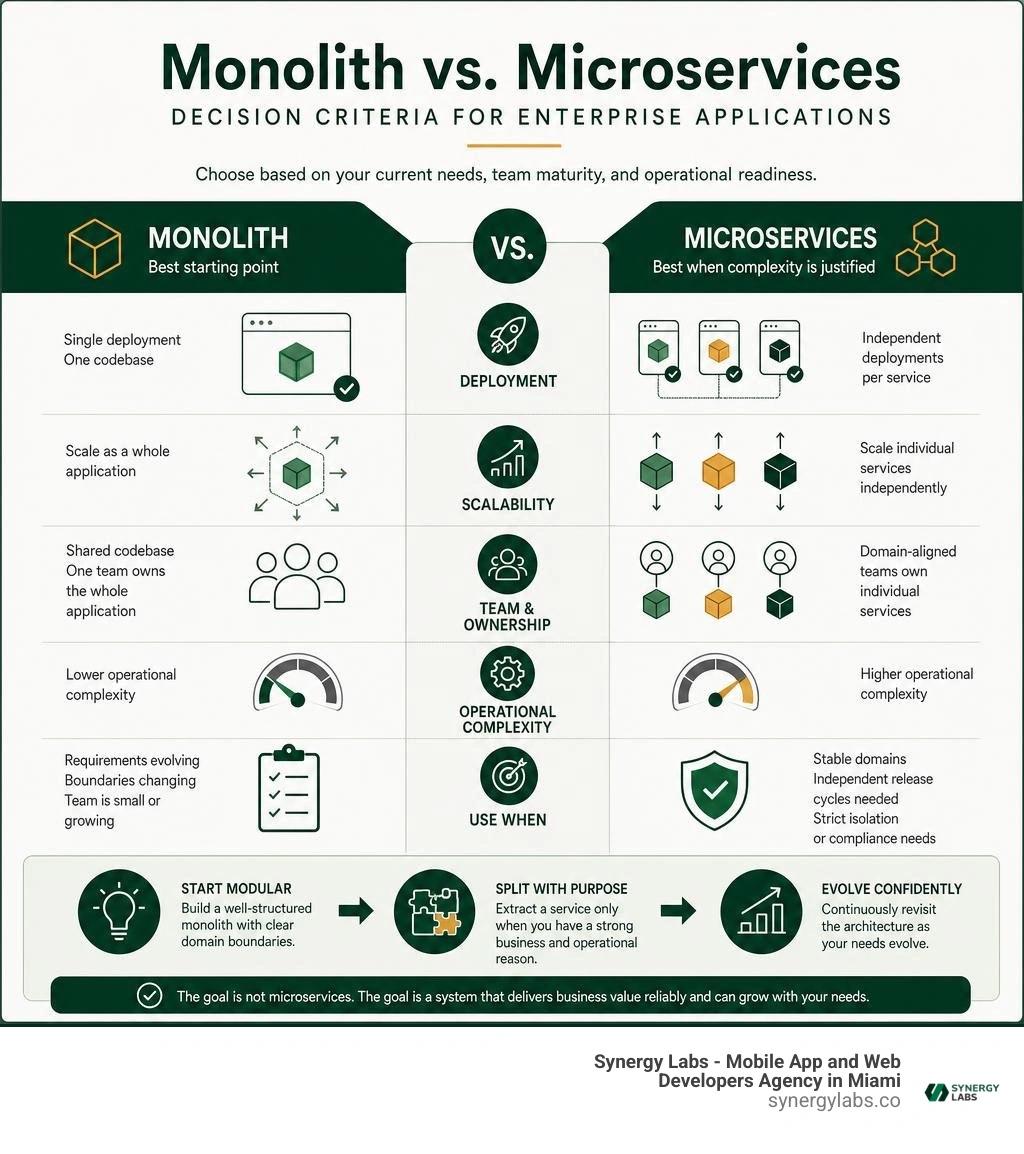
When building enterprise applications, start with the business workflow, security needs, integrations, and expected growth - not with a trendy architecture label. A modular monolith is usually the best starting point when your team is small, domain boundaries are still changing, and most modules ship together. Choose microservices only when separate areas need independent deployments, scaling, ownership, or compliance boundaries.
Enterprise software is different from a typical consumer app. It must support multiple roles, complex approvals, data sharing with systems such as ERPs and CRMs, audit trails, and reliable uptime. The architecture has to make those needs easier to manage over time.
A practical decision rule:
- Start modular. Keep clear boundaries between billing, users, reporting, and other business domains.
- Prove the need to split. Extract a service when one domain has a distinct release cycle, workload, or security requirement.
- Design for operations early. Identity, monitoring, backups, testing, and integration resilience are not "later" work.
- Avoid complexity theater. Five tiny services with one shared database are often just a monolith with more meetings.
A well-structured monolith can cost 30-40% less to build and 50-60% less to operate during its first two years than microservices adopted too early. Microservices can be powerful, but they also add network failures, deployment coordination, observability demands, and more moving parts - because apparently one production problem was not enough.
As Director of Product at Synergy Labs, I help teams turn product goals into scalable application foundations before architecture choices become expensive to undo.
Building enterprise applications further reading:
- Enterprise App Development
- The Complete Guide to App Development for Enterprise Solutions in 2026
- Enterprise Mobile App Development: Scaling Solutions for Large Organizations
Core Architectural Patterns for Building Enterprise Applications
Every software system reflects the communication structure of the organization that built it. When an organization builds an enterprise application, it is constructing a digital backbone that must support concurrent departmental workflows, cross-system automations, strict regulatory controls, and deep integration points.
At this tier, software architecture ceases to be an academic exercise in clean code and becomes a core driver of operational sustainability. Miscalculating your architectural patterns early leads to an expensive trap: engineering teams end up spending 80% of their sprints managing infrastructure friction rather than shipping valuable business capabilities. Understanding the cost of enterprise grade app development 2026 benchmark guide reveals that infrastructure and maintenance overhead can quickly exceed initial delivery costs if the system boundaries are drawn incorrectly.
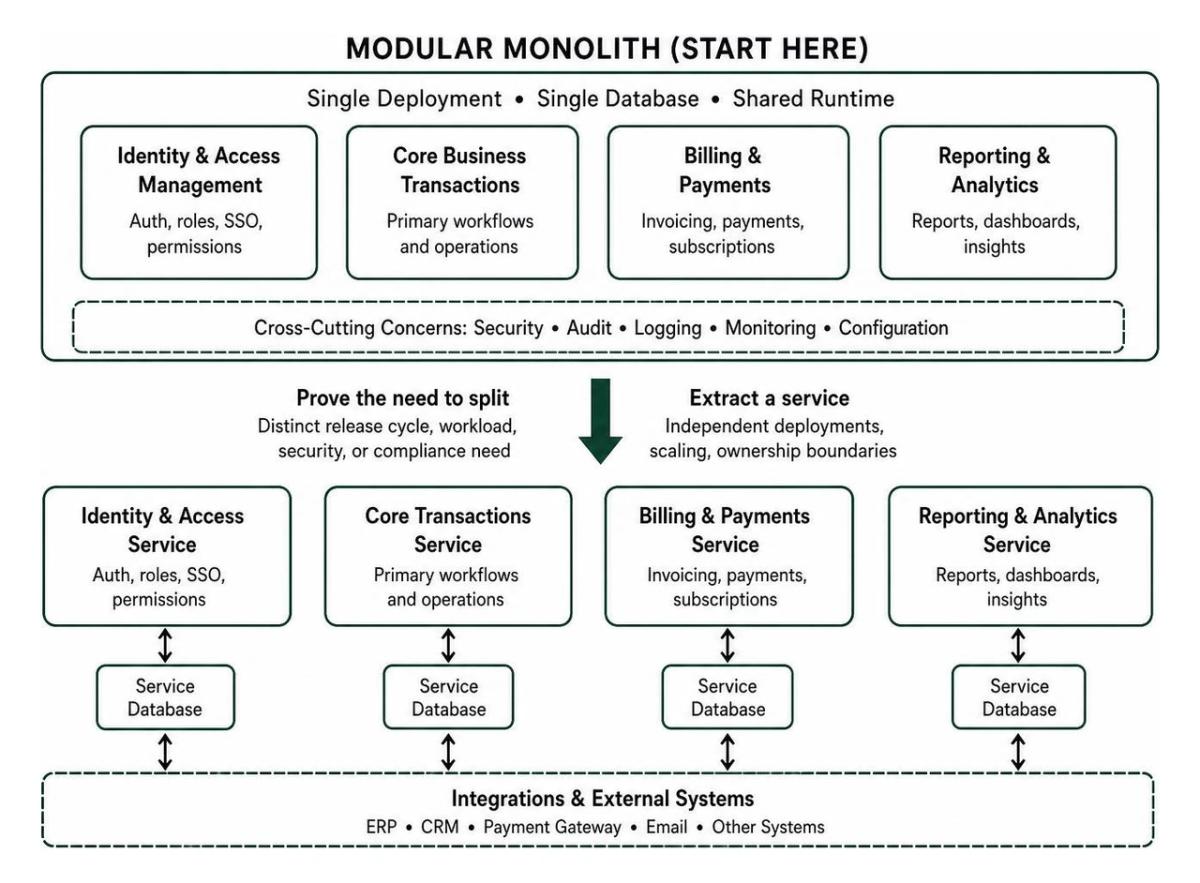
To architect effectively, we must establish clean domain boundaries using bounded contexts. A bounded context defines the explicit boundary within which a specific business domain model applies. Inside that perimeter, domain terms, data schemas, and business logic remain unified and unpolluted by external concepts.
In a modern enterprise platform, these bounded contexts might encompass:
- Identity and Access Management (IAM): Managing authentication tokens, permission trees, single sign-on (SSO) handshakes, and tenant role assignments.
- Core Business Transactions: Executing the primary revenue-generating workflows, contract states, or high-volume transactional pipelines.
- Financial Ledger and Billing: Ensuring tamper-evident audit logging, double-entry ledgers, automated tax calculations, and subscription synchronization.
- Reporting and Analytics: Aggregating real-time telemetry, running complex analytical queries, and powering operational dashboards without locking transactional tables.
Maintaining these boundaries within a unified codebase is known as a modular monolith. Unlike a tangled legacy codebase, a modular monolith enforces strict code-level isolation between modules via well-defined internal API interfaces, prohibiting arbitrary cross-module database joins. This guarantees the modularity benefits of distributed systems while completely eliminating network latency, distributed transactions, and deployment synchronization headaches.
Evaluating Monolithic vs Microservices Architectures
The technology industry has witnessed countless organizations attempt to solve organizational delivery bottlenecks by prematurely carving systems into dozens of microservices. In practice, adopting microservices before understanding domain boundaries simply transforms internal function calls into brittle network requests over HTTP or message queues.
The operational tax of microservices is significant. Every distinct service demands its own automated continuous integration and delivery (CI/CD) pipeline, dedicated observability configuration, health checks, secrets management, and failure mitigation strategies. If two services must always be deployed together to prevent breaking schema changes, they are not independent services; they are distributed monoliths sharing all the downsides of both paradigms.
Engineers seeking deep structural expertise often turn to resources like Building Scalable Enterprise Application with .NET Apps | Coursera to master the separation of concerns, hexagonal architectures, and data isolation models required before breaking apart large applications.
When evaluating these patterns, consider these core trade-offs:
- Team Size Threshold: Microservices are designed to solve team communication scaling issues, not code scaling issues. If an engineering organization has fewer than 15 to 20 engineers, the overhead of managing service orchestration will actively slow feature delivery.
- Deployment Cadence Disparities: If your payment execution engine updates three times a day while the quarterly tax compliance module updates once a month, isolating the payment module into a standalone microservice makes operational sense.
- Hardware and Scaling Asymmetry: When a specific subsystem requires specialized compute resources—such as an image rendering pipeline, AI inference worker, or heavy cryptographic hashing—extracting that single capability into an independently scaled microservice prevents over-provisioning the rest of the application cluster.
- Data Boundary Stability: If database schemas are frequently mutating across multiple functional areas during rapid product discovery, keep them in a monolithic structure. Splitting a database across boundaries that are still fluid results in painful distributed data migrations.
A modular monolith costs roughly 30% to 40% less to build and 50% to 60% less to operate during the first two years of its operational lifecycle compared to a microservices architecture introduced prematurely. Start unified, maintain rigorous internal module boundaries, and let real-world production metrics dictate when a module should be extracted.
Event-Driven Architecture and Service-Oriented Approaches
When enterprise systems outgrow purely synchronous request-response communication, event-driven architecture (EDA) and modernized service-oriented architecture (SOA) patterns bridge the gap. In a synchronous architecture, when a user triggers an action, Service A calls Service B, which calls Service C, and everyone waits. If Service C stumbles, the entire transaction collapses.
Event-driven architecture changes this paradigm from active orchestration to choreographic publication:

When a critical business event occurs—such as ContractSigned or InvoiceSettled—the emitting service publishes an immutable event payload to a centralized message broker. Subscribing services independently ingest, process, and persist their own local views of the data without the producing service ever knowing who consumed the message.
Key patterns within modern event-driven enterprise architecture include:
- Command Query Responsibility Segregation (CQRS): By decoupling write models from read models, applications can optimize write operations for absolute consistency and transaction speed, while projecting denormalized read views tailored specifically for complex UI dashboards and lightning-fast search indexing.
- Webhook-Based Cache Invalidation: Rather than relying on arbitrary, time-based cache expiration (TTL) that serves stale enterprise data, decoupled services emit lightweight webhooks to signal state changes, immediately clearing targeted cache keys across distributed Redis clusters.
- Asynchronous Integration Buffering: Enterprise message brokers act as a shock absorber. If a downstream legacy enterprise resource planning (ERP) system experiences downtime or latency spikes during nightly batch operations, the event queue safely buffers incoming messages until the legacy system recovers, preventing data loss.
Build, Buy, or Modernize: The Strangler Fig Migration Framework
Every Chief Technology Officer faces the perpetual crossroads: do we build custom software, buy commercial off-the-shelf software, or modernize our legacy application?
Commercial software excels at commoditized business functions where your company has no distinct competitive advantage, such as standard payroll or baseline employee directory hosting. However, attempting to heavily customize off-the-shelf systems to fit proprietary, complex operational workflows often results in astronomical vendor licensing costs and rigid software lock-in. Understanding why no-code alone isnt enough for enterprise applications reinforces that complex enterprise platforms inevitably hit hard operational limits when forced into restrictive proprietary platforms without true code-level customizability.
When dealing with mission-critical legacy monoliths that cannot simply be turned off, the Strangler Fig pattern provides the safest path forward. Named after the Australian fig trees that seed in the upper branches of host trees and slowly grow down until they replace the host entirely, this pattern avoids the catastrophic failure risks of "big-bang" full software rewrites.
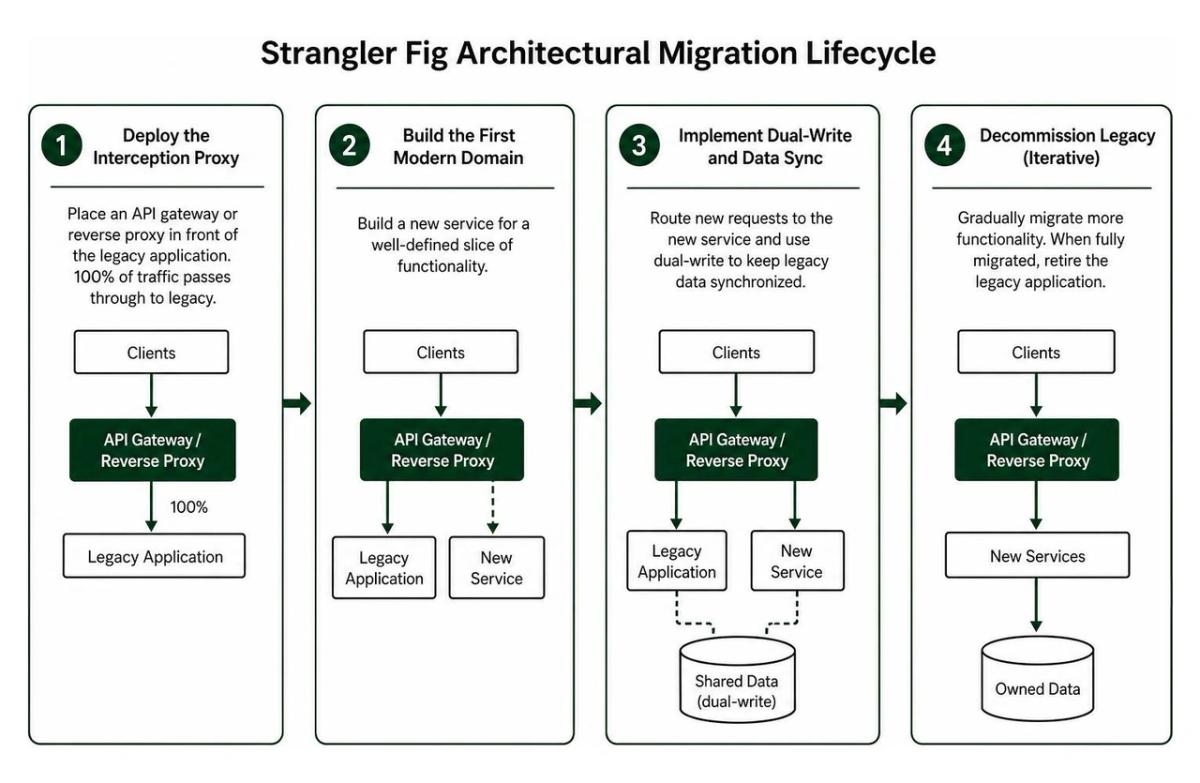
The Strangler Fig modernization lifecycle operates across four structured stages:
- Deploy the Interception Proxy: Place an API gateway or intelligent reverse proxy directly in front of the existing legacy application. Initially, 100% of incoming web traffic passes straight through to the legacy backend.
- Build the First Modern Domain: Construct a brand-new service or modular backend for a single, well-defined slice of business functionality (e.g., modern customer onboarding or updated billing).
- Implement Dual-Write and Data Sync: As the API gateway is reconfigured to route new feature requests to the new service, a dual-write mechanism keeps the legacy database synchronized in real-time. This provides an instant fallback mechanism should unexpected edge cases arise.
- Progressive Deprecation: Once the new module demonstrates stability under production loads, cut traffic over permanently, switch the legacy database tables for that module into read-only mode for 30 days as a safety net, and safely decommission that section of legacy code. Repeat for the next module.
Essential Design Principles: Scalability, Performance, and Integration
Designing enterprise software demands an uncompromising commitment to performance engineering, structural maintainability, and user-centric design. Enterprise software was once notorious for clunky, unintuitive user interfaces that drove down employee adoption. Modern enterprises recognize that developer velocity, operational efficiency, and user adoption hinge directly on standardizing frontend design systems and enforcing strict architectural budgets across the entire software development lifecycle.
Our enterprise app development complete guide 2026 outlines how modern engineering teams leverage unified component libraries to eliminate UI fragmentation. Enterprise applications that implement a centralized design system can reduce frontend development timelines by up to 50% while guaranteeing strict accessibility and visual consistency across distributed international teams.
Modern Tech Stacks and Frameworks for Building Enterprise Applications
Selecting the optimal tech stack for an enterprise web application requires evaluating rendering performance, developer ecosystem maturity, and backend stability. Modern frameworks have evolved beyond simple client-side rendering (CSR), introducing hybrid rendering pipelines that evaluate performance on a route-by-route basis:
- Static Site Generation (SSG): Pre-renders pages into static HTML at build time. This provides sub-100ms Time to First Byte (TTFB), near-infinite edge caching, and bulletproof security. SSG is ideal for public documentation portals, compliance directories, and knowledge bases.
- Server-Side Rendering (SSR): Generates HTML on the server dynamically for every incoming HTTP request. SSR is essential for authenticated enterprise dashboards, complex analytics reporting, and admin portals where dynamic permission models dictate interface rendering.
- Incremental Static Regeneration (ISR): Allows static pages to be updated in the background without rebuilding the entire application. When database records update, ISR serves stale cached content while asynchronously regenerating fresh static pages in the background.
On the backend, modern architectures thrive on strongly typed ecosystems. TypeScript across Node.js (via Fastify or NestJS), Go, and modern .NET 9 with ASP.NET Core dominate enterprise development due to their robust concurrency handling, compile-time type safety, and massive cloud ecosystem support.
Database Multi-Tenancy and Three-Tier Caching Strategies
For Business-to-Business (B2B) enterprise applications serving multiple organizational clients, architecting multi-tenancy is a foundational decision. There are three primary multi-tenancy models:
- Database-per-Tenant: Every client receives a completely isolated physical or logical database instance. This offers maximum data isolation and simple tenant deletion, but introduces significant infrastructure management costs and complex fleet-wide schema migration overhead.
- Schema-per-Tenant: A single database cluster houses distinct PostgreSQL schemas for each tenant. This provides good isolation while sharing infrastructure resources, but can strain database catalog memory when scaling past hundreds of tenants.
- Shared Database with Row-Level Security (RLS): All tenants share the same database tables, with every table containing a
tenant_idcolumn. PostgreSQL Row-Level Security policies enforce data isolation directly at the database engine level. Even if an application query forgets to filter bytenant_id, the database kernel blocks unauthorized access.
PostgreSQL with Row-Level Security is the recommended multi-tenancy model for most growth-stage B2B applications, delivering ironclad data isolation at the lowest total cost of ownership. Infrastructure costs for a growth-stage enterprise web application managing between 1,000 and 10,000 active organizational users typically range from €730 to €2,430 per month when leveraging this optimized architecture.
To protect relational databases from transactional exhaustion during high-concurrency spikes, enterprise architectures deploy a disciplined three-tier caching hierarchy:
- L1 In-Memory Caching: Ultra-fast local node memory (e.g., LRU cache) for static configuration constants and authorization public keys (sub-millisecond latency).
- L2 Distributed Caching: Centralized Redis clusters holding shared session states, active tenant access lists, and pre-calculated dashboard metrics (1-3 millisecond latency).
- L3 Edge CDN Caching: Global Content Delivery Network edge nodes caching static assets, public API payloads, and immutable SSG routes close to end users worldwide.
Enterprise Integration Patterns for ERP, CRM, and Legacy Systems
Enterprise applications rarely live in isolation. They must continuously synchronize data with existing enterprise resource planning (ERP) systems like SAP, customer relationship management (CRM) platforms like Salesforce, and proprietary mainframe systems.
Connecting modern web and mobile apps to these external systems requires resilient integration patterns. When expanding web architectures to support distributed field operations, leveraging enterprise mobile app development scaling solutions for large organizations ensures mobile clients remain performant even when syncing across constrained networks.
To prevent third-party outages from cascading throughout your entire architecture, implement these mission-critical resilience patterns:
- API Gateway Pattern: Consolidates authentication, rate limiting, request transformation, and protocol translation at the network perimeter, protecting internal services from legacy quirks.
- Circuit Breaker Pattern: If an external ERP endpoint begins throwing continuous 500 errors or timing out, the circuit breaker trips open. Subsequent requests immediately fail fast or return cached fallback data without consuming backend threads or waiting on unresponsive external servers.
- Exponential Backoff with Jitter: When retrying transient network failures against rate-limited third-party APIs, apply randomized jitter to backoff intervals to prevent self-inflicted "thundering herd" denial-of-service spikes against integrated services.
Operationalizing Enterprise Apps: Security, CI/CD, and AI SDLC
Engineering excellence in enterprise software extends far beyond local development environments. It requires embedding security compliance, automated deployment governance, and comprehensive system observability directly into operational pipelines.
Security cannot be treated as a secondary phase tacked onto an application before launch. Incorporating automated security baselines from day one is not only safer—it is vastly more economical. Retrofitting SOC 2 compliance into an existing enterprise application takes 3 to 6 months and costs €30,000 to €80,000, while engineering compliance into the architecture from the very start adds only 10% to 15% to initial development costs.
Managing Security, Governance, and AI in Building Enterprise Applications
Modern enterprise security models operate on zero-trust principles: never trust, always verify, and enforce default-deny authorization policies across every API endpoint and database query.
Essential security controls include:
- Centralized Identity Providers (IdP): Leverage standardized SAML 2.0 and OIDC integrations (such as Okta, Azure Entra ID, or Keycloak) rather than building bespoke authentication. This offloads credential storage liabilities and allows enterprise clients to enforce hardware-backed Multi-Factor Authentication (MFA).
- Immutable, Tamper-Evident Audit Logging: Every critical data read, update, role modification, and export must generate a structured JSON log containing tenant identifiers, user IDs, IP addresses, and cryptographic timestamps stored in write-once-read-many (WORM) storage for SOC 2, HIPAA, and GDPR compliance.
- Attribute-Based Access Control (ABAC): While basic Role-Based Access Control (RBAC) handles simple static permissions, enterprise compliance often requires ABAC or Relationship-Based Access Control (ReBAC) to evaluate dynamic environmental attributes (e.g., "Allow access only if User Department matches Document Department and connection originates from corporate VPN").
As enterprise engineering accelerates through artificial intelligence, understanding the integration of enterprise ai agents within corporate workflows is transforming productivity. Teams leveraging AI-driven workflows and tools like Code Studio can deliver production-ready applications three to five times faster with built-in governance.
To maintain architectural integrity when using AI tools:
- Centralize Project Rulebooks: Store architectural standards, dependency limits, and design system tokens in persistent instruction files to prevent context fragmentation.
- Deterministic Model Selection: Prioritize large, reasoning-focused AI models for system architecture and schema design, where multi-step reasoning and deterministic instruction-following matter far more than raw generation speed.
- Human-in-the-Loop Deployment Gates: AI agents should prepare Dockerfiles, unit tests, and migration scripts, but production deployments, cloud provisioning, and secrets management must always require authenticated human sign-off.
CI/CD Pipelines, Performance Budgets, and Incident Observability
To deliver software reliably at scale, modern enterprise teams replace manual QA with fully automated CI/CD deployment pipelines:

A production-grade pipeline enforces quality at every gate:
- Automated Verification: Static application security testing (SAST) and Software Composition Analysis (SCA) automatically scan for CVE vulnerabilities and license compliance.
- Performance Budget Gates: Automated Lighthouse CI builds enforce strict web performance budgets directly in the pipeline. Enterprise applications that automate performance budgets in CI successfully prevent bundle bloat, keeping Largest Contentful Paint (LCP) strictly under 2.5 seconds and initial JavaScript bundle sizes below 200KB.
- Deployment Strategies: Utilize Blue/Green or Canary deployments. A canary release routes 5% of production traffic to the new build while monitoring error budgets and latency metrics. If error rates remain flat, traffic progressively ramps up to 100% with zero user downtime.
- Full-Stack Observability: Standardize telemetry collection via OpenTelemetry (OTel). Distributed tracing instruments user requests as they traverse frontend clients, API gateways, database queries, and third-party integrations, allowing Site Reliability Engineers (SREs) to pinpoint latency bottlenecks in minutes rather than hours.
Frequently Asked Questions about Enterprise Architecture
When should an organization choose a modular monolith over microservices?
An organization should default to a modular monolith when the engineering team consists of fewer than 15 to 20 developers, the domain boundaries of the business are still evolving, and core modules share similar deployment cadences. A modular monolith provides the structural code isolation and maintainability of distributed systems without the operational tax of network latency, complex CI/CD pipelines, and distributed data migrations. Microservices should only be adopted when distinct functional modules require radically different infrastructure scaling profiles, independent multi-team deployment pipelines, or strict regulatory isolation boundaries.
How do teams maintain security and compliance by design in enterprise apps?
Teams achieve compliance by design by embedding security controls directly into the architectural layers from day one rather than attempting to retrofit them before launch. This includes configuring database-level Row-Level Security (RLS) for multi-tenant data isolation, implementing default-deny Attribute-Based Access Control (ABAC), utilizing centralized Identity Providers (IdPs) for Single Sign-On (SSO) and MFA, and routing all critical system actions to immutable, tamper-evident audit logs. Automating dependency vulnerability scans and license audits within CI/CD pipelines ensures continuous adherence to SOC 2, HIPAA, and GDPR frameworks.
What is the most effective rendering strategy for enterprise web applications?
The most effective rendering strategy is a hybrid, route-by-route approach rather than an app-wide uniform setting. Public-facing documentation, help portals, and marketing knowledge bases should utilize Static Site Generation (SSG) for sub-100ms response times and global CDN edge caching. Dynamic catalogs and frequently updated data feeds benefit from Incremental Static Regeneration (ISR). Authenticated dashboards, transactional workflows, and real-time operational views should use Server-Side Rendering (SSR) to enforce strict, request-level authentication and dynamic permission rendering securely on the server.
Partner with Synergy Labs for Scalable Enterprise Engineering
Building enterprise software requires balancing technical scalability with business pragmatism. The architectural decisions made during the initial phases of system design determine whether an engineering organization accelerates feature delivery or becomes bogged down in technical debt.
At Synergy Labs, we specialize in architecting, building, and scaling world-class digital platforms. Our unique delivery model pairs you with an experienced in-shore CTO who oversees your system architecture while working alongside an elite engineering team to ensure rapid, high-velocity execution. We eliminate project risk through our transparent, fixed-budget model and milestone-based payments, ensuring your platform is delivered on time, within budget, and built to the highest enterprise standards.
Whether you are modernizing a legacy system, planning an event-driven architecture, or launching a mission-critical platform, explore our custom enterprise app development services to turn your architectural vision into scalable software.