Flutter vs. React Native: Which Framework is Right for Your 2026 Project? The answer depends on your priorities. Here's the quick breakdown:
Choose Flutter if:
You need pixel-perfect UI consistency across all platforms
Your app requires high-performance animations (60-120fps)
Brand identity and custom design are paramount
You're building for mobile, web, desktop, and embedded from one codebase
Choose React Native if:
Your team already knows JavaScript or React
You need to ship fast and iterate quickly
Your app follows standard platform UI patterns
You want seamless integration with existing web applications
You have a brilliant app idea, but choosing the right tech stack is challenging. Cross-platform development is the go-to for many businesses, with nearly 50% of mobile projects using frameworks like Flutter and React Native. In 2026, the key question is about long-term performance and sustainability, not just current benchmarks.
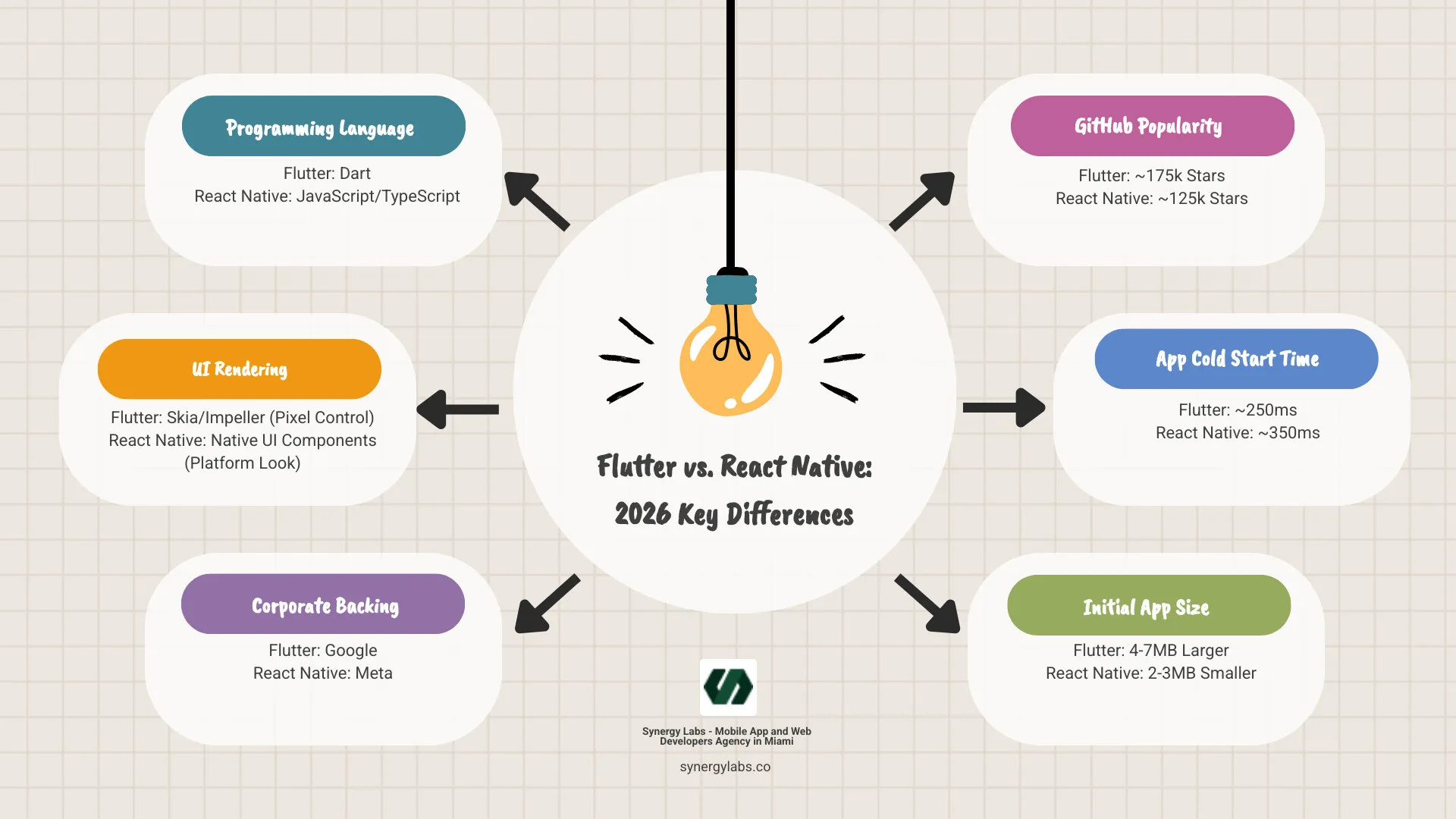
The landscape has evolved far beyond early tools like PhoneGap. Today, both Flutter and React Native offer native-beating performance through different methods. With strong corporate backing from Google and Meta respectively, Flutter leads with 46% of the cross-platform market share to React Native's 35%. The choice isn't about a universal winner, but the right tool for your project.
In 2026, the focus is on smart sustainability: maintainability, scalability, and relevance. React Native has a larger talent pool (1.4 developers for every Flutter developer), but Flutter developers are in high demand, commanding salaries of $135k-$180k versus React Native's $125k-$160k. Since maintenance accounts for 70% of an app's total cost, long-term stability is a critical factor.
At Synergy Labs, we guide founders through this decision, focusing on their unique context, timeline, and vision. Let's cut through the hype and provide the ground truth you need to choose with confidence.
Terms related to Flutter vs. React Native: Which Framework is Right for Your 2026 Project?:
The Core Philosophy: Painting Pixels vs. Orchestrating Views
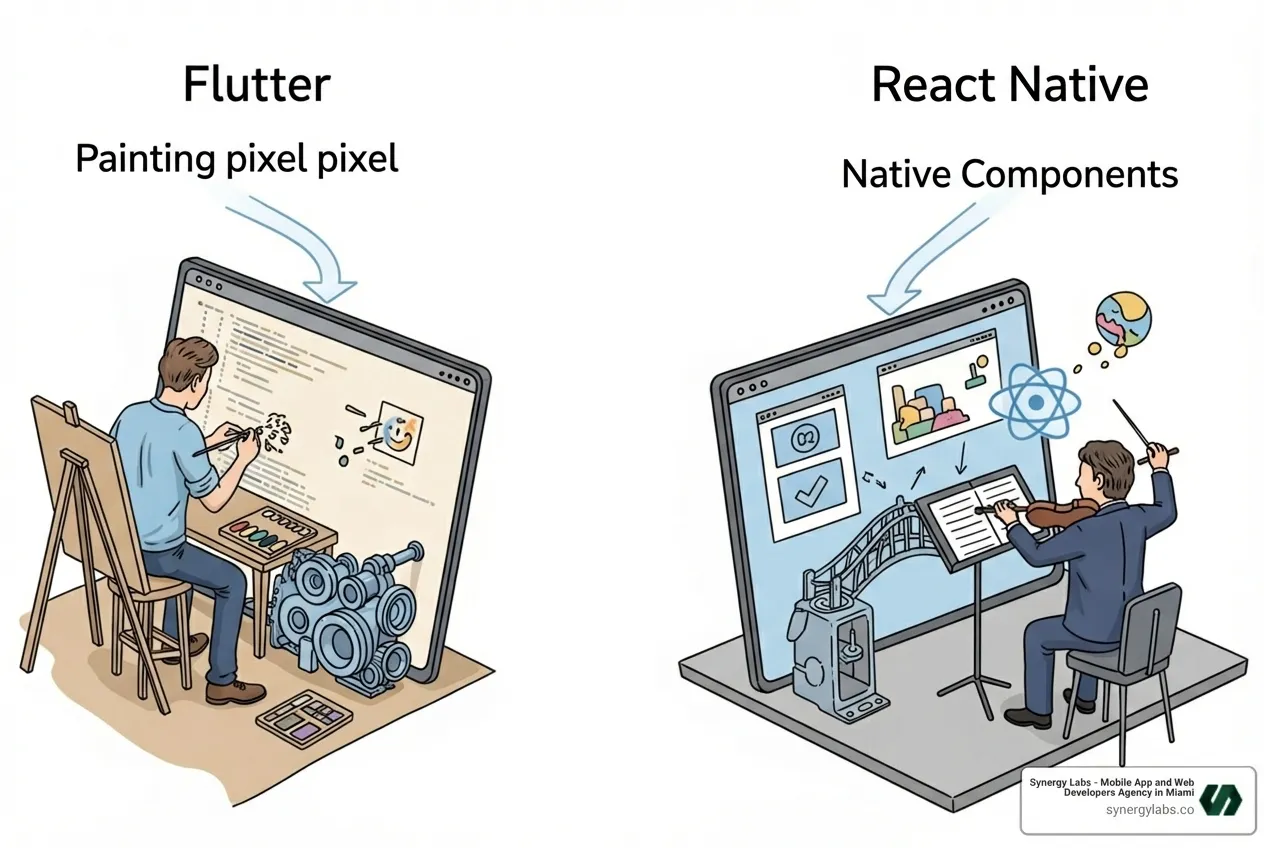
The core of the Flutter vs. React Native: Which Framework is Right for Your 2026 Project? debate is a philosophical difference in UI rendering. Flutter is like an artist painting every pixel on a canvas, while React Native is a conductor orchestrating native UI components. This choice impacts performance, visual consistency, and maintenance, and has major implications for The Importance of User Experience (UX) in Mobile App Design.
Flutter: The Pixel-Perfect Control Freak
Flutter's philosophy is complete control. It uses its own rendering engine (Skia, and now Impeller) to draw every pixel, bypassing native OS UI components. This ensures a Flutter app looks and behaves identically on all platforms and OS versions. This "pixel-perfect" control is a major advantage for brands requiring a highly customized and consistent UI.
Flutter's UI is a tree of widgets-blueprints for the interface. It includes both Material Design widgets (Google’s design language) and Cupertino widgets (Apple’s iOS design), allowing apps to mimic native looks while using Flutter's rendering pipeline. This ensures a consistent user experience and simplifies development.
For projects where brand identity and custom UI are paramount, Flutter's ability to render exactly what you design, regardless of platform quirks, is invaluable. This is why we see Flutter powering sophisticated applications that require rich animations and intricate visual effects. If you're curious about what's possible, check out some of the Best Apps in Flutter. Flutter's "write once, deploy everywhere" concept is fully realized here, supporting a consistent user experience across mobile, web, and desktop.
React Native: The Diplomatic Native Orchestrator
React Native takes a different, more diplomatic approach. Instead of drawing its own UI, it leverages JavaScript to communicate with the native UI components provided by the operating system. When you write React Native code, it maps your JSX components to actual native UI elements (like UIView on iOS or android.view on Android). This means a React Native app naturally inherits the look, feel, and subtle behaviors of the platform it's running on. An iOS app built with React Native will feel distinctly like an iOS app, and an Android app will feel like an Android app.
Historically, communication occurred via a "JavaScript bridge," a potential performance bottleneck. By 2026, React Native's "bridgeless architecture" uses JavaScript Interface (JSI) for direct, synchronous communication between JavaScript and native modules. Combined with the new Fabric Renderer and TurboModules, this has drastically improved performance. The default Hermes performance engine further boosts startup times and reduces memory usage by pre-compiling JavaScript to bytecode.
The advantage is that React Native apps automatically adopt platform design guidelines and OS updates. This is a double-edged sword: it provides an authentic native feel but may require adjustments if an OS update unexpectedly changes the UI.
2026 Performance Showdown: A Look Under the Hood
Performance is a top concern for any 2026 project. While both frameworks have improved, their architectures create different performance profiles in benchmarks like cold start times, animation smoothness, and app size. Scalability is also a key factor, as detailed in What Makes an App Scalable: A Technical Guide for Growing Companies.
Cold Start and App Size: The First Impression
An app's cold start time-the time to launch from a closed state-is a critical first impression.
Flutter generally boasts faster cold start times, averaging around ~250ms on mid-range Android devices. This is due to its Ahead-of-Time (AOT) compilation, which compiles Dart code into native machine code, and its Impeller rendering engine that pre-compiles shaders.
React Native, even with Hermes and bytecode pre-compilation, clocks in around ~350ms for cold start times. While Flutter has a slight edge, this difference is often negligible to users.
When it comes to app size, there's a trade-off.
Flutter's apps tend to be 4-7MB larger than equivalent React Native builds. This is because Flutter bundles its rendering engine and Dart runtime with every app, contributing to its consistent performance but resulting in a larger download.
React Native apps typically start 2-3MB smaller. However, this initial advantage can diminish as more native dependencies and third-party libraries are added.
If every megabyte counts, React Native has an initial size advantage. However, Flutter's fixed overhead means its size may not grow as disproportionately with app complexity.
Animations and Rendering: The Quest for 120fps
Smooth animations are non-negotiable for a modern UX, and this is where Flutter often shines.
Flutter's Impeller engine, the default for Android and iOS in Flutter 3.27 (released in 2026), delivers predictable performance. By leveraging advanced GPU APIs, Impeller ensures smooth 60/120fps graphics, making it ideal for apps with intricate UIs or complex animations. We've used Flutter to build fluid, graphics-heavy interfaces that scale from phones to kiosks.
React Native has significantly improved its animation capabilities with the Fabric architecture, aiming for 60fps on modern devices. However, because it still interacts with the native UI thread, complex animations or a heavily loaded JavaScript thread can occasionally lead to dropped frames. While it handles most business apps well, achieving consistently smooth 120fps animations can be more challenging than with Flutter.
For projects prioritizing visual consistency and high-performance animations, Flutter's rendering model provides a more reliable foundation. This is especially relevant in the era of AI-First App Development: How Modern Products Are Built in 2026, where dynamic interfaces are becoming standard.
The Developer's Battlefield: Ecosystem, Tooling, and Talent
Developer experience (DX) is crucial for project success, influencing speed and team morale. Key factors include the programming language, ecosystem, tooling, and talent availability. Understanding these is vital when choosing a framework, a topic covered in The Ultimate Guide to Choosing a Custom Mobile App Development Agency.
Language & Learning Curve: Dart vs. JavaScript/TypeScript
Dart (for Flutter): Developed by Google, Dart is an object-oriented language optimized for client-side development. It features sound null safety, pattern matching, and data destructuring, making code more robust. Developers from Java, Kotlin, or C# backgrounds find Dart familiar due to its static typing. For web-focused teams, there's a learning curve, though many become productive in 2-4 weeks.
JavaScript/TypeScript (for React Native): JavaScript remains dominant, with 66% of developers relying on it for their projects. This creates a massive talent pool and a lower barrier to entry for web developers. TypeScript, a superset of JavaScript, adds static typing, improving code quality and maintainability. If your team is proficient in JavaScript and React, React Native allows them to leverage existing knowledge.
Your language choice impacts time to market. React Native is a smoother transition for web-first teams. Flutter is a strong case if you're building a new team or value Dart's robust, modern features.
Ecosystem & Tooling: Curated Garden vs. Sprawling Jungle
Flutter's Ecosystem: The Curated Garden: While smaller than React Native's npm ecosystem (~40k vs. 1M+ packages), Flutter's packages on pub.dev have health scores and maintenance indicators, making it easier to find reliable options. Core functionalities are often maintained by Google, leading to more stability and smoother upgrades. Flutter's tooling, including the integrated Flutter DevTools and its famously solid hot reload feature, is considered robust.
React Native's Ecosystem: The Sprawling Jungle: React Native benefits from the vast npm ecosystem, offering a package for almost any need. However, package quality and maintenance can vary, sometimes causing dependency issues. The DX has improved with modern tooling and its Fast Refresh feature. Debugging uses familiar tools like React DevTools and Chrome DevTools, plus ecosystem tools like Flipper.
While React Native offers immense flexibility, Flutter provides a more tightly controlled and often more stable environment.
The Human Factor: Hiring, Team Skills, and Salaries
Hiring costs and developer availability are practical considerations for any 2026 project, tying into App Development Team Collaboration.
React Native's Talent Pool: React Native benefits from the massive JavaScript talent pool, making it easier to upskill web engineers. It has an edge in job postings, potentially making hiring faster. The average annual salary for a React Native developer is around $125,000-$160,000.
Flutter's Growing Demand: While the talent pool is smaller, demand for Flutter developers is growing rapidly, and they sometimes command a premium. The average annual salary for a senior Flutter developer is roughly $135,000-$180,000. The investment in finding or training Dart developers can pay off in product quality.
The decision depends on your team's DNA. For a strong JavaScript/React team, React Native leverages existing skills. If starting fresh, Flutter's modern language and structured ecosystem are appealing, despite the learning curve.
Strategic Implications: Flutter vs. React Native: Which Framework is Right for Your 2026 Project?
Choosing a framework is a strategic decision impacting your budget, market reach, and long-term success. For a 2026 project, consider total cost of ownership (TCO), maintenance, platform reach, and security. These factors are key to an informed decision, as explored in The Cost of Enterprise-Grade App Development 2026: Benchmark Guide.
Platform Reach & Long-Term Vision
Flutter's Broad Horizon: Flutter is designed for "write once, deploy everywhere" across mobile (iOS, Android), web, desktop (Windows, macOS, Linux), and embedded devices. Its web support, improved with WebAssembly (WASM) support, delivers consistent browser experiences. This makes Flutter excellent for a long-term strategy targeting maximum market penetration from a single codebase, streamlining releases and feature creation.
React Native's Mobile Focus: React Native is laser-focused on iOS and Android. While community efforts for desktop and web exist (e.g., React Native Windows/macOS), they aren't as mature as Flutter's multi-platform offerings. React Native for Web allows code sharing but may require extra integration effort and not match native web performance. For mobile-first projects, React Native is a strong contender. For a truly unified codebase across all platforms, Flutter has the advantage, a vital distinction for your Enterprise Mobile App 2026: Ultimate Guide.
Ideal Use Cases for Your 2026 Project
Choose Flutter if:
Brand-centric UI and High-Performance Animations: Your app demands a unique, pixel-perfect design and fluid 60-120fps animations.
True Multi-Platform Codebases: You plan to launch on mobile, web, and desktop from a single codebase.
Rapid Development and Iteration: Flutter's hot reload and widget-based architecture accelerate UI development.
New Projects with Custom Needs: Greenfield projects where you have full control over the design.
Choose React Native if:
Rapid Iteration and Time-to-Market: You need to ship fast, especially for MVPs.
Content-Driven Apps and Social Feeds: Applications like social feeds, marketplaces, or content-driven products.
Leveraging Existing JS Talent: Your team has strong JavaScript/React expertise you want to capitalize on.
Over-the-Air (OTA) Updates: You need the flexibility of over-the-air (OTA) updates to deploy fixes without app store review.
Native Integration, State Management, and Security
Native Integration:
Flutter: Uses "Platform Channels" for API communication. For more complex needs, Dart FFI (Foreign Function Interface) enables interop with native languages like C, C++, or Objective-C/Swift.
React Native: The New Architecture uses Turbo Modules and JSI for direct communication with native code, improving performance for native module integration.
State Management:
Flutter: Popular choices include BLoC, Provider, Riverpod, GetX, and MobX, which provide structured ways to manage state.
React Native: Common patterns include Redux, Zustand, Context API, MobX, and Recoil, benefiting from the wide array of battle-tested solutions in the JS ecosystem.
Security:
Flutter: Being compiled to native code, it benefits from underlying platform security. It emphasizes security through built-in features and regular patches.
React Native: Can improve security by leveraging native modules. Developers must be diligent about securing third-party dependencies and data handling.
Both frameworks require diligent implementation of security best practices like secure coding, API key management, and data encryption.
Frequently Asked Questions about Flutter vs. React Native
Is Flutter replacing React Native in 2026?
No, Flutter is not replacing React Native. Both frameworks are robust, evolving, and serve different needs. While Flutter's popularity has surged (holding 46% of the market share to React Native's 35%), React Native's market is also growing, projected to reach $499 million by 2031. The choice isn't about a winner but the best fit for your project's goals, team, and vision.
Which framework is better for a Minimum Viable Product (MVP)?
The best framework for an MVP depends on its core objectives.
React Native can be faster for teams with existing JavaScript/React skills, especially if the MVP uses standard UI patterns. Its rapid iteration capabilities can lead to quicker launches, a key aspect of The Benefits of Building a Minimum Viable Product (MVP) First.
Flutter shines for MVPs where a highly polished, custom UI or complex animations are a key differentiator. If your MVP's success hinges on a unique visual experience, Flutter can deliver that quickly.
For my 2026 project, which framework has a better future: Flutter or React Native?
Both have bright futures with strong corporate backing from Google and Meta.
Flutter is expanding beyond mobile into ambient computing-mobile, web, desktop, and embedded devices. Its consistent rendering positions it well for emerging technologies.
React Native continues to thrive within the massive JavaScript ecosystem, leveraging its vast community and innovations like the New Architecture.
The "better" future depends on your long-term platform strategy. If your vision is a single, pixel-perfect codebase for diverse devices, Flutter is well-aligned. If your strategy is tied to the web and JavaScript community, React Native is a strong, future-proof choice.
Making the Final Call for Your App's Future
The Flutter vs. React Native: Which Framework is Right for Your 2026 Project? decision is a strategic trade-off. Flutter offers unparalleled UI control, pixel-perfect consistency, and high-performance animations, ideal for brand-centric apps. React Native provides the flexibility of the JavaScript ecosystem, a lower learning curve for web developers, and rapid development for apps using standard UI and prioritizing quick iteration.
There is no universally "better" framework, only the right fit for your context. Consider your project goals, team skills, budget, and long-term vision. Both Flutter and React Native are powerful tools that deliver native-quality experiences through different paradigms.
Feeling overwhelmed? Choosing the right framework is a major decision that can impact your project's timeline, budget, and ultimate success. At Synergy Labs, we understand these complexities. We help businesses in Miami, Dubai, New York City, Chicago, Phoenix, San Francisco, Hartford, Austin, Doha, Riyadh, and London steer these choices to build scalable, successful apps. With our fixed-budget model, an in-shore CTO guiding an expert offshore team, and milestone-based payments, we ensure your project is delivered on time and on budget, without surprises. Let's build the future of your app, together. Explore our app development services.



.avif)

.avif)


