
Why Legacy System Modernization Matters More Than Ever in 2026

Best Practices for Legacy System Modernization in 2026 center on AI-native approaches, hybrid cloud, data modernization, composable strategies, and security by design. Key takeaways include:
- Start with AI-powered analysis to map dependencies and technical debt.
- Adopt a phased approach like the Strangler Fig pattern to minimize disruption.
- Prioritize hybrid cloud architectures, which 90% of organizations will adopt by 2027.
- Modernize data with lakehouses and build with flexible, API-first architectures.
- Embed security from the start using Zero Trust principles.
- Measure progress incrementally with clear KPIs tied to business outcomes.
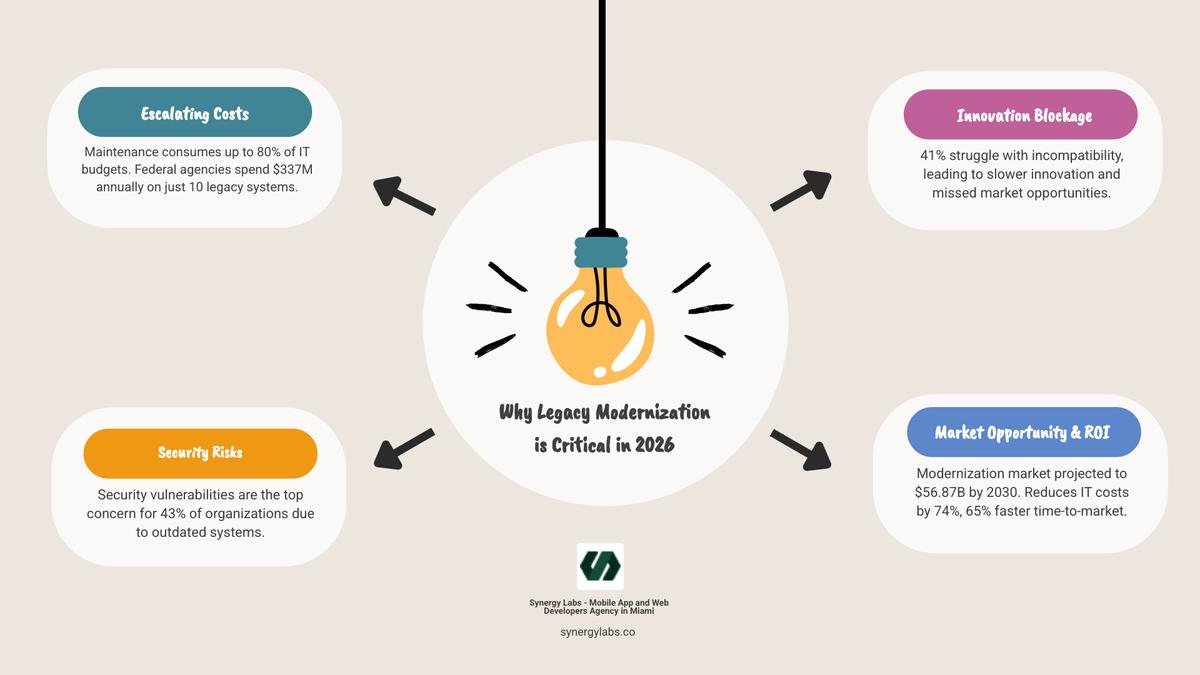
The numbers tell a stark story. In 2026, 62% of U.S. firms still rely on outdated software, with maintenance consuming up to 80% of IT budgets. Federal agencies spend $337 million annually on just ten legacy systems, and enterprises lose around $370 million per year to technical debt.
These systems are not just expensive; they're a liability. Security is a top concern for 43% of organizations, and 41% struggle with incompatibility, leading to slower innovation and missed opportunities.
The good news is that 2026 is a turning point. The modernization market is projected to hit $56.87 billion by 2030. AI tools can improve code design by 20% over manual efforts, and modernized firms report up to a 74% reduction in IT costs and a 65% faster time-to-market. The question isn't if you should modernize, but how.
This guide covers the Best Practices for Legacy System Modernization in 2026, from assessment to execution. As experts who have guided countless businesses at Synergy Labs through these challenges, we know success hinges on strategic planning, smart technology choices, and measurable progress.
Best Practices for Legacy System Modernization in 2026 terms made easy:
- What Makes an App Scalable? A Technical Guide for Growing Companies
- The Cost of Enterprise-Grade App Development: 2026 Benchmark Guide
- app development for enterprise
Why 2026 is a Critical Turning Point for Legacy Systems

In 2026, legacy system modernization is about survival and competitive advantage. The cost of inaction now far outweighs the investment in change. These outdated systems are no longer just inconvenient; they actively hinder progress, like a crumbling bridge preventing business goals from being reached.
The cost of inaction is staggering, with enterprises losing around $370 million annually to outdated tech and technical debt. This traps organizations in a maintenance cycle that consumes up to 80% of IT budgets, stifling innovation. Studies show that approximately 90% of businesses underperform due to their reliance on outdated technology, leading to lost revenue and an inability to keep pace with agile competitors.
Furthermore, technical maturity heavily impacts company valuations. Investors in hubs like Miami and New York City now scrutinize a company's tech stack as a signal of future growth potential. Deep technical debt signals risk and can limit performance, affecting everything from M&A to public valuations. Aligning modernization with investor expectations is key to securing buy-in, and understanding the tangible benefits and ROI of modernizing legacy systems is crucial.
The Primary Technical and Financial Problems
U.S. organizations face multifaceted challenges with legacy systems:
Technical Problems:
- Security Vulnerabilities: A top concern for 43% of organizations, as older systems lack modern security features.
- Incompatibility with New Tools: 41% struggle with siloed systems that can't integrate with modern tools, causing manual workarounds.
- Scalability Limitations: Legacy systems often can't handle today's user loads or data volumes, creating bottlenecks.
- Absent Vendor Support: 32% face issues with discontinued support, leaving them vulnerable to unpatched bugs.
Financial Problems:
- High Maintenance Costs: A significant issue for 39% of organizations, draining IT budgets.
- Budget Constraints: 44% of projects are delayed by daunting upfront costs, which average $2.9 million per system.
- Fear of Downtime: The perceived risk of operational disruption deters 38% of organizations from modernizing.
- Organizational Resistance: 30% lack internal buy-in due to unclear ROI and change aversion.
Sector-Specific Urgency in the U.S.
The need for modernization is acute in key sectors, including our core markets like Miami, New York City, and Hartford:
- Government: U.S. federal agencies spend $337 million annually maintaining just ten critical legacy systems, some over 60 years old, posing risks to national security and public service.
- Finance: The sector's reliance on outdated languages like COBOL creates significant technical debt and security risks, limiting innovation in financial hubs like New York City.
- Healthcare: Insecure legacy systems put sensitive patient data at risk, making modernization critical for compliance (HIPAA), patient safety, and advanced analytics.
- Insurance: Outdated core systems cause inflexibility (46%), integration issues (45%), and high maintenance burdens (44%), hindering competitiveness in markets like Phoenix and Chicago.
- Manufacturing: Outdated technology causes underperformance in 90% of businesses, blocking innovation and the adoption of Industry 4.0. Modernization can cut IT infrastructure costs by up to 74%.
The 2026 Modernization Playbook: Key Trends and Strategies

In 2026, the legacy modernization market is booming, projected to reach $56.87 billion by 2030. This growth is fueled by powerful trends that form a new modernization playbook. At Synergy Labs, we see these as essential components for success.
The key strategies defining Best Practices for Legacy System Modernization in 2026 are:
- AI-driven modernization
- Data modernization as a core priority
- Hybrid and multi-cloud architectures
- API-first and composable architectures
- Security-driven modernization
These elements create an efficient path forward, as detailed in our insights on AI-First App Development: How Modern Products Are Built in 2026.
AI-Native Modernization Takes Center Stage
AI is now integral to the modernization process, leading the market and accounting for a third of enterprise investments. Its applications are transformative:
- Code Analysis & Re-architecting: Large language models can reduce poor code design 20% better than developers, quickly identifying technical debt and improving dependency mapping.
- AI-driven Testing: AI-powered tools dramatically reduce migration timelines, with AI-enabled testing capable of accelerating regression cycles by 400%.
- Mainframe Modernization: AI is even tackling entrenched systems. AI-powered tools, including advanced code assistants and agentic AI, help migrate legacy COBOL code, a game-changer for critical systems in government and finance. Our AI Infusion Service leverages these capabilities to streamline your journey.
The New Foundation: Cloud, Data, and Composable Architectures
The infrastructure for modernized systems has shifted, with cloud, data, and composable architectures as the new baseline for Best Practices for Legacy System Modernization in 2026.
- Cloud Readiness as the Default: Organizations are building cloud-native solutions to leverage cloud elasticity and resilience, moving beyond simple "lift-and-shift" migrations.
- Hybrid and Multi-Cloud Architectures: Industry reports indicate that 90% of organizations will adopt hybrid cloud practices through 2027, using multiple cloud providers for flexibility and vendor independence.
- Data Modernization with Lakehouses: Traditional data warehouses are being replaced by lakehouses, which unify diverse data flows and enable advanced analytics. This is critical, as 29% of enterprises cite poor data quality as a top barrier to AI adoption.
- API-First and Composable Modernization: An API-first approach enables independent module updates and faster integrations, with 82% of businesses already adopting it. This facilitates composable modernization, reducing the risk of "big bang" changes.
- Security-by-Design and Zero Trust Architecture: Security is now embedded from the start. A Zero Trust architecture, which continuously verifies identity and device health, is becoming standard, especially for organizations handling sensitive data in sectors like finance and healthcare.
Choosing Your Path: Modernization Approaches Explained
One of the most crucial decisions in Best Practices for Legacy System Modernization in 2026 is determining the right approach for your specific systems. It's not a one-size-fits-all solution, and sometimes, the best choice isn't to modernize at all, but to replace entirely.
When deciding whether to modernize or replace a legacy system, consider if maintenance costs outweigh business value, if features are rigid, or if security gaps exist. If the system still provides value but has specific shortcomings, modernization is likely the answer. If it's a complete drain on resources, replacement may be more cost-effective.
Here are the primary legacy modernization strategies available:
- Rehosting (Lift-and-Shift): Moving an application to a new environment (like the cloud) with minimal code changes. It's fast and ideal for quick infrastructure cost savings but doesn't fix core architectural issues.
- Re-platforming (Lift-and-Reshape): Similar to rehosting but with minor optimizations to leverage new platform capabilities, offering more benefits without a full rewrite.
- Re-architecting: Significantly altering the code and architecture (e.g., moving from monolith to microservices) for greater scalability, agility, and maintainability.
- Refactoring: Improving the internal code structure without changing external behavior. This improves code quality and is often part of a re-architecting effort.
- Replacement (Rip-and-Replace): Discarding the old system and building a new one from scratch. It's the most disruptive but can yield the biggest long-term gains when a system is beyond repair.
- Emulation: Creating a virtual replica of original hardware to run old software on modern platforms, preserving investments without a rewrite.
When choosing a strategy, ask: What is the system's business value? What is its technical condition? What is our risk tolerance, budget, and timeline? Understanding What Mid-Sized Businesses Get Wrong About Digital Transformation often means avoiding the failure to align these technical strategies with business goals.
Your Blueprint for Success: Best Practices for Legacy System Modernization in 2026
A successful modernization journey requires a clear blueprint guided by strategic planning and incremental delivery. For Best Practices for Legacy System Modernization in 2026, this means adopting principles like platform engineering for efficiency and real-time event-driven operations for responsiveness. Our approach at Synergy Labs mirrors Agile Methodologies: Accelerating App Development Without Compromising Quality, emphasizing iterative development and continuous feedback.
Step 1: Findy, Prioritization, and Strategic Alignment
The first step is to understand what you have and what you need.
- Conduct a System Audit: Perform a comprehensive audit of current systems to document dependencies, assess risks, and map business processes to technical assets.
- Map Technical Debt: Visualize where technical debt resides and its business impact to inform prioritization.
- Align with Business Outcomes: Set clear, measurable objectives (e.g., improved reliability, reduced TCO) that align with strategic business goals.
- Redraw System Boundaries: Identify core features to modernize and decide if others can be moved to SaaS platforms or retired.
- Prioritize High-Impact Components: Focus first on increments that deliver the most business value or mitigate the highest risks.
- Create a Business Case: Articulate the ROI of modernization to secure budget and internal buy-in.
Step 2: A Phased Roadmap for Incremental Delivery
Build a roadmap that minimizes disruption and delivers value incrementally. One of the best practices for legacy system modernization in 2026 is creating a phased roadmap using techniques like:
- Strangler Fig Pattern: Gradually replace legacy modules with new services, allowing both to coexist to minimize disruption.
- Canary Releases: Release changes to a small subset of users first to test impact and reduce risk.
- Feature Toggles: Enable or disable new features without redeploying code for flexible release management.
- Parallel Runs: Operate old and new systems concurrently to ensure the new logic is stable before a full switch.
- API Gateways: Redirect traffic to modern components seamlessly without exposing backend changes.
- Build a Cross-Functional Alliance: Involve IT, operations, and management from the start to ensure alignment.
- Execute a Pilot Project: Start with a small, high-impact pilot to minimize risk, gain lessons, and build momentum.
Step 3: Ensuring Sustainable and Future-Ready Systems
Modernization is an ongoing journey. Another key best practice for legacy system modernization in 2026 is focusing on long-term maintainability.
- Optimizing for Adaptability: Build flexible systems designed to evolve with future technologies like AI agents and multi-cloud environments.
- Mapping Changeability: Separate high-change zones from stable ones (dual-speed architecture) to make modernization more predictable.
- Building a Unified Data Strategy: Implement a unified data strategy with strong governance to ensure a single source of truth across all platforms.
- Planning for Continuous Evolution: Adopt a mindset of continuous improvement, refining the roadmap based on outcomes and building new components with maintainability and automated testing from the start.
Frequently Asked Questions about Legacy Modernization
We often get asked similar questions from clients in Miami, Dubai, London, and beyond who are struggling with legacy systems. Here are some of the most common ones:
What is a realistic timeline for a modernization initiative?
The timeline for a modernization initiative varies significantly depending on the scope, complexity, and chosen strategy. In our experience at Synergy Labs, most clients see:
- 3 to 6 months for a major business-domain rebuild, focusing on one critical module or service.
- 12 to 18 months for a full-scale change across an entire platform.
Early success signals to watch for, which indicate the project is on track, include:
- Clear decomposition of the first module into APIs and services.
- Automated CI/CD pipelines set up early in the project.
- The first migrated component operates independently without regressions.
- Engineering velocity increases (fewer dependency blockers, less rework).If these milestones are achieved within the first quarter, it's a strong indicator that the project is heading in the right direction.
How much internal engineering capacity is needed to start?
You don't need a full-scale internal team to initiate a modernization effort. In most cases, a core squad of 3 to 6 people is sufficient at the early stages. Key roles typically include:
- Product Owner: Responsible for prioritizing functionality and validating results quickly.
- One or two Senior Engineers: Deeply understand your product's value-driving features and architecture.
- About two Technical Leads: Can support findy, documentation, and early technical decisions.The focus should be on having individuals who are well-versed in your business domain and can collaborate effectively with external experts, rather than needing an army of developers for the initial phases. We often find that partnering with an experienced team like Synergy Labs can augment your internal capacity, providing specialized skills and accelerating the process.
How can we modernize without disrupting business operations?
Minimizing disruption is a paramount concern for organizations, and thankfully, several effective phased approaches exist to achieve this:
- Strangler Fig Pattern: This involves gradually replacing parts of the legacy system with new components, allowing both old and new to run concurrently. The new system "strangles" the old one over time, reducing risk.
- Canary Releases: New features or updated components are released to a small group of users first. If stable, the release gradually expands to the entire user base.
- Feature Toggles: This allows new functionalities to be turned on or off dynamically, providing control over deployments and enabling quick rollbacks if issues arise.
- Parallel Runs: Both the legacy and the modernized systems operate simultaneously for a period, with outputs compared to ensure consistency and correctness before fully switching over.
- API Gateways: These act as communication checkpoints, directing traffic between new and old services. They allow new microservices to be introduced and integrated seamlessly without requiring changes to the existing client applications.These strategies help avoid a "big bang" cutover, which is inherently risky, and instead promote an incremental, measurable transition with minimal impact on ongoing business operations.
Charting Your Course: From Legacy Burden to Future-Ready Advantage
The landscape of 2026 presents both challenges and unparalleled opportunities for enterprises shackled by legacy systems. We've seen that modernization is no longer an optional IT project but a strategic business imperative, directly impacting your agility, security, innovation, and ultimately, your market valuation. The high costs of inaction, from escalating maintenance budgets to crippling security vulnerabilities and innovation blockages, paint a stark picture of the consequences of delay.
But the path to a future-ready state is clear. By embracing Best Practices for Legacy System Modernization in 2026—leveraging AI-native analysis, adopting hybrid cloud and composable architectures, prioritizing data, and embedding security by design—organizations can transform their technical debt into a competitive advantage. The journey may seem daunting, but with a well-structured roadmap, incremental delivery, and the right expertise, it's entirely achievable.
At Synergy Labs, we specialize in turning these complex challenges into seamless changes. Our approach is designed to guide you through every step, ensuring your modernization project is not just a technical upgrade, but a strategic leap forward for your business. With our fixed-budget model, you gain predictability and control over costs. Our in-shore CTO provides strategic guidance and technical leadership, working hand-in-hand with our expert offshore development teams to deliver world-class solutions. And with milestone-based payments, we ensure that progress is tangible and aligned with your business objectives, completing projects efficiently and effectively.
Don't let legacy systems dictate your future. The time to modernize is now, and the rewards are immense. Ready to start your journey from legacy burden to future-ready advantage? Explore our expert modernization services and let's build your future, together.