Cross-platform app solutions let you build one app that runs on iOS, Android, and beyond—using a single codebase. Instead of maintaining separate native apps, you write your code once and deploy everywhere. This approach can cut development costs by 30–40% and slash time-to-market, making it ideal for startups and businesses that need to move fast without sacrificing quality.
Top Cross-Platform Frameworks:
Flutter – A UI toolkit using Dart, with hot reload and a custom rendering engine
React Native – A framework using JavaScript/TypeScript with native UI components
.NET MAUI – A framework using C# and XAML for .NET developers
Ionic – Web-based framework using HTML, CSS, and JavaScript with support for popular front-end frameworks
Key Benefits:
Cost-Effective – One codebase for multiple platforms reduces development hours
Faster Launch – Deploy to iOS and Android simultaneously
Easier Maintenance – Update once, roll out everywhere
Wider Reach – Access billions of smartphone users across all devices
Cross-platform development isn't always the right fit—performance-intensive apps or those requiring deep native integrations may need a different approach. But for most modern applications, it's the fastest path from idea to launch.
As the founder of Synergy Labs, I've helped clients from startups to established brands choose and implement the right cross-platform app solutions for their needs. Our team has delivered dozens of mobile apps using Flutter, React Native, and other modern frameworks—always focusing on speed, scalability, and user experience.
The Business Case: Why Choose Cross-Platform Development?
In a mobile-first world with over 6 billion smartphone users, reaching every customer is paramount. Cross-platform app solutions offer an efficient strategy to launch on both iOS and Android, providing compelling advantages for businesses navigating a competitive market.
Advantages of Cross-Platform App Solutions
The "write once, run anywhere" philosophy translates into tangible business benefits:
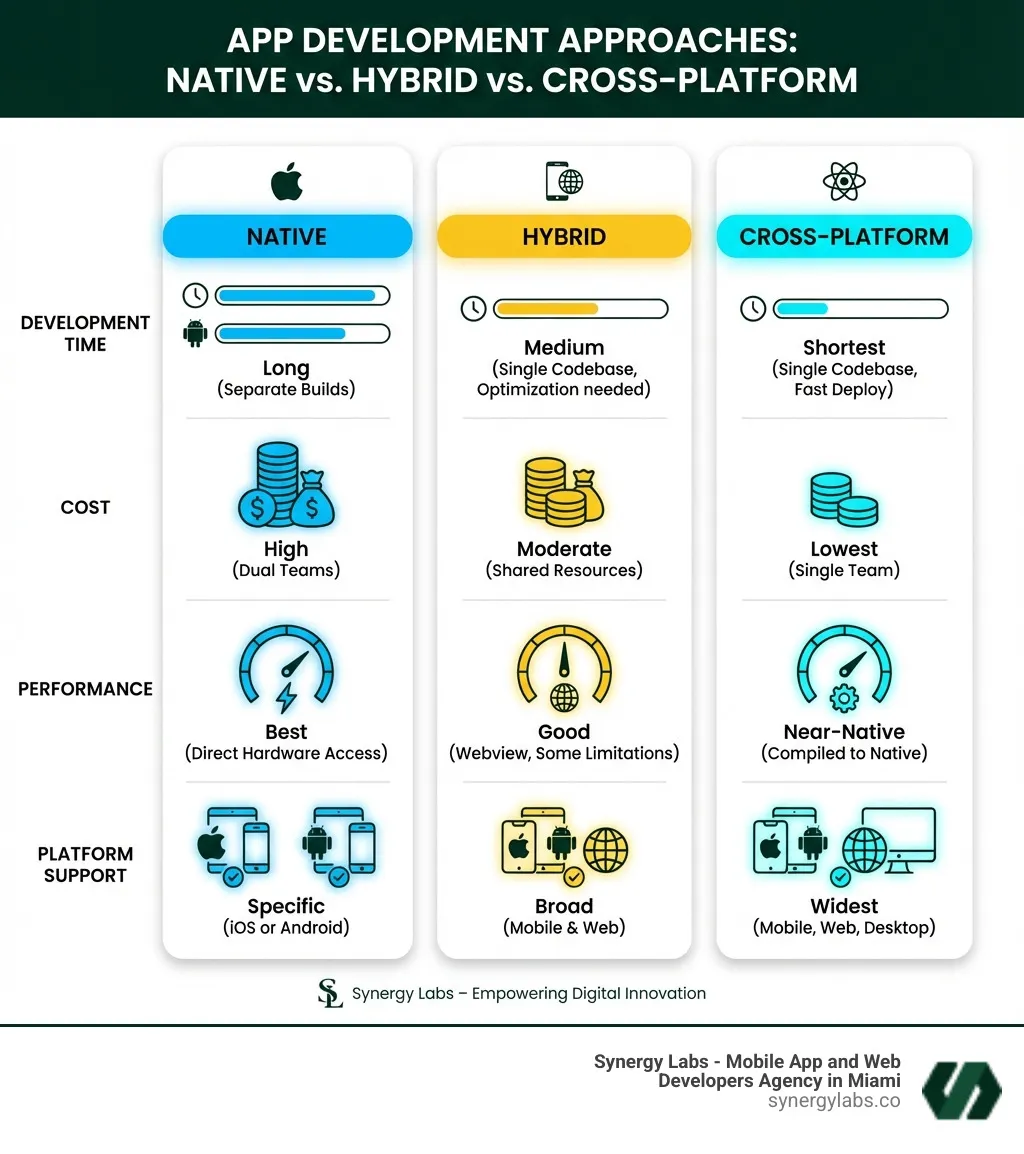
Cost Reduction: Maintaining a single codebase eliminates the need for two separate development teams, potentially reducing development efforts by 50-80%. This leads to substantial savings, making it an attractive option for businesses with tight budgets.
Faster Time-to-Market:Cross-platform app solutions accelerate the development cycle. A single codebase allows for quicker builds and simultaneous deployment, enabling businesses to launch faster, capture market share, and respond rapidly to user feedback.
Wider Audience Reach: A single cross-platform app instantly expands your potential user base to billions of smartphone users across both iOS and Android, maximizing your market exposure.
Easier Maintenance and Deployment: Managing one codebase is simpler than two. Updates, bug fixes, and new features are implemented once and rolled out everywhere simultaneously, saving time and ensuring a consistent user experience.
Disadvantages and Considerations
While the benefits are compelling, it's important to understand the limitations of cross-platform app solutions:
Performance Considerations: For apps with intensive graphics or real-time processing, cross-platform frameworks may have slight performance limitations compared to native apps. However, for most business applications, this difference is negligible.
UI/UX Challenges: Achieving a perfect "native feel" can be challenging due to subtle differences in platform UI guidelines. Careful design is required to ensure the app feels intuitive on both iOS and Android.
Delayed OS Feature Updates: Native apps can integrate new OS features immediately, while cross-platform frameworks require updates to add support. This can cause a short delay in adopting the latest functionalities.
For most businesses prioritizing efficiency and broad reach, the advantages of cross-platform app solutions far outweigh these potential challenges.
A Deep Dive into Leading Cross-Platform Frameworks
Choosing the right framework is like picking the perfect tool for a job—it needs to fit the task, the team, and the desired outcome. At Synergy Labs, we work with a variety of cutting-edge cross-platform app solutions to deliver exceptional results for our clients. Here's a look at some of the top contenders we often leverage:
Flutter: A UI Toolkit for Beautiful, Natively Compiled Apps
Flutter is an open-source UI toolkit for building natively compiled applications for mobile, web, and desktop from a single codebase.
Dart Language: Flutter uses Dart, a modern, object-oriented language optimized for client-side development.
Hot Reload: This standout feature allows developers to see code changes almost instantly, drastically speeding up development, testing, and debugging.
Skia Rendering Engine: Flutter uses its own high-performance rendering engine, giving developers pixel-level control for customized, consistent designs across all platforms.
Customizable Widgets: It includes a rich set of pre-built, flexible widgets following established design guidelines for major mobile platforms, enabling complex UIs with ease.
Community and Growth: Flutter has a vibrant, growing community, with usage trending upwards. This strong support system ensures ample resources and continuous improvement. Learn more on our blog: Best Flutter App Development Company.
Multi-Platform Capabilities: Flutter delivers on its promise to build beautiful apps for every screen, deploying to iOS, Android, web, desktop, and embedded devices from one codebase.
React Native: Building Native Apps with React
React Native allows developers to build natively rendered mobile apps using JavaScript and React, a familiar stack for many web developers.
JavaScript and TypeScript: Its use of JavaScript makes it highly accessible, while TypeScript support adds type safety for improved code quality on larger projects.
Fast Refresh: Similar to Hot Reload, this feature provides immediate feedback on UI changes, enhancing developer productivity.
Native UI Components: React Native renders actual native UI components, not a web view, resulting in a genuine native look and feel.
Large Community and Ecosystem: As a popular JavaScript-based framework, it has a massive community and a rich ecosystem of libraries and tools. Learn more about its place in development here: Hybrid App or Native App: Which One Is Right For Your Business?.
Real-World Applications: It is used by many well-known applications and companies.
.NET MAUI: A Framework for .NET Developers
As a modern framework, .NET MAUI is a compelling option among cross-platform app solutions for building native mobile and desktop apps with C# and XAML.
C# and XAML: .NET MAUI leverages the skills of millions of .NET developers by using C# for logic and XAML for UI definition.
Single Project System: It features a single project system to target Android, iOS, macOS, and Windows from one codebase, simplifying project management.
Access to Native APIs: The framework provides seamless access to native device features and platform-specific APIs, allowing apps to use the full capabilities of each device.
Hot Reload: .NET Hot Reload lets developers modify C# and XAML while the app is running, providing instant UI updates and boosting productivity.
Ecosystem Integration: It integrates perfectly with the .NET ecosystem and its tools, making it ideal for enterprises already invested in .NET. Get started with the official .NET MAUI documentation.
Ionic: Building with Web Technologies
Ionic allows developers to build hybrid mobile apps and Progressive Web Apps (PWAs) using familiar web technologies like HTML, CSS, and JavaScript.
HTML, CSS, and JavaScript: Ionic empowers web developers to build mobile apps by integrating with popular front-end frameworks.
PWA Support: It's an excellent choice for developing PWAs, which offer an app-like experience in the browser and don't require app store downloads.
Large UI Library: Ionic provides a rich library of pre-designed UI components that mimic native iOS and Android elements for fast, consistent interface design.
Wrapper Integration: It uses wrappers to bridge the gap between the web app and native device features like the camera or GPS. While its WebView-based rendering can affect performance, it's a cost-effective, rapid solution for many business apps.
How to Choose the Right Framework for Your Project
Selecting the ideal framework for your cross-platform app solutions is a pivotal decision that influences the entire project lifecycle. It’s a strategic choice, not just a technical one, that should be custom to your business goals.
Key Decision Factors for Cross-Platform App Solutions
When guiding clients, we consider several critical factors:
App Complexity: Simple content apps have different needs than complex apps with heavy data processing. More complex apps may require frameworks with closer-to-native performance.
Performance Needs: For gaming or real-time analytics, frameworks like Flutter or React Native are suitable. For less intensive apps, web-based solutions like Ionic can be effective.
UI/UX Goals: Decide whether you need a platform-specific UI or a consistent, branded experience. Some frameworks excel at mimicking native UIs, while others offer unique, customizable widgets.
Developer Skillset: Match the framework to your team's proficiency (e.g., JavaScript for React Native/Ionic, .NET for MAUI).
Learning Curve: A steep learning curve can impact your timeline and budget.
Budget and Time-to-Market: We recommend frameworks that align with your financial goals and launch deadlines, leveraging features like hot reload to speed up development.
The Importance of Community and Ecosystem
A framework is only as strong as its support system:
Community Support: An active community provides quick answers, best practices, and open-source tools.
Documentation and Libraries: Quality documentation and a rich ecosystem of third-party plugins are crucial for efficiency.
Long-Term Viability: We consider if a framework is backed by a major tech company and has a growing community to protect your investment.
Common Mistakes to Avoid When Selecting Cross-Platform App Solutions
Sidestep these common pitfalls when choosing your framework:
Choosing based on hype rather than project needs.
Ignoring your team's existing skillset and the framework's learning curve.
Neglecting long-term maintenance costs and challenges.
Underestimating performance requirements for demanding applications.
Focusing on development speed at the expense of quality and scalability.
The Future of Cross-Platform App Solutions
The landscape of mobile development is changing, and cross-platform app solutions are at the forefront of this change. We at Synergy Labs are constantly monitoring these trends to ensure our clients in Miami, Dubai, London, and beyond benefit from the most advanced and efficient technologies available. The future promises even more powerful, intelligent, and seamless development experiences.
Here's what we see on the horizon for cross-platform development:
AI-Powered Development: Artificial intelligence is set to revolutionize how we build apps. We anticipate more AI-driven development tools that can assist with code generation, context-aware updates to UI and data systems, automated testing, and even predictive analytics to optimize user experiences. This will make app development faster, smarter, and more efficient.
Closing the Performance Gap: Modern cross-platform frameworks are already significantly closing the performance gap with native applications. We expect this trend to continue, with frameworks leveraging advanced rendering techniques and optimizing resource utilization to deliver near-native or even indistinguishable performance for a wider range of applications. This means fewer trade-offs for businesses choosing cross-platform.
Low-Code and No-Code Integration: The rise of low-code and no-code platforms is democratizing app development, allowing business leaders and even non-coders to rapidly prototype and build applications. We foresee deeper integration of these tools with robust cross-platform frameworks, enabling quicker initial development and iteration, while still allowing for custom coding when needed.
Improved Security and Compliance: As cyber threats evolve, security and compliance will remain paramount. Future cross-platform app solutions will likely integrate more robust security features by default, including end-to-end encryption, advanced authentication methods (like biometrics), and built-in tools for ensuring regulatory compliance (e.g., GDPR).
IoT and AR/VR Integration: The Internet of Things (IoT), Augmented Reality (AR), and Virtual Reality (VR) are becoming increasingly intertwined with mobile experiences. Cross-platform frameworks will offer more seamless and powerful integrations with these emerging technologies, allowing developers to build innovative apps that connect with smart devices, create immersive experiences, and leverage spatial computing. Imagine managing your smart home devices or experiencing an AR shopping spree, all powered by a single cross-platform app.
These trends indicate a future where cross-platform app solutions become even more versatile, performant, and accessible, solidifying their position as a go-to strategy for businesses looking to innovate and expand their digital footprint.
Frequently Asked Questions about Cross-Platform Development
We often get asked similar questions about cross-platform app solutions from our clients in cities like New York City, Austin, and San Francisco. Here are some of the most common ones, answered with our expert perspective:
Which is better, native or cross-platform?
The best choice depends on your project requirements, business goals, and resources.
Native Apps are built for a single OS (iOS or Android). They offer the highest performance and immediate access to new OS features, making them ideal for graphically intensive games or apps requiring deep hardware integration.
Cross-Platform Apps are built once and deployed on multiple platforms. They reduce development costs (by 30-40%), speed up time-to-market, and simplify maintenance. For most business, e-commerce, and social media apps, modern cross-platform frameworks deliver excellent performance and user experience.
For companies seeking an affordable, efficient, and broad-reaching solution, cross-platform app solutions are often the ideal choice.
What are the main challenges of cross-platform development?
While beneficial, cross-platform app solutions have challenges to consider:
Performance Issues for Demanding Apps: Graphically intensive apps might experience minor performance bottlenecks compared to native apps.
Limited Native Access: There can be delays in support for brand-new or highly specialized native device features.
UI/UX Inconsistency: Achieving a perfect native look and feel on both iOS and Android can require extra customization.
Delayed OS Updates: Frameworks need time to update to support the latest OS features released by platform holders.
Obsolete Plugins and Dependencies: Reliance on third-party plugins can lead to compatibility or security issues if they are not well-maintained.
Addressing these challenges requires expertise and careful planning.
Can cross-platform apps access native device features?
Yes, absolutely. Modern cross-platform app solutions are designed to provide extensive access to native device features like the camera, GPS, and push notifications. This is achieved through:
Wrappers and Plugins: Framework-specific tools like modules and plugins bridge the gap between the app's code and native APIs.
Cross-Platform APIs: Frameworks provide APIs that allow developers to write code once to access common features across platforms.
Custom Native Modules: For rare cases where a feature isn't supported, developers can write custom native code and integrate it into the cross-platform project, ensuring no capability is out of reach.
So, while the implementation method differs from native development, cross-platform app solutions are fully capable of creating rich and powerful applications.
Build Your Next-Gen App with the Right Partner
Navigating cross-platform app solutions can feel like charting a course through a vast ocean of possibilities. From Flutter's vibrant widgets to React Native's familiar JavaScript, and .NET MAUI's enterprise-ready C#, each framework offers unique strengths. The strategic decision of which path to take is crucial, impacting everything from your budget and timeline to your app's performance and user adoption.
At Synergy Labs, we understand that every business has a unique vision and specific requirements. That's why we don't just offer generic solutions; we provide personalized service with direct access to senior talent, ensuring that your project benefits from years of expertise and innovative thinking. Whether you're a startup in Austin or an established enterprise in Chicago, our rapid app launches and ongoing support are designed to meet your needs, always with a focus on user-centered design and robust security.
We're not just building apps; we're crafting digital experiences that drive growth and connect you with your audience across all devices. Let us be your trusted partner in bringing your next-gen app to life.
Oops! Something went wrong while submitting the form. Try again, please!
Perguntas mais frequentes
Tenho uma ideia, por onde é que começo?
Por que razão devemos utilizar o SynergyLabs em vez de outra agência?
Quanto tempo demorará a criar e lançar a minha aplicação?
Para que plataformas é que desenvolve?
Que linguagens de programação e estruturas utiliza?
Como é que vou proteger a minha aplicação?
Prestam apoio contínuo, manutenção e actualizações?
Parceria com uma agência de primeira linha
Está pronto para começar o seu projeto?
Agendeuma reunião através do formulário aqui e ligá-lo-emos diretamente ao nosso diretor de produto - sem vendedores envolvidos.
Prefere falar agora?
Ligue-nos para + 1 (645) 444 - 1069
Fale-nos um pouco do seu projeto e entraremos em contacto consigo em breve.
Está reservado! Veja o que acontece a seguir.
Estamos entusiasmados por o conhecer e saber tudo sobre a sua ideia de aplicação. A nossa equipa já está a preparar-se para tirar o máximo partido da sua chamada.
Um rápido olá do nosso fundador e o que esperar
Obtenha a nossa lista de verificação "Escolha a sua agência de desenvolvimento de aplicações" para se certificar de que está a fazer as perguntas certas e a escolher a equipa perfeita para o seu projeto.





.avif)

.avif)


