"By 2026, industry analysts expect 70% of new applications to be built using low-code or no-code technologies. Simultaneously, AI coding assistants now write nearly half of a developer’s code on major repositories, helping developers complete tasks 55% faster."
No-Code vs AI-Generated Apps: What Businesses Should Choose in 2026 is a decision that could define your competitive edge. Here's the quick answer:
Choose No-Code if you need to launch fast, have limited technical resources, and want business users to build and iterate on simple-to-moderate apps without writing code.
Choose AI-Generated Apps if you require deep customization, complex business logic, high scalability, and have developers who can guide and review AI-generated code.
Choose a Hybrid Approach if you want the best of both worlds—speed and simplicity from no-code for the front-end, combined with AI-powered intelligence and custom logic for the back-end.
The software development landscape is shifting. By 2026, industry analysts expect 75% of new enterprise applications to be built using low-code or no-code technologies. Simultaneously, AI coding assistants now write nearly half of a developer's code on major repositories, helping developers complete tasks 55% faster.
But there's a tension: while no-code tools can cut app development time by 90%, and AI agents can boost workflow efficiency by 30%, nearly 55% of enterprises abandon AI agent projects due to poor implementation.
This means you're at a crossroads in 2026. One path offers rapid deployment, the other deep customization. A third, hybrid path is emerging that combines both. AI and low-code platforms are converging into a new paradigm, redefining what's possible.
At Synergy Labs, we've helped startups and enterprises steer this exact challenge, delivering cross-platform solutions that balance speed, innovation, and scalability. We've seen how the right development approach can mean the difference between launching ahead of competitors or getting left behind.
Handy No-Code vs AI-Generated Apps: What Businesses Should Choose in 2026 terms:
The Two Titans of App Development: A 2026 Showdown
Deciding between no-code platforms and AI-generated applications in 2026 is like choosing between a sleek, ready-to-drive electric car and a high-performance custom-built race car. Both get you to your destination, but the journey and capabilities are wildly different. Understanding these fundamental differences is crucial for any business looking to innovate.
What is No-Code Development?
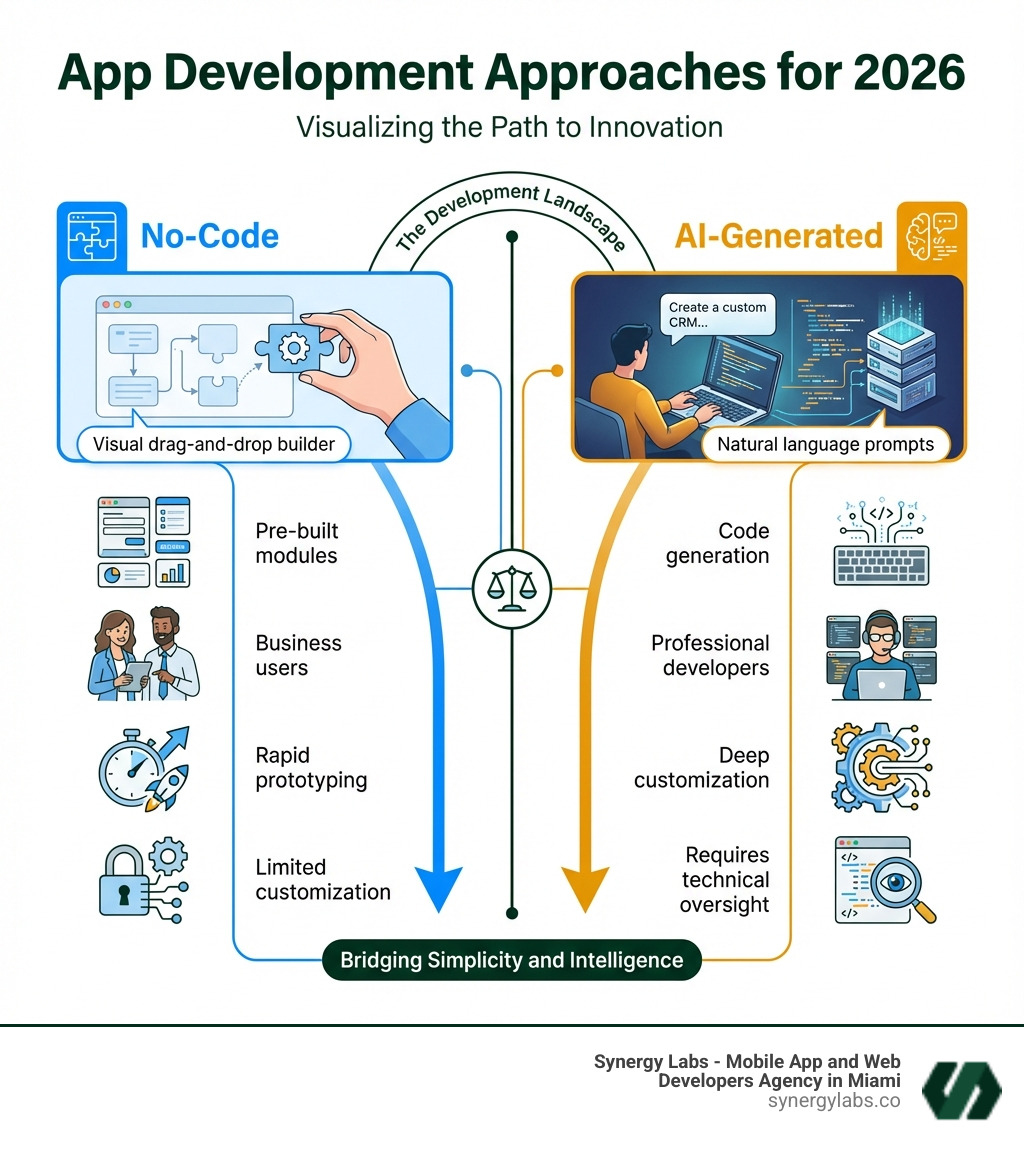
No-code development is exactly what it sounds like: building applications without writing a single line of code. It's a visual, drag-and-drop process where pre-built modules and intuitive interfaces allow anyone, from a marketing manager in New York City to a small business owner in Miami, to assemble functional applications. Think of it as building with digital LEGOs: you snap pieces together, configure settings, and you have an app.
This approach empowers "citizen developers"—business users who understand their operational needs but aren't professional programmers. The impact is staggering: industry forecasts predict that by 2026, a whopping 70% of new applications will be built using low-code or no-code technologies. Why? Because these tools can reduce app development time by up to 90%, allowing businesses to respond to market demands with unprecedented agility. For instance, these platforms enable users to quickly design forms, tables, and dashboards, connecting workflows with simple rules. It's a game-changer for rapid prototyping, and many platforms offer free trials to get a feel for the experience.
What are AI-Generated Applications?
AI-generated applications are a different beast. This approach leverages generative AI to write the actual code for an application based on natural language prompts. Instead of visually assembling components, you tell an AI agent what you want, and it attempts to write the underlying code. It's like having an incredibly fast, albeit sometimes quirky, junior developer at your beck and call.
AI-assisted development tools and modern coding copilots have become indispensable for many professional developers. Industry reports show that these tools now write a substantial portion of a developer's code on major repositories, with some language communities seeing more than half of their boilerplate and repetitive code handled by AI. In controlled tests, developers using AI coding assistants often complete tasks around 55% faster. Emerging tools are even pushing the boundaries, marshaling multiple AI agents to work in parallel on software projects. This isn't just about speeding up coding; it's about automating entire segments of the development process, allowing experienced engineers to focus on architectural design and complex problem-solving.
Core Differences: Process, Flexibility, and Control
The core differences between these two approaches lie in their development processes, flexibility, and the level of control a business maintains.
Development Process & User Experience:
No-Code: A visual, intuitive process. Users drag and drop elements and configure settings through menus, abstracting away technical complexity. It's designed for simplicity, allowing non-technical teams in Miami or London to build apps quickly.
AI-Generated Apps: A prompt-based process. Developers articulate needs to an AI, which generates code. A human must still guide, review, and debug, making the experience geared toward technical professionals.
Technical Skill Requirements:
No-Code: Requires minimal to no coding skills, empowering business users to build their own applications.
AI-Generated Apps: Demands strong technical skills. Developers must guide the AI and debug its output. A significant "verification tax" exists, as many teams report that verifying AI code can take as long or longer than writing it manually, making technical oversight essential.
Flexibility & Customization:
No-Code: Flexible for standard processes but limited by the platform's pre-built modules. It's like building in a sandbox, which can be restrictive for highly unique logic.
AI-Generated Apps: Offers immense flexibility. Since it generates actual code, it can create bespoke solutions for complex needs, ideal for unique applications in places like Dubai or Doha.
Licensing & Code Ownership:
No-Code: You don't own the underlying platform code, just the app configuration and data built on top of it. Licensing is typically tied to your subscription.
No-code democratizes app creation, while AI-generated apps boost professional developers, offering a path to unprecedented customization—provided you have the technical talent to wield them effectively.
No-Code vs AI-Generated Apps: What Businesses Should Choose in 2026
Choosing between no-code and AI-generated apps in 2026 is a strategic business decision. It impacts your time-to-market, scalability, maintenance costs, and ultimately, your return on investment.
The Case for No-Code: Speed, Simplicity, and Accessibility
No-code platforms offer compelling advantages for businesses prioritizing rapid deployment and accessibility.
Pros of No-Code:
Rapid Prototyping and Time-to-Market: This is no-code's superpower. You can go from idea to a functional prototype in days, not months. These tools can reduce app development time by up to 90%, allowing businesses in markets like San Francisco or Austin to seize opportunities instantly.
Lower Initial Cost: By reducing the need for specialized developers, no-code significantly cuts initial development expenditures. The low-code/no-code market is expected to grow to roughly £23.5 billion by 2026, reflecting its cost-efficiency.
Empowering Business Users: No-code decentralizes app creation, allowing non-technical employees to build tools custom to their needs. This fosters innovation from within, whether in a small team in Hartford or a large enterprise in Chicago.
Agile Iteration: Making changes is often as simple as reconfiguring visual elements. This agility is invaluable for businesses that need to adapt their applications based on user feedback.
Cons of No-Code:
Scalability Ceilings and Customization Constraints: No-code operates within the boundaries of its platform. Highly complex logic, unique integrations, or massive user loads can push against these limits, potentially leading to vendor lock-in.
Vendor Dependency: Your application's fate is tied to the no-code platform. If the platform changes its pricing, features, or ceases to exist, your business could face significant challenges.
Performance Limitations: For performance-critical applications, no-code might not offer the granular optimization possible with custom-coded solutions.
The Power of AI-Generated Apps: Customization, Complexity, and Scale
AI-generated applications represent the bleeding edge, promising next-level capabilities, albeit with a different set of considerations.
Pros of AI-Generated Apps:
Deep Customization and Complex Logic: Since AI generates actual code, it offers strong customization potential. This is ideal for applications requiring unique business logic or intricate integrations that no-code platforms can't handle, such as a complex financial platform in New York City or a bespoke logistics system in Riyadh.
High Scalability and Performance Optimization: AI-generated code can be structured and tuned for performance and scalability in ways that pre-built no-code modules often cannot. This is crucial for applications expecting massive user bases.
Automation of Boilerplate Code: AI can handle a large portion of the time developers previously spent on boilerplate and repetitive code, freeing up your skilled developers for more strategic tasks.
Cons of AI-Generated Apps:
Higher Technical Barrier: A strong technical team is essential. Developers must guide the AI, understand the generated code, and ensure its quality and security.
Ongoing Maintenance Costs: AI-generated code requires ongoing maintenance, including updates and bug fixes, which incurs long-term costs and necessitates dedicated developer resources.
The Rise of AI "Slop": A major concern is the risk of "slop"—low-quality, generic, or error-ridden AI output. The term, highlighted in many recent discussions and even cited in Merriam-Webster's 2026 word of the year coverage, reflects this growing issue. AI can produce misinformation and low-quality content, which can be a liability in production systems. This risk contributes to the "verification tax," where developers spend significant time validating AI-generated code.
Choosing between these titans requires a clear understanding of your project's needs, your team's capabilities, and your tolerance for risk.
Finding the Perfect Fit: Use Cases for 2026
The beauty of 2026's app development landscape is that it offers custom solutions. The choice between no-code and AI-generated apps isn't about which is "better" in a general sense, but which is the perfect fit for your specific project and business needs.
When to Choose No-Code Solutions for Your Project
No-code shines brightest when agility, internal efficiency, and rapid validation are key. It's the ideal choice for projects where:
Internal Tools: Need a custom CRM, project management dashboard, or inventory tracker for your team in Phoenix? No-code allows you to build these quickly, empowering your employees to create tools that perfectly match their workflows.
Business Process Automation (BPA): Automating repetitive tasks, such as onboarding new employees, managing approvals, or generating reports, is a sweet spot for no-code platforms.
Minimum Viable Products (MVPs): Want to test a new business idea in Miami or Dubai without a massive upfront investment? No-code lets you launch an MVP, gather user feedback, and iterate rapidly.
Simple Customer-Facing Portals: For basic customer logins, support portals, or information hubs, no-code can provide a professional and functional interface without extensive development time.
Data Collection Forms: Whether it's for surveys, lead generation, or event registrations, no-code makes creating robust data collection forms a breeze.
Event Management Apps: Planning a conference in Austin or a workshop in London? No-code can help you build registration, scheduling, and communication apps quickly.
No-code is particularly effective for projects where the core functionality is well-defined, and the need for extreme custom code is minimal.
When to Leverage AI-Generated Applications for Your Project
AI-generated applications step in where no-code might falter—in areas demanding high complexity, unique performance, and deep integration. Consider AI-generated apps for:
Data-Intensive Platforms: If your application needs to process, analyze, and visualize massive datasets, AI-generated code can be optimized for performance and efficiency, crucial for areas like predictive analytics in Riyadh.
Performance-Critical Systems: For applications where every millisecond counts, such as real-time trading platforms or high-frequency data processing, AI can generate highly optimized code.
Apps with Unique Business Logic: When your business has proprietary algorithms or complex, one-of-a-kind processes that can't be replicated with standard modules, AI-generated code offers the flexibility to build precisely what you need.
Microservices Architecture: For large, distributed systems composed of many small, independent services, AI can assist developers in generating and managing the code for these complex architectures.
Integrating with Legacy Systems: AI can help bridge the gap between modern applications and older, existing systems by generating custom integration code.
Building Proprietary Algorithms: If your competitive advantage relies on unique algorithms, AI can assist in developing and optimizing the code for these crucial components.
At Synergy Labs, we understand that these complex scenarios often require a nuanced approach. Our expertise in mobile app and web development allows us to steer the intricacies of your project, ensuring that whether you choose no-code, AI-generated, or a hybrid model, your application is built for success. Find [More info about our services](https://synergylabs.co/our-services) and how we can help.
The Hybrid Horizon: Combining No-Code and AI for Best Synergy
In 2026, the smartest approach isn't choosing one over the other, but combining them. This hybrid model blends the rapid deployment of no-code with the intelligent power of AI, creating a synergistic future for software development.
How a Hybrid Model Works in Practice
Imagine building an app where the user-facing elements are handled by a no-code platform for quick setup and easy iteration. Then, for the clever stuff—like personalized recommendations or predictive analytics—you integrate AI-generated components.
No-Code for Front-End UI & Basic Workflows: A business user in Miami could design the visual interface and data entry forms using a no-code platform, handling common tasks quickly.
AI for Back-End Logic & Custom Features: For advanced functionalities, like an AI agent that analyzes customer sentiment or a model that predicts sales trends, your developers use AI-generated code. This code can be deployed as an API and integrated into the no-code platform.
Generating Custom Extensions: When a no-code platform lacks a specific feature, AI can generate a custom code snippet or microservice to extend its capabilities. This approach allows even non-coders to leverage AI for specific needs with the help of a development team.
Integrating AI Models into No-Code Apps: Many no-code tools are now embedding AI and generative AI features directly. For example, some platforms integrate AI-based assistants to help users generate content or optimize processes without leaving the visual environment.
Embracing this hybrid model delivers a potent combination of advantages:
Accelerated Development Cycles: You get the rapid prototyping speed of no-code for common elements, combined with AI-driven efficiency for complex coding.
Improved App Capabilities: Your applications become smarter and more personalized by leveraging AI's analytical and generative power where it matters most.
Smarter Automation: Beyond simple workflow automation, AI integration allows for intelligent automation—systems that can learn, adapt, and make decisions, revolutionizing operations from Doha to San Francisco.
Increased Innovation: By removing development bottlenecks, both no-code and AI empower more people to experiment and innovate.
Reduced Dependency on Specialized Developers: The hybrid model reduces the burden on your highly skilled developers, allowing them to focus on high-value architecture and problem-solving.
Fostering Collaboration: This approach breaks down silos, enabling business users to contribute directly to app creation while technical teams improve it with advanced AI.
The hybrid model is not just a compromise; it's a strategic evolution, ready to redefine how businesses create and deploy applications in 2026.
Your Strategic Blueprint: Making the Right Choice for Your Business
Navigating the choice between no-code, AI-generated apps, or a hybrid approach requires a clear strategic blueprint. It's about aligning your development strategy with your business goals, considering both immediate benefits and long-term implications.
Key Decision Factors for No-Code vs AI-Generated Apps in 2026
When we sit down with clients at Synergy Labs, from startups in Austin to established firms in London, we guide them through a series of critical questions to pinpoint the best path:
Team Skill Level:
No-Code: Best for non-technical teams or for empowering business users.
AI-Generated Apps: Requires experienced developers to guide, review, and manage AI-generated code.
Project Complexity:
No-Code: Best for standard functionalities and clear workflows.
AI-Generated Apps: Suited for complex apps needing deep customization or unique algorithms.
Time-to-Market Pressures:
No-Code: The fastest option, especially for MVPs and internal tools.
AI-Generated Apps: Can be fast, but verification and integration add time.
Budget and Long-Term Costs:
No-Code: Lower initial cost with predictable subscriptions, but risk of vendor lock-in.
AI-Generated Apps: Higher upfront investment in talent, with ongoing maintenance costs similar to custom code.
Integration Needs:
No-Code: Strong with popular services but can be limited for niche or legacy systems.
AI-Generated Apps: Offers maximum flexibility for custom integrations.
Scalability Requirements:
No-Code: Scales well for many needs but can have limits for hyper-growth applications.
AI-Generated Apps: Provides greater control for robust, custom scalability solutions.
Navigating Risks and Ethical Considerations with AI-Generated Apps in 2026
While AI-generated apps offer tremendous potential, businesses must approach them with a clear understanding of the inherent risks and ethical considerations. The excitement around AI shouldn't overshadow the need for diligence.
Data Privacy: AI models need vast data. Ensuring secure and compliant data handling, especially in regulated locations like Dubai and Doha, is paramount.
Intellectual Property Liability: The origin of AI-generated code can be ambiguous, creating IP risks. Businesses need clear policies on ownership and infringement.
Security Vulnerabilities: AI can generate insecure code. In 2026, vulnerability checks, software bills of materials (SBOMs), secret scanning, and automated policy enforcement must be continuous rather than occasional. This continuous vigilance is crucial.
Ethical Gaps and Bias: AI can inherit biases from training data. Businesses must actively identify and mitigate these biases to prevent unfair outcomes.
Accountability: When an AI app fails, who is responsible? Establishing clear accountability is vital.
Human Oversight: Despite the hype, human oversight remains critical. The high abandonment rate of AI agent projects (nearly 55% of enterprises) underscores the need for careful implementation and management by skilled teams.
Adopting AI-generated development tools requires a robust governance framework, continuous security assessments, and a commitment to ethical AI practices. It's not just about building fast; it's about building responsibly.
Frequently Asked Questions about Modern App Development
Can no-code and AI tools work together?
Yes, they form a powerful hybrid model. No-code platforms can provide the user-friendly front-end and workflow structure, while AI can be used to generate complex back-end logic, custom functions, or intelligent features that integrate into the no-code app. This synergy allows businesses to leverage the speed and accessibility of no-code for common functionalities and the power of AI for advanced, custom capabilities.
Are AI tools replacing no-code platforms?
No, they are evolving to solve different problems and often complement each other. AI tools primarily assist developers in writing code faster, while no-code platforms empower non-developers to build applications visually. Many no-code platforms are now integrating AI to improve their capabilities, blurring the lines and creating more powerful hybrid solutions rather than one replacing the other.
Which is better for non-technical business users?
No-code platforms are generally the better choice for non-technical users. They are designed with visual, intuitive interfaces that abstract away the complexity of coding, allowing business users to build and manage their own applications directly. AI-generated apps, while powerful, still require a level of technical understanding to effectively prompt, review, and manage the generated code.
Charting Your Course: Building Tomorrow's Apps with Today's Best Tools
As we steer the dynamic waters of 2026, the choice between no-code and AI-generated apps is less about a definitive winner and more about strategic alignment. No-code offers unparalleled speed and accessibility, empowering business users to drive innovation from within. AI-generated apps provide the power for deep customization and complex logic, supercharging your development teams.
The real magic, however, often lies in the hybrid approach—a synergy that combines the best of both worlds. This allows businesses to launch faster, build smarter, and scale more effectively, creating applications that are both agile and intelligent.
At Synergy Labs, we're not just observers of this evolution; we're active participants, helping businesses like yours in Miami, Dubai, San Francisco, Hartford, Doha, New York City, Austin, Riyadh, London, Chicago, and Phoenix chart their course. With our expertise in high-quality, scalable, cross-platform app development, we ensure that your strategic choice translates into a competitive advantage. We focus on user-centered design, robust security, and personalized service with direct access to senior talent, ensuring your vision becomes a reality.
The future of app development is exciting, complex, and full of potential. Let us help you open up it. Build your next-gen application with us and turn your innovative ideas into powerful, market-leading applications.
Oops! Something went wrong while submitting the form. Try again, please!
Perguntas mais frequentes
Tenho uma ideia, por onde é que começo?
Por que razão devemos utilizar o SynergyLabs em vez de outra agência?
Quanto tempo demorará a criar e lançar a minha aplicação?
Para que plataformas é que desenvolve?
Que linguagens de programação e estruturas utiliza?
Como é que vou proteger a minha aplicação?
Prestam apoio contínuo, manutenção e actualizações?
Parceria com uma agência de primeira linha
Está pronto para começar o seu projeto?
Agendeuma reunião através do formulário aqui e ligá-lo-emos diretamente ao nosso diretor de produto - sem vendedores envolvidos.
Prefere falar agora?
Ligue-nos para + 1 (645) 444 - 1069
Fale-nos um pouco do seu projeto e entraremos em contacto consigo em breve.
Está reservado! Veja o que acontece a seguir.
Estamos entusiasmados por o conhecer e saber tudo sobre a sua ideia de aplicação. A nossa equipa já está a preparar-se para tirar o máximo partido da sua chamada.
Um rápido olá do nosso fundador e o que esperar
Obtenha a nossa lista de verificação "Escolha a sua agência de desenvolvimento de aplicações" para se certificar de que está a fazer as perguntas certas e a escolher a equipa perfeita para o seu projeto.





.avif)

.avif)


