Why Growing Companies Fail at App Development (And How to Avoid It)
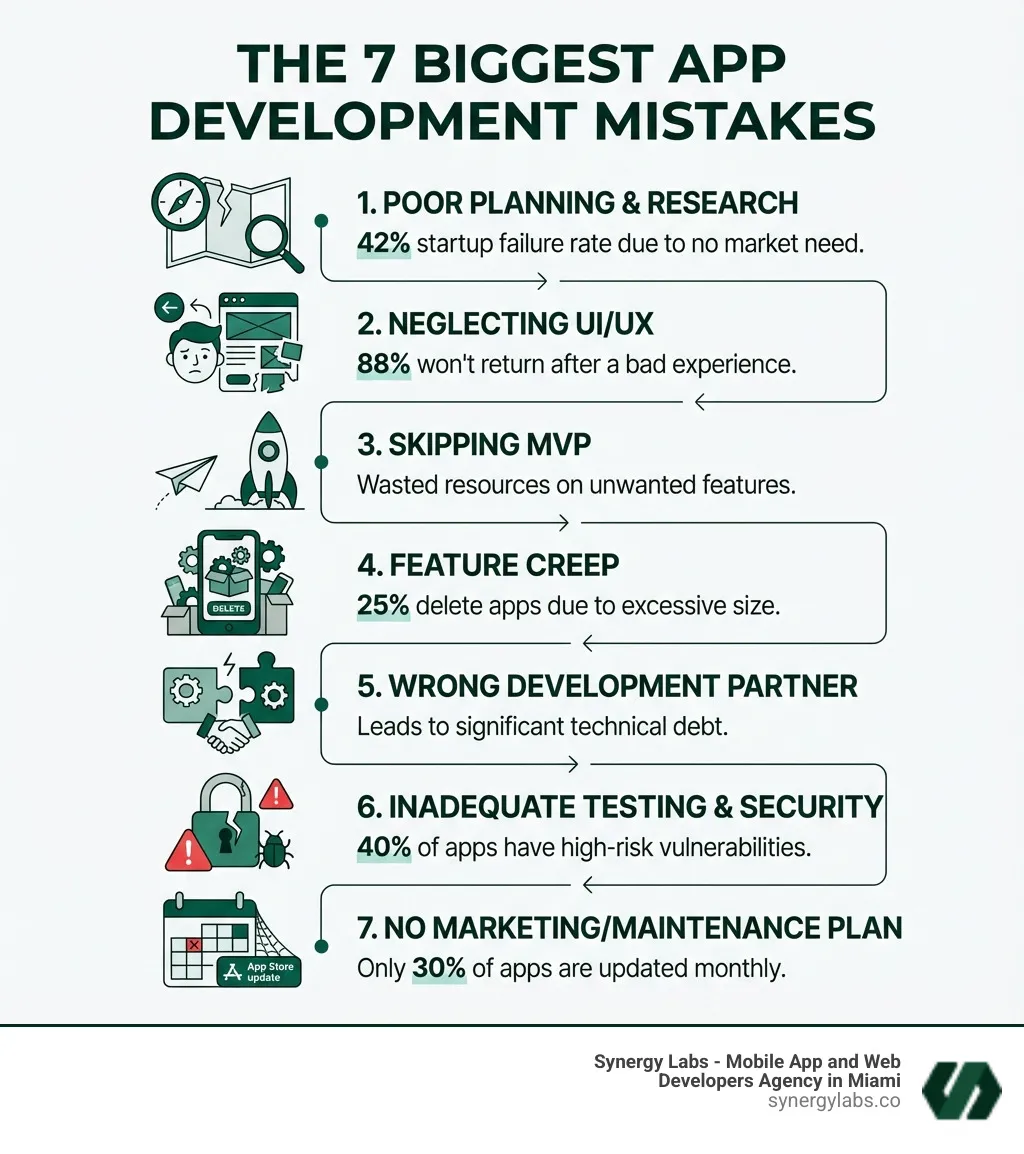
The Biggest App Development Mistakes Growing Companies Make often happen before a single line of code is written and they can cost you millions. Here are the seven most critical errors:
Poor Planning and Research - Skipping market research or ignoring your target audience (42% of startups fail because they build products nobody wants)
Neglecting User Experience (UI/UX) - Creating confusing navigation or inconsistent design that drives users away
Skipping the MVP - Trying to build everything at once instead of validating your core idea first
Feature Creep - Overloading your app with unnecessary features that slow performance and confuse users
Choosing the Wrong Development Partner - Working with inexperienced teams or selecting the wrong tech stack
Inadequate Testing and Security - Rushing to market without proper QA, exposing users to bugs and data breaches
No Marketing or Maintenance Plan - Launching without ASO strategy or ongoing support, leading to app abandonment
The mobile app market is projected to generate over $781.7 billion by 2029, yet most apps fail within their first year. The competition is fierce—approximately 4 million apps sit in the major app marketplaces combined. What separates successful apps from failures? Avoiding preventable mistakes.
Fixing problems after launch costs exponentially more than preventing them. A poor user experience drives away 88% of users permanently, and skipping security is a major risk, with 40% of mobile apps having at least one high-risk vulnerability.
As a founder at Synergy Labs, we've guided dozens of growing companies, from consumer apps to complex fintech platforms, helping them avoid these critical errors. We've seen how the right approach—starting with deep findy, building MVPs, and prioritizing user experience—differentiates an app that scales from one that stalls. Let's walk through each mistake and how to avoid it.
The Biggest App Development Mistakes Growing Companies Make vocab to learn:
Foundational Flaws: Mistakes Made Before a Single Line of Code is Written
Before we even think about writing a single line of code, the foundation of our app's success is laid. Unfortunately, this is where many growing companies stumble, making critical errors that can derail the entire project.
Mistake #1: Why Poor Planning is One of The Biggest App Development Mistakes Growing Companies Make
Imagine building a house without a blueprint. You'd end up with a disaster, right? The same applies to app development. One of the most frequent and Biggest App Development Mistakes Growing Companies Make is failing to plan and research adequately. Many businesses mistakenly believe that an app's success is solely dependent on its technical prowess, overlooking the crucial strategic groundwork.
The Pitfalls of Neglecting Research:
Ignoring Your Target Audience: Without in-depth market research, you risk building a product nobody wants—the reason 42% of startups fail. Understanding user personas, demographics, and motivations is mandatory before development begins.
Unclear App Purpose: If you can't articulate the core problem your app solves, development becomes a guessing game, leading to a product that fails to resonate with users.
No Unique Value Proposition: In a market with 4 million apps, a unique value proposition is essential. Without understanding the competition, you can't create a solution that offers distinct value and stands out.
Flawed Monetization Strategy: A clear monetization strategy (subscriptions, in-app purchases, etc.) must be established before development begins. Many apps fail because their revenue model doesn't align with user expectations or isn't integrated into the core design.
Our Solution: At Synergy Labs, we emphasize thorough conducting market research and strategic planning. This involves defining the app's core purpose, identifying the target audience, analyzing competitors, and outlining a viable monetization strategy. This foundational work ensures that the subsequent development phases are guided by a clear vision, preventing wasted resources and ensuring the app solves a real problem for its users. For a comprehensive guide on how to approach this, refer to our article: From Idea to Launch: A Step-by-Step Guide to Developing Your First Mobile App.
Mistake #2: Neglecting User Experience (UI/UX)
Once the planning is solid, the next critical step is crafting an intuitive and engaging user experience. Neglecting UI/UX design is another one of The Biggest App Development Mistakes Growing Companies Make, leading to frustration, negative reviews, and high uninstall rates. A poor UI/UX design is, in fact, one of the top reasons why people uninstall apps.
The Impact of Poor UI/UX:
High Uninstall Rates: A bad user experience is a major turn-off, causing high uninstall rates. In fact, 88% of users won't return to an app after a single bad experience.
Confusing Navigation: If users can't easily find what they're looking for, they'll get frustrated. We aim for simple navigation, ensuring users can find what they need within three clicks. An app's navigation should be intuitive, not a puzzle.
Inconsistent Design: Imagine watching a movie where every scene has a different color filter. Doesn't make sense, right? Inconsistent design elements—from fonts and colors to button styles—create a jarring and unprofessional experience. We follow the lead of successful apps that have simple navigation, a clear search function, and consistent home menus.
Ignoring Platform-Specific Guidelines: Mobile apps and web apps work differently, and both products have different User Experience (UX) requirements. A mobile app shouldn’t merely be a ‘smaller version’ of our desktop site. Each platform (iOS and Android) has its own design conventions and user expectations. Ignoring these can make an app feel foreign and clunky to users.
Negative Reviews: Frustrated users leave negative reviews, which can severely harm your app's reputation and visibility in the app stores.
Our Solution: At Synergy Labs, we believe that the primary element defining good UI and UX is a client-centric design. We invest time in usability testing to monitor users and identify areas for improvement. We use established design systems and collaborative design tools to ensure consistency and a seamless user journey. We treat UX as an early-stage growth lever, as highlighted in our article: Why Founders Should Treat UX as an Early-Stage Growth Lever in 2025.
The Biggest App Development Mistakes Growing Companies Make During Development
With a solid plan and a user-centric design approach, we move into the development phase. However, even here, there are critical mistakes that can hinder progress and lead to app failure.
Mistake #3: Trying to Build Everything at Once (Instead of an MVP)
It's tempting to add every feature imaginable to our app, thinking it will make it stand out. But one of The Biggest App Development Mistakes Growing Companies Make is trying to build everything at once instead of starting with a Minimum Viable Product (MVP).
Why Skipping the MVP is a Mistake:
Wasted Resources: Skipping the MVP phase leads to wasted resources on unwanted features. The misconception that an app must be fully featured from day one is a costly one.
Increased Time-to-Market: Trying to perfect every single feature before launch inevitably extends the development timeline. This delay can mean missing market opportunities or being outpaced by competitors.
Lack of Validation: An MVP allows us to test our core assumptions and the app's functionalities with real users under real marketing conditions. Without this early validation, we risk pouring resources into a product that lacks market fit. It's like building an entire car just to find out people prefer bicycles.
Ignoring User Feedback: An MVP is designed to gather valuable user feedback. By releasing a simplified version first, we can observe user behavior, collect insights, and refine our app strategy based on real-world input. This iterative development approach ensures we build what users truly want.
Our Solution: We advocate for the MVP approach, focusing on the essential features that solve a core problem for our target audience. This allows us to launch faster, gather crucial user feedback, and iterate based on actual usage data. An MVP shouldn't be an experiment that deviates from the final product's core purpose; it should be the foundational components (like wheels, frame, and engine) upon which future features are built. For a deeper dive into the benefits, check out The Benefits of Building a Minimum Viable Product (MVP) First.
Mistake #4: Overloading the App with Unnecessary Features (Feature Creep)
Closely related to skipping the MVP is the dreaded "feature creep." This occurs when we continuously add new functionalities to an app beyond its initial scope, often in an attempt to please everyone or make the app "more competitive." However, overloading an app with too many features is a significant mistake.
The Harmful Effects of Feature Creep:
Cluttered Interface and Confusing User Journey: Adding too many features leads to a cluttered, confusing user experience. Users become overwhelmed and can't find the core functionality. When it comes to features, quality trumps quantity.
Slow Performance: Every additional feature adds to the app's codebase and complexity. This can lead to slower loading times, increased battery consumption, and overall sluggish performance, frustrating users and leading to abandonment.
Increased App Size: More features typically mean a larger app file size. This is a critical concern for mobile users, as research shows that one in four people will delete an app for a lack of phone storage. We want our app to be a welcome guest on a user's device, not a storage hog.
Increased Development Costs and Bugs: Adding too many features will set us up for loads of problems down the road, increasing budget and potentially hindering performance. More features also mean more potential points of failure, making the app more susceptible to bugs, errors, and crashes.
Our Solution: We advise focusing on a strong product vision to strip the app of non-essentials and prioritize intuitive, simple features that genuinely add value. Our goal is to make the app do one thing really well before expanding. We believe in quality over quantity, ensuring that each feature contributes to a seamless user experience rather than detracting from it. For insights on what truly makes an app successful, explore our article: Top Features Every Successful App Needs in 2024.
Critical Errors in Execution and Launch
Once we've defined our app's core purpose and designed a user-friendly MVP, the execution phase demands careful attention. Here, two more of The Biggest App Development Mistakes Growing Companies Make frequently surface.
Mistake #5: Choosing the Wrong Development Partner or Tech Stack
The development team and the technology stack they employ are the backbone of our app. Making the wrong choices here can lead to a host of problems, from project delays to technical debt that cripples future growth.
The Risks of a Poor Choice:
Inexperienced Teams: Hiring an inexperienced or unqualified team leads to delays, technical issues, and a final product that doesn’t meet expectations. A skilled development team doesn’t just write code—they help refine ideas, suggest improvements, and ensure a smooth app development process. They should understand our vision and challenge us constructively.
Poor Communication: Mobile app development is a complex, collaborative process. Poor communication during development can lead to misunderstandings, rework, and missed deadlines. We need a partner who prioritizes clear, frequent communication and transparency.
Wrong Development Approach (Native vs. Cross-Platform): The choice between native, cross-platform, or hybrid development has significant implications for cost, performance, and reach. A focus on one platform (iOS or Android) reduces reach, and creating separate native apps for each platform increases costs and development time. Unless our app requires highly platform-specific features, cross-platform development is often the smarter choice for businesses looking for efficiency and broader reach, especially for a growing company. Cross-platform development tools allow us to build one app that runs on both iOS and Android, offering lower costs and faster launches.
Wrong Tech Stack & Scalability Issues: The technology stack chosen dictates the app's performance, security, and future scalability. An inappropriate tech stack can lead to an app that can't handle user growth, causing crashes during peak usage times. We need a tech stack that supports scalability from day one, allowing our app to grow with our user base.
Our Solution: At Synergy Labs, we believe in partnering with experienced mobile app development teams who understand the nuances of various development approaches and tech stacks. We review past projects, ask for references, and ensure a deep understanding of our client's vision. We help clients steer the complexities of choosing the right path, whether it's native for specialized performance or cross-platform frameworks for efficiency. We guide you through selecting a tech stack that aligns with your business goals and ensures long-term scalability. To help you make an informed decision, refer to our guide: How to Choose the Best App Development Company for Your Business in 2024, and explore the pros and cons of different development approaches in Hybrid App or Native App: Which One is Right for Your Business?.
Mistake #6: Inadequate Testing and Ignoring Security - One of The Biggest App Development Mistakes Growing Companies Make
We've all heard the horror stories: apps riddled with bugs, data breaches, or worse. Rushing to market without thorough testing and robust security measures is undeniably one of The Biggest App Development Mistakes Growing Companies Make. It can lead to catastrophic consequences, both financial and reputational.
The High Stakes of Neglect:
Bugs and Crashes: One of the biggest mistakes in mobile app development is skipping or rushing the testing phase, leading to apps full of bugs and crashes. This frustrates users, leads to negative reviews, and ultimately drives people away. Product testing is not just a developer's job; beta testing by dedicated app testers is indispensable.
Poor Performance: Inadequate testing can result in an app that performs poorly across different devices, operating systems, and network conditions. This includes slow loading times, unresponsive interfaces, and excessive battery drain.
Security Vulnerabilities: Neglecting security measures can lead to data breaches, loss of user trust, and even legal trouble. Globally, companies face substantial expenses due to inadequate security, with cyberattacks posing significant financial risks. The average total cost of a data breach is over $4.4 million, with industries like healthcare facing even higher costs. For instance, a cyber attack on a crypto exchange resulted in the theft of $230 million in user funds, highlighting the severe consequences of inadequate security.
Loss of User Trust and Legal Liabilities: Skipping the testing stage increases mobile app security issues and puts users’ data at risk, as well as legal liabilities. Security isn’t something to think about later—it should be part of our app’s foundation. Shockingly, 40% of mobile apps have at least one high-risk vulnerability.
Our Solution: At Synergy Labs, we integrate comprehensive testing and security measures throughout the entire development lifecycle, not just at the end. We conduct unit testing, functional testing, UI/UX testing, and regression testing, often leveraging dedicated beta testers. For security, we ensure robust measures are in place from the foundation up, including data encryption (using strong algorithms like AES and SHA256), multi-factor authentication, regular security audits, and protection against vulnerabilities. We believe in being proactive, not reactive, when it comes to safeguarding user data and maintaining app integrity. Our approach aligns with Agile Methodologies: Accelerating App Development Without Compromising Quality to build secure and reliable apps.
The Post-Launch Stumble: Why the Work Isn't Over
Even after a successful launch, the journey isn't over. Many growing companies make the mistake of adopting a "launch and forget" mentality, neglecting crucial post-launch activities.
Mistake #7: Having No Plan for Marketing or Maintenance
Launching an app without a solid marketing strategy and a clear plan for ongoing maintenance is like opening a beautiful store but never telling anyone it exists and never dusting the shelves. This is arguably one of The Biggest App Development Mistakes Growing Companies Make that leads to app abandonment.
The Consequences of Neglect:
Low Visibility and User Adoption: With the vast majority of apps being free, effective marketing and App Store Optimization (ASO) are critical for visibility. Many developers focus solely on the app itself and forget about the importance of visibility. Without a comprehensive marketing strategy, our app will get lost in the sea of millions.
Ignoring User Feedback: The launch is just the beginning. Ignoring user feedback after our app is live can lead to negative reviews, low retention, and eventually, app abandonment. Users expect their voices to be heard and their issues addressed.
No Update Schedule and OS Compatibility Issues: Technology evolves rapidly, with new OS versions released frequently. Without regular updates, an app can become outdated, incompatible, and insecure, causing users to leave. About 30% of apps are updated monthly, and over 80% are updated every six months to stay relevant and functional.
App Abandonment: A combination of poor visibility, unaddressed user issues, and outdated features inevitably leads to users uninstalling our app. This negates all the effort and investment poured into development.
Our Solution: At Synergy Labs, we understand that app success is a continuous journey. We work with our clients to develop comprehensive pre-launch and post-launch marketing strategies, including robust ASO to ensure visibility in app stores. We also emphasize the importance of continuous engagement: monitoring user reviews, fixing bugs promptly, and releasing regular updates based on user feedback and evolving OS requirements. Our approach ensures that our apps stay relevant, perform optimally, and continue to delight users. For more on scaling your app effectively, read How to Successfully Scale Your Mobile App Development.
Frequently Asked Questions about App Development Mistakes
Why is an MVP so crucial for a growing company?
An MVP (Minimum Viable Product) is crucial for a growing company because it allows for rapid market validation with minimal investment. Instead of spending extensive time and resources building a fully-featured app that might miss the mark, an MVP focuses on core functionalities. This enables us to:
Test core assumptions: We can quickly determine if our app idea genuinely solves a user problem and has market demand.
Gather real user feedback: Early adopters provide invaluable insights, helping us understand what works and what doesn't, allowing for data-driven iterations.
Reduce risk: By validating the concept early, we mitigate the risk of building features users don't want, saving significant time and money.
Accelerate time-to-market: Launching an MVP faster allows us to gain a competitive edge and start building a user base sooner.
An MVP is about smart growth, ensuring that every subsequent development phase is informed by real user needs and market feedback.
What's the biggest risk of choosing the wrong development approach (e.g., native vs. cross-platform)?
The biggest risk of choosing the wrong development approach (native, cross-platform, or hybrid) is a misalignment between our app's performance, budget, and target audience needs, leading to significant compromises or even project failure.
Native Development: Offers the best performance, user experience, and access to device-specific features. The risk here is higher cost and longer development time if we need to build two separate apps for iOS and Android, potentially delaying market entry and straining our budget, especially for growing companies.
Cross-Platform Development: Allows a single codebase to run on multiple platforms, offering cost savings and faster development. The risk is that if not executed well, it might sacrifice some native performance or access to very specific device features.
Hybrid Development: Uses web technologies wrapped in a native container. It's often the quickest and cheapest, but can suffer from performance limitations and a less "native" feel, which might disappoint users expecting a seamless experience.
Choosing incorrectly can result in an app that is either too expensive to develop, too slow to launch, performs poorly, or fails to use critical device functionalities, ultimately impacting user satisfaction and business goals.
How much should I budget for app maintenance and updates?
Budgeting for app maintenance is crucial, becoming one of the hidden Biggest App Development Mistakes Growing Companies Make. Many businesses focus only on the initial development cost, leading to budget overruns or an app that quickly becomes outdated.
As a general rule, we advise clients to budget 15-20% of the initial development cost annually for ongoing maintenance, updates, and support. This figure can vary based on:
Frequency of updates: About 30% of apps are updated at least once a month, and more than 80% are updated every six months. Regular updates are required to improve the user experience, fix bugs, ensure OS compatibility, and introduce new features.
Complexity of the app: More complex apps with intricate features and integrations will naturally require more maintenance.
Operating system changes: Operating system providers frequently release new OS versions, which often necessitate app updates to maintain compatibility and leverage new features.
User feedback and feature improvements: Ongoing development to incorporate user feedback and add new features is essential for retention and competitive advantage.
Security patches: Regular security updates are vital to protect against new vulnerabilities.
An experienced app development company like Synergy Labs will help you plan for these costs upfront, ensuring your budget includes funds for unexpected issues and continuous improvement, rather than treating maintenance as an afterthought.
Building for Success: Turning Mistakes into Milestones
We've explored The Biggest App Development Mistakes Growing Companies Make, from the initial planning stages to post-launch activities. The journey of app development is complex, but understanding these common pitfalls is the first step toward avoiding them. Each mistake presents an opportunity to learn, strategize, and ultimately build a more successful product.
At Synergy Labs, we believe that true success comes from a strategic, user-centric approach combined with a long-term vision. We focus on:
Deep Findy and Planning: Ensuring your app solves a real problem for a defined audience.
User-Centric Design: Crafting intuitive and engaging UI/UX that keeps users coming back.
Strategic MVP Development: Validating your core idea efficiently and iteratively.
Expert Partnership: Providing direct access to senior talent and the right tech stack for scalable solutions.
Rigorous Quality Assurance & Security: Protecting your app and users from bugs and breaches.
Continuous Growth: Planning for marketing, maintenance, and ongoing updates from day one.
Our unique selling proposition at Synergy Labs is personalized service with direct access to senior talent, ensuring client satisfaction and innovation. We offer rapid app launches and ongoing support, focusing on user-centered design and robust security, whether you're in Miami, Dubai, London, or any of our other locations.
Don't let preventable mistakes derail your app's potential. Partner with us to transform your vision into a thriving mobile application that scales with your growing company.




.avif)

.avif)


