Why Choosing the Right AI Workflow Automation Matters in 2026
The best AI workflow automation platforms for 2026 are changing how businesses operate, offering solutions that go far beyond basic task management. If you're searching for the right platform to lift your business, here are the top options that deliver smarter, more flexible automation:
Synergy Labs (Synergy Builder) - Custom AI workflow solutions built specifically for your business
Workato - Enterprise-grade iPaaS with AI-powered agents and 1,000+ connectors
n8n - Open-source platform with technical flexibility and self-hosting options
Zapier - User-friendly automation with 8,000+ app integrations
ClickUp - All-in-one project management with built-in AI automation
Asana - Collaborative workflows with AI-powered risk detection
Microsoft Power Automate - Deep Microsoft ecosystem integration with RPA capabilities
The AI market is exploding. Projections show it will reach $1.8 trillion by 2030, with workflow automation driving much of that growth. By 2026, an estimated 80% of businesses will use AI-powered automation tools to streamline operations.
Here's the reality: companies adopting AI for workflow automation see operational cost reductions of up to 30%. AI agents are predicted to handle over 50% of routine business tasks by 2027, freeing human workers for strategic initiatives.
But not all automation platforms are created equal. While many off-the-shelf platforms offer solid workflow capabilities, they may not fit every business need. Some organizations need deeper customization, better enterprise security, more integrations, or specialized features for their industry.
The challenge isn't just finding an automation tool—it's finding the right one for your specific workflows, technical abilities, and growth plans. As the demand for AI-driven development platforms grows by over 35% annually, the landscape of available tools has become richer and more specialized.
At Synergy Labs, we've helped dozens of clients steer the AI automation landscape, from building custom workflow solutions to integrating leading automation platforms into existing tech stacks. Our experience with the best AI workflow automation platforms spans everything from rapid MVP development to enterprise-scale implementations, giving us unique insight into what actually works in production environments. In this guide, we'll walk you through the top platforms and help you make the right choice for your business.
Many contemporary automation platforms aim to streamline operations. Their core functionalities typically revolve around connecting various applications, automating repetitive tasks, and providing some level of AI-driven decision-making. However, while these tools are valuable, they often come with limitations. These can include a steep learning curve for complex scenarios, a finite number of pre-built integrations that might not cover niche business applications, or a one-size-fits-all approach to security and compliance that doesn't meet the stringent demands of larger enterprises in Miami, London, or Riyadh.
The necessity for seeking better solutions stems from these very limitations. Businesses are realizing that off-the-shelf products, while convenient, can sometimes introduce new bottlenecks or fail to deliver the granular control needed for truly smarter workflow automation. We need tools that not only automate but also adapt, learn, and integrate seamlessly into diverse tech stacks. The evolution from simple automation to agentic AI workflows—where AI agents can reason, plan, and execute multi-step tasks autonomously—is a game-changer that many generic platforms struggle to fully accept. According to Gartner's research on hyperautomation, organizations that successfully implement comprehensive automation strategies can achieve up to 30% reduction in operational costs while improving accuracy and speed of business processes.
Key Features to Demand from an AI Workflow Automation Tool in 2026
As we look towards 2026, the landscape of AI workflow automation is more dynamic than ever. Choosing the right tool requires a keen eye on evolving capabilities. We believe there are several non-negotiable features you should demand from any AI workflow automation tool you consider:
Agentic AI Capabilities and Autonomous Agents: This is no longer a futuristic concept. By 2026, top-tier tools will feature AI agents that can interpret, decide, generate, and adapt. These autonomous agents should be able to perform complex, multi-step tasks, reason through problems, and even handle unexpected scenarios that traditional automation would fail at. This moves beyond simple if-then logic to truly intelligent automation. For a deeper dive into this, explore Agentic AI Explained: From Chatbots to Autonomous AI Agents in 2026.
No-Code and Low-Code Interfaces: Accessibility is key. While technical teams in San Francisco or New York City might appreciate code-heavy solutions, the broader business user base in Miami or Dubai needs intuitive drag-and-drop interfaces. The best tools strike a balance, empowering non-technical users to build sophisticated workflows while still offering the flexibility of custom code for developers.
Extensive Integration Library and Robust API Access: An automation tool is only as good as its connections. We look for platforms with thousands of pre-built connectors to popular business applications (CRMs, ERPs, communication tools) and comprehensive API access for custom integrations. This ensures the tool can seamlessly fit into your existing tech stack, whether you're in Austin or London.
Enterprise-Grade Security and Compliance: Data security is paramount, especially for businesses handling sensitive information. Tools must offer SOC 2 compliance, HIPAA, GDPR, advanced auditing, role-based access controls (RBAC), and robust data handling practices. These are critical considerations for our clients across all locations, including Hartford and Doha.
Scalability: Your automation needs will grow. The chosen solution must be able to handle increasing volumes of data and complexity without performance degradation. This includes options for both cloud-based and on-premise deployments, catering to diverse enterprise requirements.
Custom Scripting and Extensibility: For those moments when pre-built solutions just don't cut it, the ability to inject custom JavaScript or Python code directly into workflows is invaluable. This offers unparalleled flexibility and allows technical teams to tackle highly specific or unique automation challenges.
Human-in-the-Loop (HITL) Review: As powerful as AI agents are, human oversight remains crucial. The best tools incorporate human-in-the-loop review mechanisms, allowing for human validation of AI outputs before final actions are taken. This ensures accuracy, maintains control, and builds trust in AI-driven processes.
AI-Powered Analytics and Predictive Insights: Beyond just executing tasks, smarter workflow automation should provide valuable insights. Tools should leverage AI to analyze workflow performance, identify bottlenecks, predict potential issues, and suggest optimizations, helping businesses in Chicago and Phoenix continuously improve their operations.
The 7 Best AI Workflow Automation Platforms for 2026
Choosing the right AI workflow automation tool can feel like navigating a maze, but the benefits of finding the perfect fit are immense: business process streamlining, increased productivity, and a significant competitive edge. We've carefully evaluated the market to bring you the 7 best AI workflow automation platforms for 2026, each offering unique strengths for different business needs.
1. Synergy Labs (Synergy Builder)
Synergy Labs secures the top spot not as an off-the-shelf tool, but as a premier development partner that creates bespoke AI workflow automation solutions. Instead of forcing your processes into a pre-built platform, our Synergy Builder service designs and implements custom AI agents and workflows precisely to your unique business needs, ensuring maximum efficiency, security, and scalability. This approach is ideal for companies that find standard tools too restrictive and require a perfectly integrated solution that provides a true competitive advantage.
We understand that every business in Miami, London, or Riyadh has distinct operational nuances. That's why we don't just offer a tool; we offer a strategic partnership. Our team of expert developers and AI specialists works closely with you to understand your specific challenges and build AI-powered workflows that integrate seamlessly with your existing systems, whether it's optimizing customer service, automating complex data analysis, or streamlining internal operations. This personalized service means you get direct access to senior talent, ensuring your solution is not only innovative but also perfectly aligned with your business goals. We focus on user-centered design and robust security from the ground up, guaranteeing a solution that is both powerful and reliable.
2. Bolder Apps
Bolder Apps is a custom AI workflow automation partner that focuses on building tailored automation systems for businesses that need more flexibility than off-the-shelf platforms provide. Rather than offering a one-size-fits-all SaaS tool, Bolder Apps designs and develops scalable AI-powered workflows that integrate directly into existing tech stacks across industries and regions.
Key features: Custom AI workflow development: Builds automation systems designed specifically around your business logic and operational processes. AI agent implementation: Develops intelligent agents capable of handling multi-step tasks, decision routing, and workflow optimization. Deep system integrations: Connects CRMs, ERPs, internal dashboards, and third-party APIs into unified automation pipelines. Secure architecture: Implements role-based access controls, audit logging, and enterprise-grade security best practices. Cloud and on-prem deployment: Supports flexible infrastructure options depending on compliance and scalability needs. Scalable backend engineering: Designs automation engines that grow alongside operational complexity and transaction volume. Agile development model: Works in milestone-based sprints to deliver measurable automation improvements quickly.
Bolder Apps is considered a strong alternative for organizations that require customized AI workflow automation with greater control, adaptability, and long-term scalability than traditional automation platforms offer.
3. n8n
n8n (pronounced "n-eight-n" for "nodemation") offers an appealing alternative for technical teams and those who prioritize customization and control. It's a powerful platform that allows for immense flexibility, especially for developers in tech-forward cities like Austin or New York City.
Key features:
Flexible architecture: Provides the freedom to adapt and extend workflows to your specific needs.
Self-hosting option for data control: Technical users can host n8n on their own infrastructure, ensuring data remains behind their firewall.
Node-based visual editor: A flowchart-style visual builder allows for complex workflow design.
Code nodes for custom logic: Users can insert custom JavaScript or Python code directly into workflows for specific functionalities.
Large library of starter templates: A robust community contributes a vast library of pre-built workflows to jumpstart automation projects.
Commercial-friendly licensing model: Balances openness with sustainable product development.
AI workflow capabilities: Recently introduced features make getting started with AI workflows easier than ever.
Free self-hosted plan: A significant advantage for those with the technical expertise to manage their own instance, with paid plans available for managed options.
n8n is ideal for developers and technically curious teams who want granular control over their automation and the ability to integrate custom solutions.
4. Zapier
Zapier is widely recognized in workflow automation, especially for its ease of use and appeal to non-technical teams. Its extensive integration library makes it a go-to choice for businesses in any location, from Miami to London.
Key features:
Huge integration library: Connects with thousands of popular business applications, making it incredibly versatile.
Simple trigger-action model: Its intuitive interface allows users to easily set up automated workflows without coding.
AI orchestration tools: Includes features such as agent-like steps and AI-improved automation building blocks to improve workflow intelligence.
User-friendly interface: Designed for beginners and non-technical users, making automation accessible to a broad audience.
Strong community support: A vast user base and extensive documentation provide ample resources for troubleshooting and learning.
Scalable freemium pricing model: Offers a free plan for basic automations and scalable paid plans for more tasks and features.
Zapier excels at connecting disparate applications and automating routine tasks, making it an excellent choice for businesses looking for straightforward, high-impact automation.
5. ClickUp: A Top Choice for Project-Centric Automation
ClickUp is an all-in-one productivity platform that has integrated AI into its core offerings, making it a strong alternative for project-centric automation. It's particularly useful for teams looking to consolidate their tools and streamline project management from end to end.
Key features:
Unified platform: Combines tasks, projects, docs, chat, and AI automation into a single workspace.
AI-powered workspace assistant: Leverages multiple large language models for increased flexibility in its AI capabilities.
Custom AI agents for tasks: Users can create agents to answer questions, perform simple tasks, and automate workflows.
Broad integration catalog: Connects with popular tools like Slack, GitHub, Salesforce, and Zoom, supporting cross-functional collaboration.
Multiple project views: Offers various ways to visualize work, including List, Board, Calendar, and Timeline.
Enterprise-grade security: Supports compliance with major industry standards, crucial for businesses in sectors like finance or healthcare in places like Hartford or Phoenix.
ClickUp's strength lies in its ability to bring AI-powered automation directly into the project management workflow, empowering teams to automate routine tasks and prioritize intelligently.
6. Asana: A Leader in Collaborative Workflows
Asana is a well-established project management platform that has significantly improved its offerings with AI capabilities, making it a powerful alternative for teams focused on collaborative workflows and goal alignment.
Key features:
AI-powered risk detection and project insights: Helps teams proactively identify potential blockers and understand project health.
Prebuilt AI workflows and tooling for custom automation: Users can leverage ready-made automations or design their own using a no-code builder.
Strong focus on team alignment: Designed to help teams plan, track, and manage complex projects effectively.
Integrates with hundreds of tools: Connects with essential tools like Slack, Microsoft Teams, and Google Drive, preventing information silos.
Multiple project views: Offers various ways to visualize tasks and projects for clarity and flexibility.
Asana's AI integration allows teams to automate repetitive work, gain insights, and keep projects on track, freeing up valuable time for strategic initiatives across all our client locations.
7. Microsoft Power Automate
For organizations deeply embedded in the Microsoft ecosystem, Microsoft Power Automate stands out as a natural and powerful choice. It leverages the familiarity and integration of Microsoft products to provide seamless workflow automation, particularly strong for businesses in places like Chicago or Doha that rely heavily on Microsoft 365.
Key features:
Deep integration with Microsoft 365 and Azure: Provides connectivity and automation capabilities within the Microsoft suite (Outlook, SharePoint, Teams, Excel).
AI Copilot for workflow creation: An AI assistant helps users design and build workflows, simplifying the automation process.
Robotic Process Automation (RPA) for legacy systems: Allows for the automation of tasks in applications that may not have APIs, mimicking human actions on the user interface.
Strong security and governance: Benefits from Microsoft's enterprise security and compliance framework.
Included with many Microsoft licenses: Often available as part of existing Microsoft 365 subscriptions, offering cost-effectiveness.
Microsoft Power Automate is ideal for streamlining operations within a Microsoft-centric environment, enabling powerful automation across both modern cloud services and legacy applications.
How to Choose the Best AI Workflow Automation Platform for Your Business
Navigating the array of AI workflow automation tools can be daunting, but making an informed decision is critical for long-term success. We guide our clients in Miami, Austin, and beyond through a structured evaluation process.
Here's how we recommend you choose the best AI workflow automation platform for your specific needs:
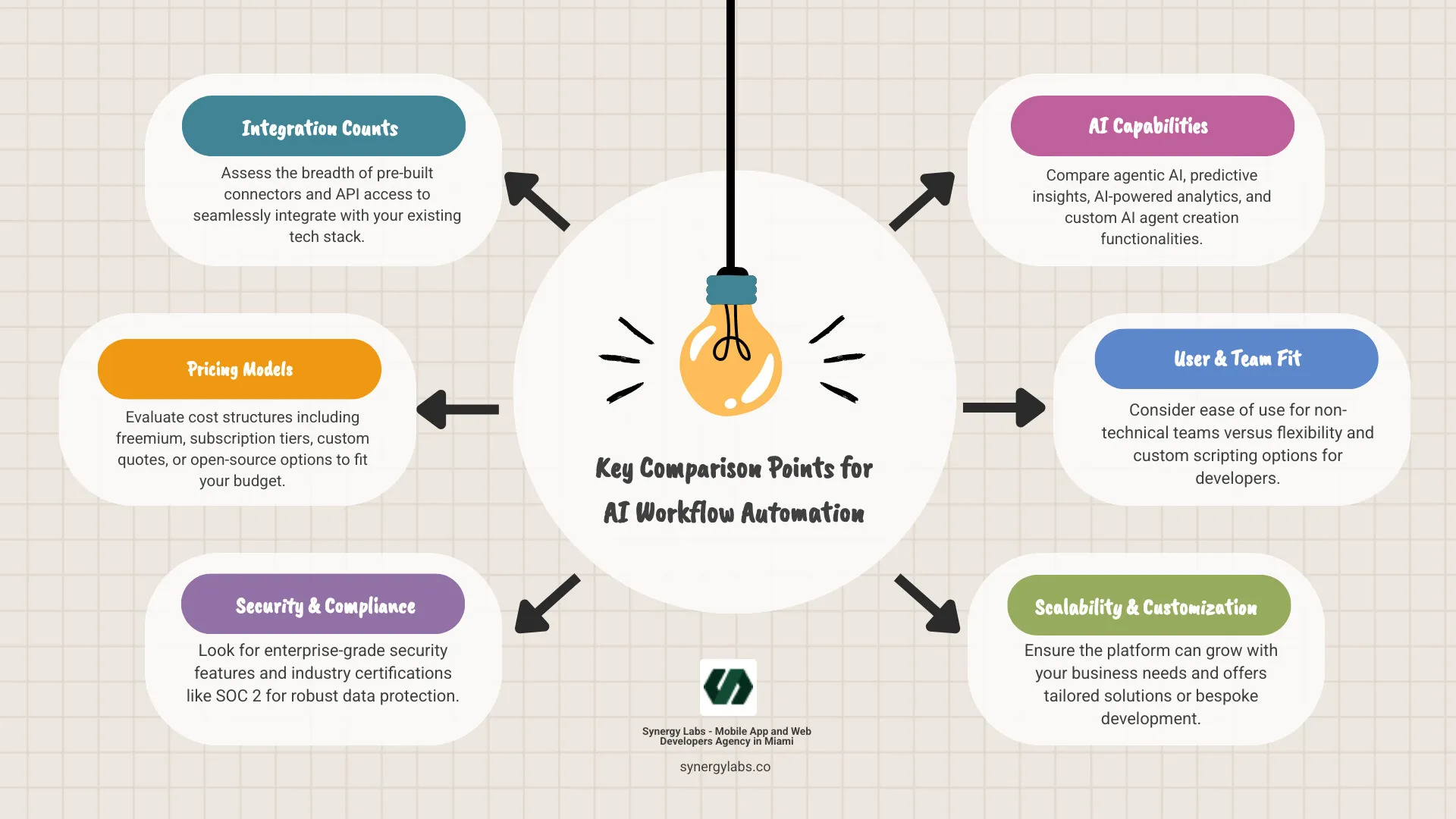
Assess Your Needs and Identify Pain Points: Start by auditing your current workflows. What tasks are repetitive? Where are the bottlenecks? Which departments could benefit most from automation? Pinpointing these specific pain points will narrow down your options significantly. For example, if you need to automate customer outreach, you'll look for different features than if you're automating internal IT processes.
Evaluate Team Skills and Technical Abilities: Consider the technical proficiency of your team. Do you have developers who can leverage custom code, or do you need a strictly no-code, user-friendly interface? Some platforms offer immense power for technical users, while simpler visual tools are more approachable for non-technical teams. Choosing a tool that matches your team's skill set will ensure quicker adoption and greater success.
Consider Your Existing Tech Stack: How well does the alternative integrate with your current software ecosystem? If you're heavily invested in a particular software ecosystem, a solution from that same provider might be a natural fit. If you use a broad range of applications, a tool with a vast integration library will be more effective. Seamless integration is key to avoiding data silos and ensuring smooth operations.
Analyze Pricing Models: AI workflow tools come with diverse pricing structures—some charge per task, others per workflow execution, and some by credits or user seats. Understand the implications of each model for your expected usage. For enterprise solutions, custom quote-based pricing is common. Factor in not just the subscription cost but also potential costs for additional integrations or premium features.
Scalability Planning: Will the tool grow with your business? As your operations expand, your automation needs will become more complex and voluminous. Ensure the chosen alternative can handle increased workloads and offers deployment options (cloud, on-premise) that align with your future growth strategy.
Security and Compliance Requirements: This is non-negotiable, especially for businesses handling sensitive data. Verify that the tool meets industry-specific compliance standards (e.g., HIPAA, GDPR, SOC 2 Type II) and offers robust security features like advanced auditing, secret management, and role-based access controls.
Use Case Specificity: Some tools are generalists, while others excel in niche areas. For instance, project-focused platforms are ideal for PMO teams, while CRM-centric tools focus on sales use cases. Matching the tool to your primary use case will yield the best results.
At Synergy Labs, our AI Infusion Service is designed to help you steer these choices, providing expert guidance to integrate AI into your existing operations effectively and build solutions that truly transform your business.
Future-Proofing Your Operations: Trends in AI Workflow Automation
The world of AI workflow automation isn't standing still; it's evolving at breakneck speed. To truly future-proof your operations, we must look beyond current capabilities and anticipate the trends that will define 2026 and beyond.
Hyperautomation: This isn't just about automating individual tasks; it's about identifying and automating as many business processes as possible using a combination of AI, machine learning, robotic process automation (RPA), and other intelligent technologies. The goal is an end-to-end automation strategy that continuously adapts and optimizes.
Rise of Autonomous AI Agents: As we've seen, AI agents are becoming increasingly sophisticated. By 2026, we'll witness a greater proliferation of truly autonomous agents capable of learning, reasoning, and making decisions without constant human intervention. These agents will handle over 50% of routine business tasks by 2027, freeing up human workers for more strategic initiatives. For a deeper understanding, refer to Agentic AI Explained: From Chatbots to Autonomous AI Agents in 2026.
AI-Native User Experiences: The way we interact with software is changing. Expect more intuitive, conversational interfaces where AI assists users in building workflows, generating content, and analyzing data. This shift towards AI-native UX will make complex automation accessible to even more users.
Vibe Coding Concepts: Popularized as a more intuitive, natural language-driven approach to software development, "vibe coding" describes how AI interprets high-level prompts and generates functional code or applications. This concept will increasingly influence workflow automation tools, making it easier for non-developers to "vibe" their desired automations into existence.
Personalized AI Assistants: Workflow tools will integrate more sophisticated, personalized AI assistants that understand individual user preferences, work styles, and common tasks. These assistants will proactively suggest automations, provide real-time insights, and even anticipate needs, making automation feel less like a tool and more like a dedicated digital colleague.
Proactive Automation: Moving from reactive to proactive, AI will increasingly identify opportunities for automation before problems arise. For instance, an AI might detect a recurring manual task performed by multiple employees and suggest an automated workflow, or predict a potential bottleneck in a supply chain and initiate corrective actions.
These trends highlight a future where AI isn't just a feature but the foundational layer of all workflow automation, driving unprecedented levels of efficiency and innovation across businesses in Miami, London, and globally.
Open up Your Potential with Custom AI Automation
The search for the perfect AI workflow automation tool reveals a crucial truth: the most powerful automation isn't about finding a tool that fits most of your needs, but building a solution that fits all of them perfectly. While off-the-shelf platforms offer a great starting point, a custom-built AI workflow is your ultimate competitive edge.
Ready to stop compromising and start optimizing? Partner with Synergy Labs to build a bespoke AI automation engine for your business. We deliver on a fixed budget with milestone-based payments, combining an expert in-shore CTO with a world-class offshore development team to ensure your project is a resounding success. Explore our AI development services today!


.avif)

.avif)


