Is Your Infrastructure Ready for Cloud Based Enterprise Apps?
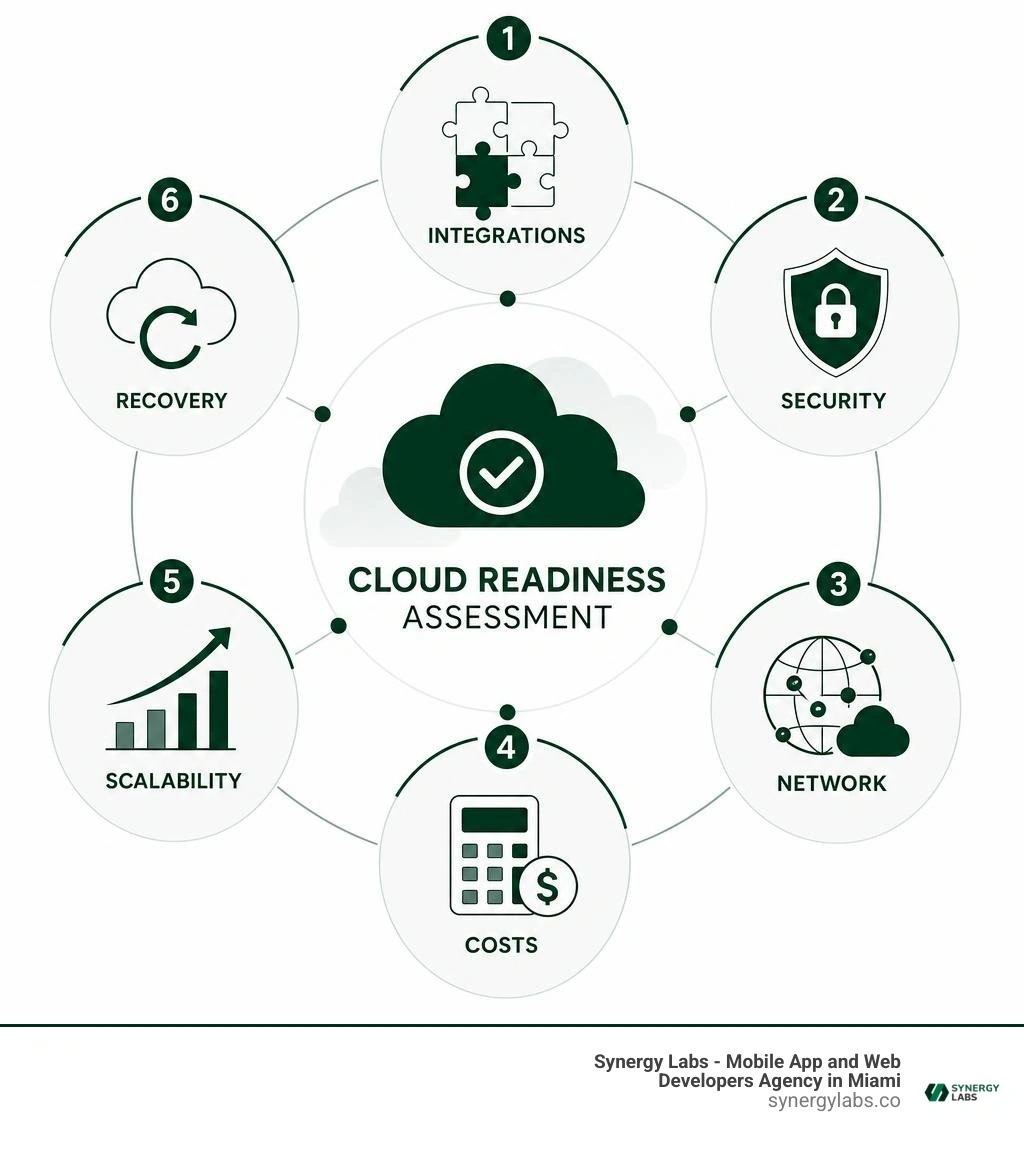
Cloud based enterprise apps run business functions such as customer management, finance, HR, analytics, and project delivery on internet-connected cloud infrastructure rather than servers your team owns and maintains onsite. To prepare for them, first assess your integrations, data controls, network reliability, security roles, and cost model. Then move workloads in phases, starting with a lower-risk app or service.
The payoff can be meaningful: faster releases, easier scaling during demand spikes, and less time spent maintaining hardware. But cloud is not a magic fog machine. A weak API layer, unclear data ownership, or unmanaged usage can turn a fast migration into an expensive rebuild.
Your core infrastructure is ready when it can securely connect systems, govern sensitive data, monitor performance, and recover from failures without relying on one vendor or one fragile server room. For many startups, a hybrid approach is the practical first step: keep tightly controlled workloads where they belong while moving scalable customer-facing services to the cloud. For a broader view of how cloud computing fits into modern IT, see cloud computing.
As Director of Product at Synergy Labs, I help teams turn these readiness checks into practical architecture and development decisions.
Cloud based enterprise apps glossary:
Architecture and Deployment: What Defines Cloud Based Enterprise Apps?

At their core, cloud based enterprise apps are software systems engineered to run across distributed, virtualized IT resources accessed via secure networks. Unlike traditional desktop or legacy client-server software that lives inside an isolated on-premises machine room, modern cloud architectures rely on a pool of dynamic compute, network, and storage capacity that can grow or shrink within minutes.
When we evaluate software through our enterprise applications framework, the core architectural differentiator is workload elasticity combined with multi-tenant efficiency. Multi-tenant architecture allows multiple business units or client organizations to securely share underlying compute and database layers while maintaining complete logical data isolation.
This architectural shift underpins pay-per-use economics. Instead of provisioning hardware for maximum hypothetical peak traffic that sits idle 95% of the year, enterprises consume and pay for compute resources dynamically. Global cloud spending is projected to reach $824 billion in 2026, driven directly by organizations replacing fixed capital assets with elastic cloud services.
Deployment Models: Public, Private, Hybrid, and Multi-Cloud
Choosing how to deploy enterprise cloud software requires balancing security controls, latency requirements, regulatory compliance, and cost.
- Public Cloud: Services run on shared physical infrastructure managed by global hyperscalers. Public cloud offers near-infinite scalability, rapid regional deployment, and hands-off hardware maintenance. It is ideal for customer-facing web apps, mobile backends, and high-volume data analytics.
- Private Cloud: Dedicated infrastructure provisioned exclusively for a single enterprise, hosted either in-house or by a specialized managed provider. Private clouds provide deep hardware-level data isolation and governance for organizations operating under strict regulatory mandates.
- Hybrid Cloud: Combines public and private environments, orchestrating data and applications between them. A hybrid model lets you retain sensitive records or proprietary core databases on-premises while bursting compute-heavy workloads or deploying employee-facing interfaces to the public cloud.
- Multi-Cloud: Distributes enterprise services across multiple independent cloud providers. This model prevents single-vendor dependency, optimizes latency by using local data centers, and ensures high availability if an outage strikes one provider.
Service Models Across the Stack: IaaS, PaaS, and SaaS
Understanding where vendor responsibility ends and your internal engineering control begins is critical when designing your stack.
- Infrastructure-as-a-Service (IaaS): Delivers raw virtualized compute, storage, and networking. Your engineering team manages the operating systems, runtimes, middleware, and application code.
- Platform-as-a-Service (PaaS): Provides managed runtimes, automated scaling frameworks, and database engines. Developers deploy application code without managing underlying virtual machine patches or hardware clustering.
- Software-as-a-Service (SaaS): Delivers complete, turnkey applications accessed via web browsers or native mobile interfaces. The provider handles everything from server maintenance and database indexing to application features and uptime SLAs.
When building enterprise applications, many teams leverage PaaS container orchestration platforms such as managed Kubernetes alongside secure API gateways. This combination gives you the agility to build custom microservices while eliminating the operational overhead of physical server maintenance.
Strategic Evaluation: Cloud vs. On-Premises Infrastructure
Transitioning from on-premises hardware to cloud infrastructure represents a fundamental shift from Capital Expenditure (CAPEX) to Operational Expenditure (OPEX). On-premises data centers demand significant upfront capital for server racks, networking switches, cooling, physical security, and periodic 3-to-5-year hardware refresh cycles.
In contrast, cloud infrastructure converts fixed overhead into variable monthly operational costs. However, moving to the cloud without assessing your technical debt can backfire. If your team migrates poorly optimized legacy software without refactoring, you risk paying continuous cloud consumption premiums on inefficient code.
Evaluating the true ROI of enterprise app development requires weighing infrastructure agility against network bandwidth costs and long-term licensing fees.
Assessing Infrastructure Readiness for Cloud Based Enterprise Apps
Before migrating mission-critical systems, your engineering leadership should conduct a thorough infrastructure readiness audit across three main areas:
- Legacy Application Discovery & Dependency Mapping: Identify interdependencies between internal services, database clusters, and third-party tools to prevent broken workflows during migration.
- API Readiness and Integration Architecture: Evaluate whether your current applications expose modern RESTful or GraphQL endpoints, or if they rely on brittle direct database connections.
- Network Bandwidth and Latency Testing: Cloud applications require reliable, high-throughput network connectivity. Conduct stress tests on your local networks to confirm they can handle continuous bidirectional data syncs.
Our team frequently guides engineering leaders through comprehensive enterprise app development strategies that pinpoint integration bottlenecks before writing a single line of production code.
Compliance, Data Governance, and TCO Analysis
Data governance is often the deciding factor in how cloud infrastructure is architected. Highly regulated industries must adhere to rigorous frameworks like HIPAA, GDPR, SOC 2 Type II, and regional data residency laws. If your business operates internationally, you must ensure that customer data remains within authorized geographic borders.
Total Cost of Ownership (TCO) analysis must account for:
- Egress Bandwidth Costs: Public cloud providers often charge for moving data out of their networks. High-volume data transfers can cause unexpected bill spikes if not monitored closely.
- FinOps Governance: Implement real-time monitoring tools to identify unused virtual machines, unattached storage volumes, and over-provisioned database instances.
- Internal Staffing and Training: Account for the operational investment needed to train system administrators in cloud-native security, container management, and continuous integration pipelines.
Key Benefits and Technical Risks of Modern Cloud Infrastructure

Modernizing your infrastructure unlocks substantial performance and productivity gains. Enterprise data shows that adopting cloud solutions can accelerate project delivery timelines by up to 35% compared to on-premises deployments. Furthermore, organizations using optimized cloud platforms achieve up to 78% faster execution of business changes and a 43% faster time to market for new digital products.
Scalability, Elasticity, and Accelerated Delivery Timelines
Cloud environments provide horizontal and vertical autoscaling. When customer traffic spikes, automated policies spin up additional container instances to absorb the load seamlessly. When traffic drops, resources scale down automatically, preventing wasted spend.
Combined with automated disaster recovery and high-availability multi-region clusters, cloud-native apps dramatically reduce business disruption. Development teams can implement automated CI/CD deployment pipelines that push bug fixes and new features in minutes rather than scheduling risky, midnight maintenance windows. This agility is a cornerstone of modern digital transformation.
Mitigating Downtime, Vendor Lock-in, and Security Vulnerabilities
Despite its advantages, cloud computing carries operational risks that require active mitigation. Industry research reveals that combined downtime across major cloud service providers has totaled 568 hours, generating an estimated economic impact on customers exceeding $71.7 million. Relying blindly on vendor uptime without independent failover mechanisms can leave your business vulnerable.
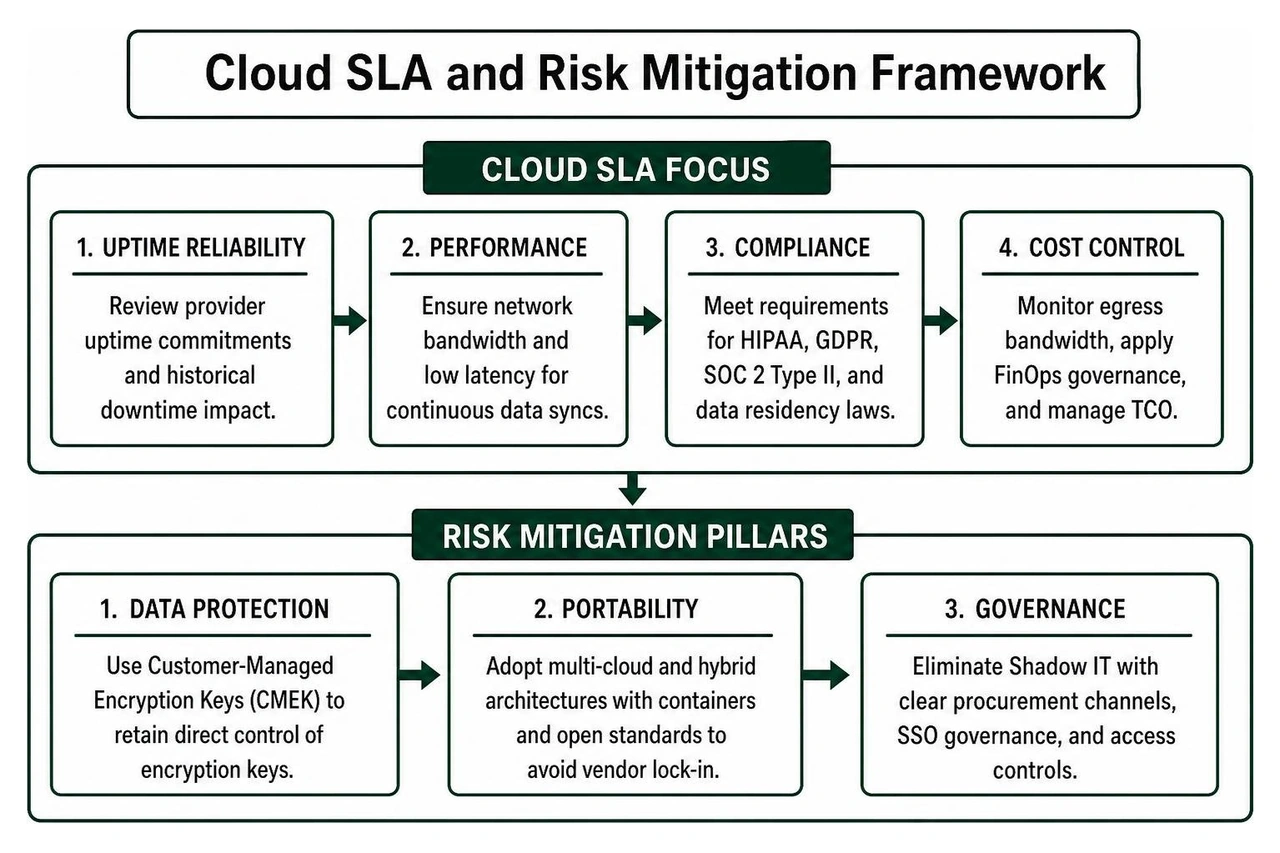
To protect your core operations, ensure your cloud strategy addresses the following factors:
- Customer-Managed Encryption Keys (CMEK): Retain direct ownership and control over your data encryption keys rather than relying solely on provider-managed defaults.
- Multi-Cloud and Hybrid Portability: Build services using containerized, open-standard architectures to prevent vendor lock-in and simplify moving workloads between environments.
- Shadow IT Elimination: Establish clear internal procurement channels and single sign-on (SSO) governance to prevent team members from spinning up unauthorized, unmonitored SaaS subscriptions.
- Contractual SLA Negotiation: Ensure vendor Service Level Agreements include clear financial remedies, robust uptime guarantees (e.g., 99.99%), and strict security breach notification timelines.
Modernizing the Tech Stack: Integrating AI and Next-Gen Capabilities
The enterprise software landscape has evolved beyond basic data collection forms and static reporting dashboards. In 2026, leading organizations build their applications on AI-native architectures featuring unified data models, event-driven microservices, and real-time streaming pipelines.
While rapid prototyping tools are useful, understanding why no-code alone isn't enough for enterprise applications is essential for long-term scalability. Enterprise systems require granular role-based permissions, custom business logic, resilient database indexing, and deep system integrations that generic platforms cannot provide.
Embedding Agentic AI and Intelligent Workflows in Cloud Based Enterprise Apps
Modern cloud ecosystems allow organizations to embed specialized AI agents directly into operational workflows. Rather than simply responding to static search queries, autonomous enterprise agents monitor real-time transaction streams, detect anomalous supply chain disruptions, draft contextual customer responses, and automate complex reconciliations.
Modern enterprise AI platforms illustrate how organizations combine large language models with enterprise data lakes. By integrating custom AI capabilities with your internal databases, your team can turn passive documentation into actionable, automated decision-making engines.
Leading Enterprise Application Categories: ERP, CRM, and HRM
Enterprises rely on interconnected cloud application suites to run their core operations:
- Enterprise Resource Planning (ERP): Cloud ERP solutions unify finance, procurement, manufacturing, and inventory tracking into a single data model, eliminating operational silos.
- Customer Relationship Management (CRM): Cloud CRM platforms coordinate sales pipelines, marketing automation, and customer support history across distributed teams in real time.
- Human Resource Management (HRM): Modern HR suites streamline talent acquisition, employee onboarding, benefits administration, and performance reviews.
Connecting these systems with responsive enterprise mobility solutions ensures that field agents, floor managers, and executives have access to critical data from any device, anywhere.
Practical Roadmap: Vendor Selection, Migration, and Governance
The global cloud managed services market is projected to reach $305.16 billion by 2030, underscoring the growing reliance on specialized engineering partners to navigate infrastructure transitions. A successful migration requires a structured, multi-phase roadmap.
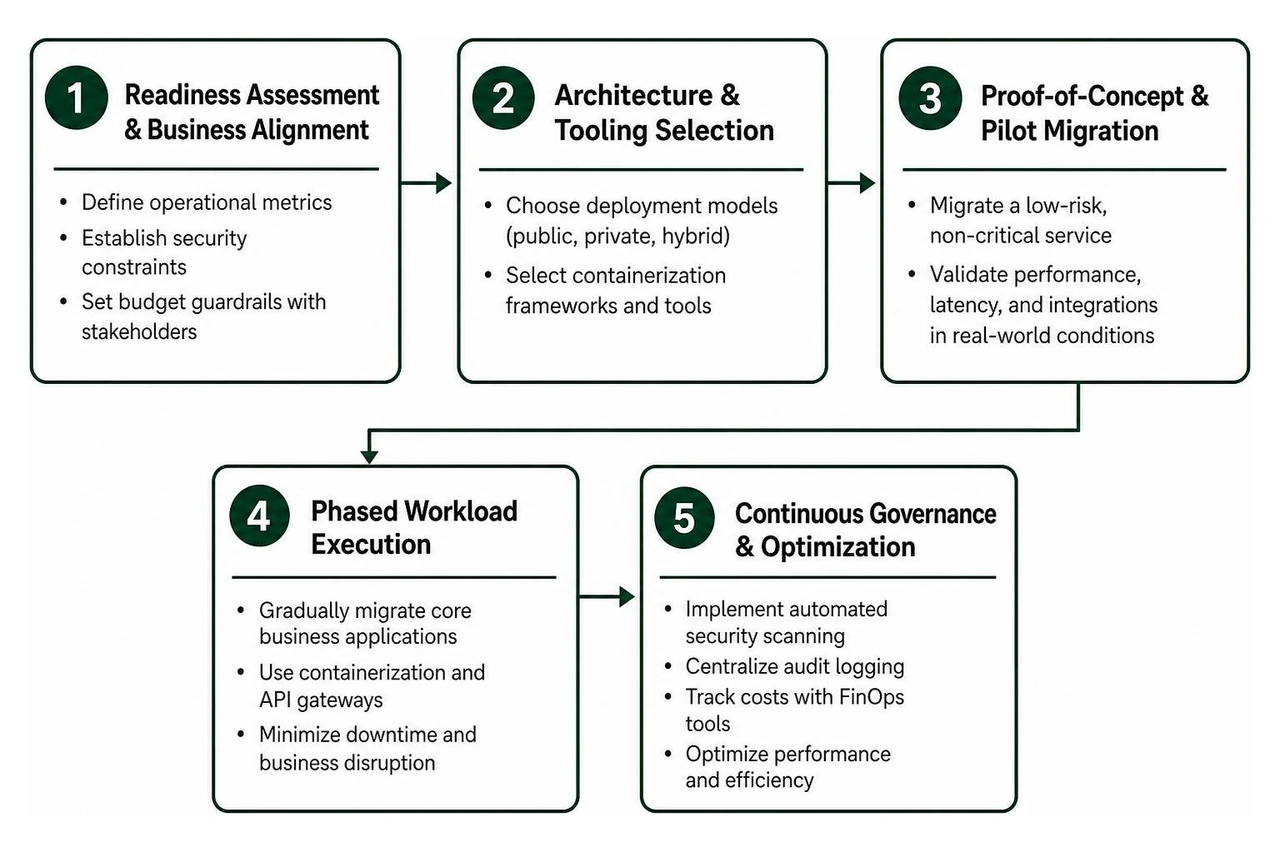
- Readiness Assessment & Business Alignment: Define clear operational metrics, security constraints, and budget guardrails with all key business stakeholders.
- Architecture & Tooling Selection: Choose the appropriate deployment models (public, private, hybrid) and containerization frameworks that fit your technical goals.
- Proof-of-Concept & Pilot Migration: Migrate a low-risk, non-critical service first to validate performance, latency, and integration points under real-world conditions.
- Phased Workload Execution: Gradually migrate core business applications using containerization and API gateways to minimize downtime.
- Continuous Governance & Optimization: Implement automated security scanning, centralized audit logging, and FinOps cost-tracking tools to maintain peak performance.
Frequently Asked Questions About Cloud Enterprise Migration
How does total cost of ownership differ between cloud and on-premise apps?
On-premise deployments require heavy upfront capital expenditures for physical servers, storage arrays, networking hardware, and facility cooling, alongside recurring maintenance and dedicated on-site IT support.
Cloud deployments convert these costs into predictable, subscription-based operational expenses. While cloud eliminates hardware replacement cycles, total cost of ownership depends on disciplined FinOps governance to monitor data egress charges, prevent unbudgeted service sprawl, and right-size compute instances.
What are the biggest security risks when transitioning to enterprise cloud solutions?
The most common security risks stem from misconfigured access permissions, unmanaged API endpoints, and a misunderstanding of the cloud shared responsibility model.
While the cloud provider manages physical hardware and data center security, your organization remains responsible for data classification, user identity management, and application-level access controls. Implementing multi-factor authentication, role-based access control, and customer-managed encryption keys effectively mitigates these risks.
How long does an enterprise-grade cloud application migration take?
Migration timelines vary based on application complexity and architecture:
- Modular SaaS Deployments: Simple rollouts of standardized cloud software can take between 6 to 12 weeks.
- Complex Legacy Migrations: Refactoring monolithic legacy software into cloud-native microservices typically requires 6 to 9 months of phased planning, data migration, security validation, and pilot testing.
Future-Proofing Your Enterprise: Build Scalable Cloud Systems with Synergy Labs
Transitioning your core operations to the cloud is no longer just an infrastructure upgrade—it is a strategic requirement for long-term business agility. A well-architected cloud infrastructure empowers your organization to scale effortlessly during demand surges, deploy AI-driven automations, and roll out new digital products months ahead of competitors.
At Synergy Labs, we partner directly with ambitious startups and enterprise leaders to architect, build, and scale world-class digital products. We eliminate the friction and uncertainty of complex software projects through our proven delivery model:
- Personalized Senior Leadership: You work directly with an in-shore CTO who guides your technical strategy and architecture from day one.
- High-Velocity Engineering: Our elite offshore development teams deliver rapid sprint cycles without sacrificing code quality or security standards.
- Fixed-Budget Transparency: We operate on transparent, milestone-based payments and fixed budgets, ensuring your projects are delivered on time, within scope, and without surprise overages.
Whether you are modernizing legacy backends or building next-generation web and mobile platforms from the ground up, explore our tailored app development services or connect with our team at Synergy Labs today to turn your cloud vision into scalable software.


.avif)

.avif)


