Enterprise applications connect finance, sales, ops, and HR into one consistent data flow — and for fast-growing startups, getting that architecture right early beats fixing a spreadsheet habit later.
What Are Enterprise Applications and How Do They Power Global Business?
#
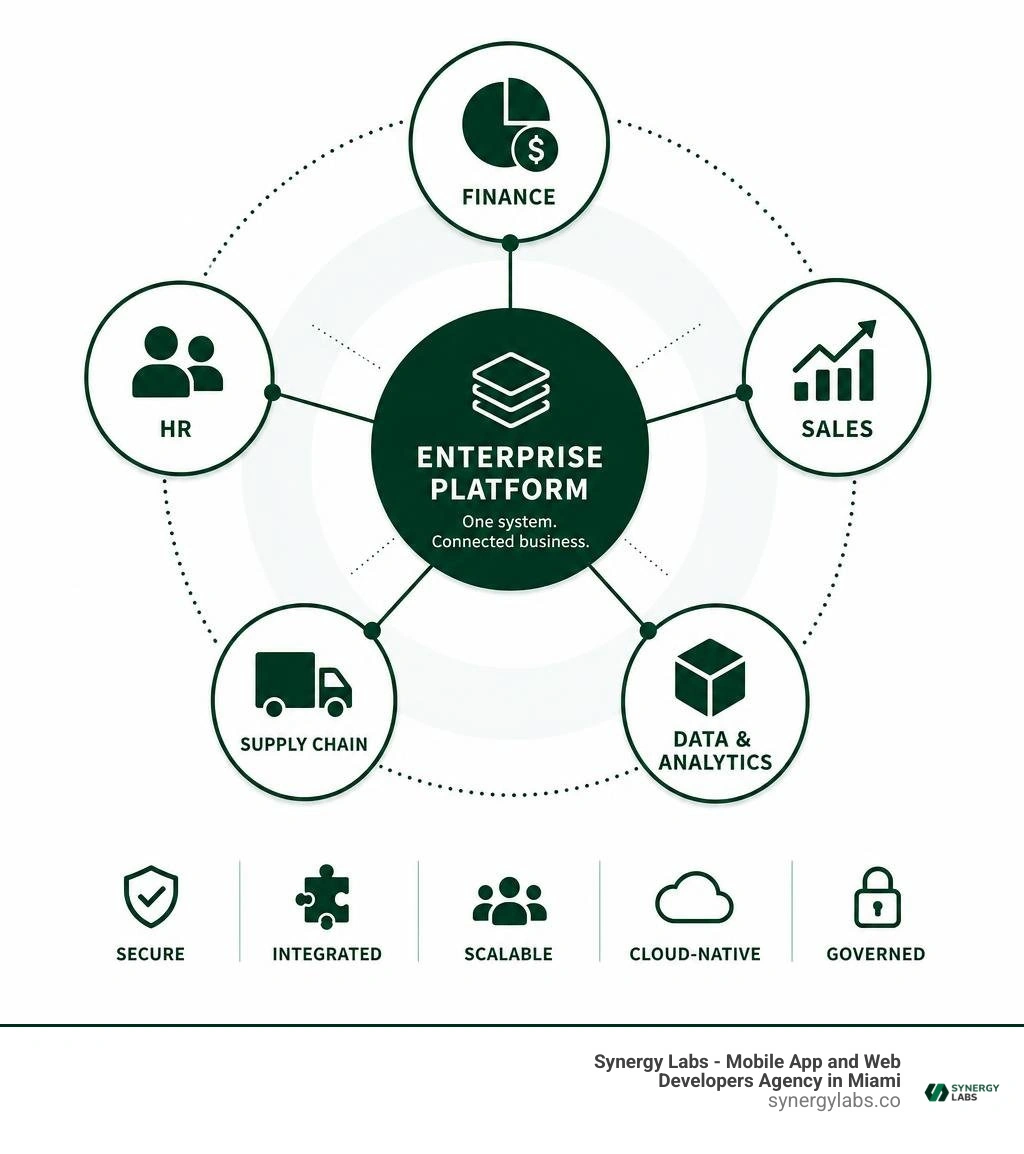
Enterprise applications are large-scale software systems that connect people, data, and workflows across an organization. They help finance, sales, operations, HR, and supply chain teams work from consistent information instead of juggling disconnected spreadsheets and one-off tools.
In practical terms, an order entered by sales can update inventory, production plans, invoices, and delivery schedules with far less manual work. That shared flow of data is why these systems sit behind many mission-critical businesses.
Modern enterprise applications include platforms for enterprise resource planning (ERP), customer relationship management (CRM), supply chain management (SCM), human capital management (HCM), analytics, billing, and collaboration. They are built for high user volumes, complex permissions, deep integrations, security controls, and growth.
For a startup, the lesson is simple: build systems that can connect and scale early, before a fast-growing product turns into a very expensive spreadsheet habit.
As Director of Product at Synergy Labs, I help teams turn complex business workflows into secure, scalable web and mobile products.
Enterprise applications represent the connective tissue of modern business operations. At their foundation, these solutions are multi-layered software architectures designed to ingest, process, store, and distribute data across different operational business units simultaneously. Rather than operating in isolation, they orchestrate complex interactions between sales, inventory, accounting, legal, and fulfillment.
A critical distinction exists between standard business applications and true Enterprise Application Software (EAS). Standard business apps are typically departmental point solutions designed to address isolated challenges, such as a localized task tracker or a single-department spreadsheet repository. While simple to deploy, they naturally introduce data silos. EAS, by contrast, operates across the entire organizational footprint, enforcing unified data governance, strict audit trails, granular role-based permissions, and massive transaction processing capabilities.
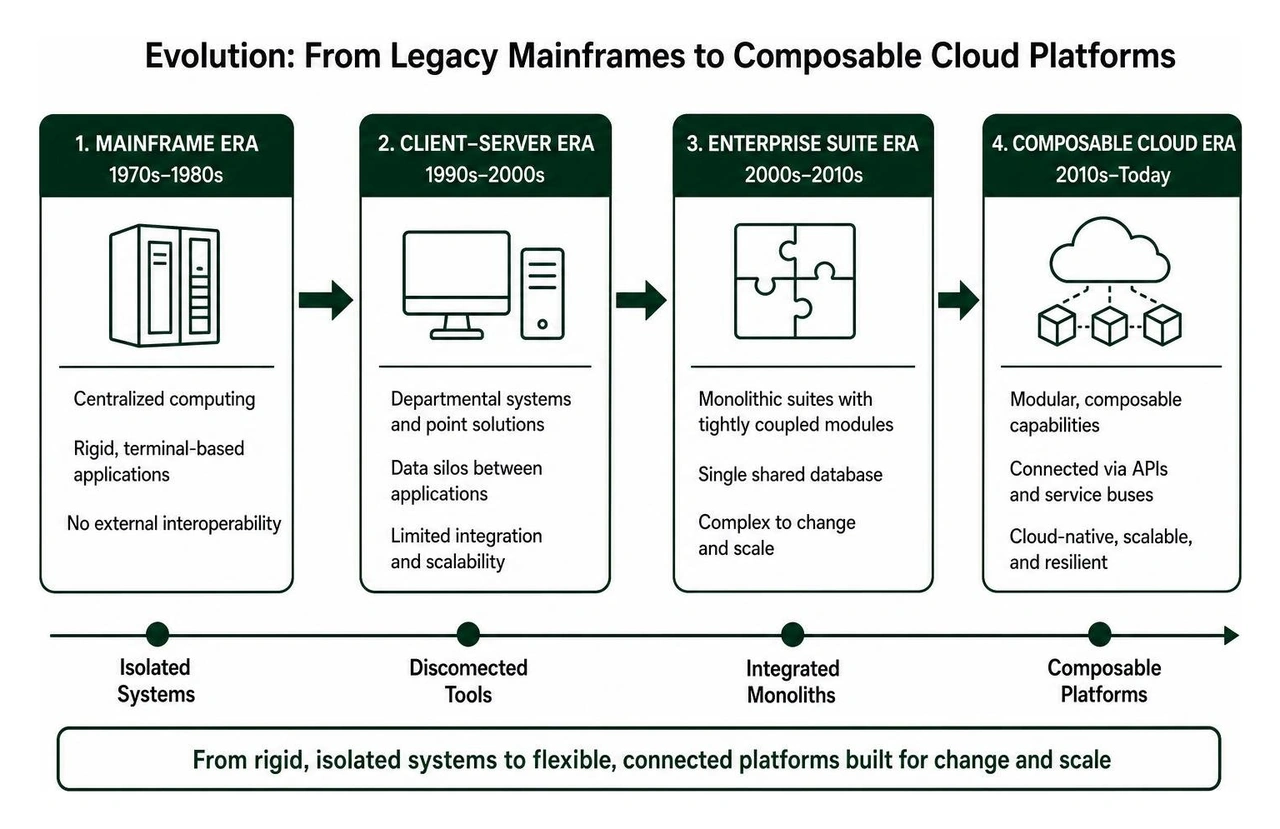
Historically, organizations deployed massive, monolithic systems where every module was tightly coupled to a single shared database. While this provided a unified source of truth, it created boundless architectural complexity: making a minor update to an invoicing rule could inadvertently disrupt warehouse shipping queues.
Today, enterprise architecture has shifted toward modular, composable architectures. In a composable model, business capabilities are treated as independent, swappable components connected via robust APIs and enterprise service buses. This approach allows global enterprises to handle millions of concurrent transactions without risking widespread system downtime. For a deeper breakdown of structural design patterns, our Enterprise App Development Complete Guide 2026 covers modern architectural paradigms in detail.
Evolution from Legacy Systems to Cloud Platforms
The journey of enterprise software spans several distinct technological eras:
The Mainframe Era (1970s–1980s): Centralized computing power running rigid, terminal-based applications with virtually no external interoperability.
Client-Server Systems (1990s–2000s): On-premises desktop clients connected to local database servers, introducing graphical interfaces but requiring painful, localized upgrade cycles.
Cloud SaaS and Hybrid Deployments (2010s–Present): Multi-tenant cloud ecosystems, real-time data streaming, and web/mobile access layers that deliver continuous updates without operational interruption.
Modern cloud platforms have fundamentally transformed total cost of ownership and operational scalability. Industry data demonstrates that major cloud providers now support unprecedented compute capacity, with AWS holding an impressive 28% market share in cloud computing. Enterprise leaders no longer manage physical server racks just to process month-end financial reconciliations; instead, they rely on flexible cloud infrastructure backed by comprehensive Oracle E-Business Suite Applications and managed services to support distributed workforces across international borders.
Custom Development vs. Off-the-Shelf Software
When modernizing operations, corporate leadership inevitably faces the classic "build vs. buy" dilemma:
Commercial Off-the-Shelf (COTS) Platforms: Ideal for standardized business functions that do not provide a competitive differentiator, such as standard general ledger accounting or basic payroll processing. They offer rapid initial deployment but can become prohibitively expensive as licensing scales.
Custom Bespoke Solutions: Essential when an organization runs proprietary workflows, unique customer engagement models, or specialized algorithms that represent a true market advantage. Custom development provides complete ownership over data, user experience, and architectural roadmap.
While low-code platforms have gained popularity for basic internal utilities, high-volume transactional systems demand dedicated engineering. We explore this boundary extensively in our analysis on Why No-Code Alone Isn't Enough for Enterprise Applications, highlighting why mission-critical security and high concurrency require robust, production-grade codebases.
Core Categories and Architecture of Enterprise Systems
Core Functional Categories of Enterprise Applications
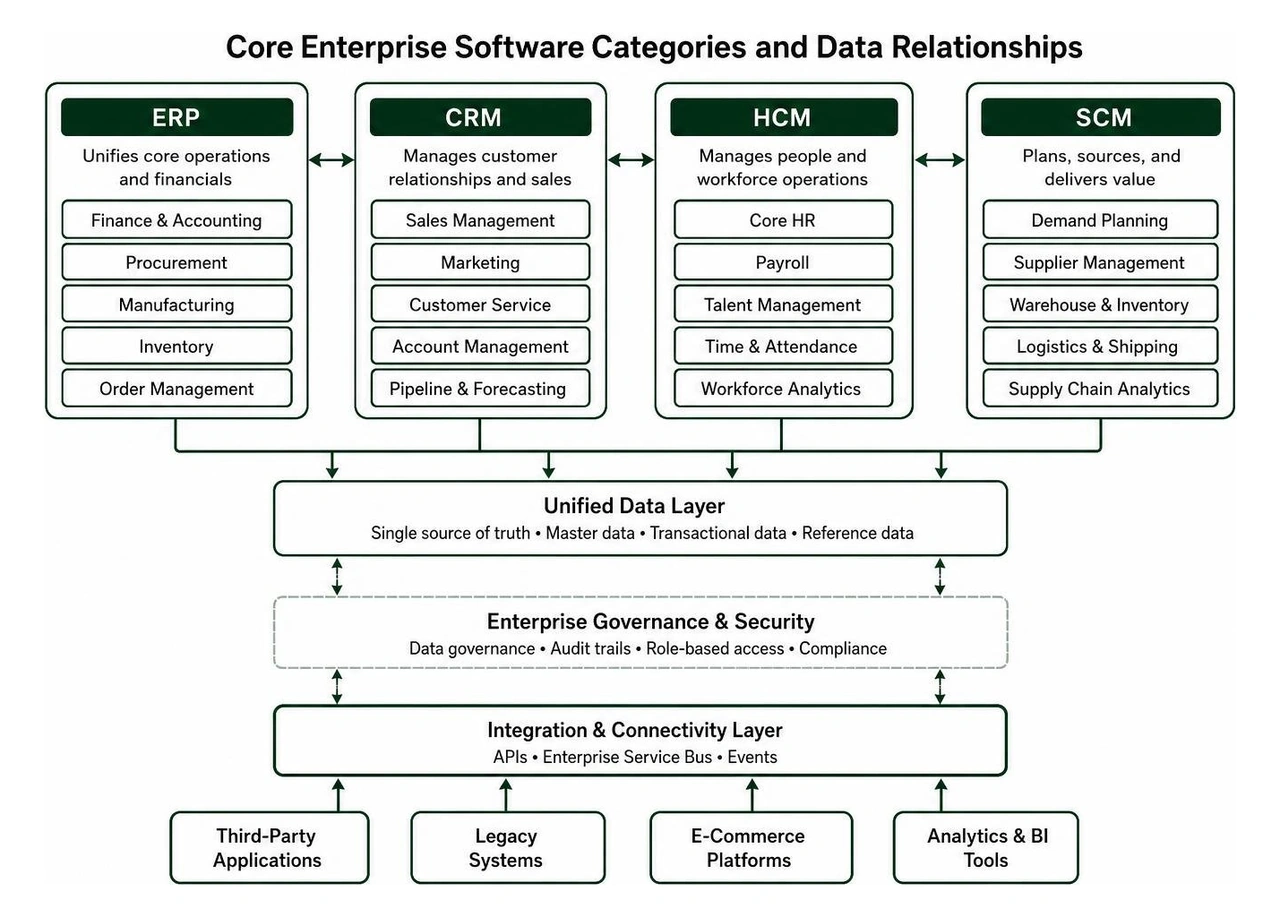
Enterprise software ecosystems are typically anchored by four major operational pillars:
Enterprise Resource Planning (ERP): Often called the operational central nervous system, an ERP unifies financial accounting, procurement, manufacturing, and order management into a single relational ecosystem. Modern architectures support multi-entity accounting, automated intercompany eliminations, and global inventory coordination, as seen in modern ERP Powered by AI platforms.
Customer Relationship Management (CRM): Connects marketing lead capture, sales pipelines, client communication logs, and customer support ticketing into an auditable record of client lifecycle interactions.
Supply Chain Management (SCM): Manages end-to-end logistics, supplier vendor scorecards, freight tracking, demand forecasting, and inventory optimization across multi-site distribution networks.
Human Capital Management (HCM): Oversees recruitment, employee onboarding, benefits administration, continuous performance tracking, and regulatory labor compliance. With the HR technology market expected to reach a value of almost $78 billion by 2031, organizations are heavily investing in systems that streamline talent retention and workforce analytics.
Specialized and Departmental Business Platforms
Surrounding these core pillars are specialized departmental engines that automate targeted operational workflows:
Business Intelligence (BI) & Analytics: Data lakes and aggregation tools that transform raw transactional logs into executive forecasting dashboards.
Learning Management Systems (LMS): Centralized training platforms that automate corporate certifications, compliance testing, and employee skill development.
Automated Billing & Revenue Recognition: Specialized financial engines that manage recurring subscriptions, multi-currency invoicing, and complex revenue deferral rules in compliance with ASC 606 and IFRS 15 standards.
Enterprise Content Management (ECM): Secure repositories governing contract lifecycles, digital asset storage, and version-controlled corporate documentation.
Building intuitive, high-performance interfaces for these complex systems is vital for user adoption. Utilizing modern component-driven frontends is key to maintaining speed across massive datasets; learn more about structuring scalable interfaces in our guide on React for Enterprise Applications.
Strategic Benefits and Measurable Business Impact
Implementing enterprise applications delivers measurable operational and financial returns when executed with clear business alignment:
Drastic Error Reduction: Automating data transmission between departments eliminates repetitive, manual data entry. When an inventory item is checked into a warehouse terminal, financial balance sheets and sales catalogs update instantly.
Accelerated Financial Closing Cycles: Multi-entity enterprises often reduce their monthly accounting close from weeks to days by automating intercompany reconciliation and currency conversions.
Optimized Working Capital: End-to-end supply chain visibility prevents over-purchasing, reduces warehouse holding costs, and flags supplier delivery delays before they impact customer fulfillment.
Audit Readiness and Regulatory Compliance: Automated audit logs record every database modification, user approval, and permission change, substantially lowering the cost of regulatory audits.
Scaling Operations and Driving Digital Transformation
As businesses expand across regions, their underlying infrastructure must accommodate exponential increases in data volume and transaction throughput without latency spikes. Scalable enterprise solutions leverage event-driven microservices to process orders, track inventory movements, and update ledgers asynchronously.
Furthermore, modern field operations require real-time connectivity outside traditional corporate offices. Whether equipping warehouse personnel with digital barcode scanning or arming field technicians with mobile dispatch tools, organizations rely on Enterprise Mobile App Development: Scaling Solutions for Large Organizations to extend core enterprise workflows to the frontline.
Embedded AI and Agentic Automation
The latest frontier in enterprise technology centers on embedded artificial intelligence and agentic workflows. Rather than functioning as passive record repositories, modern systems leverage AI agents to actively execute multi-step operational tasks:
Intelligent Document Processing: Automatically reading, verifying, and matching incoming vendor invoices against purchase orders and shipping receipts.
Predictive Pipeline Forecasting: Analyzing historical CRM interaction patterns to alert account executives of deal risks or upsell opportunities.
Proactive Anomaly Detection: Identifying fraudulent procurement patterns or operational bottlenecks across global production lines before they cascade.
Advanced enterprise suites such as the Gemini Enterprise app: Best of Google AI for Business demonstrate how natural language agents grounded in internal business data allow employees to synthesize complex documentation, generate reports, and automate cross-application workflows securely.
Overcoming Integration, Security, and Governance Challenges
Despite the profound benefits, enterprise software initiatives face common implementation hurdles:
Legacy Data Fragmentation: Decades of unstructured data across disparate systems require rigorous data profiling, cleansing, and normalization before migration.
Cultural Resistance and Change Management: Employees accustomed to legacy routines often push back against modern software. Successful rollouts require executive sponsorship, continuous training, and user-friendly interface designs.
Customization Scope Creep: Attempting to customize every minor feature to replicate obsolete legacy processes can balloon budgets and complicate future upgrades.
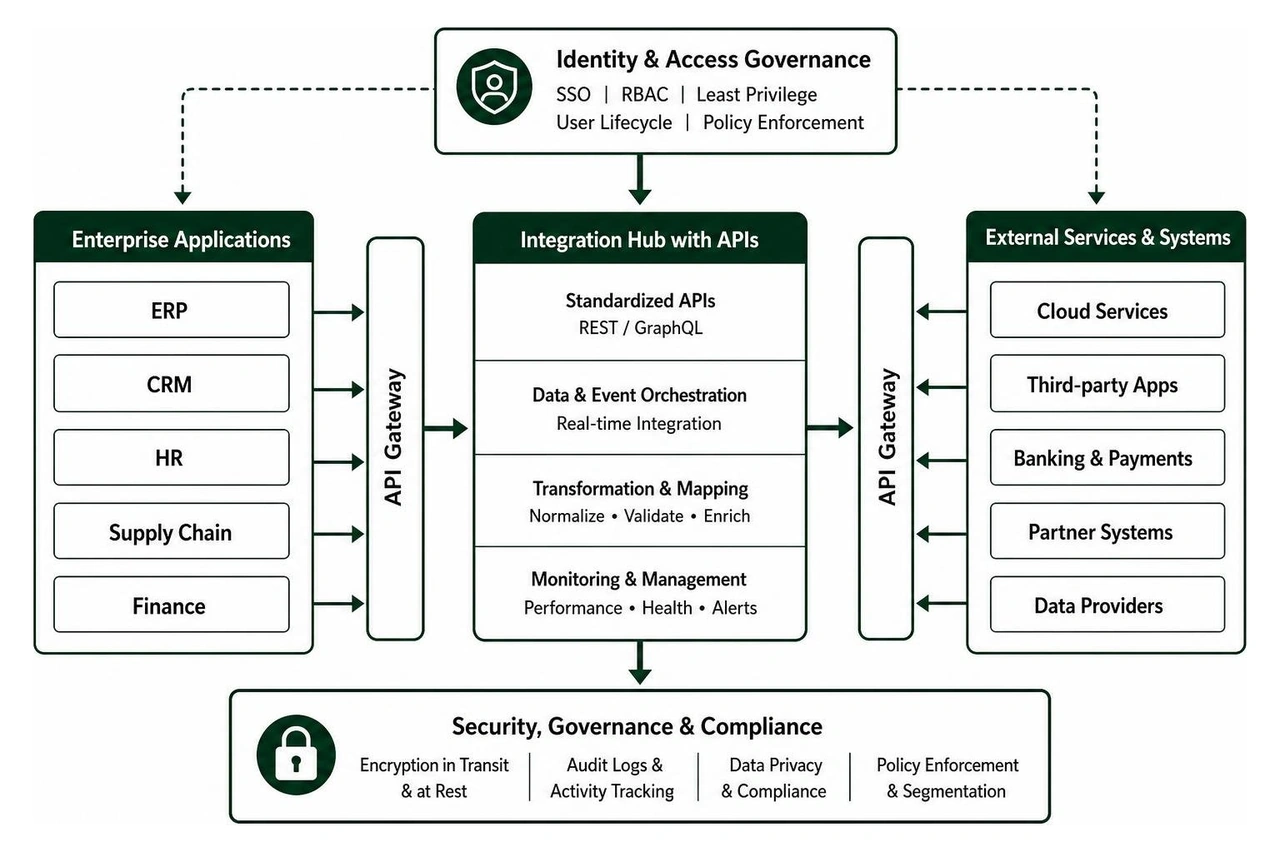
RESTful & GraphQL APIs: Standardized communication layers allowing disparate web, mobile, and backend services to exchange data securely.
Publish-Subscribe Event Streaming: Message brokers (such as Apache Kafka or RabbitMQ) that broadcast transactional events across multiple consumer systems in real time.
Zero-Trust Security Architecture: Enforcing continuous authentication, granular Role-Based Access Control (RBAC), and encryption both in transit (TLS 1.3) and at rest (AES-256).
Managing Cloud Identity and Governance in IT Environments
In enterprise IT ecosystems, centralized identity governance is non-negotiable. IT administrators utilize platforms like Microsoft Entra ID (formerly Azure Active Directory) to manage application registrations, enforce Single Sign-On (SSO), and automate provisioning lifecycles.
Key administrative practices include:
Federated Authentication: Implementing SAML 2.0 or OpenID Connect (OIDC) protocols so employees access all enterprise systems using a single secure corporate identity.
Automated Provisioning via SCIM: Automatically provisioning and de-provisioning user accounts as employees join, change roles, or depart the company.
Programmatic Lifecycle Management: Using tools like the Microsoft Graph API to programmatically instantiate and configure applications across enterprise tenants.
Tenant Hygiene: Periodically auditing and removing unused enterprise application registrations, external guest permissions, and test environments to minimize corporate attack surfaces.
Frequently Asked Questions About Enterprise Applications
What is the difference between enterprise applications and standard business software?
Enterprise applications serve the operational requirements of an entire organization across multiple departments, locations, and user tiers. They feature deep cross-system integration, high transaction scalability, granular permission controls, and strict compliance tracking. Standard business software typically focuses on a single task or departmental function with limited integration capabilities.
What are the essential security requirements for modern EAS?
Modern EAS requires end-to-end data encryption (in transit and at rest), Customer-Managed Encryption Keys (CMEK), multi-factor authentication (MFA), role-based access control (RBAC), immutable audit logging, and compliance with standards such as SOC 2, HIPAA, GDPR, or ISO 27001.
How do organizations manage enterprise app lifecycles and integration?
Organizations manage enterprise lifecycles using API gateways, enterprise service buses (ESB), automated CI/CD deployment pipelines, and centralized cloud identity directories. This allows IT teams to monitor performance, push updates safely, and govern user access without disrupting day-to-day operations.
Building the Future of Enterprise Software with Synergy Labs
Modern enterprise applications are the technological engines that keep global trade, logistics, healthcare, and finance moving forward. As legacy architectures reach their limits, forward-thinking organizations are transitioning away from brittle, monolithic software in favor of secure, scalable, and beautifully designed web and mobile platforms.
At Synergy Labs, we specialize in translating complex operational workflows into high-performance digital products. Our proven delivery framework pairs an in-shore CTO with an elite offshore development team, giving you direct access to senior technical leadership while optimizing development velocity. With our predictable, fixed-budget model and milestone-based payments, we ensure your mission-critical enterprise systems are delivered efficiently, on time, and without unexpected financial surprises.
Ready to modernize your business operations and build software designed to scale? Explore our custom App Development Services or contact our team today to begin planning your next-generation enterprise application.




.avif)

.avif)


