A 10-second Sora 2 Pro clip at 1080p costs $7 — and with the API sunsetting in September 2026, founders building video features need a cost and migration plan now.
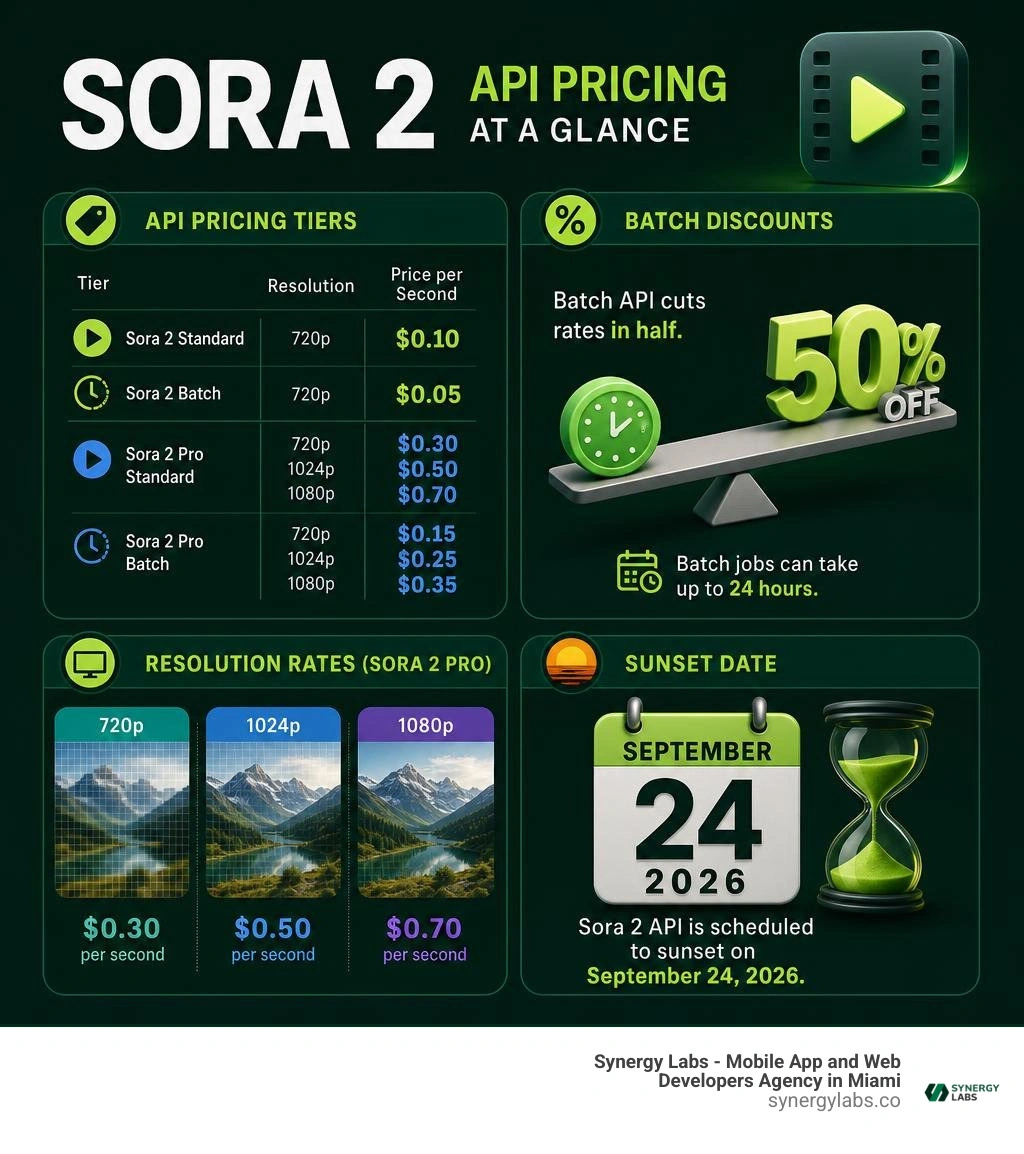
Sora 2 pricing starts at $0.10 per second for standard 720p video on the OpenAI API. Sora 2 Pro costs more, from $0.30 per second at 720p to $0.70 per second at 1080p. The Batch API cuts those rates in half, but jobs can take up to 24 hours.
Sora 2 Standard (720p): $0.10 per second
Sora 2 Batch (720p): $0.05 per second
Sora 2 Pro Standard (720p / 1024p / 1080p): $0.30 / $0.50 / $0.70 per second
Sora 2 Pro Batch (720p / 1024p / 1080p): $0.15 / $0.25 / $0.35 per second
That means a 10-second standard clip costs about $1, while a 10-second Sora 2 Pro clip at 1080p costs $7 on the standard API. Simple math, until prompt retries, longer clips, editing, and resolution upgrades join the party.
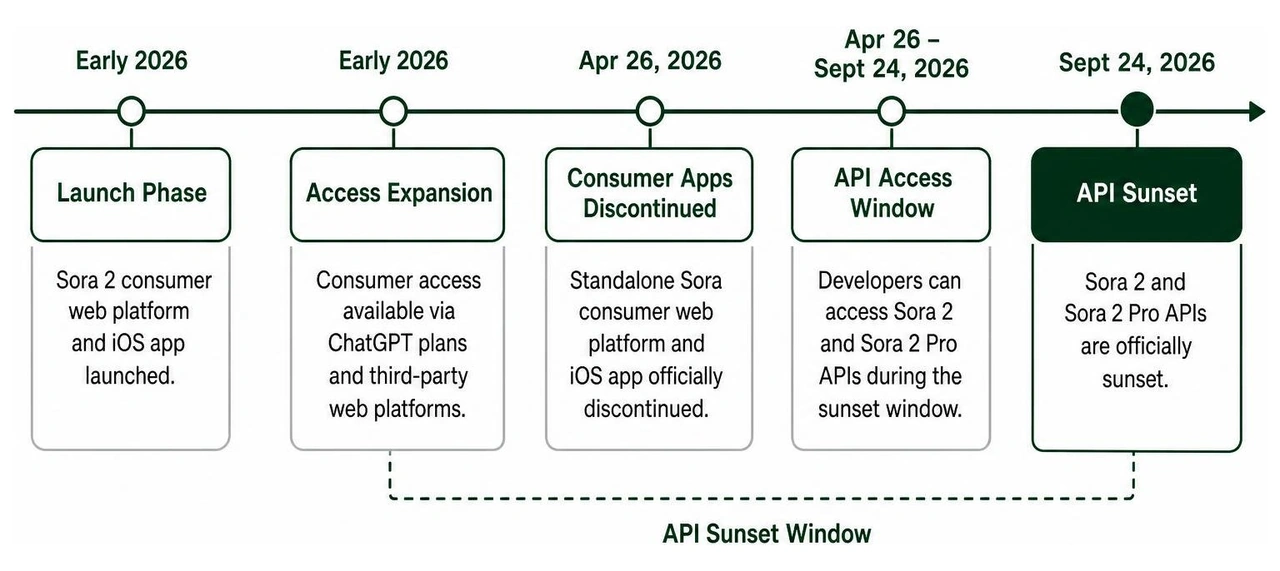
There is an important deadline, too: OpenAI discontinued the Sora consumer app on April 26, 2026, and the Sora 2 API is scheduled to sunset on September 24, 2026. For founders building video features into an app, cost planning and migration planning now need to happen together.
As Director of Product at Synergy Labs, I will help you look past headline rates and understand what Sora 2 could really cost in a scalable product workflow.
Official OpenAI Sora 2 Pricing Structure and API Rates
When building video generation capabilities into modern web or mobile applications, unit economics dictate product sustainability. Unlike traditional text or code generation APIs that bill based on input and output tokens, video generation compute is intrinsically tied to frame rendering, spatial resolution, and temporal duration. Consequently, OpenAI structures the Sora 2 API around a strict per-second execution rate.
Under the Official Sora 2 API documentation, billing occurs based on the total duration of video generated rather than prompt token length. Whether your prompt is five words or five hundred words, the foundational rate depends on the chosen model variant, resolution profile, and dispatch queue.
To manage server load and prevent compute starvation across infrastructure regions, OpenAI governs API access using a multi-tiered rate limit structure based on organization spending tiers. Access starts at Tier 1 and scales up to Tier 5:
Standard Sora 2 (720p): Rate limits begin at 25 Requests Per Minute (RPM) at Tier 1, scaling up to 375 RPM at Tier 5.
Sora 2 Pro: Due to increased GPU overhead per render, rate limits start at 10 RPM at Tier 1 and top out at 150 RPM at Tier 5.
Free Tier API: Free usage tiers do not support Sora 2 or Sora 2 Pro video endpoints. Pay-as-you-go credit balances or verified organization accounts are strictly required.
Understanding these operational parameters ensures engineering teams do not encounter unexpected throttling during peak application traffic.
Standard vs Pro Sora 2 Pricing Tiers
OpenAI bifurcates its flagship video models into two operational categories: standard Sora 2 and Sora 2 Pro. Choosing between them comes down to a balance between raw cost efficiency and broadcast-level fidelity.
Standard Sora 2 is built specifically for speed, rapid prototyping, and high-volume generation where standard definition is acceptable. It operates at a fixed resolution of 720p (offering portrait 720x1280 or landscape 1280x720 aspect ratios) at a uniform price point of $0.10 per second of generated video.
Conversely, Sora 2 Pro provides enhanced motion physics, superior prompt adherence, richer color depth, and multi-resolution output capabilities. The pricing for Sora 2 Pro scales dynamically according to pixel density:
720p Resolution (720x1280 or 1280x720): $0.30 per second. This represents a 3x price multiplier over the standard Sora 2 model at the same pixel resolution, reflecting the deeper compute layer used for motion rendering.
1024p Resolution (1024x1792 portrait or 1792x1024 widescreen): $0.50 per second. This mid-tier widescreen format bridges mobile portrait feeds and cinematic displays.
1080p Resolution (1080x1920 portrait or 1920x1080 full HD): $0.70 per second. This full high-definition tier represents the highest quality video rendering option available in the Sora ecosystem.
For developers evaluating sora 2 pricing, this multi-tier model means output resolution choices heavily dictate overall infrastructure costs.
Video Duration Limits and Per-Generation Costs
In addition to resolution variations, the underlying duration limits enforce hard boundaries on how clips can be generated. You cannot simply request a custom 3.2-second or 19.5-second output. Instead, the API requires discrete duration parameters tailored to each model family.
For standard Sora 2, supported clip lengths are limited to 4 seconds, 8 seconds, or 12 seconds. A standard 720p generation breaks down into predictable unit costs:
4-second clip at $0.10/sec: $0.40
8-second clip at $0.10/sec: $0.80
12-second clip at $0.10/sec: $1.20
For Sora 2 Pro, clip length allocations expand to accommodate cinematic narrative beats, supporting 10 seconds, 15 seconds, or maximum 25-second durations. Depending on chosen resolution, single-generation costs span a wide economic spectrum:
10-second clip: Costs $3.00 at 720p ($0.30/s), $5.00 at 1024p ($0.50/s), and $7.00 at 1080p ($0.70/s).
15-second clip: Costs $4.50 at 720p, $7.50 at 1024p, and $10.50 at 1080p.
25-second clip: Costs $7.50 at 720p, $12.50 at 1024p, and $17.50 at 1080p full HD.
A key capability included across both standard Sora 2 and Sora 2 Pro models is native, synchronized audio generation. The API outputs diegetic sound effects, ambient background audio, and speech directly embedded in the video container without requiring additional per-second audio processing fees.
Leveraging the Sora 2 Batch API for 50% Cost Savings
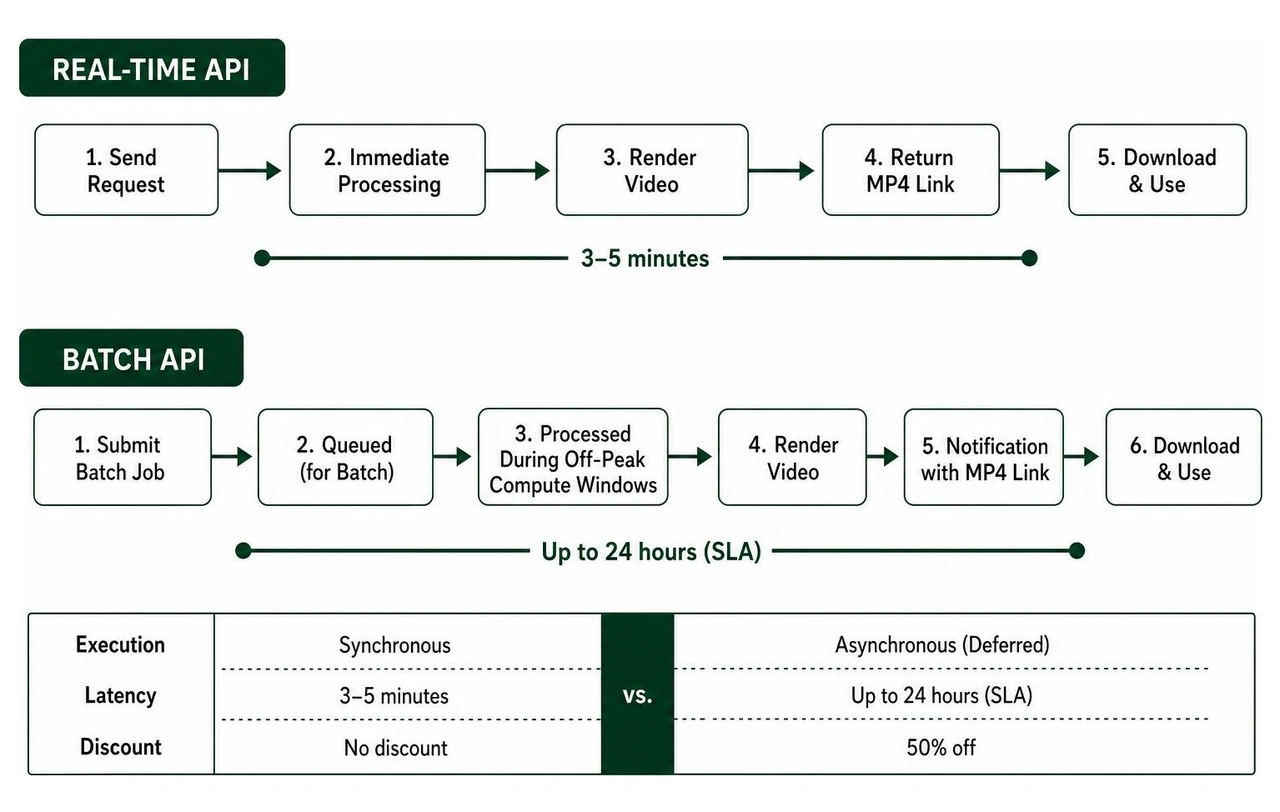
For applications that do not demand instantaneous, real-time user feedback, OpenAI provides an official Batch API endpoint. By submitting video requests asynchronously into a deferred queue, organizations receive a flat 50% discount across all Sora 2 and Sora 2 Pro resolutions.
The primary trade-off for this massive rate reduction is latency. While real-time API calls return completed mp4 rendering links within 3 to 5 minutes, the Batch API operates under a 24-hour Service Level Agreement (SLA). The system processes jobs during off-peak compute windows across global data centers.
This makes the Batch API ideal for automated content pipelines, overnight marketing video generation, push-notification preview creation, and bulk asset rendering where real-time turnaround is unnecessary.
Calculating Sora 2 Pricing Discounts on Batch Jobs
When utilizing the Batch API tier, every per-second rate is sliced exactly in half:
Sora 2 Standard (720p): Drops from $0.10/sec down to $0.05/sec.
Sora 2 Pro (720p): Drops from $0.30/sec down to $0.15/sec.
Sora 2 Pro (1024p): Drops from $0.50/sec down to $0.25/sec.
Sora 2 Pro (1080p): Drops from $0.70/sec down to $0.35/sec.
To put these savings into context, let us look at real-world generation budgets. If an enterprise app pipeline generates 1,000 15-second promotional videos per month in Sora 2 Pro 1080p full HD:
Standard Real-time API cost: 1,000 videos x 15 seconds x $0.70/sec = $10,500 monthly spend.
Batch API cost: 1,000 videos x 15 seconds x $0.35/sec = $5,250 monthly spend.
By shifting non-urgent tasks to asynchronous batch queues, product teams save $5,250 every single month on direct compute costs alone. Similarly, rendering a maximum-length 25-second Sora 2 Pro 1080p scene drops from $17.50 on the standard API down to $8.75 on the Batch tier.
Subscription Access vs API Usage: Consumer Apps and ChatGPT Tiers
Understanding how sora 2 pricing intersects with consumer access models requires reviewing OpenAI's distribution evolution throughout early 2026. Initially, OpenAI introduced standalone consumer interfaces alongside subscription bundles before streamlining operations toward dedicated enterprise APIs.
The standalone Sora consumer web platform and iOS app were officially discontinued on April 26, 2026. Since that shutdown, end-user consumer access to Sora video capabilities exists primarily through ChatGPT subscription tiers or third-party web portals utilizing underlying APIs.
For creators and founders assessing whether to use pre-built SaaS subscription access or direct API integration, key plan boundaries include:
ChatGPT Plus ($20/month): Offers basic access to standard Sora 2 generation. Usage is heavily rate-limited, capped at short clips (typically 5 to 10 seconds), carries visible watermarks on exports, and processes requests on a standard queue subject to high-traffic delays.
ChatGPT Pro ($200/month, with promotional tiers testing at $100/month): Unlocks Sora 2 Pro capabilities with expanded generation limits (often providing approximately 10,000 generation credits monthly). It permits clips up to 25 seconds in 1080p resolution without watermarks and grants priority rendering access.
Third-Party Web Platforms: Independent credit-reseller platforms offer subscription bundles starting between $9.50/month and $29.90/month. These grant dedicated credit pools (e.g., 1,000 to 1,500 credits), where a standard 720p video consumes roughly 20 credits and a high-definition Pro video consumes up to 85 credits.
While subscription plans work well for manual, human-driven content creation, direct integration into consumer mobile applications demands developer API keys. Direct API access provides full parameter control over aspect ratios, seed numbers, webhook status notifications, and dynamic prompt injection.
Hidden Overhead and Sora 2 Pricing Cost Optimization Strategies
A common pitfall for product teams integrating AI video generation is calculating runway based on a theoretical single-take success rate. In reality, generative video models frequently require multiple generation attempts before achieving desired camera movement, character consistency, and prompt accuracy.
As noted in industry cost analysis, the true financial expense of generative video stems from "effective cost per usable clip" rather than raw per-second billing. If a prompt requires three iterations to fix camera motion anomalies before producing a clean deliverable, your effective cost is three times higher than the baseline rate.
To keep production spending under control, we recommend enforcing five core optimization strategies within your software architecture:
Mandatory Low-Resolution Drafting: Configure your application workflow to execute initial video prompts using standard Sora 2 at 720p ($0.10/sec) or standard batch settings ($0.05/sec). Once users approve the scene layout, camera framing, and action sequencing, trigger a high-resolution Sora 2 Pro 1080p final render ($0.70/sec).
Short Duration Verification: Test complex prompts using 4-second or 10-second duration bounds before committing compute budget to a maximum 25-second generation run. Failed 25-second Sora 2 Pro 1080p renders cost up to $17.50 on standard endpoints or $8.75 on batch queues, whereas a short 10-second draft limits exposure to $3.50.
Automated Prompt Guardrails: Implement client-side validation logic and system prompt sanitization to eliminate ambiguous descriptors that lead to video hallucinations, object clipping, or physics errors.
Scene Splitting and Post-Production Editing: Rather than attempting to render a complex 60-second continuous narrative in a single prompt—which increases failure rates exponentially—generate discrete 4-second or 8-second sub-scenes and stitch them together using automated cloud video editing workflows.
Real-Time Cost Tracking and Budget Caps: Utilize specialized API spending analytics tools to set dynamic spend alerts and hard cut-offs per user or per client organization.
API Sunset Guide: Transitioning to Alternatives Before September 2026
The most critical factor influencing video AI development roadmap decisions today is OpenAI's official deprecation timeline. The consumer web and iOS applications were shut down on April 26, 2026, and the Sora 2 and Sora 2 Pro APIs are officially scheduled to sunset on September 24, 2026.
Building long-term proprietary feature sets exclusively dependent on the Sora 2 API without an abstraction layer presents serious architectural risk. Software engineering teams must prepare active migration paths now to ensure uninterrupted service when the September sunset date arrives.
When transitioning away from Sora 2, consider the following migration alternatives and strategies:
Primary Enterprise Alternatives: Advanced enterprise video models represent stable long-term direct replacements for commercial video workflows. Enterprise video model pricing ranges between $0.03/sec for fast draft models up to $0.40/sec for flagship multi-modal video models, offering native audio integration, high prompt adherence, and predictable enterprise SLAs.
Decentralized Serverless Inference Providers: Third-party cloud inference providers host open-weights and commercial video generation models with pay-per-second billing structures. Migrating API call structures to multi-model abstraction libraries allows applications to dynamically route video generation jobs to alternative video engines based on cost, speed, and real-time GPU availability.
Architectural Abstraction Layer Implementation: Wrap all video generation API logic inside internal provider-agnostic service adapters. By decoupling your application UI from OpenAI's specific JSON request schema, switching backend video providers from Sora 2 to alternative video engines requires altering configuration routing files rather than rewriting client-side mobile app code.
For complete background on OpenAI's foundational model releases, review original launch details at Sora 2 is here | OpenAI.
Frequently Asked Questions About Sora 2 Costs
Is there still a free tier or consumer app access for Sora 2 in 2026?
No. OpenAI officially phased out free consumer app access and discontinued the standalone Sora web portal and iOS application on April 26, 2026.
Today, access is restricted to paid ChatGPT subscription tiers (ChatGPT Plus at $20/month or ChatGPT Pro at $200/month) or direct pay-as-you-go developer API usage. The developer API has never offered a free tier; organization balances must maintain positive credit top-ups to process video generation calls.
How much does a 10-second Sora 2 video cost?
The baseline cost for a 10-second video depends heavily on the chosen model tier, output resolution, and dispatch queue:
Standard Sora 2 (720p, Standard API): $1.00 ($0.10/sec)
Standard Sora 2 (720p, Batch API): $0.50 ($0.05/sec)
Sora 2 Pro (720p, Standard API): $3.00 ($0.30/sec)
Sora 2 Pro (1024p Widescreen, Standard API): $5.00 ($0.50/sec)
Sora 2 Pro (1080p Full HD, Standard API): $7.00 ($0.70/sec)
Sora 2 Pro (1080p Full HD, Batch API): $3.50 ($0.35/sec)
What replaces Sora 2 after the September 24, 2026 sunset?
Enterprise-grade multimodal video APIs serve as the primary alternative, offering comparable multi-modal video generation and synced audio starting between $0.03/sec and $0.40/sec.
Additionally, serverless model platforms host alternative state-of-the-art video models with pay-as-you-go per-second pricing.
Navigating AI Video Costs with Synergy Labs
Navigating the shifting landscape of generative AI models, fluctuating per-second pricing structures, and impending API sunset dates requires an experienced technical partner. At Synergy Labs, we help founders and corporate innovation teams design, build, and deploy high-performing mobile apps and web platforms powered by cutting-edge artificial intelligence.
When integrating video generation into your product ecosystem, selecting the right model is only half the battle. You need custom application architectures that intelligently route jobs between real-time and batch endpoints, enforce prompt guardrails, manage user credit quotas, and abstract backend API dependencies to insulate your business from model deprecations.
Through our specialized Transform your app with AI infusion services, we partner with clients to deliver scalable cross-platform software. We eliminate financial unpredictability through our transparent fixed-budget model and milestone-based payments, ensuring projects are completed efficiently, on time, and on budget.
Our unique operational structure pairs you directly with an in-shore CTO and senior talent who oversee an elite offshore development team. This hybrid model gives you high-level executive advice, rapid app deployment, robust security, and cost-effective development execution.
If you are looking to build video generation tools or need to transition an existing codebase away from sunsetting APIs before September 2026, we are here to help. Contact us at Synergy Labs today to schedule a consultation with our senior engineering team and bring your product vision to life.


.avif)

.avif)


