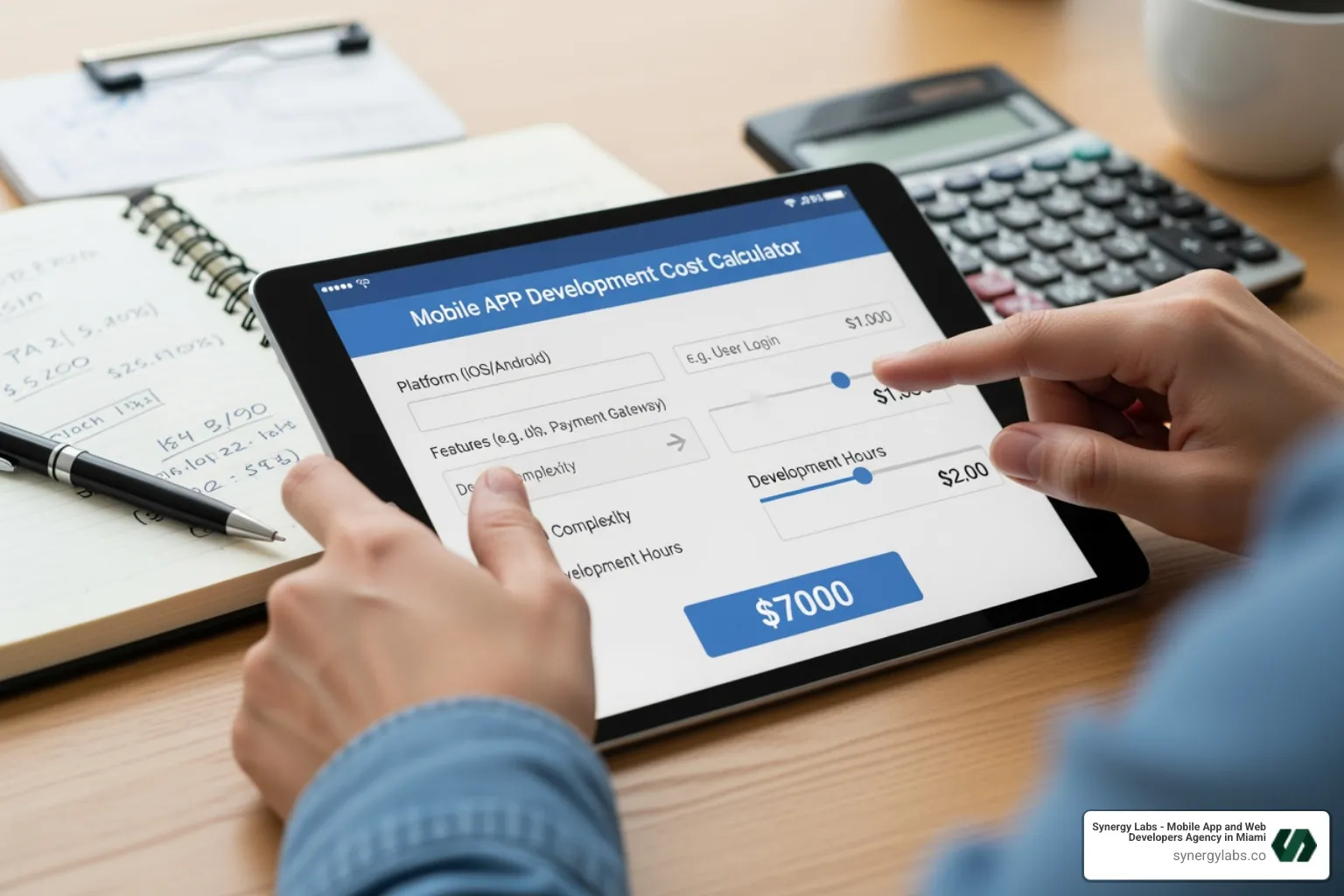
From Budgeting to Launch: How to Use a Mobile App Development Cost Calculator is a straightforward process that empowers you to estimate your project's financial scope with real, decision-ready numbers instead of vague guesses. Rather than relying on gut feeling or random blog posts, you plug your idea into a structured, logical set of questions and get a transparent cost range you can actually plan around.
Here's how it typically works from a practical, non-mysterious standpoint:
Select your platform (iOS, Android, or both)
Choose your desired features (login, push notifications, payments, etc.)
Define UI/UX requirements (simple, custom, or complex design)
Include third-party integrations (APIs, payment gateways, analytics)
Set your development timeline (rush vs. standard pace)
Review the instant estimate and adjust as needed to match your budget and priorities
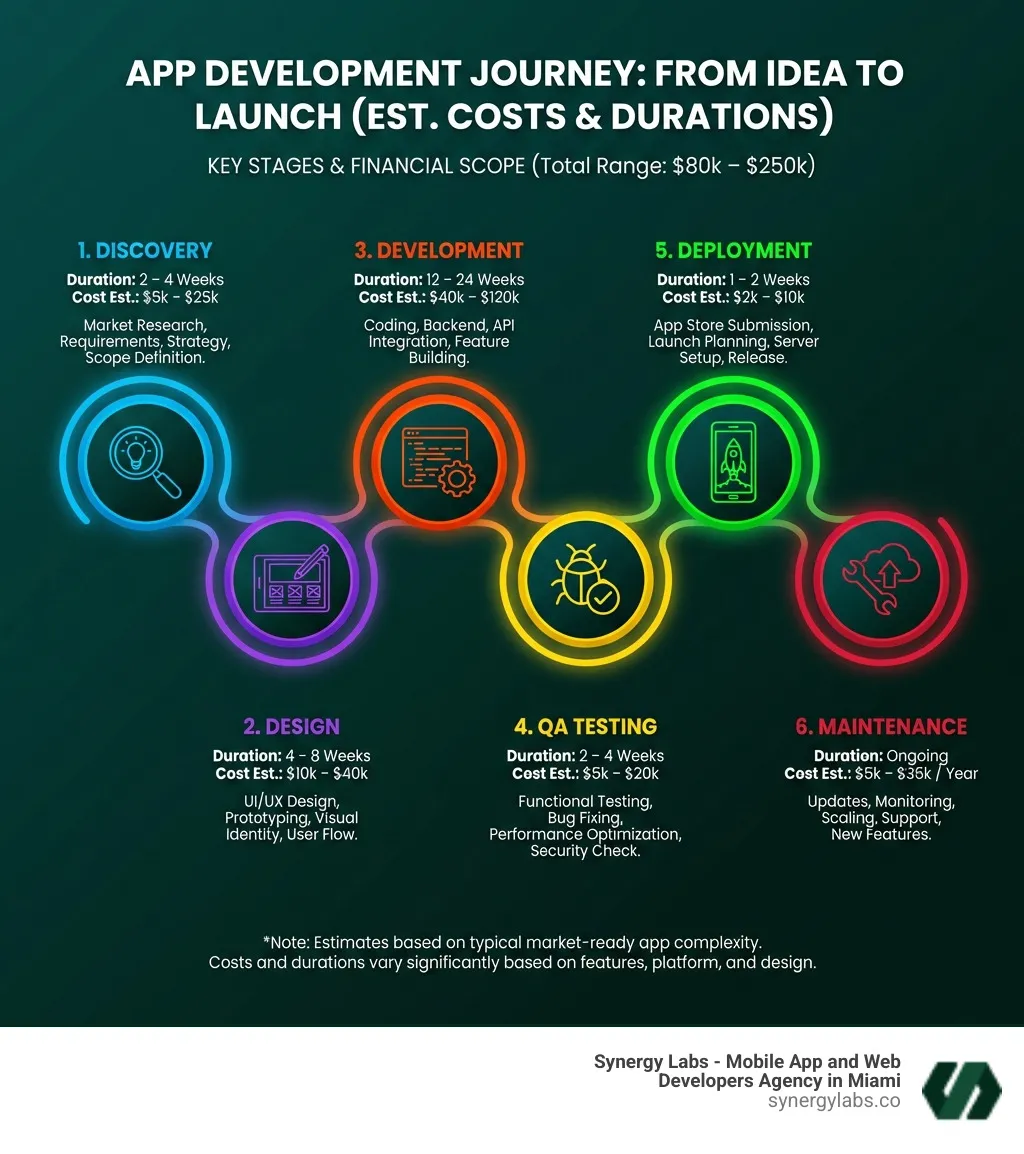
Most calculators provide a cost range instantly—typically between $80,000 and $250,000 for a market-ready app, depending on complexity and scope.
Many mobile apps fail within their first year, and it's rarely due to poor functionality. The real killer is often running out of money at the wrong time—for example, just before marketing, or midway through a critical feature. Without a clear budget blueprint, you're flying blind. A mobile app development cost calculator is a practical tool that demystifies the core formula: (Total Development Hours) x (Developer Hourly Rate) = Total Cost. Every feature and screen translates into development hours, helping you prioritize, plan for ROI, and avoid the budget-killer known as scope creep.
Understanding what drives cost before you start coding is critical. With the FinTech and broader app markets expected to keep growing through 2026 and beyond, and a majority of clients preferring mobile-first experiences, the stakes are high. This means mapping out your feature list, choosing the right platform, and factoring in ongoing costs like maintenance and app store fees.
At Synergy Labs, we've built apps like Peanut and Slowly for global audiences, and we've seen how a solid budget can transform vague ideas into funded, launchable products. Whether you're a startup founder or an entrepreneur validating a concept, this guide will show you how to budget smarter and launch faster, using a calculator as your financial compass rather than a crystal ball.
Decoding the Price Tag: Primary Factors Influencing App Costs
The cost of a mobile app boils down to several primary factors. Once you understand these drivers, the "mystery" price tag becomes a set of logical trade-offs instead of a scary, random number.
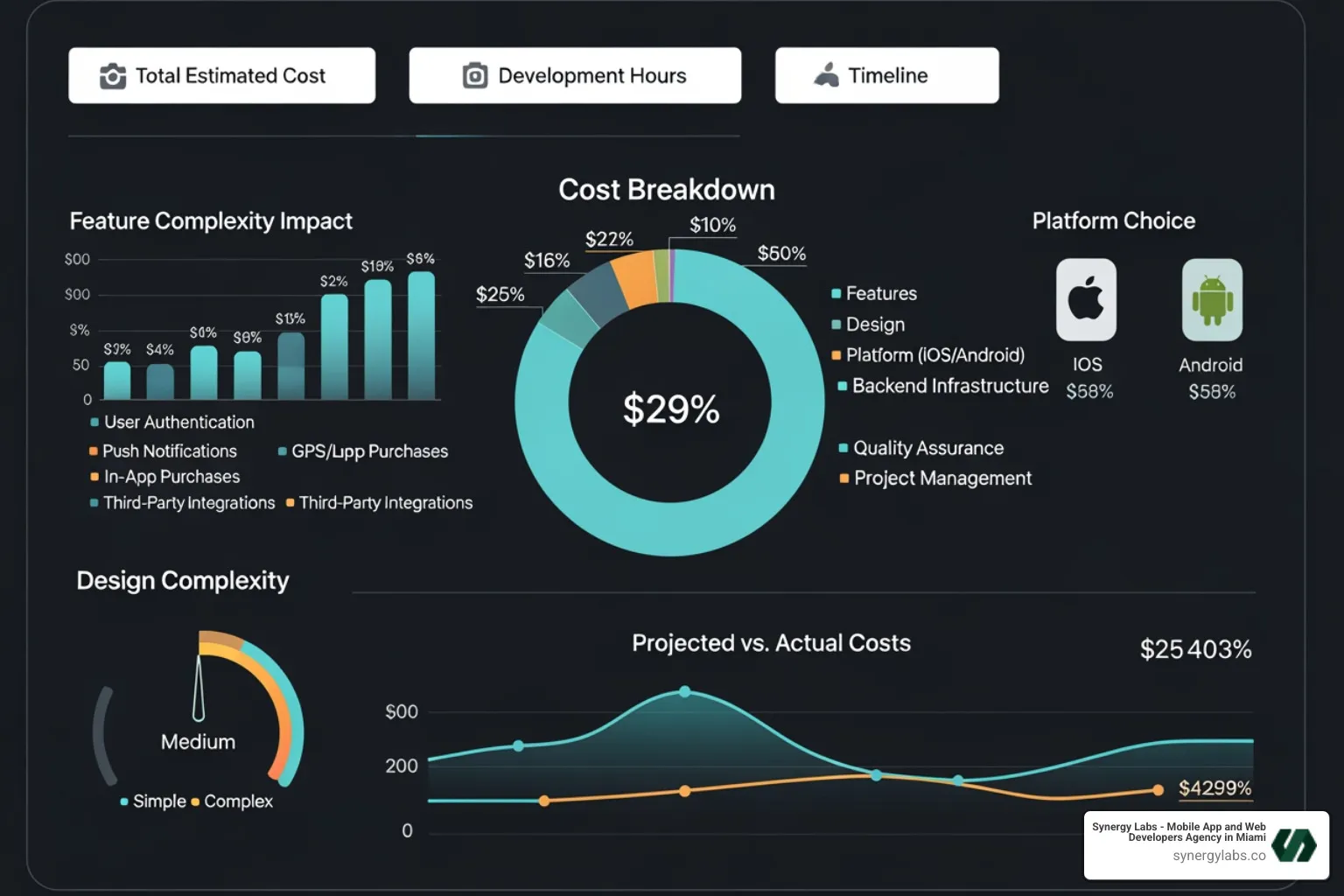
The most significant factor is app complexity. A simple app with basic features might cost around $50,000, while a complex app with advanced functionalities can easily exceed $300,000. Complexity is determined by the intricacy of features and how they interact. Other key cost drivers include:
UI/UX Design: A unique, polished user experience costs more than a template-based design, with costs ranging from $5,000 to $55,000.
Backend Infrastructure: The unseen engine of your app (servers, databases, APIs) can cost from $2,000 to $60,000.
Development Timeline: A simple app may take 2-4 months, while complex apps can take 9+ months. Rushed timelines can increase costs because more developers and overtime are needed.
These factors do not just add up; their interdependencies can multiply the effort required. For example, adding real-time chat to a simple app does not just add a "chat screen"—it impacts backend complexity, notifications, data storage, and QA. Understanding these relationships is key to a realistic budget you can defend in front of investors or internal stakeholders.
The MVP Advantage vs. a Full-Featured App
A smart strategy for managing costs is starting with a Minimum Viable Product (MVP). An MVP is a strategic first step that includes only the core features needed to solve a key user problem and validate your idea. This approach can slash initial development costs by 50-60%, enabling a faster market launch with less investment.
Unlike a full-featured app, which is expensive and risky to build all at once, an MVP allows you to test your concept, gather user feedback, and iterate based on real demand. This ensures every dollar is spent on features that add value, controlling costs and boosting your chances of success. In a calculator, this looks like deliberately toggling off non-essential features for v1 so you can see how much budget you free up. For more insights, check out The Benefits of Building a Minimum Viable Product (MVP) First.
Platform Choices: Native, Cross-Platform, and No-Code
Your choice of platform is a cornerstone of the budget, dictating the tech stack and development time.
Native Development: Building separate apps for iOS (Swift/Objective-C) and Android (Kotlin/Java) offers the best performance and user experience. However, maintaining two codebases significantly increases cost and time, with Android sometimes costing more due to extensive device testing.
Cross-Platform Development: This is a go-to strategy for many new products. Using frameworks like React Native or Flutter, we write one codebase for both iOS and Android. This can reduce development costs by 30-40% and speed up time-to-market because most features are built once and shared.
No-Code/Low-Code Approach: These visual tools are cost-effective and fast for simple apps or internal tools but lack the flexibility and customization of custom coding for complex functionalities.
At Synergy Labs, we are experts in all three approaches and will help you choose the right strategy to align with your goals and budget, so the calculator estimate reflects a realistic technical path instead of a generic average.
The Building Blocks: How Features and UI/UX Drive Your Budget
Every feature and design element translates into development hours and cost. Here is a look at some common features and their impact:
User Login/Authentication: A basic login takes 40-80 hours, with social logins adding around $1,000 each.
Push Notifications: Simple alerts take 20-50 hours, with more complexity for rich or targeted notifications.
In-App Purchases: Secure implementation on the App Store and Google Play can take 80-150 hours.
Geolocation and Mapping: Basic location services require 60-160 hours, with more for advanced features like real-time tracking.
API Integrations: Connecting to external services can cost $4,000-$6,000 per integration.
On-device System Features: Integrating with FaceID or Apple Auth is a relatively low-cost investment, typically under $1,000 each, but still needs to be counted.
Beyond features, UI/UX design is critical for an intuitive user experience. Costs can range from $5,000 to $55,000, depending on the level of custom design and complexity. A custom interface is more expensive but provides a unique brand identity and superior user journey. When you interact with a cost calculator, you are usually choosing between these levels of design—each option quietly adjusting the design hours behind the scenes. For more on this, see App Building: When to Prioritize Features Over Design for Your MVP.
Backend, Infrastructure, and Third-Party Integrations
A robust backend is often the most complex and costly part of development, handling data storage, user authentication, and business logic.
Backend Development: Building server-side logic can range from $1,000 for a simple backend to over $14,000 for complex system integrations.
Server and Hosting Fees: Recurring fees for cloud services like AWS or Google Cloud typically range from $1,000 to $5,000 per year and scale with user growth.
Third-Party Integrations: Connecting to services like payment gateways or analytics tools adds complexity, costing $4,000-$6,000 per integration.
Scalability and Security: Planning for user growth with a scalable architecture is crucial. If your app handles sensitive data, you must also budget for security compliance with regulations like GDPR or HIPAA, which can cost $2,000-$5,000 for legal and implementation measures.
At Synergy Labs, we build secure, scalable backend solutions designed to grow with your user base, ensuring a solid foundation for your app. When you see a backend-related line item in a cost calculator, you are really seeing an estimate for this architecture and security work, not just "some servers."
From Budgeting to Launch: How to Use a Mobile App Development Cost Calculator
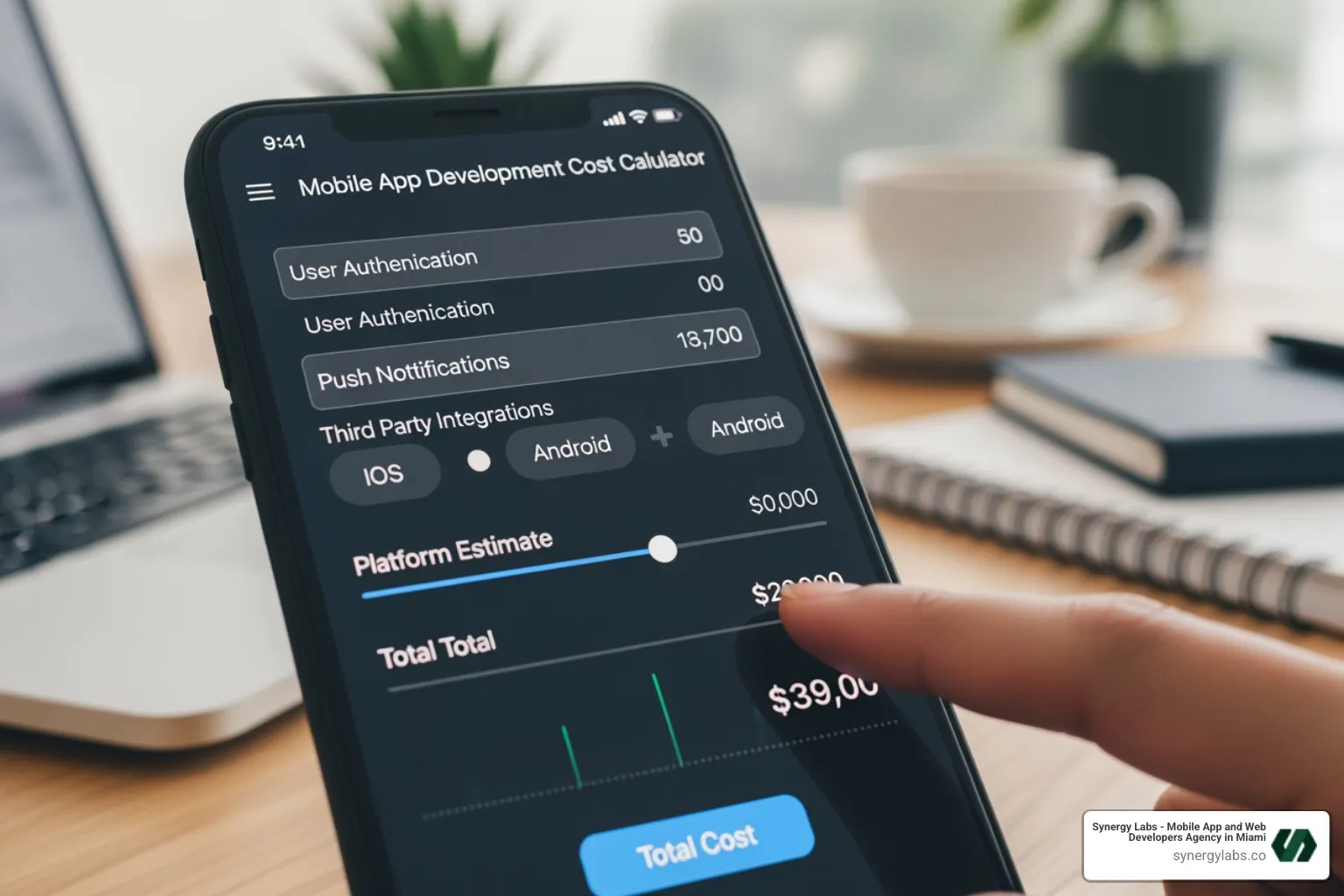
A mobile app development cost calculator is a strategic asset for your planning journey, not just a novelty widget that spits out random numbers. Used correctly, it gives you a clear, logical link between the app you imagine and the budget you actually need.
It empowers smarter decisions by helping with feature prioritization—letting you see the immediate cost impact of each choice—and risk management, by identifying potential budget overruns early. Instead of finding too late that your "must-have" feature set is twice your budget, you can iterate on scope in minutes.
To maximize its value, be specific about your app idea, select your options carefully, and view the estimate as a dynamic blueprint, not a final price. For an overview of our process beyond the calculator itself, explore our Mobile App Development Agency: What to Expect from Discovery to Launch guide.
In practice, using a calculator from budgeting to launch looks like this:
You start with a rough idea and generate an initial estimate.
You refine your features and platforms based on that estimate.
You share the output with a team like Synergy Labs to sanity-check assumptions.
You use the refined numbers to support funding discussions or internal approvals.
As scope evolves, you revisit the calculator to keep your budget aligned with reality.
How to Maximize the Accuracy of Your Estimate
An online calculator is a great start, but its accuracy depends on your input. To get the most precise estimate:
Be Specific and Detailed: Instead of "user profiles," describe the exact functionality, like "profiles with picture uploads and social media linking." This affects design, storage, and integration costs.
Consider Scalability: Mention future growth plans, as this affects the initial architecture and may change backend and hosting assumptions.
Consult Development Teams: Bring your estimate to a partner like Synergy Labs. Our senior talent can spot hidden complexities and suggest cost-effective alternatives, such as using cross-platform frameworks or phased feature rollouts.
Revisit the Calculator Periodically: As your project evolves, update your selections to see the budget implications. Treat it like a living financial model, not a one-time quiz.
At Synergy Labs, we partner with you to refine your estimate, leveraging our experience to ensure your budget reflects the true scope of your app and aligns with realistic timelines.
What to Look for When Choosing an App Cost Calculator
Not all calculators are equal. A basic widget that asks three questions and outputs a single number is more entertainment than planning. For real budgeting, look for these features:
Detailed Customization: Lets you select individual features for a more precise cost breakdown.
Clear Cost Breakdowns: Shows costs per feature, platform, or phase so you understand why the total is what it is.
Result Saving or Exporting: Allows you to save and share estimates for comparison, pitching, or internal review.
Transparency in Methodology: Explains how it calculates costs, including assumptions about hourly rates and timelines.
User-Friendliness: An intuitive interface is essential so non-technical stakeholders can participate in the budgeting conversation.
Offer of Expert Consultation: The best tools are backed by agencies offering a follow-up consultation to create an actionable proposal.
Our tools at Synergy Labs are designed to be transparent and user-friendly, backed by our senior development team to provide the most accurate insights for your project, from the very first estimate all the way to launch.
Assembling Your Dream Team: How People and Places Affect Your Budget
The people you hire and where they are located significantly impact your budget. Luckily, this is not random: once you understand different team setups and geographical rate variations, you can deliberately design a team that fits both your vision and your wallet.
The Talent Equation: In-House, Agency, or Freelancers?
Your choice of team structure is a major financial decision:
In-House Team: The most expensive option, offering maximum control but requiring you to cover salaries, benefits, recruitment, management, and overhead. Best for large enterprises with ongoing, long-term product roadmaps.
Agency Partnership: Agencies like Synergy Labs offer a full-service package with a dedicated team, streamlined processes, and a single point of contact. The efficiency and reliability often lead to a more cost-effective, high-quality outcome than trying to assemble and manage a team yourself.
Freelancers: Can offer lower hourly rates but require significant project management on your part to coordinate individuals, align quality, and maintain continuity over time.
Common engagement models include:
Fixed-Price: Best when scope is well-defined. You agree on a clear feature set, timeline, and budget upfront.
Time and Materials: More flexible when scope is evolving, but requires disciplined tracking and prioritization.
At Synergy Labs, we often use a hybrid model, combining an in-shore CTO's strategic oversight with efficient offshore development teams, managed through milestone-based payments for optimized costs and senior-level guidance. This structure gives you the strategic clarity of an internal leader with the cost efficiency of a globally distributed team.
The World is Your Oyster: How Developer Location Impacts Cost
Developer location is a huge factor in hourly rates. It is about balancing cost with quality, communication, and time zone overlap rather than chasing the lowest number.
Here is a general overview of hourly rates by region:
North America (for example, Miami FL, San Francisco CA, New York City NY, Austin TX, Chicago IL, Phoenix AZ, Hartford CT): $100-$250 per hour. Highest rates but excellent communication and time zone alignment for US-based businesses.
Western Europe (for example, London UK): $80-$180 per hour. A good balance of quality and cost, with manageable time zone differences for clients in Europe and the Middle East.
Middle East (for example, Dubai UAE, Doha Qatar, Riyadh Saudi Arabia): Competitive rates, often similar to or better than Western Europe, with high quality and manageable time zones for both Europe and Asia.
Eastern Europe: $35-$70 per hour. Known for a strong, affordable talent pool and solid technical foundations.
South Asia: $20-$50 per hour. Most budget-friendly, but you should be mindful of time zone and communication differences, as well as project management needs.
At Synergy Labs, we strategically leverage our global talent in locations like Miami, Dubai, Hartford, San Francisco, Doha, New York City, Austin, Riyadh, London, Chicago, and Phoenix to balance cost, quality, and project management. This globally distributed yet tightly coordinated model lets you benefit from world-class development while keeping your budget under control.
Beyond the Build: Planning for Post-Launch and Hidden Costs
Congratulations! Your app is launched. But the journey—and the costs—do not end there. Many entrepreneurs overlook the crucial post-launch phase, which can lead to unexpected financial strain when bug reports, OS updates, and user feedback start rolling in.
We are here to help you plan for the full app lifecycle, not just the exciting "launch day" moment.
The Long Game: Ongoing App Maintenance and Updates
Post-launch maintenance is essential for your app's longevity and security. A realistic rule of thumb is to budget 15% to 20% of the initial development cost annually. The first year can be higher, up to 50%, to cover initial bug fixes and user feedback integration. This budget typically covers:
Bug Fixes and Security Patches: Addressing issues and protecting against vulnerabilities as they are found in the real world.
OS Updates: Ensuring compatibility with new iOS and Android versions and device types.
Performance Monitoring: Tracking crash rates, load times, and other key metrics so you can keep the experience smooth.
Hosting Costs: Recurring fees for cloud services like AWS or Google Cloud, typically $1,000 to $5,000 per year, which scale with your user base and data usage.
Neglecting support leads to poor reviews, uninstallations, and eventually app failure. We help you plan for the long game by baking maintenance into your budget conversations from day one. For more on scaling, see From MVP to Market Leader: Scaling an App Without Rewriting Everything.
Uncovering the Hidden Costs of App Ownership
Beyond development, several "hidden" costs can derail your budget if not anticipated. These are not bugs in the system—they are just parts of real-world app ownership that often get ignored during the early excitement phase:
App Store Fees: Google Play has a one-time $25 fee, and Apple's developer account is $99 annually. Both the App Store and Google Play take a 15% to 30% commission on sales.
Marketing and User Acquisition: A significant investment is needed to get users to find and download your app, whether through ads, content, influencers, or partnerships.
Analytics Tools: Subscriptions to analytics services are necessary to track user behavior and performance so you can make data-driven decisions.
Legal and Compliance Costs: Budget $2,000-$5,000 for privacy policies, terms of service, and compliance with regulations like GDPR or HIPAA, depending on your industry and markets.
Third-Party Service Subscriptions: Fees for APIs, SDKs, or other services your app relies on—such as email providers, messaging platforms, or specialized data services.
Our team at Synergy Labs helps you anticipate these costs up front, providing a holistic view of your app's financial journey so you are not surprised by line items that "suddenly" appear six months after launch.
Frequently Asked Questions about App Development Costs
How accurate is a mobile app development cost calculator?
A mobile app development cost calculator is a fantastic tool for getting a ballpark estimate—a rough idea of your project's financial scope. It's excellent for initial budgeting, comparing different feature sets, and understanding the general cost drivers. However, it's crucial to remember that it's not a final quote. The accuracy heavily depends on the quality and detail of the information you input. Factors like unforeseen technical challenges, specific design nuances, and the exact hourly rates of your chosen development team can cause the actual cost to vary. Think of it as an intelligent starting point, perfect for sparking discussions and guiding your preliminary planning, but always requiring a detailed proposal from a development partner for a precise figure.
Can building an MVP really save me money?
Yes, absolutely and significantly! Launching a Minimum Viable Product (MVP) is arguably the single best strategy for managing initial investment and mitigating risk in app development. By focusing solely on the core features needed to solve a primary user problem, an MVP can reduce your initial development costs by as much as 50-60%. This approach gets your app into users' hands faster, allowing you to gather real-world feedback and validate your concept before pouring more money into additional features. It helps prevent "scope creep" and ensures that subsequent development is driven by actual user needs and market demand. At Synergy Labs, we often recommend an MVP-first approach for many clients, as it's a proven path to both cost savings and market success. You can learn more about this strategy in App Building: MVP Success Hinges on Differentiation.
How much should I budget for app maintenance?
As a general rule of thumb, you should budget approximately 15% to 20% of the initial development cost annually for ongoing app maintenance. This covers essential services like bug fixes, updates for new operating system versions (iOS and Android), security patches, performance monitoring, and minor improvements. The first year after launch can often be higher, sometimes up to 50% of the initial development cost, as it typically involves more intense bug resolution, initial user feedback integration, and optimization. Consistent maintenance is vital for your app's security, stability, and continued relevance in the changing mobile ecosystem.
Your Launchpad to App Success: Turning Estimates into Reality
We have covered a lot of ground, from the intricate factors influencing costs to the strategic advantages of an MVP and the often-overlooked hidden expenses. The journey From Budgeting to Launch: How to Use a Mobile App Development Cost Calculator is about empowering you with clear, grounded knowledge, turning vague ideas into concrete financial plans, and mitigating risks before they become expensive emergencies.
A calculator is not just a gadget; it is your first step toward a strategic budgeting blueprint. It turns "How much does an app cost?" from an unanswerable question into a series of understandable trade-offs: which platforms, which features, what level of design, and how fast you want to move.
Turning an estimate into a reality requires more than just numbers—it requires expertise, transparency, and a dedicated partnership. That is where Synergy Labs comes in.
We offer a clear path to launch with a fixed-budget model, ensuring no surprise costs derail your vision once development starts. Our unique structure combines an in-shore CTO for high-level strategy and product guidance with a dedicated offshore development team for efficiency and scale. Everything is managed through milestone-based payments that keep your project on track, give you predictable cash flow, and provide clear checkpoints for reviewing progress.
If you are ready to move from "rough estimate" to a realistic launch plan:
Use a cost calculator to outline your initial scope and budget.
Bring that estimate to Synergy Labs so our senior team can refine it and uncover hidden assumptions.
Partner with us to design, build, and launch your app on a timeline and budget you can confidently stand behind.
Ready to build your app with confidence and financial clarity? Explore our mobile app services, and let Synergy Labs turn your calculator estimate into a launched, scalable product.


.avif)

.avif)


