Why Scaling Your App Without Rewriting Is the Ultimate Founder Challenge
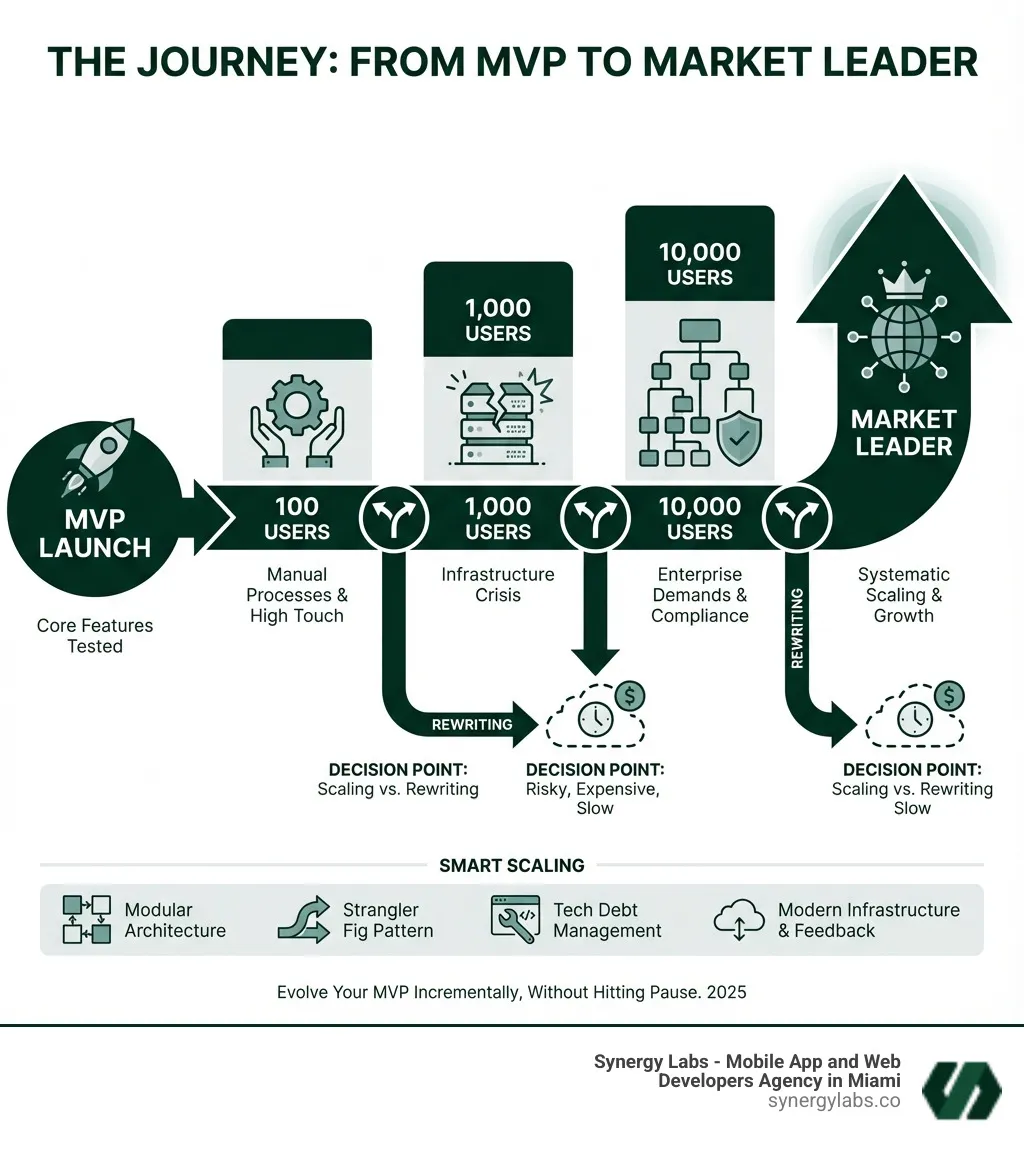
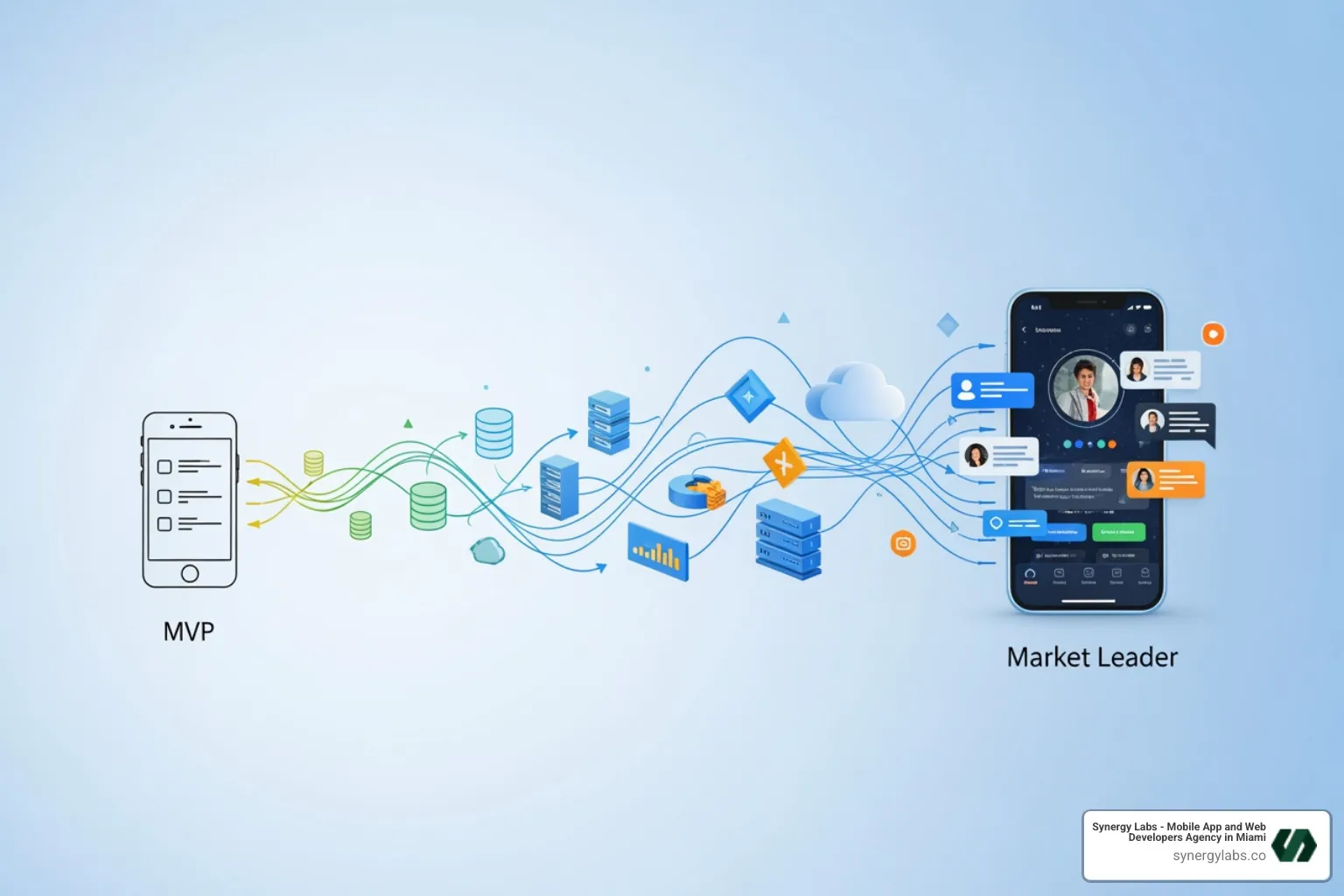
From MVP to Market Leader: Scaling an App Without Rewriting Everything is possible and often necessary—for startups that want to survive. Most founders assume they'll rebuild their app from scratch once it gains traction. But that's expensive, risky, and slow. Instead, smart scaling means evolving your MVP incrementally: strengthening your architecture, managing technical debt, and building systems that grow with you—without hitting the pause button on your business.
Quick Answer: How to Scale Without Rewriting
Start with a V2-ready MVP: Design your initial product with modular architecture and clear boundaries
Use the Strangler Fig Pattern: Replace legacy components gradually while keeping your app live
Leverage modern infrastructure: Cloud-native tools, microservices, and API-first design support growth
Build in feedback loops: Use analytics and user data to guide feature development
Invest in your team: Hire DevOps, security, and data roles before you desperately need them
Here's the reality: 90% of startups fail, often because they build a product no one wants or run out of cash trying to rebuild what they already built. After your MVP proves product-market fit, you hit a crossroads. One path leads to a costly, time-consuming rewrite. The other leads to smart, incremental scaling that preserves momentum and capital. This guide walks you through the second path—the one that gets you to market leadership without starting over.
I'm writing this as a product development strategist who's worked with early-stage startups navigating the exact challenge of From MVP to Market Leader: Scaling an App Without Rewriting Everything. At Synergy Labs, we've helped dozens of founders move past their MVP without burning their runway on rewrites, and we've seen what works—and what doesn't.
Similar topics to From MVP to Market Leader: Scaling an App Without Rewriting Everything:
The MVP Trap: Why "Build Fast, Fix Later" Leads to a Rewrite
The Minimum Viable Product (MVP) approach has become a cornerstone of startup strategy, and for good reason. A staggering 91.3% of businesses report launching their product using an MVP, with 59% doing so to accelerate product creation and 53.4% aiming to attract investors. It's a brilliant way to test the feasibility of an idea (81.6% find it effective) and evaluate market demand (78.3%). It allows us to get into the market for $20,000–$60,000, significantly less than the $150,000+ for a full-scale SaaS project.
However, the very speed that makes MVPs attractive can also lay a trap for future scaling. We often fall into what we call the "scaling illusion"—the dangerous assumption that progress will be linear, and what worked for a handful of users will simply work for millions. This leads to overconfidence and an underestimation of the exponential complexity that scaling introduces.
The core issue here is technical debt. This isn't just about sloppy code; it's the unintended consequence of prioritizing speed over long-term scalability. Quick fixes, a lack of documentation, and knowledge silos accumulate during the rapid MVP development phase. While acceptable for validating an idea, these shortcuts become brutal roadblocks when trying to achieve From MVP to Market Leader: Scaling an App Without Rewriting Everything. Architectural limitations of an MVP, often built as a monolith for simplicity, are rarely designed for massive scale. They become inflexible and difficult to modify, leading to cascading failures under increased load. We've seen this happen time and again, where a codebase designed for a few hundred users buckles under the weight of a few thousand.
This is why building a Minimum Viable Product should be viewed not just as a launchpad, but as a foundation for future growth. The goal isn't just to build fast, but to build smart. For more on the initial benefits, read our guide on The Benefits of Building a Minimum Viable Product (MVP) First.
What's the Difference? MVP vs. Prototype vs. Proof of Concept
Before we dive deeper into scaling, let's clarify three terms often used interchangeably, but with distinct purposes:
Proof of Concept (PoC): This is about testing technical feasibility. Its goal is to answer: "Can this technology work?" A PoC is typically an internal project, not shown to users, and focuses on a single, risky technical aspect. For instance, if you're building an app that uses a novel AI algorithm to extract text from images, a PoC would involve building just that specific functionality to see if it's possible.
Prototype: This is a visual representation of your idea, often interactive, to gather early feedback on user experience and design. Its goal is: "How will this look and feel?" A prototype is great for raising seed money, aligning co-founders on the vision, or getting qualitative user feedback. Think of a clickable prototype that shows the user flow without any backend logic.
Minimum Viable Product (MVP): This is a functional, deployable version of your product with just enough features to solve a core problem for early adopters. Its goal is: "Will users actually use and pay for this?" An MVP is about validating market demand and gathering real-world user data. It's a small but complete product that delivers value, tests core assumptions, and can be safely released to early customers. For example, a famous file-syncing service's MVP was a simple video demonstrating how the sync software would work, validating demand before complex coding began.
Each serves a crucial role, but the MVP is the one that truly tests your business hypothesis in the market.
Common Pitfalls When Scaling an App After the MVP Phase
Even if you successfully launch an MVP, the journey to From MVP to Market Leader: Scaling an App Without Rewriting Everything is fraught with pitfalls. Here are some of the most common traps we've observed:
The Metrics Mirage: What got you here won't get you there. Vanity metrics like total downloads, which signaled MVP success, often become irrelevant during scaling. A telehealth app, for instance, might celebrate new sign-ups initially, but as it scales, meaningful KPIs shift to patient retention, successful video calls, and doctor engagement. Failure to evolve your metrics leads to misinformed decisions.
The Prioritization Challenge: As your product gains traction, the number of stakeholders multiplies, and everyone has a "must-have" feature. This leads to a breakdown of focus and a lack of structured prioritization. Without clear frameworks like the MoSCoW method, teams can get bogged down in competing demands.
Overvaluing Intellectual Property (IP) Prematurely: Many founders overestimate the value of their IP by a staggering 255% before achieving product-market fit. This often leads to overengineering features in the MVP that aren't truly needed for validation, wasting resources and making the product harder to evolve.
Scope Creep: The insidious "just one more feature" mentality. While well-intentioned, adding features without ruthless prioritization delays launch and diverts resources from core scaling efforts. Every week you delay is a week you aren't learning from your users in the market. It's crucial to cut until it hurts to maintain focus.
The Scalable MVP Blueprint: Building for Tomorrow, Today
The secret to achieving From MVP to Market Leader: Scaling an App Without Rewriting Everything lies in the initial blueprint. We need to build our MVP not just for today's validation, but with tomorrow's growth in mind. This means designing for V2-readiness from day one. It's about having a long-term vision and making conscious decisions that balance the speed required for an MVP with the quality needed for scalability.
Our approach at Synergy Labs involves envisioning your app as a future market leader, even when it's just a seed. This allows us to make informed choices about the tech stack, ensuring it can handle increased user loads and feature complexity without breaking. Cloud-native infrastructure, for example, offers inherent flexibility for scaling and integration, making it a wise choice from the outset. We also carefully consider data handling, anticipating the exponential growth in data volume as your user base expands. For a comprehensive guide on initial development, check out From Idea to Launch: A Step-by-Step Guide to Developing Your First Mobile App.
Key Technical Considerations for a Growth-Ready MVP
The architectural decisions made during the MVP phase profoundly impact future scalability.
Monolith vs. Microservices: While a monolithic architecture might be faster to build initially, it can quickly become a hindrance. A single service crash can bring down the entire application, and it's difficult to scale individual components. Microservices, on the other hand, offer modularity and independent scalability. Each service can be developed, deployed, and scaled independently. While jumping into microservices too early can add unnecessary complexity for a simple MVP, designing with modularity in mind from the start allows for a smoother transition. We often begin with a modular monolith, where components are logically separated, making it easier to extract them into microservices later if needed. Many large-scale applications have documented their journey from monolith to microservices, providing excellent insights into this approach.
API Gateways and Service Contracts: To future-proof your data flow, implementing API gateways and clear service contracts is vital. An API gateway acts as a single entry point for all client requests, routing them to the appropriate services. Service contracts define how different parts of your system communicate, allowing for independent evolution and upgrades without breaking integrations. This means you can swap, upgrade, or scale individual services (like payment providers or analytics tools) without disrupting the entire system.
Caching Layers and Read Replicas: Performance is paramount as you scale. Implementing caching layers with popular caching tools can turn a slow application into a fast one by storing frequently accessed data, reducing the load on your databases. Additionally, leveraging read replicas is a powerful strategy. Most applications read data far more often than they write it, so read replicas can improve performance by 10x, buying you valuable time before more sophisticated scaling solutions are needed.
The Strangler Fig Pattern: Evolving Without a Big Bang Rewrite
One of the most effective strategies for achieving From MVP to Market Leader: Scaling an App Without Rewriting Everything is the Strangler Fig Pattern. This incremental migration approach involves gradually replacing parts of a legacy system with new components or services, rather than attempting a risky, costly, and time-consuming "big bang" rewrite.
Imagine a strangler fig tree that starts as a small vine on a host tree, slowly growing and enveloping it until the host is no longer needed. That's precisely how this pattern works in software. New functionalities are built alongside the old system, diverting traffic to the new parts as they become ready. This minimizes disruption, reduces risk, and allows for continuous operation. We've used this pattern effectively to help clients modernize their applications.
Microfrontends, for instance, are an excellent way to implement the Strangler Fig Pattern in front-end development. They allow us to break down large, monolithic front-end applications into smaller, independently deployable units. This means you can replace a specific section of your user interface with new technology or a new implementation without touching the rest of the application. This approach effectively decouples services, allowing for independent evolution and deployment. For a deeper dive into modernizing legacy code and scaling your app, see our guide on How to Successfully Scale Your Mobile App Development.
From MVP to Market Leader: Scaling an App Without Rewriting Everything
The transition from a successful MVP to a market-leading product is not merely a technical challenge; it's a holistic organizational change. This phase introduces operational complexity, demanding careful financial management, a relentless focus on user-centric growth, and the ability to maintain agility.
As your user base grows and your product matures, the "scrappy, everyone pitch in" mentality that propelled your MVP forward will no longer suffice. You'll face new problems in team scaling, evolving workflows, and managing resources effectively. Our experience in cities like Miami, Dubai, and New York City has shown us that these are universal challenges for growing businesses. The goal is to evolve your entire operational ecosystem in parallel with your technology, ensuring every part of your business is geared towards sustainable growth. For more strategies on navigating this phase, explore our guide on 5 Proven Strategies in 2025 for Building Scalable Apps in Emerging Markets.
Scaling Your Team and Operations
As your app gains traction, your team and operational processes must evolve. The informal communication and flexible roles that characterized your early startup days will eventually become bottlenecks.
Evolving Workflows: Simple task boards become insufficient. You'll need more robust project management tools and clear decision-making processes. Establishing clear escalation paths ensures issues are resolved efficiently.
Role Definition: As teams grow, defining clear roles and responsibilities becomes critical. The previous "everyone does everything" approach becomes unsustainable. We help clients establish structures that support growth.
Communication Channels: Robust communication protocols are essential. Modern communication platforms facilitate seamless information flow, especially across distributed teams in locations like London, San Francisco, or Doha. Regular check-ins and structured updates prevent knowledge silos.
Knowledge Management: Documenting architectural decisions, processes, and institutional knowledge is paramount. This prevents new team members from reinventing the wheel and reduces reliance on individual expertise.
Agile Methodologies: Continuing with or adopting agile methodologies (Scrum, Kanban) allows your team to remain flexible and responsive to change, iterating faster and delivering value continuously.
To support this growth, you'll need to invest in specialized talent. Here are some critical roles to consider as you scale:
DevOps Engineer: Crucial for automating infrastructure, deployments, and monitoring. Experienced DevOps engineers prevent infrastructure problems from constraining growth.
Security Specialist: Essential for protecting your growing user base and sensitive data, especially as you become a more attractive target for cyberattacks.
Data Analyst/Scientist: To extract meaningful insights from your increasing data volume, guiding product and business decisions.
Customer Success Manager: To proactively engage with users, reduce churn, and identify expansion opportunities.
Leveraging User Feedback for Strategic Growth
User feedback is the lifeblood of product development, especially during scaling. It's how we ensure continued product relevance and drive user-centric growth.
Multi-Channel Feedback Collection: Don't limit yourself to app store reviews. Implement in-app surveys, user interviews, and dedicated feedback channels.
Analytics Tools: Product analytics platforms provide deep insights into user behavior, feature adoption, and engagement patterns. Use this data to predict customer churn, identify expansion opportunities, and understand resource requirements.
A/B Testing: Continuously experiment with new features, UI changes, and marketing messages. A/B testing allows you to make data-driven decisions on what resonates best with your growing audience.
Churn Prediction: Predictive analytics can identify users at risk of churning, allowing you to intervene proactively and improve retention.
Prioritizing Features: With a wealth of feedback and data, use structured frameworks like the MoSCoW method to prioritize features that align with your strategic goals. Focus on what is "Must-Have," "Should-Have," "Could-Have," and "Won't-Have."
Closing the Feedback Loop: Users want to know their voices are heard. Transparently communicate how their feedback is influencing product development, fostering trust and loyalty.
Managing Finances and Resource Allocation
Scaling an app is expensive, and financial mismanagement is a common reason startups fail. To achieve From MVP to Market Leader: Scaling an App Without Rewriting Everything, smart financial planning is non-negotiable.
Strategic Investments: Focus your resources on key growth drivers. This means prioritizing investments in infrastructure, security, and talent that directly support your scaling objectives, rather than spreading your budget too thin.
Revenue Diversification: Relying on a single income stream is risky. Explore various monetization strategies as your app grows, such as in-app purchases, subscriptions, advertising, or premium features. This creates financial resilience.
Changing Operational Costs: Be prepared for significant shifts in operational costs. What was once cheap (e.g., cloud hosting for a few users) becomes a major expense at scale. Anticipate these increases and budget accordingly.
Budgeting for Scale: Watch spending carefully and ensure every dollar brings value. While an MVP might cost $20,000–$60,000, a full-scale project can easily exceed $150,000. Strategic resource allocation helps avoid financial burnout. For more insights into smart financial planning, refer to From MVP to Moat: Why Your Startup Needs a Smarter Build Partner in 2025.
Navigating Growth: Advanced Strategies for Sustainable Expansion
As your app transcends its initial market, the complexities multiply. From MVP to Market Leader: Scaling an App Without Rewriting Everything often involves global expansion, stringent compliance, and sophisticated monetization.
This phase requires a strategic approach to navigating new regulatory landscapes, optimizing revenue streams, and potentially leveraging external expertise to accelerate growth. Our work with clients expanding into regions like Dubai, Riyadh, and Doha highlights the need for a global-first mindset from the outset. We also explore how to balance rapid innovation with sustainable scaling, a challenge discussed in AI Growth Challenges: Balancing Speed with Sustainable Scaling.
Compliance and User Trust as a Competitive Advantage
In today's digital economy, compliance and user trust are not merely checkboxes; they are foundational elements for sustainable growth and can even be a competitive advantage.
Regulatory Landscape: The regulatory environment is constantly evolving. Understanding and adhering to regional privacy laws like GDPR (which affects how you collect, store, and process customer data globally) is critical. Ignorance can lead to costly fines and reputational damage.
SOC 2 Type II Compliance: For businesses targeting enterprise clients, SOC 2 Type II compliance has become table stakes. Achieving this requires implementing comprehensive security controls, undergoing annual audits, and maintaining documentation that proves control effectiveness.
Industry-Specific Regulations: Depending on your app's domain, you may face additional regulations. For example, the healthcare sector has HIPAA, and payment processing requires PCI DSS compliance. These are not afterthoughts but gateways to specific markets.
Data Privacy and Security Audits: Regular security audits and robust data protection measures are essential to build and maintain user trust. This includes encryption of data at rest and in transit, sophisticated user authentication, and authorization capabilities.
From MVP to Market Leader: Scaling an App Without Rewriting Everything Requires a Scalable Monetization Strategy
Your monetization strategy must evolve and scale alongside your product. What worked for a small user base might not be sustainable for a market leader.
Freemium Models: Offer a basic version of your app for free to attract a wide user base, then charge for premium features or an improved experience. This allows users to experience value before committing financially.
Subscription Tiers: Provide different subscription levels with varying features and pricing. This caters to diverse user needs and budgets, from individual users to large enterprises.
In-App Purchases (IAPs): For consumer apps, IAPs can be a powerful revenue driver, offering virtual goods, additional content, or one-time feature open ups.
Usage-Based Pricing: Charge users based on their consumption (e.g., number of transactions, data storage, API calls). This aligns cost with value and scales naturally with usage.
Adapting Pricing for New Markets: As you expand globally (e.g., into markets like Phoenix, Chicago, or Austin), you must adapt your pricing to local economies, cultural norms, and payment preferences. This might involve supporting regional currencies and payment methods.
The Role of Outsourcing in Accelerating Growth
Outsourcing can be a powerful lever for achieving From MVP to Market Leader: Scaling an App Without Rewriting Everything, especially for startups facing talent shortages and budget constraints.
Access to Expertise: Outsourcing provides access to specialized skills for scalable systems, faster development, and risk management that might be hard to find in-house. This is particularly relevant given that 64% of business leaders cite talent shortages as their biggest hurdle when adopting new technologies.
Cost Advantages: Outsourcing can cut development costs by up to 50% compared to hiring in-house teams. With the global outsourcing market expected to hit $350 billion USD in 2023, it's a proven strategy for efficient scaling.
Proven Success Stories: Many successful tech companies have famously used outsourcing to scale efficiently, focusing their internal teams on core strategy while leveraging external partners for development.
Selecting a Partner: When choosing an outsourcing partner, look for clear KPIs and reporting metrics from the start. It's wise to read reviews and talk to previous clients for insights into a partner’s ability to scale. We believe in providing personalized service with direct access to senior talent, ensuring client satisfaction and innovation, which is why boutique app development agencies often offer more agile and dedicated partnerships. Read more in Why Businesses Should Choose Boutique App Development Agencies for Scalable Solutions.
Your Blueprint for Sustainable App Growth
The journey From MVP to Market Leader: Scaling an App Without Rewriting Everything is not a destination but a continuous evolution. It demands a strategic mindset that prioritizes smart growth over simply fast growth. It means making deliberate choices at every stage, from your initial MVP architecture to your global expansion strategy, ensuring that every component of your app and business is designed to adapt and scale.
We understand that this path is complex, filled with technical challenges, operational shifts, and financial considerations. But with the right approach—embracing modularity, managing technical debt proactively, leveraging user feedback, and building a flexible, adaptable organization—a complete rewrite becomes an avoidable and unnecessary burden.
At Synergy Labs, we specialize in guiding businesses through this intricate journey. With our expertise in building high-quality, scalable, cross-platform apps and our commitment to user-centered design and robust security, we provide the personalized service and senior talent access needed to transform your vision into a market-leading reality. Let us help you build a foundation that supports your ambitions without holding you back.




.avif)

.avif)


