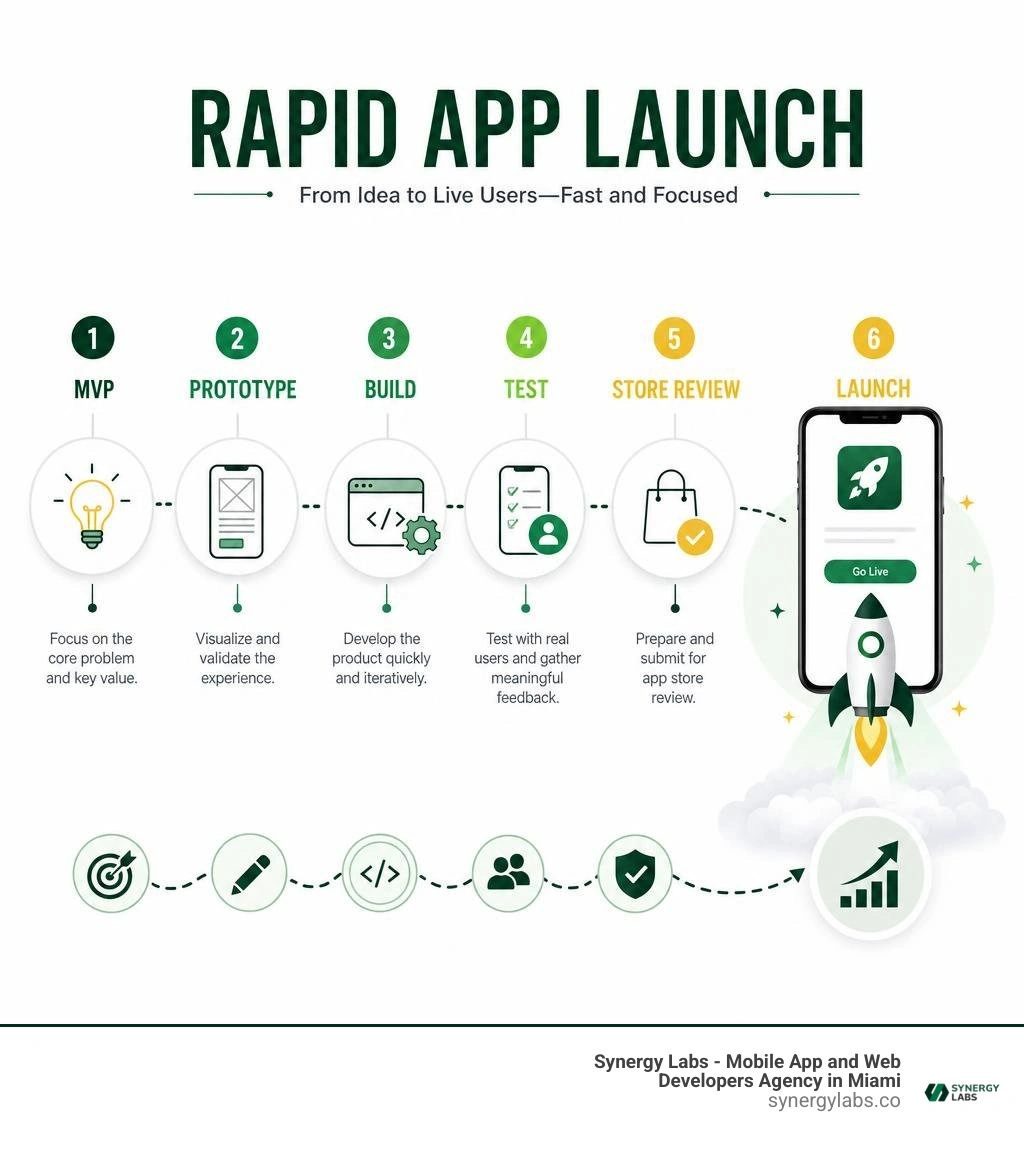
A rapid launch isn't about rushing — it's about shipping the right first version fast enough to test demand, learn from real users, and avoid building features nobody needs.
A rapid app launch is a focused way to take a validated core product from idea to live users quickly - often by building an MVP, testing it with real people, and improving it after release rather than waiting for every possible feature.
For a startup founder, the goal is not to rush out a fragile app. It is to launch the right first version fast enough to test demand, learn from customers, and avoid spending months building features nobody needs.
Key priorities of a rapid launch and why they matter:
Core user problem: Keeps the first release useful and focused.
Clickable prototypes and early testing: Finds UX issues before expensive development work.
Cross-platform delivery: Reaches iOS and Android users without duplicating effort.
Security and store readiness: Prevents speed from becoming a costly compliance problem.
Fast feedback after launch: Turns real behavior into smarter product decisions.
Traditional development can spend long stretches on fixed requirements before users see anything. Rapid Application Development (RAD) takes a different view: build a functional version early, put it in front of users, and refine based on evidence. That approach can reduce early capital risk and shorten the distance between a business hypothesis and a real market signal.
There is one important reality check: app development may move quickly, but app store setup, privacy disclosures, code signing, and review still need time. Apple reviews commonly take 1 to 3 days, while Google Play reviews may take hours to 2 days. A practical launch plan accounts for those steps instead of treating them as an afterthought. Speed is useful; surprise rejection emails are less exciting.
As Director of Product at Synergy Labs, I will walk through the decisions that help teams move quickly while protecting user experience, security, and room to scale.
What Is Rapid Application Development and How It Drives a Rapid App Launch
To understand how a modern rapid app launch works, we have to look at its underlying philosophy: Rapid Application Development (RAD). Originally introduced by computer scientist James Martin in the late 1980s and formalized in his 1991 framework, RAD emerged as a direct rebellion against the rigid, paper-heavy software models of the era. Martin recognized that trying to write down every software requirement up front was like trying to predict the weather six months in advance — technically ambitious, but practically impossible.
In 2026, RAD has evolved from 1990s desktop tools into modern cross-platform mobile app development. At its heart, RAD is a user-centered philosophy built on adaptive planning rather than immovable specifications. Instead of spending six months writing documentation, we build usable prototypes early and often. This allows us to put working software directly into hands-on testing environments where real users can click, scroll, and offer feedback.
By adopting this mindset, digital products align far better with real user expectations. When market dynamics shift, or when initial user testing reveals that a feature isn't as intuitive as we thought, we don't need a massive change-order committee. We adjust dynamically. As explored in our article on how to Launch First, Refine Later: Agile Development in the New Age, shortening the distance between initial design concepts and production deployment is the single best way to protect capital while validating core business goals.
RAD vs. Traditional Waterfall and Agile Methodologies
When choosing a software development lifecycle for a rapid app launch, understanding the core differences between development frameworks is essential.
The traditional Waterfall methodology follows a strict, sequential process: requirements, system design, implementation, verification, and maintenance. Testing is deferred until the very end of the engineering cycle. If a fundamental flaw in user experience or technical design is uncovered during final testing, fixing it is extraordinarily expensive. Waterfall works well for safety-critical hardware or flight control systems, but for consumer and enterprise mobile applications, it often leads to delayed market readiness and inflated budgets.
Agile development improved on Waterfall by breaking work down into two-week feature sprints. However, standard Agile can sometimes suffer from endless sprint loops without a clear focus on launching a complete product.
This is where RAD shines. While Agile focuses on delivering small, incremental user stories sprint after sprint, RAD prioritizes building interactive prototypes of the entire product experience right away. Industry data shows that applying RAD principles can help bring enterprise applications to market in half the time and at one-third of the traditional cost.
Choosing between these frameworks comes down to technical complexity, regulatory demands, and time-to-market priorities. When speed and market validation are critical, as discussed in our guide on App Building: When to Prioritize Speed Over Perfection, RAD provides the ideal middle ground: high-speed interactive validation paired with disciplined software engineering.
The 4 Essential Phases of the RAD Framework
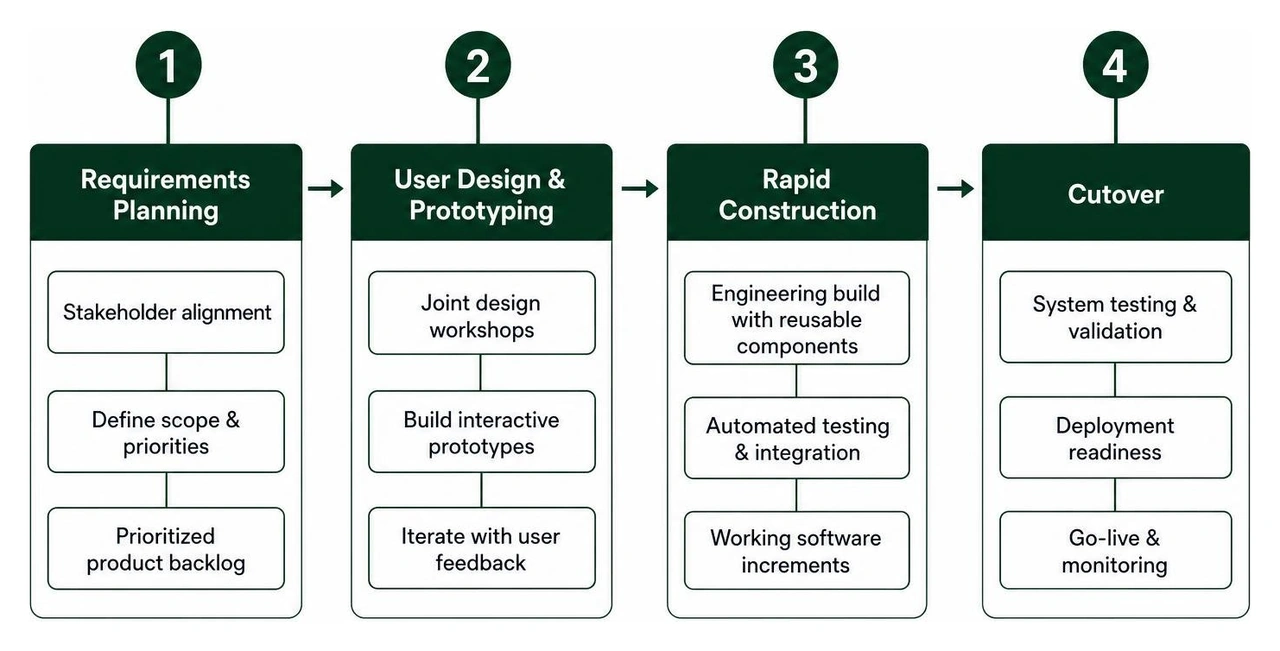
The RAD framework simplifies the software engineering process into four distinct, highly collaborative phases designed to minimize friction and maximize feedback.
Phase 1: Requirements Planning. Unlike traditional development models that demand months of specification writing, RAD condenses requirements gathering into short, focused sessions. Key business stakeholders, product designers, and lead developers come together to define the project scope, identify core user pain points, and outline non-negotiable features. The output is a clear, prioritized product backlog rather than a heavy manual.
Phase 2: User Design and Prototyping. This is the core engine of RAD. Developers and designers conduct Joint Application Design (JAD) workshops to build interactive, functional prototypes. Users test these prototypes in real time, providing immediate input on navigation flow, layout, and functionality. We iterate on these prototypes repeatedly until the user experience feels seamless.
Phase 3: Rapid Construction. Armed with a validated prototype, the engineering team moves directly into build mode. Using reusable modular components, pre-built backend services, and automated testing tools, developers convert interactive designs into production-ready software. Because users already validated the design in Phase 2, developers build with confidence, avoiding major mid-code rework.
Phase 4: Cutover and Deployment. The final phase covers system integration, user acceptance testing (UAT), data migration, and cloud environment configuration. Sandbox testing guarantees that security protocols, data encryption, and server capacity are thoroughly audited before the app is pushed live to end users.
Weighing Pros and Cons: Speed, Flexibility, and Scope Control
Adopting a rapid application delivery strategy offers significant strategic benefits, but it also introduces specific operational trade-offs that teams must manage actively.
On the positive side, the advantages are compelling:
Significantly lower development expenditure due to fewer wasted hours on unwanted features.
Early market entry, allowing startups and enterprises to capture market share months ahead of competitors.
Early bug detection through continuous user engagement, preventing costly post-delivery architecture overhauls.
Higher overall client and user satisfaction because the end product is shaped directly by early user feedback.
However, speed without discipline introduces real risks. The most common pitfall in a rapid app launch is feature creep. Because RAD embraces continuous user input, unmanaged client requests can expand the project scope uncontrollably. To prevent this, teams must enforce strict time-boxing — setting rigid delivery dates and constraining features to fit those windows rather than letting deadlines slip.
Furthermore, RAD requires direct, active involvement from senior technical talent and business stakeholders throughout the project. If domain experts are unavailable to answer questions or review prototypes during iterative cycles, the fast feedback loop breaks down. Maintaining structural safety, regulatory compliance, and clean architectural design requires skilled developers who know how to build quickly without accumulating unmanageable technical debt.
Strategic Roadmap: Key Steps from Prototype to App Store Deployment
Executing a successful rapid app launch requires a clear technical strategy. To achieve rapid speed to market across both major mobile platforms, modern development relies heavily on cross-platform frameworks such as React Native and Flutter. Building a single, high-performance codebase that runs natively on both iOS and Android instantly cuts engineering efforts in half while maintaining smooth 60-fps native performance.
Alongside cross-platform frameworks, establishing flexible cloud infrastructure is vital. Leveraging microservices architecture and serverless environments allows applications to scale auto-magically when user traffic surges post-launch. Designing modular component systems and well-documented API integration layers ensures that adding third-party tools — such as payment gateways, analytics trackers, or user authentication providers — requires hours rather than weeks.
To keep code moving smoothly from local developer workstations to production environments, we set up continuous integration and continuous deployment (CI/CD) pipelines right from day one. Automated build checks, syntax linting, and unit test suites run automatically with every code push, guaranteeing that technical quality remains uncompromised even at high speeds.
Rapid Prototyping to Accelerate Your Rapid App Launch
Prototyping is the absolute heart of any accelerated development initiative. Rather than handing engineers static design comps or abstract text descriptions, we build clickable, functional UI/UX wireframes early in the process.
This approach delivers substantial benefits. First, interactive prototypes allow non-technical founders and enterprise stakeholders to experience the app's workflow before heavy engineering begins. Second, observing real users interact with a functional prototype reveals usability flaws early — such as a confusing checkout button or an unclear navigation menu — long before backend APIs are hooked up.
To accelerate this phase, modern product teams rely on design token libraries and pre-built design systems. By leveraging modular component libraries, design-to-code conversion happens at lightning speed. As highlighted in our analysis of The Benefits of Building a Minimum Viable Product (MVP) First, establishing early interactive feedback loops allows product managers to ruthlessly trim non-essential "nice-to-have" features, reserving them for post-launch updates while focusing engineering energy on core user value.
Leveraging Low-Code, No-Code, and AI for Speed
In 2026, the technology stack supporting rapid development has been transformed by low-code platforms, visual application builders, and artificial intelligence. These modern tools execute the vision James Martin outlined decades ago, empowering both professional software engineers and non-technical business builders.
AI utilities now serve as powerful accelerants throughout the development pipeline:
Automated code generation tools create standard boilerplate code, database schemas, and API integration endpoints instantly.
AI-driven debugging utilities scan codebases in real time to spot memory leaks, security vulnerabilities, and syntax bugs before human code reviews take place.
For secondary internal administration screens, reporting dashboards, or basic database management portals, low-code and visual building platforms eliminate traditional developer handoffs completely. This allows senior engineers to focus exclusively on custom, high-performance algorithms, custom hardware integrations, and complex business logic.
However, speed automation must be balanced with strict enterprise governance. Relying blindly on automated code generators without human review can introduce hidden security flaws or unmaintainable code structures. High-speed automation should always be paired with expert technical oversight to preserve long-term maintainability and performance.
App Store Submission: Navigating Apple and Google Play Reviews
Building the app is only half the battle; getting it published on the Apple App Store and Google Play Store is where many inexperienced teams encounter unexpected roadblocks. Navigating app store requirements requires meticulous preparation.
To launch a mobile application, developers must register official developer credentials:
An Apple Developer Account, which carries an annual fee of $99 and requires organizational identity verification.
A Google Play Developer Account, which requires a one-time fee of $25.
Beyond accounts, store compliance requires compiling mandatory metadata, privacy disclosures, terms of service agreements, data safety declarations, content rating questionnaires, and high-resolution assets (including 1024x1024 pixel application icons and device-specific screenshots). Managing code signing certificates, provisioning profiles, and build release tracks in Google Play Console and App Store Connect can quickly become administrative bottlenecks if not handled systematically. Utilizing automated deployment resources and official guidelines, such as Apple Developer Documentation, can illustrate how automated release workflows simplify certificate management and metadata preparation.
Timeline expectations must be realistic. On average, Apple reviews submissions within 1 to 3 days, whereas Google Play reviews generally take between a few hours and 2 days. However, a smooth submission pipeline typically spans 10 to 14 days total from initial build setup to going live. This timeline accommodates potential initial rejections, which are routine in mobile development. Whether an app is flagged for a missing privacy policy URL or a minor interface compliance detail, treating submission feedback as an iterative step ensures a stress-free launch.
User Feedback Integration and Avoiding Critical Launch Pitfalls
Launching an application rapidly does not mean releasing buggy code into the wild and hoping for the best. On the contrary, maintaining high software quality requires structured pre-launch testing protocols.
Before public release, applications should be distributed to controlled groups of beta testers using sandbox environments such as Apple TestFlight and Google Play Beta Testing. Beta distribution lets teams evaluate how the application performs across dozens of distinct physical hardware devices, screen resolutions, operating system versions, and real-world network connectivity levels (such as switching between 5G and spotty Wi-Fi).
Crucially, data privacy and security compliance checks must be built into rapid delivery pipelines. Verifying compliance with regulations like GDPR and CCPA, verifying SSL/TLS encryption for all data in transit, and auditing OAuth user authentication flows must occur before submission. Automated regression testing suites and vulnerability scanning tools protect app integrity, ensuring that rapid speed never comes at the expense of user privacy or brand reputation.
Establishing Feedback Loops in Iterative Cycles
Once your application is live in the stores, the rapid development loop enters its most exciting phase: continuous post-launch iteration. A successful launch is simply the start of an ongoing conversation with your real user base.
To capture actionable user insights, we embed telemetry tools directly into the application from day one:
In-app feedback widgets that allow users to report bugs or submit feature suggestions directly from their mobile screen.
Automated crash reporting utilities (such as Firebase Crashlytics) that instantly log stack traces and device state whenever an unexpected error occurs.
Behavioral analytics platforms that track user navigation paths, feature engagement rates, and drop-off points during onboarding.
This live operational telemetry converts raw user behavior into a prioritized product backlog. Instead of guessing what to build next, product teams conduct fast, weekly iteration sprints to solve real user friction points. As demonstrated across modern tech initiatives, rapid market adaptations driven by real-time user metrics consistently separate market leaders from forgotten apps.
Mitigating Common Risks in a Rapid App Launch
Navigating a rapid app launch requires dodging several well-known operational landmines. Uncontrolled feature growth, unaddressed security vulnerabilities, and team burnout are real risks when pushing for tight release dates.
To mitigate these risks effectively:
Enforce rigid scope control mechanisms. Use strict product backlog grooming to push non-critical feature requests into post-launch updates. As detailed in our guide on Breaking the Build Loop: How to Launch Smarter with Strategic MVP Planning in 2026, keeping the launch scope lean is the single best way to avoid endless build loops.
Implement automated security testing. Run continuous static and dynamic security analysis on code repositories to catch software vulnerabilities before code hits production.
Protect backend scalability. Use cloud infrastructure auto-scaling and database connection pooling to handle unexpected surges in user sign-ups immediately following press releases or marketing campaigns.
Maintain sustainable engineering cadences. Avoid developer burnout by using modular code structures, component reuse, and sensible time-boxing rather than relying on endless late-night crunch sessions.
Project Suitability: When to Use RAD and When to Avoid It
While rapid application strategies offer enormous benefits, they are not universally suitable for every digital product. Knowing when to apply RAD — and when to step back — is a vital strategic decision.
RAD excels in scenarios characterized by evolving, non-static user requirements where early market validation yields huge dividends. Perfect use cases include:
Early-stage startup MVPs designed to validate value propositions and secure venture funding quickly. As showcased in our case study on Building an MVP in Chicago: Idea to App Store in 8 Weeks, rapid development can take a fresh concept to live store listings in a matter of weeks.
Consumer web and mobile utility applications competing in fast-moving commercial markets.
Enterprise internal business automation tools, custom B2B portals, and workflow dashboards where direct employee feedback shapes feature development.
Conversely, RAD should be avoided for safety-critical or heavily regulated mission-critical systems. Life-support medical device software, flight control systems, nuclear infrastructure controls, and high-frequency core banking engines demand formal mathematical verification, exhaustive upfront documentation, and stringent regulatory audits. In those non-negotiable risk environments, speed takes a backseat to exhaustive structural validation.
Frequently Asked Questions
What is the typical timeline for a rapid app launch?
A standard rapid app launch timeline typically spans between 4 to 8 weeks for core product development, followed by a 10 to 14 day submission and app store approval window.
The exact duration depends on overall application complexity, the number of custom API integrations required, and the readiness of backend data structures. By using cross-platform development frameworks, pre-built component libraries, and visual prototyping tools, basic utility applications and streamlined MVPs can routinely achieve initial live release status on the Apple App Store and Google Play Store in a fraction of traditional software development timelines.
How does RAD differ from standard Agile software development?
While both methodologies prioritize flexibility and iterative delivery, their primary focus differs significantly. Standard Agile methodologies (such as Scrum) break software development into fixed feature sprints, focusing on delivering small, incremental user stories sprint after sprint.
In contrast, Rapid Application Development (RAD) centers heavily on creating functional, clickable prototypes of the complete application experience right at the start. RAD prioritizes immediate, holistic user testing across full system workflows, leveraging reusable component libraries and automated code generation tools to assemble end-to-end working software rapidly.
What projects are best suited for rapid application development?
RAD is ideal for early-stage startup Minimum Viable Products (MVPs), customer-facing SaaS platforms, mobile utility apps, e-commerce prototypes, and enterprise business process automation tools.
It thrives best in competitive markets where business requirements evolve continuously based on user input, and where getting a working product into users' hands quickly provides a crucial first-mover market advantage.
Ready to Accelerate Your Mobile Product Strategy?
Executing a rapid app launch is the most efficient strategy for modern businesses to validate ideas, capture market share, and deliver digital products that users love. By replacing rigid upfront planning with interactive prototyping, modular cross-platform engineering, and real-time user feedback loops, you dramatically lower capital risk while accelerating time to market.
At Synergy Labs, we specialize in turning ambitious application ideas into high-performing, scalable digital realities across our global hubs in Miami FL, San Francisco CA, Austin TX, New York City NY, Chicago IL, Phoenix AZ, Hartford CT, London UK, Dubai UAE, Riyadh Saudi Arabia, and Doha Qatar. Our unique hybrid development model pairs you with an experienced in-shore CTO who oversees your project architecture while directing a high-velocity development team.
We protect your investment with a transparent fixed-budget model and milestone-based payments, ensuring your project is completed efficiently, securely, and without budget surprises. From initial visual wireframing to managing complex store submissions, our senior talent delivers cross-platform excellence tailored to your business goals.
Ready to take your product from concept to the App Store and Google Play? Explore our expert mobile and web software solutions by visiting Transform Your Product Idea with Synergy Labs Services and schedule a strategy session with our technical team today!



.avif)

.avif)


