"The change of how companies operate, moving far beyond simple chatbots to become specialized tools that handle complex business processes with precision and speed. "
Top GPT Wrapper Use Cases for Business Automation in 2026 are changing how companies operate, moving far beyond simple chatbots to become specialized tools that handle complex business processes with precision and speed.
Quick Answer: The Top GPT Wrapper Use Cases for Business Automation in 2026
Customer Support Automation - Intelligent ticket routing, sentiment analysis, and 24/7 personalized responses
Content Creation & Marketing - SEO-optimized articles, social media variations, and email campaigns at scale
Sales & Lead Management - Call analysis, personalized follow-ups, and automated RFP responses
HR & Recruitment - Smart resume screening with contextual understanding and inclusive job descriptions
The AI landscape in 2026 looks nothing like it did two years ago. Back then, most companies were still asking "What is ChatGPT?" Today, the question has shifted to "How do we integrate this into our actual workflow?"
That's where GPT wrappers come in. These aren't just repackaged chatbots—they're specialized applications built on top of foundation models like GPT-4, designed to solve specific business problems. Think of them as the difference between owning a Swiss Army knife and having a full toolbox. Both use the same core technology, but one is purpose-built for the job.
The statistics tell an interesting story. Research shows that 78% of AI startups launched in 2024 are essentially API wrappers—applications that take a foundation model and wrap it in custom logic, interfaces, and integrations. But here's the catch: many fail because they don't add enough value. The ones that succeed? They deeply understand their users' workflows and build automation that actually saves time.
Freelancers spend 30+ hours monthly on invoicing and client onboarding. Business owners spend 2.6 hours daily just on email. Recruiters dedicate 23 hours screening 250 resumes for a single hire. These aren't small problems—they're massive time sinks that GPT wrappers are uniquely positioned to solve.
But not all wrappers are created equal. The difference between a tool that gets abandoned after 90 days (the average churn rate for wrapper startups is 65%) and one that becomes indispensable comes down to three things: deep integration with existing tools, customization for specific workflows, and security that enterprises can trust.
This article will walk you through the most impactful use cases, show you what features matter, and help you understand how to implement these tools strategically—not just because AI is trendy, but because automation done right creates a genuine competitive advantage.
As someone who's led AI integration projects at Synergy Labs, I've seen how Top GPT Wrapper Use Cases for Business Automation in 2026 are reshaping industries—from customer service to sales to internal operations. The companies winning aren't the ones with the most AI tools; they're the ones using AI to eliminate bottlenecks and free their teams to focus on high-value work.
Learn more about Top GPT Wrapper Use Cases for Business Automation in 2026:
What Are GPT Wrappers and Why Are They a Game-Changer for Business?
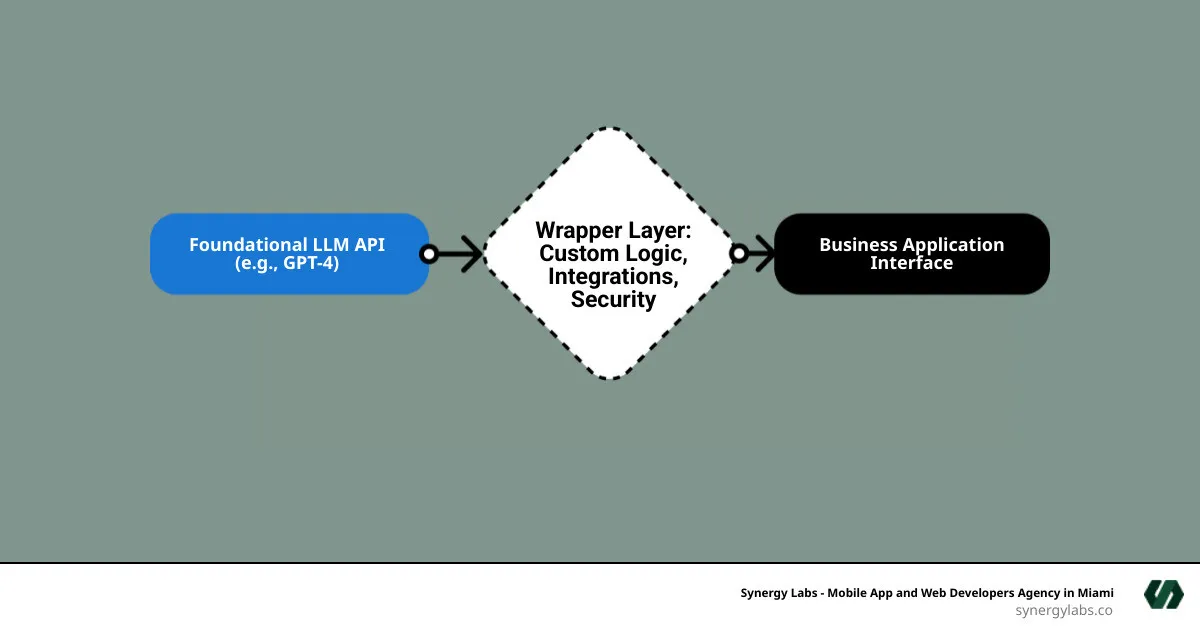
At its core, a GPT wrapper is a specialized application built on top of a large language model (LLM) API, like those offered by OpenAI. Instead of interacting directly with the raw, general-purpose LLM, businesses use a wrapper that adds custom logic, pre-configured prompts, specific workflows, and integrations with other business tools. This creates a tool that is highly specialized for a particular task, making the powerful AI accessible and actionable for everyday business processes. It's the difference between a raw engine and a finely tuned car designed for a specific purpose, like a luxury sedan or a rugged SUV.
The distinction between direct API use and leveraging a wrapper is crucial. Using an LLM API directly often requires significant technical expertise to build and maintain an application. A GPT wrapper, however, abstracts away much of that complexity. It provides a user-friendly interface and pre-built functionalities that cater to specific business needs, without requiring a developer for every interaction.
The advantages of using a wrapper for business automation are compelling:
Faster Deployment: Wrappers come with pre-built components and integrations, significantly reducing the time it takes to get an AI solution up and running. This means quicker time-to-value for your automation efforts.
Lower Technical Barrier: Businesses can implement sophisticated AI automation without needing a team of AI researchers or deep coding expertise. The wrapper handles the complex interactions with the LLM.
Cost-Effectiveness: While direct API usage might seem cheaper initially, the development, maintenance, and optimization costs can quickly add up. A well-designed wrapper, especially if it's a custom solution custom to your needs, can provide a more predictable and often lower total cost of ownership by streamlining processes and reducing manual effort.
Improved Security and Control: Custom wrappers allow businesses to implement their own security protocols, data handling policies, and access controls around the LLM. This is vital for sensitive business data, ensuring it remains within your organizational boundaries.
While the "AI hype + pretty interface = instant SaaS business" model has led to a proliferation of what some call "expensive wrappers" (with an average 65% churn rate within 90 days for AI wrapper startups), the successful ones demonstrate genuine innovation at the application layer. They don't just put a new coat of paint on a generic LLM; they transform it into an indispensable tool. As we’ve explored, these wrappers are about accelerating your AI product development by focusing on specific, high-value problem-solving.
The Top GPT Wrapper Use Cases for Business Automation in 2026
The shift towards Top GPT Wrapper Use Cases for Business Automation in 2026 isn't just about adopting new technology; it's about fundamentally rethinking how work gets done. Businesses are leveraging these specialized AI tools to open up unprecedented levels of efficiency, reduce operational costs, and free up their human talent for more strategic, creative tasks. We're seeing a true change across various departments, from the front lines of customer interaction to the intricate details of internal knowledge management.
Hyper-Personalized Customer Support: A Key Use Case for Business Automation in 2026
Customer service is often the first touchpoint for AI automation, and for good reason. GPT wrappers are revolutionizing how companies handle inquiries, moving beyond basic chatbots to provide truly intelligent and empathetic support.
Automated Ticket Responses and Intelligent Routing: Imagine an AI that can not only understand a customer's query but also instantly categorize it, prioritize it, and draft a personalized, accurate response. These wrappers can analyze incoming tickets, extract key information, and route them to the most appropriate human agent or department, significantly reducing resolution times.
Sentiment Analysis and Proactive Issue Resolution: Advanced wrappers can analyze the sentiment of customer communications, flagging frustrated customers for immediate human intervention or even predicting potential issues before they escalate. This proactive approach can transform customer satisfaction.
Knowledge Base Generation and CRM Integration: GPT wrappers can dynamically generate answers from vast internal knowledge bases and integrate seamlessly with CRM systems. This means support agents (or the AI itself) have instant access to customer history, preferences, and product information, leading to more informed and efficient interactions. We've seen examples where AI-powered support tools reduced customer call center volume by 40% for an e-commerce client.
Industries seeing the most significant impact include e-commerce, SaaS, and finance, where high volumes of customer inquiries and the need for rapid, accurate responses are paramount.
Intelligent Content Creation and Marketing Automation
Content is king, but creating it can be a time-consuming, repetitive task. GPT wrappers are empowering marketing teams to produce high-quality, targeted content at scale, driving engagement and growth.
SEO-Optimized Articles: Wrappers can integrate with SEO tools to research keywords, analyze search engine results page (SERP) competition, and then generate complete, optimized articles. This can dramatically reduce the manual effort involved in content creation. We've even heard anecdotes of founders making $5K/month with automated SEO content software, a testament to its potential.
Social Media Variations and Email Campaigns: Adapting one piece of content for multiple social media platforms (LinkedIn, Instagram, X, Facebook) usually takes 20+ minutes per piece. GPT wrappers can be fine-tuned on platform best practices to automatically adapt tone, length, and style. The same applies to generating personalized email campaign sequences, saving content creators hours daily.
Product Descriptions and Ad Copy: For e-commerce businesses, generating unique and compelling product descriptions for hundreds or thousands of items can be a huge bottleneck. Wrappers can automate this, along with testing numerous ad copy variations to optimize campaign performance.
This automation is making a significant impact in marketing, e-commerce, and publishing, allowing businesses to maintain a consistent brand voice across all channels without the associated manual overhead.
Sales teams are always looking for an edge, and GPT wrappers are providing it by automating time-intensive tasks and offering deeper insights into customer interactions.
Sales Call Analysis: Wrappers can transcribe and analyze sales calls, identifying successful talk tracks, common objections, and key win/loss patterns. This provides sales managers with actionable insights for coaching their teams and improving close rates.
Personalized Follow-up Emails: After a call or meeting, generating personalized follow-up emails that reference specific discussion points can be automated, ensuring timely and relevant communication without manual drafting.
Lead Data Enrichment: By integrating with various data sources, wrappers can enrich lead profiles with publicly available information, helping sales reps tailor their approach.
RFP Response Generation: Companies often spend 20-40 hours responding to Requests for Proposals (RFPs), with a manual response win rate of only 44%. GPT wrappers can maintain a knowledge base of company capabilities and automatically match RFP requirements to relevant content, generating accurate draft responses much faster and increasing submission volume.
These solutions are particularly impactful in B2B sales and enterprise software, where complex sales cycles demand efficiency and precision.
Research on improving sales processes
Optimizing HR and Recruitment: A Top GPT Wrapper Use Case for Business Automation in 2026
The human resources and recruitment functions are ripe for AI-driven automation, especially when it comes to sifting through large volumes of data and ensuring fair, efficient processes.
Smart Resume Screening with Contextual Understanding: Recruiters spend an average of 23 hours screening 250 resumes per hire, often dedicating only 6 seconds per resume. Generic keyword filters miss qualified candidates. GPT wrappers can deeply understand job requirements and score resumes based on transferable skills, project relevance, and cultural fit, providing detailed explanations for each scoring decision. This reduces screening time by up to 60% and helps identify "hidden gems."
Inclusive Job Descriptions: Biased language in job descriptions can reduce applications from qualified candidates by 30-40%. Wrappers can be trained on inclusive language patterns to analyze job descriptions, flag exclusionary terms, and suggest alternatives, promoting diversity and inclusion in hiring.
Automated Candidate Communication: From initial acknowledgments to scheduling interviews and providing updates, AI can automate much of the repetitive communication with candidates, ensuring a positive experience.
All industries benefit from these advancements, but large corporations with high recruitment volumes see particularly significant gains. This is a prime example of agentic AI, where autonomous agents handle complex, multi-step processes.
Enhancing Internal Operations and Knowledge Management
Beyond customer-facing roles, GPT wrappers are changing internal workflows, making teams more productive and ensuring critical knowledge isn't lost.
Meeting Summaries and Automated Documentation: Professionals spend hours writing meeting notes and documentation. Wrappers can transcribe meetings (from Google Meet, Zoom, Teams) and transform them into polished documents with executive summaries, action items, and key decisions. This saves 3-4 hours weekly per professional.
Agenda Generation from Slack/Email: Teams waste 30% of meeting time on unclear agendas. GPT wrappers can analyze Slack conversations, email threads, and project updates to automatically generate relevant meeting agendas, integrating them directly into calendar tools.
Capturing Institutional Knowledge: When engineers leave, critical project context often disappears, making onboarding new developers a lengthy process. AI-powered systems can "interview" departing team members, asking structured questions about projects and automatically generating searchable documentation. This can reduce onboarding time by 50% or more.
AI Email Assistants: Business owners spend 2.6 hours daily (28% of their workday) on email. AI email assistants, built as GPT wrappers, can understand email history and business context to auto-categorize and draft responses, saving 5+ hours weekly.
These applications are particularly impactful in tech, consulting, and remote-first companies where efficient communication and access to up-to-date information are critical.
Implementing GPT Wrappers: Strategy, Security, and ROI
Implementing Top GPT Wrapper Use Cases for Business Automation in 2026 is about more than just picking a cool new tool; it requires a strategic approach that considers features, mitigates risks, and clearly defines the return on investment. We believe in moving beyond simple tools to create solutions that are truly integrated and transformative.
Key Features to Look for in an Automation Solution
When evaluating GPT wrappers or considering building a custom solution, several key features stand out as essential for business automation in 2026:
Seamless Integrations: The best wrappers don't operate in a vacuum. They connect effortlessly with your existing CRM, ERP, project management tools, communication platforms, and other business software. This ensures data flows smoothly and automation becomes a natural part of your workflow.
Customization and Fine-tuning: Generic AI responses won't cut it for long. Look for solutions that allow you to fine-tune the model with your proprietary data, embed your brand voice, and implement custom prompts that drive specific outcomes. This is where the real value lies.
Scalability: As your business grows, your AI solutions must grow with it. Ensure the wrapper can handle increasing data volumes, user loads, and complex workflows without compromising performance.
Robust Security Protocols: Given the sensitive nature of business data, top-tier encryption, secure API key management, and compliance with industry standards are non-negotiable.
User-Friendly Interface: An intuitive and easy-to-use interface ensures high adoption rates and minimizes the learning curve for your team.
Analytics and Reporting: The ability to track performance, identify bottlenecks, and measure the impact of your automation efforts is crucial for continuous improvement and demonstrating ROI.
While the potential of GPT wrappers is immense, we must also acknowledge and proactively address the inherent challenges and risks.
Data Privacy and Security: This is often the top concern for businesses. When dealing with sensitive company data, robust encryption, secure API key management, and potentially private cloud deployment options are critical. Compliance with regulations like the EU AI Act is paramount, especially for our clients in London, Dubai, and Doha. We ensure that our solutions adhere to the highest standards.
Model Accuracy and Hallucinations: LLMs, while powerful, can sometimes generate inaccurate or nonsensical information (hallucinations). To mitigate this, a "human-in-the-loop" review process is essential for critical tasks, allowing human oversight before final actions are taken. Retrieval-Augmented Generation (RAG) techniques, which ground AI responses in verified internal data, also significantly improve accuracy.
Vendor Lock-in and the "Thin Wrapper" Problem: Many early AI wrapper startups offered generic solutions that were easily replicated or superseded by direct LLM providers. This led to high churn rates. The key to avoiding vendor lock-in and becoming a "real moat" for your business is to build a wrapper that is deeply integrated, customized with your proprietary data, and solves a unique, complex problem. As we explore in Are GPT Wrappers the Real Moat, the true value lies in the application layer innovation.
How to Evaluate the ROI of Your Automation Investment
Measuring the Return on Investment (ROI) for GPT wrapper solutions is crucial for justifying the investment and demonstrating tangible business value. We focus on both quantitative and qualitative metrics.
Quantitative Metrics:
Time Saved: Track the hours saved by automating tasks previously performed manually (e.g., 30+ hours monthly for freelancers, 2.6 hours daily on email).
Cost Reduction: Calculate savings from reduced labor costs, fewer errors, and optimized resource allocation.
Increased Output/Throughput: Measure the increase in content generated, customer inquiries handled, or leads processed.
Improved Accuracy: Quantify the reduction in errors or the increase in successful outcomes (e.g., higher RFP win rates).
Qualitative Metrics:
Employee Morale and Satisfaction: Automated tedious tasks free employees for more engaging, high-value work, boosting morale.
Customer Satisfaction: Faster, more personalized service leads to happier customers.
Competitive Advantage: The ability to innovate faster and operate more efficiently positions your business ahead of the curve.
A simple ROI formula for an automation project might involve comparing the total cost of implementation and ongoing operation (including API token costs and integration expenses) against the monetary value of time saved, increased output, and improved quality. We find that the true ROI often emerges when we look at the total cost of ownership over time.
As we peer into 2026 and beyond, the evolution of GPT wrappers is pointing towards a future dominated by autonomous AI agents. These aren't just tools that respond to prompts; they are systems capable of planning, executing multi-step workflows, and adapting to dynamic environments.
Autonomous Agents and Multi-Step Workflows: The next generation of GPT wrappers will feature increasingly autonomous agents. OpenAI's own Computer-Using Agent (CUA) model, currently in preview, combines advanced reasoning with vision capabilities (GPT-4o) to simulate controlling computer interfaces and performing tasks across applications. Imagine an AI that can not only draft an email but also log into your CRM, pull relevant customer data, and send the email, then update the CRM record—all without direct human intervention at each step.
Multi-Modal Integration: The future is not just text. Wrappers will seamlessly integrate text, image, voice, and video inputs and outputs. This means an agent could analyze a product image, generate a description, and then create a social media video with an AI-generated voiceover.
Hyper-Personalization: As AI models become more sophisticated, wrappers will enable an even deeper level of personalization, understanding individual user preferences, work styles, and even emotional states to deliver custom experiences.
The "Micro-Stack" Revolution: We are seeing a trend where startups are replacing large, monolithic platforms with single-purpose AI tools—the "Micro-Stack" revolution. These highly specialized GPT wrappers, often designed to solve one very specific pain point, can be combined to create powerful, custom workflows. This democratization of AI empowers smaller businesses and even individual users to build sophisticated automation.
The companies that will thrive in this environment are those that accept "AI-First" development, embedding AI deeply into the core of their products and processes.
From Automation to Advantage: Building Your AI Future
The journey into Top GPT Wrapper Use Cases for Business Automation in 2026 is not merely about adopting technology; it’s about strategic integration and building a lasting competitive advantage. We’ve explored how these specialized AI applications can revolutionize customer support, marketing, sales, HR, and internal operations, changing time-consuming tasks into seamless, efficient workflows. The potential for cost savings, efficiency gains, and improved productivity is undeniable.
The key takeaway is this: success doesn't come from simply "using AI," but from intelligently applying it to solve specific business problems. The future belongs to those who view GPT wrappers not as a fleeting trend, but as the foundational layer for a more agile, intelligent, and human-centric business.
At Synergy Labs, we specialize in crafting custom AI solutions that are perfectly aligned with your business objectives. We understand that generic tools often fall short, which is why we offer a personalized service with direct access to senior talent. Our unique fixed-budget model, combined with an in-shore CTO and offshore dev team, ensures cost predictability and efficient execution. We also use milestone-based payments, so you only pay for tangible progress, guaranteeing that your projects are completed efficiently and to your exact specifications.
Ready to transform your business operations and leverage the power of custom AI? Let's build something extraordinary together.





.avif)

.avif)


