Why Enterprise App Development is No Longer Optional in 2026
The Complete Guide to App Development for Enterprise Solutions in 2026 addresses a critical shift: mobile and web applications are now the operational backbone of competitive enterprises. Here's what you need to know:
Enterprise apps are strategic infrastructure, not vanity projects—they streamline operations, automate workflows, and integrate with systems like ERP and CRM
The global enterprise application market is projected to reach USD 625.66 billion by 2030, up from USD 320.40 billion in 2024
Three core pillars define success: scalability (cloud-native, microservices), security (DevSecOps, encryption, compliance), and intelligence (AI, automation, analytics)
Development timelines range from 2-4 months for an MVP to 8-18+ months for complex systems, with costs spanning $30,000 to $250,000+
Maintenance accounts for 15-25% of annual budgets, making ongoing support a critical planning factor
Cross-platform frameworks can reduce development time and cost by up to 40% compared to building separate native apps
The business landscape in 2026 demands agility, integration, and relentless efficiency. Fragmented IT stacks slow decision-making and increase costs, while AI, cloud-native architecture, and security-first design have become baseline expectations. The narrative has shifted—it's not about building a single app, but a full enterprise app ecosystem.
Inside your organization, mobile apps are central to how work gets done. From logistics tracking to HR tasks, enterprise mobile apps deliver tangible improvements in efficiency and engagement. Businesses that build apps with a clear purpose, reliable performance, and strong data governance are positioned for growth.
This guide covers everything from strategy and core pillars to the development process, costs, and partner selection. Whether launching your first enterprise app or rescuing a project, you'll find a clear roadmap for 2026 and beyond.
As a mobile app and web development agency based in Miami, we've helped enterprises in healthcare, logistics, fintech, and SaaS build scalable, secure applications that drive business outcomes. We've seen how a strategic approach to app development transforms concepts into competitive advantages. Our model combines an in-shore CTO for strategic oversight with a dedicated offshore development team, delivered within a fixed budget and milestone-based payments to keep projects on track.
The Complete Guide to App Development for Enterprise Solutions in 2026 word guide:
Foundations: What is Enterprise App Development in 2026?
At its core, enterprise application development is the creation of complex, scalable software designed to streamline operations across an entire organization. It fuses multiple departments into a cohesive system, allowing companies to manage operations, data, and tools from a single platform. These apps are built to handle intricate workflows, large data volumes, and robust security requirements.
Enterprise vs. Consumer App Development: A Tale of Two Worlds
Enterprise app development differs significantly from consumer app development:
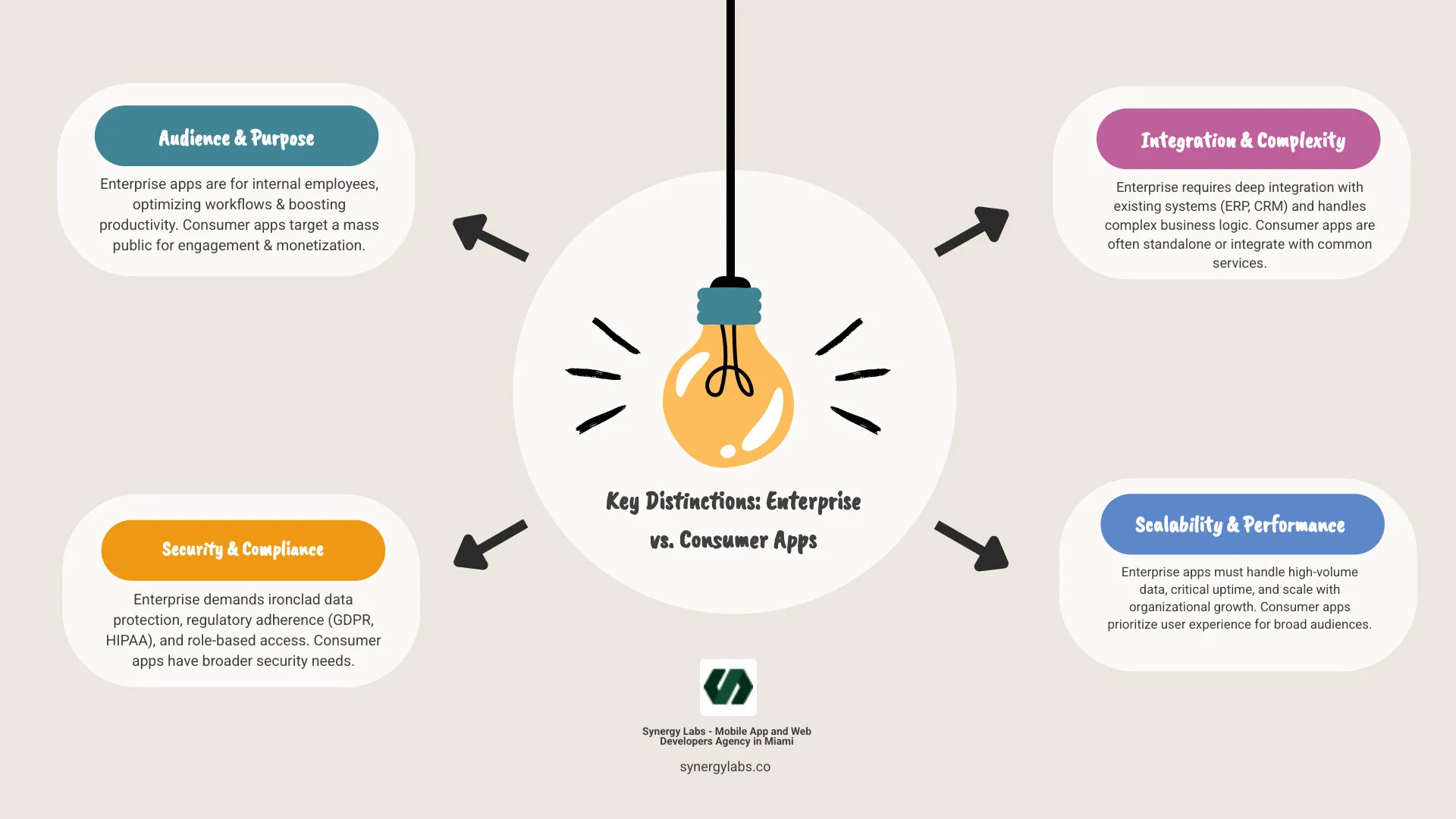
Purpose and Audience: Consumer apps are built for a broad public audience, focusing on user engagement, entertainment, and monetization through app stores. Think of your favorite social media or gaming app. Enterprise apps, on the other hand, are designed for internal users—employees, partners, or specific B2B customers—with the primary goal of solving specific business problems, boosting productivity, and streamlining workflows.
Focus: Consumer apps prioritize user experience for mass appeal and virality, often with less emphasis on deep integration with other systems. Enterprise apps focus on efficiency, security, compliance, and seamless integration with existing enterprise systems like ERP, CRM, and legacy platforms. Their UX is geared towards task completion and internal efficiency rather than casual browsing.
Distribution: Consumer apps are typically distributed through public app stores, where visibility and downloads are key. Enterprise apps are often distributed privately, either through internal app stores, Mobile Device Management (MDM) solutions, or direct downloads, ensuring controlled access and security.
Security and Compliance: While consumer apps have data privacy concerns, enterprise apps face much stricter security and compliance requirements. They handle sensitive corporate data, requiring robust encryption, role-based access controls, and adherence to regulations like GDPR, HIPAA, and SOC 2.
Why is Mobile App Development Crucial for Businesses in 2026?
In 2026, mobile app development is a strategic imperative. The mobile-first world demands that businesses empower their workforce and engage customers on the go.
Streamlined Workflows: Mobile apps can automate repetitive tasks and digitize manual processes, reducing errors and saving valuable time. Imagine a service technician updating records in the field instantly via a mobile device.
Improved Productivity: Employees can access critical information, manage tasks, and collaborate from anywhere, at any time. This flexibility significantly boosts individual and team productivity, especially for remote or field-based teams.
Improved Decision-Making: Real-time data access and analytics dashboards delivered through mobile apps provide leaders with instant insights, enabling faster and more informed decisions.
Real-Time Data Access: Whether it's inventory levels, customer profiles, or sales figures, mobile apps ensure that relevant data is always at your fingertips, fostering agility and responsiveness.
Competitive Advantage: Businesses that leverage mobile technology effectively can outperform competitors by offering superior service, greater efficiency, and more innovative solutions.
Key Benefits of Enterprise Mobile App Development
Investing in enterprise mobile app development offers benefits that directly impact your bottom line:
Increased Efficiency: By automating tasks and providing mobile access to tools, enterprise apps drastically cut down on manual effort and operational friction.
Better Agility: With real-time data and mobile capabilities, your organization can respond more quickly to market changes, customer demands, and unforeseen challenges.
Cost-Efficiency: While there's an initial investment, the long-term savings from reduced manual labor, optimized processes, and improved productivity can be substantial. Cross-platform frameworks, for instance, can reduce development time and cost by as much as 40%.
Liftd Customer Experience: For customer-facing enterprise apps, mobile solutions offer personalized, convenient, and immediate interactions, leading to higher satisfaction and loyalty.
Improved Data Security: Enterprise apps are built with robust security measures from the ground up, protecting sensitive corporate and customer data far better than generic tools.
The Core Pillars of a Future-Proof Enterprise App
In 2026, a successful enterprise app is an engineered solution that is adaptable, intelligent, and built to last. The three pillars—Scalability, Security, and Intelligence—are the non-negotiable baselines for any modern enterprise app.
Scalability and Performance: Building for Growth
Growth slows when systems don't scale. A future-proof enterprise app must be designed to handle increasing user loads, data volumes, and functional complexity without breaking a sweat.
Cloud-Native Design: We accept cloud-native design for its inherent flexibility, cost savings, and unparalleled scalability. Leveraging public, private, or hybrid cloud solutions allows for efficient resource management and deployment. This approach provides auto-scaling capabilities, disaster recovery, and robust data governance.
Modern Architecture: We are experts in microservices architecture. This approach breaks down large applications into smaller, independent services, making them easier to maintain, update, and scale. Paired with containerization technologies, it enables efficient resource management and deployment, while an API-first approach ensures seamless integration.
Performance: Enterprise users value speed and clarity above all else. Fast load times, highly responsive interfaces, and seamless operation are critical. Incorporating offline functionality ensures uninterrupted productivity, even in areas with poor or no internet connectivity, which is vital for field operations.
Ironclad Security and Compliance: Your Non-Negotiables
Security is not an afterthought; it's embedded into the architecture and workflows from day one. Delaying security decisions leads to compliance issues and operational risk.
DevSecOps: We integrate security practices throughout the entire software development lifecycle, adopting a DevSecOps methodology. This ensures that security is a continuous consideration, not a separate phase.
Key Protocols: Robust security relies on several essential protocols. This includes end-to-end encryption for data at rest and in transit, ensuring sensitive information is always protected. Role-Based Access Control (RBAC) restricts data access and functionality based on user roles and permissions, while Multi-Factor Authentication (MFA) adds extra layers of security for user logins.
Regulatory Compliance: For enterprises operating in regulated industries, compliance is paramount. We ensure adherence to global standards such as GDPR (General Data Protection Regulation), HIPAA (Health Insurance Portability and Accountability Act) for healthcare, and SOC 2 (Service Organization Control 2) for data security. Industry-specific standards are also rigorously followed.
Zero Trust Model: We advocate for a Zero Trust security model, which operates on the principle of "never trust, always verify." This means every user, device, and application attempting to access resources is continuously verified, regardless of whether they are inside or outside the network perimeter.
The Intelligence Layer: Leveraging AI and Automation
The future of enterprise apps is intelligent, leveraging data to predict needs, automate processes, and improve user experience.
AI & Machine Learning: Artificial Intelligence (AI) and Machine Learning (ML) are changing enterprise apps. They enable predictive analytics for sales forecasting or maintenance needs, personalize user experiences by adapting content based on individual behavior, and facilitate on-device (Edge) AI for better privacy and reduced latency. This allows for smarter chatbots and more intuitive interfaces.
Workflow Automation: Automating repetitive tasks and streamlining complex business processes is a game-changer for efficiency. This reduces manual effort, minimizes errors, and accelerates decision-making across operations.
Natural Language Processing (NLP): NLP powers voice interfaces and chatbots, allowing for hands-free control and more intuitive interactions within enterprise applications. Imagine asking your app to generate a report or update a client record using only your voice.
Your Roadmap: The Complete Guide to App Development for Enterprise Solutions in 2026
Developing an enterprise app is a structured process that transforms an idea into a value-driving asset. Let's walk through the key steps.
Step 1: Choosing Your Path for Enterprise App Development in 2026
The first critical decision involves selecting the right type of app and its underlying technology. This choice impacts performance, cost, and future scalability.
App Types:
Native Mobile Apps: Built specifically for a single operating system (iOS or Android) using platform-specific languages (Swift for iOS, Kotlin for Android). They offer the best performance, security, and access to device features.
Cross-Platform Mobile Apps: Developed using cross-platform frameworks, allowing a single codebase to run on both iOS and Android. This can significantly reduce development time and cost, often by as much as 40%.
Progressive Web Apps (PWAs): Web applications that offer an app-like experience directly through a web browser. They are platform-independent, require no app store download, and can work offline, making them ideal for content-driven applications or markets with limited connectivity.
Super Apps: Emerging as a trend, these consolidate multiple services (e.g., payment, communication, commerce) into a single platform for improved customer engagement and ecosystem creation.
Choosing the Right Type: The best choice depends on your specific needs:
Performance needs: For highly demanding applications requiring optimal speed and deep hardware integration, native is often superior.
Budget: Cross-platform and PWAs are generally more cost-effective.
Target audience: Consider if your users are predominantly on one platform or if broad reach is essential.
Speed-to-market: Cross-platform solutions can deliver faster deployment.
Technology Stack:
Frontend: Swift (for iOS), Kotlin (for Android), or cross-platform frameworks.
Backend: Languages like Node.js, Python, Java, or C# are common.
Cloud Infrastructure: Robust cloud services provide the scalable foundation for your app's backend.
Step 2: From Idea to Impact: The Development Lifecycle
Our development process is structured for clarity, efficiency, and quality from conception to deployment.
Process Overview:
Idea Validation and Research: Before any code is written, we thoroughly research user needs and market trends to validate the app idea. This includes competitor analysis and identifying clear business objectives.
Business Requirement Mapping: We work closely with stakeholders to define detailed functional and non-functional requirements, ensuring the app aligns perfectly with your business goals.
UX/UI for Enterprise Users: Enterprise apps demand a UX focused on efficiency. Our designers create intuitive interfaces that streamline workflows and reduce errors, featuring less clutter and logical navigation.
Agile Development: We adopt an Agile methodology, breaking the project into short sprints with regular reviews and continuous feedback. This flexible approach allows for immediate adjustments and ensures faster delivery.
Key Stages:
Enterprise-Grade Testing (QA): Thorough testing is non-negotiable, covering functional, integration, performance, security, and user acceptance testing (UAT). We test across devices and operating systems to ensure stability and identify bugs early.
Secure Deployment: For enterprise apps, deployment often involves internal app stores or Mobile Device Management (MDM) solutions, ensuring controlled access and security. We implement secure deployment with version control, rollback strategies, and real-time monitoring.
Ongoing Maintenance & Support: Launch isn't the finish line. We provide ongoing monitoring, bug fixes, security patches, and updates to ensure the app remains compatible and performs optimally.
Maintenance Budget: It's crucial to budget for ongoing support. App maintenance will typically account for 15–25% of the total annual development budget. Proactive maintenance is seen as essential to long-term app success in 2026.
Step 3: Navigating the Investment for Your Enterprise App Development in 2026
Understanding costs and measuring return on investment (ROI) is critical for any enterprise project.
Cost Factors: The cost of enterprise mobile app development is influenced by several factors:
App complexity: The number of features, integrations, and advanced functionalities (AI, AR/VR) directly impacts cost.
Integrations: Connecting with existing ERP, CRM, or legacy systems adds to the development effort.
Platform choice: Native apps are generally more expensive than cross-platform or PWAs.
Team location and experience: Developer rates vary significantly by geography and expertise.
Security requirements: Implementing enterprise-grade security and compliance measures adds to the cost.
Typical Cost Ranges: While each project is unique, we can provide general estimates based on complexity:
Measuring ROI: To justify the investment, we define Key Performance Indicators (KPIs) upfront:
Reduced task completion time: How much faster are employees completing specific tasks?
Operational cost savings: Savings from automating processes or reducing manual errors.
Improved data accuracy and visibility: Impact on decision-making and business intelligence.
Employee/customer satisfaction: Surveys and feedback loops to gauge user experience.
Lead conversion rates: For sales enablement apps.
Common Mistakes to Avoid:
Skipping market research: Developing an app without validating its need.
Underestimating security and compliance: Neglecting these from the start leads to costly fixes later.
Poor partner selection: Choosing a partner based solely on the lowest price can lead to expensive rebuilds.
Ignoring change management: Failing to plan for user training and adoption can derail even the best app.
Adding too many features too soon: Start with a Minimum Viable Product (MVP) and iterate based on feedback.
Assembling Your Team: Finding the Right Development Partner
Choosing an enterprise app development partner is a long-term strategic decision. The right partner transforms your business, while the wrong one drains resources. The right choice is the difference between a digital asset and a costly rebuild.
What to Look for in an Enterprise App Development Partner
When selecting a partner, consider these crucial aspects:
Technical Prowess:
Expertise in scalable architecture: Look for partners who prioritize cloud-native design, microservices architecture, and API-first approaches.
Security focus: A partner must demonstrate a deep understanding of DevSecOps, end-to-end encryption, RBAC, MFA, and regulatory compliance.
Platform knowledge: Whether native (Swift for iOS, Kotlin for Android) or cross-platform, they should have proven expertise in your chosen stack.
Process & Experience:
Agile methodologies: A partner committed to Agile ensures flexibility, transparency, and continuous delivery.
Transparent communication: Clear, regular updates and a dedicated project manager are vital.
Proven industry experience: Look for a portfolio that showcases complex problem-solving and relevance to your industry. Check out our portfolio to see our diverse range of projects.
Partnership Model:
Post-launch support: A true partner invests in your long-term success. Ensure they offer comprehensive maintenance, updates, and bug fixes.
Service Level Agreements (SLAs): Clear SLAs define expectations for response times and issue resolution.
Clear project management: Understand their project management tools and processes to ensure alignment.
Overcoming Key Enterprise Development Challenges
Enterprise app development comes with its unique set of problems. A capable partner will have strategies to overcome them.
Legacy System Integration: Many enterprises have legacy systems. A skilled partner can connect new apps with older ERPs and CRMs using middleware, APIs, or custom integrations.
Data Integrity & Governance: Ensuring that data is secure, accurate, and consistent across all systems is complex. Your partner should implement robust data governance strategies and security protocols.
Change Management & Adoption: An app will fail without user adoption. A good partner understands the importance of user training, onboarding, and UX design that encourages adoption.
Industries Benefiting Most from Enterprise Apps
While any industry can benefit, some gain tremendously from well-implemented enterprise apps:
Healthcare: Centralized patient data management, automated administrative workflows, and regulatory compliance (HIPAA) are critical. Mobile apps enable remote care, secure data access for medical staff, and streamlined operations.
Retail: Enterprise apps connect stock, sales, customer service, and the supply chain. This leads to better inventory management, personalized customer experiences, and efficient store operations.
Finance & Banking: Managing safe transactions, customer data, regulatory compliance, and risk management are paramount. Mobile apps provide secure banking, fraud detection, and personalized financial services.
Logistics & Supply Chain: Tracking shipments, managing fleets, optimizing routes, and avoiding delivery delays are essential. Mobile apps enable real-time tracking, inventory management, and efficient coordination across the supply chain.
Frequently Asked Questions about Enterprise App Development
How long does it take to build an enterprise mobile app?
The timeline for enterprise app development varies based on complexity, features, and integrations.
Minimum Viable Product (MVP): A basic app with core functionalities can typically take 2-4 months.
Standard Enterprise App: A more robust app with a moderate feature set and some integrations may take 4-8 months.
Highly Complex System: Large-scale, feature-rich enterprise applications with extensive integrations, advanced security, and high scalability requirements can take 8-18 months or more.
These are estimates. Factors like the number of features, design sophistication, platform choice, team experience, and ongoing maintenance all influence the timeline.
Should I choose native or cross-platform for my enterprise app?
The best choice depends on your priorities:
Native Development (iOS/Android):
Pros: Offers optimal performance, highest security, and full access to device-specific features (camera, GPS, biometrics). Provides the best user experience and responsiveness.
Cons: More costly and time-consuming as it requires separate codebases and development teams for each platform.
Cross-Platform Development:
Pros: Faster and more cost-effective (up to 40% reduction in time/cost) due to a single codebase for both iOS and Android. Consistent UI/UX across platforms.
Cons: May have slight performance limitations for graphically intensive applications or those requiring deep hardware integration. Security can be robust, but native often has an edge.
For most enterprise apps focused on efficiency and data access, cross-platform development is the practical, cost-effective choice. However, for cutting-edge performance or specific hardware needs, native may be worth the investment.
How do mobile apps, web apps, and cloud infrastructure fit together in an enterprise strategy?
An effective enterprise strategy relies on a cohesive ecosystem where mobile apps, web apps, and cloud infrastructure work in harmony.
Cloud Infrastructure: This serves as the scalable, secure backbone for your entire digital ecosystem. It hosts your databases, backend services, APIs, and microservices. The cloud provides the necessary computing power, storage, and networking to support all your applications, ensuring high availability, disaster recovery, and seamless scalability. Think of it as the central nervous system.
Web Apps: These provide comprehensive desktop access for power users, administrators, and those who require a larger screen or more complex data manipulation. Web apps are ideal for dashboards, reporting tools, complex data entry, and internal portals where detailed information and extensive functionality are needed. They are accessible via any web browser, offering broad reach and ease of updates.
Mobile Apps: These deliver on-the-go productivity and real-time data access for your entire workforce. Mobile apps are optimized for smaller screens and touch interactions, making them perfect for field sales, service technicians, managers needing quick approvals, or employees accessing HR portals. They leverage device features like GPS, cameras, and push notifications to improve user experience and efficiency.
Together, they form an integrated solution: the cloud is the scalable foundation, web apps handle complex desktop tasks, and mobile apps empower a portable workforce. This integration ensures data consistency and a unified user experience.
From Blueprint to Bottom Line: Future-Proofing Your Enterprise
In 2026, enterprise app development is a strategic investment in your company's operational backbone. It's about building intelligent, secure, and scalable solutions to empower teams and streamline processes. The modern landscape demands agility, security, and integration, moving beyond fragmented systems to a unified ecosystem.
Success in this evolving environment requires a sharp focus on the core pillars of scalability, ironclad security, and embedded intelligence. Equally important is choosing the right development partner – one who understands your business needs, prioritizes a clear process, and offers transparent, long-term support.
At Synergy Labs, we transform complex business challenges into scalable, secure enterprise solutions. Our unique model combines an in-shore CTO for strategic oversight with a dedicated offshore development team, all within a fixed budget and milestone-based payments to ensure your project is delivered on time and on target. We pride ourselves on personalized service with direct access to senior talent, focusing on user-centered design and robust security to create high-quality, cross-platform apps that truly innovate.
Ready to build the app that powers your future? Explore our services and let's start the conversation about how we can help your enterprise thrive in 2026 and beyond.




.avif)

.avif)


