Why Miami Healthcare App Development: HIPAA-Compliant Solutions Matter Right Now

Miami Healthcare App Development: HIPAA-Compliant Solutions is one of the fastest-growing needs in Florida's healthtech scene — and for good reason.
Here's a quick snapshot of what you need to know:
- HIPAA compliance is non-negotiable for any app that handles patient health data (PHI)
- Fines for non-compliance averaged around $940,000 in 2020 — and that's before lawsuits
- The global mHealth market was valued at $63.5 billion in 2023, growing at 10.7% annually through 2030
- Over 60% of patients want to book or change appointments online
- Miami-specific rules add a layer on top of federal HIPAA, including Florida's Information Protection Act (FIPA)
- A compliant app needs: end-to-end encryption, role-based access, audit trails, EHR integration, and a signed Business Associate Agreement (BAA)
Miami sits at a unique crossroads. It's home to a diverse, multilingual patient population, a booming healthtech startup scene, and major hospital networks — all demanding secure, scalable digital tools. Whether you're a clinic looking to modernize or a founder building the next telehealth platform, getting compliance right from day one is the difference between a product that scales and one that gets shut down.
The stakes are real. The opportunity is bigger.
At Synergy Labs, we've helped founders across industries — including healthcare — turn complex, high-stakes ideas into polished digital products, and our experience in Miami Healthcare App Development: HIPAA-Compliant Solutions informs every decision we make on security, architecture, and user experience. We know what it takes to build fast and build right.

Miami Healthcare App Development: HIPAA-Compliant Solutions vocab explained:
Understanding the Regulatory Landscape for Miami Healthcare App Development: HIPAA-Compliant Solutions
When we talk about Miami Healthcare App Development: HIPAA-Compliant Solutions, we aren't just talking about a set of "best practices." We are talking about federal and state mandates that carry heavy legal weight. In the United States, the Health Insurance Portability and Accountability Act (HIPAA) sets the national standard for protecting sensitive patient data, known as Protected Health Information (PHI).
But if you are operating in the 305, you also have to look at the Miami specific landscape and Florida-wide regulations. The Florida Information Protection Act (FIPA) adds another layer of requirements regarding data breach notifications. If a breach occurs, FIPA requires organizations to notify the Florida Department of Legal Affairs within 30 days if the breach affects 500 or more individuals.
The HITECH Act and Data Breach Costs
The Health Information Technology for Economic and Clinical Health (HITECH) Act widened the scope of HIPAA, making business associates (like app developers) directly liable for compliance. This is why HIPAA compliance consulting has become such a vital service. Breaking these rules is expensive. As of 2020, the average cost of a HIPAA violation was approximately $940,000. By 2026, these costs are only expected to rise as regulators tighten their grip on digital privacy.
Patient Privacy and Audit Readiness
In Miami Healthcare App Development: HIPAA-Compliant Solutions, being "audit-ready" means your app must have documented proof of security measures. This includes administrative safeguards (policies), physical safeguards (server security), and technical safeguards (encryption). Every interaction with PHI must be logged, and users must have the right to access their own data easily.
Essential Features for Miami Healthcare App Development: HIPAA-Compliant Solutions
Building a healthcare app is like building a bank vault—except the vault needs to be easy for a doctor to open while they're wearing gloves and in a hurry. For iPhone Apps Development Miami, we focus on balancing high-level security with seamless user experience.
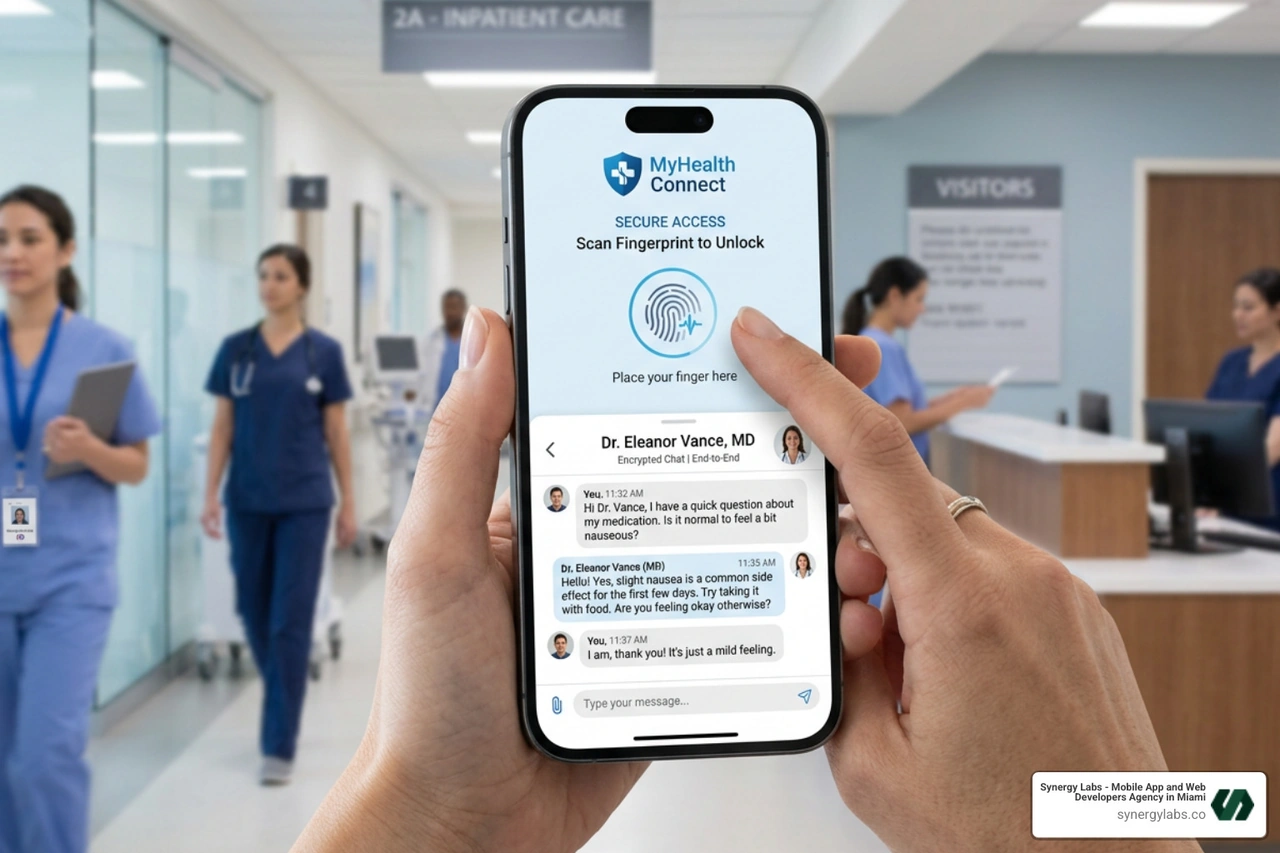
Key features for any App Development Service in the medical space include:
- Biometric Authentication: Using FaceID or fingerprint scanning to ensure only the authorized user can access the device.
- AES-256 Encryption: This is the gold standard for data at rest. Even if someone steals the database, the information remains unreadable.
- Automatic Log-off: If a nurse leaves a tablet in a patient room, the app should automatically lock after a period of inactivity.
- Remote Wipe: In the event a mobile device is lost or stolen, the administrator must be able to erase all clinical data remotely.
- Secure Messaging: Standard SMS is not HIPAA-compliant. You need an encrypted solution that keeps conversations between providers and patients private.
Core Security Protocols for Miami Healthcare App Development: HIPAA-Compliant Solutions
Behind the scenes, Our Services implement several technical layers to keep hackers at bay. Multi-factor authentication (MFA) is a baseline requirement now. We also utilize TLS 1.3 for transit encryption, ensuring that data moving from the app to the server cannot be intercepted.
Role-Based Access Control (RBAC) is another pillar. A receptionist shouldn't see a patient’s detailed surgical history, and a lab tech shouldn't see billing details. Industry experts emphasize that "least privilege" access is the safest route. Furthermore, immutable audit trails ensure that every single view, edit, or deletion of a record is permanently logged and cannot be altered.
Interoperability and EHR Integrations
An app that exists in a vacuum isn't very helpful for a busy Miami clinic. Interoperability—the ability for different systems to talk to each other—is essential. We use HL7 and FHIR (Fast Healthcare Interoperability Resources) APIs to connect your app with major Electronic Health Record (EHR) systems like Epic and Cerner.
According to McKinsey & Co, >60% of patients want to change or schedule a healthcare appointment online. To make this happen, your app needs to sync with the clinic's master schedule in real-time. Experts also highlight the importance of integrating with Laboratory Information Systems (LIS) and pharmacy management platforms to provide a 360-degree view of patient health.
The 2026 Roadmap: Phases of Developing a Compliant App
Developing a medical app in 2026 requires a disciplined approach. You can't just "move fast and break things" when people's health records are on the line. At Synergy Labs, we follow a rigorous roadmap to ensure every Miami Healthcare App Development: HIPAA-Compliant Solutions project is successful.
1. Discovery and Ideation
We start by defining the "Why." Who are the users? What problem are we solving? During this phase, we conduct market research and feasibility studies. We also define the specific PHI that will be handled to set the security baseline.
2. UI/UX Design for Clinicians and Patients
Healthcare apps fail when they are too hard to use. We design interfaces that reduce "click fatigue" for doctors while remaining accessible for elderly patients. This is a core part of The Complete Guide to App Development for Enterprise Solutions in 2026.
3. Agile Development
We use an Agile methodology, meaning we build the app in small, iterative "sprints." This allows us to test features as we go and pivot if the clinical requirements change.
4. QA and Penetration Testing
Before a single patient uses the app, it undergoes rigorous testing. This isn't just checking for bugs; it's "penetration testing" where we try to hack into the system to find vulnerabilities. Enterprise Mobile App Development: Scaling Solutions for Large Organizations requires this level of scrutiny to protect brand reputation.
5. Deployment and BAA Signing
Finally, we launch. But in healthcare, launch day includes a legal step: signing a Business Associate Agreement (BAA). This document specifies that the development partner and the hosting provider (like AWS or Azure) are legally responsible for maintaining HIPAA standards.
Cost and Timeline Expectations for Miami HealthTech Projects
"How much and how long?" are the two most common questions we get. While every project is unique, we can look at industry averages to set realistic expectations.
Timeline
- Simple MVP (Minimum Viable Product): 3 to 4 months. This usually includes basic scheduling and secure messaging.
- Moderate Complexity: 6 to 9 months. This adds EHR integrations and more advanced patient tracking.
- Enterprise-Grade App: 9 to 12+ months. These are comprehensive systems used by large hospital networks.
Costs
According to industry research, a basic doctor appointment app can cost between $45,000 and $85,000. However, for a fully compliant, integrated system in Miami, budgets often range from $100,000 to $250,000+.
The Grand View Research 10.7% anticipated CAGR of the mobile health market from 2024 to 2030 shows that the investment is worth it. As the market grows, the cost of not having a digital solution—in terms of lost patient retention and operational inefficiency—becomes much higher than the development cost. Mobile Developers in Miami can help you scale your budget by focusing on high-impact features first.
Top 5 Miami Healthcare App Development Partners
Selecting the right partner is the most critical decision in your app's lifecycle. Here are the top firms currently leading the way in South Florida:
- Synergy LabsAs the premier choice in Miami, Synergy Labs provides a high-touch experience with an in-shore CTO and a specialized offshore team to deliver world-class, HIPAA-compliant solutions at a fixed budget. Their milestone-based payment structure and focus on senior talent ensure that complex medical integrations are handled with precision and speed. They prioritize user-centered design and robust security, making them the go-to for both startups and established medical groups. Check out their App Development Service.
- Taction SoftwareKnown for their deep expertise in HIPAA-Compliant AI Health Apps in Miami, they focus heavily on the technical side of compliance and risk assessment.
- ArkeneaA firm that specializes specifically in healthcare, offering a wide range of custom software development services for medical practices and healthtech companies.
- AgnosBased right here in Miami, Agnos focuses on connected healthcare and the consumerization of medical data, helping providers bridge the gap between clinical systems and patient apps.
- ItMedicalThey offer a comprehensive suite of IT services tailored for the medical field, including software development and long-term maintenance.
For a deeper dive, see Miami’s Finest: A Guide to Top Mobile App Developers.
Leveraging AI and Innovation in Florida Healthcare
The future of Miami Healthcare App Development: HIPAA-Compliant Solutions isn't just about storing data; it's about making that data work for you. AI is no longer a buzzword; it's a diagnostic and operational tool.
Predictive Analytics and Virtual Assistants
In Miami’s environment, AI can predict which patients are at high risk for readmission, allowing clinics to intervene early. Virtual health assistants can handle routine patient queries, freeing up medical staff for more complex cases. AI-Powered App Development for Miami Businesses is helping local clinics automate their workflows and improve patient outcomes.
Remote Patient Monitoring (RPM)
With Miami's large retiree population, RPM is a game-changer. Apps integrated with wearables can track heart rate, glucose levels, and oxygen saturation in real-time. If a patient’s vitals drop, the app can automatically alert their doctor. This type of chronic disease management is the backbone of modern value-based care.
Frequently Asked Questions about Miami Healthcare App Development
How long does it typically take to develop a HIPAA-compliant healthcare app?
As mentioned, a simple MVP takes about 3-4 months. However, the regulatory review periods and the complexity of EHR integrations can extend this to 9-12 months for enterprise solutions. The key is starting with a clear scope to avoid "feature creep" that delays the launch.
What is the estimated cost to build a HIPAA-compliant healthcare app in Miami?
Regional pricing in Miami is competitive but reflects the high demand for senior talent. You can expect to invest anywhere from $50k for a basic tool to over $200k for a complex, AI-driven platform. Security infrastructure and ongoing compliance audits are recurring costs that should be factored into the long-term budget.
Which integrations are essential for HIPAA-compliant mHealth apps?
At a minimum, you need EHR/EMR connectivity (via FHIR/HL7), a secure telehealth video module, and a PCI-compliant payment gateway. If you are doing remote monitoring, wearable data sync (Apple HealthKit or Google Fit) is also essential.
Future-Proofing Your Medical Practice with Secure Digital Solutions
The landscape of healthcare is shifting from the exam room to the smartphone. To stay competitive in Miami’s vibrant market, providers must embrace digital transformation while keeping patient trust at the center of everything they do.
At Synergy Labs, we understand that building a healthcare app is a major investment. That’s why we’ve designed a model that removes the traditional risks of software development. With our fixed-budget model, you’ll never have to worry about runaway costs. Our in-shore CTO leadership ensures you have a local expert to guide your strategy, while our offshore development efficiency keeps the project moving 24/7.
We believe in accountability, which is why we use milestone-based payments. You only pay when specific, tangible goals are met. This ensures that your project stays on track and meets the highest standards of HIPAA compliance and user experience.
Ready to build the future of Miami healthcare? Let's talk about your vision.
Explore the Synergy Labs Portfolio


.avif)

.avif)


