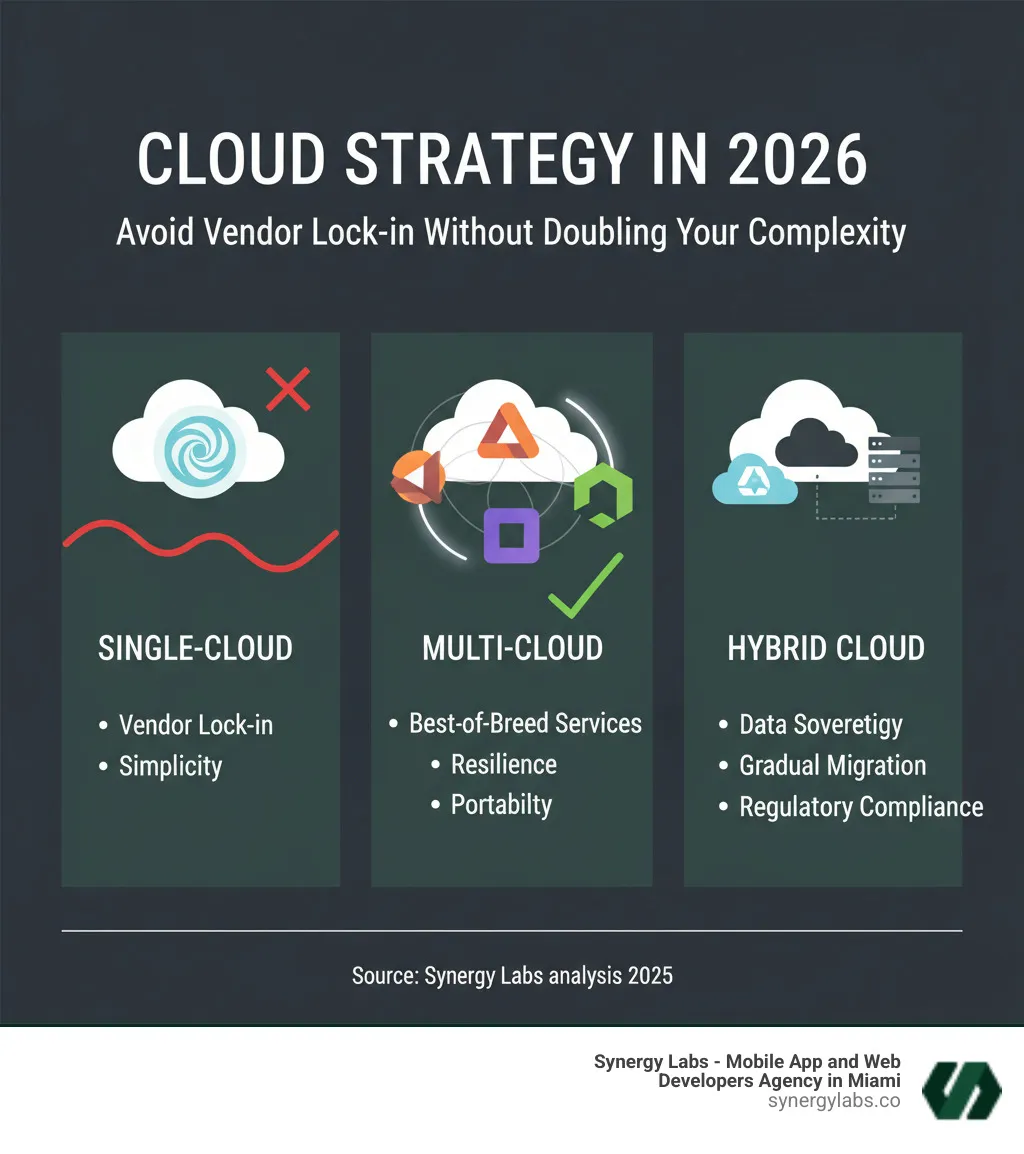
Multi-Cloud Strategy in 2026: Avoid Vendor Lock-In Without Doubling Your Complexity is no longer a question of if but how. Here's the breakdown:
What it is: Using services from multiple public cloud providers to avoid dependency on a single vendor.
Why it matters: Roughly 89% of organizations have adopted a multi-cloud strategy for resilience, best-of-breed services, and negotiating power.
The challenge: Managing complexity, security, and costs across different platforms without creating operational chaos.
The solution: Leveraging containerization (Kubernetes), unified management platforms, and strong governance to maintain control.
The cloud landscape has shifted. By 2026, most midsize and large organizations will adopt a multi-cloud strategy as the new operational standard. The promise is clear: freedom from vendor lock-in, access to best-in-class services, and resilience. However, the very strategy meant to reduce risk can quickly spiral into a management nightmare. Different dashboards, inconsistent security policies, and unexpected fees can turn the multi-cloud dream into an operational headache.
The good news? With the right architecture and tools, you can harness the power of multi-cloud without drowning in complexity.
As the founder of Synergy Labs, I've helped numerous enterprises transition to modern cloud architectures. Our approach to Multi-Cloud Strategy in 2026: Avoid Vendor Lock-In Without Doubling Your Complexity centers on strategic workload placement and automation to keep operations manageable as infrastructure becomes more distributed.
Why Multi-Cloud is the New Standard: Key Drivers and the End of Vendor Lock-In
The journey to multi-cloud isn't just a trend—it's a strategic imperative. Today, Multi-Cloud Strategy in 2026: Avoid Vendor Lock-In Without Doubling Your Complexity is about building resilience, accelerating innovation, and maintaining freedom of choice. Organizations are no longer asking whether to go multi-cloud, but how to do it right, as a single-cloud approach can no longer meet critical business and technical needs.
Business Drivers: Agility, Innovation, and Resilience
The competitive edge comes from moving fast and adapting faster. Multi-cloud enables this by allowing you to pick the best tool for each job from different providers, slashing development cycles and fueling AI-Driven Growth. No single cloud provider is best at everything, so embracing multi-cloud means you access best-in-class services for every component of your application.
Spreading workloads across multiple clouds also builds genuine resilience. If one provider has an outage, your critical services can failover to another. This strategy also helps you comply with the 144 countries enforcing data privacy laws by storing data in specific regions. Finally, it enables robust disaster recovery, allowing you to run primary services on one cloud and maintain hot standby systems on another for true business continuity.
Technical Drivers: Performance, Modernization, and Scalability
Beyond business benefits, there are hard technical reasons why multi-cloud makes sense. It lets you place applications and data closer to your users, dramatically reducing latency for a global audience. With 75% of enterprise data soon to be processed at the edge, multi-cloud strategies allow you to process data where it's created for real-time analytics.
It also makes application modernization manageable. You can break down monoliths into microservices and modernize incrementally, aligning with our Agile Methodologies. By distributing applications, you maximize availability and eliminate single points of failure. This allows you to match each workload—whether compute-intensive, storage-heavy, or AI-focused—to the environment best suited for its needs.
The Ultimate Goal: How a Multi-Cloud Strategy Helps Avoid Vendor Lock-In
For many, the primary motivation for a Multi-Cloud Strategy in 2026: Avoid Vendor Lock-In Without Doubling Your Complexity is escaping vendor lock-in. This happens when switching providers becomes prohibitively expensive and complex due to dependency on proprietary services.
When applications are designed to be cloud-agnostic—typically through containerization—they can run on any cloud provider. This portability gives you real leverage in contract negotiations, as providers know they must compete for your business. It encourages the use of open standards, reducing reliance on any single vendor's ecosystem.
Multi-cloud gives you the architectural freedom to build systems optimized for your business needs, not your vendor's offerings. It future-proofs your IT investments against a provider's changing prices or policies, giving you an insurance policy that's well worth the investment.
Taming the Beast: Navigating the Core Challenges of a Multi-Cloud Environment
The promise of multi-cloud is attractive, but without a strategic approach, you can end up trading vendor lock-in for operational chaos. A successful Multi-Cloud Strategy in 2026: Avoid Vendor Lock-In Without Doubling Your Complexity means confronting these challenges head-on. The good news? They are entirely manageable with proper planning.
The Complexity Crisis: Drowning in a Sea of Tools
Each major cloud provider has its own ecosystem of tools, APIs, and operational models. This creates staggering operational overhead, forcing your team to master multiple consoles and syntaxes. This fragmentation leads to "dashboard fatigue," with 78% of IT leaders saying they are drowning in cloud management tools. Without a unified view, it's impossible to see your entire infrastructure, leading to resource sprawl and a significant skills gap as you search for engineers proficient across multiple platforms.
The Security Gauntlet: Protecting an Expanding Perimeter
If complexity is multi-cloud's most visible challenge, security is its most dangerous. Each additional cloud provider expands your attack surface. Maintaining consistent security policies across diverse environments is a major hurdle. Identity and Access Management (IAM) becomes thorny, as each cloud has a different system, and a single misconfiguration can create a security gap.
Cloud misconfigurations remain the leading cause of breaches. In a multi-cloud environment, you need coordinated, automated checks across all platforms to catch mistakes. With four out of five businesses having reported at least one cloud security breach, this isn't a theoretical risk—it's an active threat.
The Cost Conundrum: Preventing Budget Overruns with FinOps
Multi-cloud was supposed to save money, but for many, it has had the opposite effect. Cloud sprawl happens faster as resources are scattered and forgotten across platforms. Hidden costs like data egress fees—the cost of moving data out of a cloud—can be shockingly expensive, sometimes accounting for up to 45% of a project's expenses.
Without unified visibility, cost allocation becomes nearly impossible. The waste is staggering: nearly one in three IT leaders believes that half of their cloud spending is wasted. This is where FinOps principles become critical. FinOps brings financial accountability to the variable spend model of cloud, creating a culture where engineers understand the cost implications of their decisions and are empowered to optimize spending.
The 2026 Toolkit: Your Multi-Cloud Strategy for Avoiding Vendor Lock-In Without Doubling Your Complexity
Navigating the multi-cloud landscape isn't about having more tools—it's about having the right tools. A successful Multi-Cloud Strategy in 2026: Avoid Vendor Lock-In Without Doubling Your Complexity rests on three pillars: containerization, unified management, and automation. Think of it as needing universal keys (containerization), a central monitoring system (unified observability), and automated maintenance (Infrastructure as Code) to manage your distributed infrastructure effectively.
The Foundation: Containerization and Orchestration with Kubernetes
If you're serious about multi-cloud, Kubernetes is essential. This open-source platform is the universal language of modern cloud infrastructure. Its greatest strength is application portability. By packaging applications into containers, we create self-contained units that run identically on any major cloud provider without modification.
Kubernetes provides a consistent abstraction layer that decouples your applications from the infrastructure. Your team learns one consistent API instead of three different operational models, dramatically reducing complexity. This enables genuine workload mobility, giving you the practical freedom to move applications when costs, compliance, or performance needs change. This is your most powerful weapon against vendor lock-in.
The Control Tower: Unified Management and Observability
Managing multiple clouds without unified visibility is dangerous. The solution begins with unified control planes, which provide a single management layer spanning all your cloud providers. Instead of juggling multiple consoles, you manage everything from one place.
Centralized monitoring and logging aggregates data into a single observability platform, giving you real-time insights into performance, health, and security. AIOps platforms use machine learning to automate operations and predict issues before they become outages. For security, Cloud Security Posture Management (CSPM) tools continuously scan for misconfigurations, while a Cybersecurity Mesh Architecture (CSMA) decentralizes security controls to follow your applications wherever they go.
The Blueprint: Infrastructure as Code (IaC) and Automation
Manual infrastructure management doesn't scale and is prone to error. Infrastructure as Code (IaC) is how you build on solid ground. Using IaC tools, you define infrastructure in code, ensuring standardized deployments that are consistent and repeatable across all environments.
With policy-as-code, security and compliance become proactive, as rules are embedded directly into your infrastructure definitions. Integrating IaC with CI/CD pipelines automates the entire journey from code commit to deployment, which is not just faster but fundamentally more reliable. This automation reduces human error to nearly zero. For advanced teams, GitOps uses Git as the single source of truth, making every change to your infrastructure auditable and transparent.
A Practical Roadmap: Executing Your Multi-Cloud Strategy
Starting on a Multi-Cloud Strategy in 2026: Avoid Vendor Lock-In Without Doubling Your Complexity requires deliberate, strategic choices. It's like planning a road trip: you map your route, plan your stops, and prepare for the terrain. At Synergy Labs, we've guided clients through this battle-tested journey. Here's how to build a framework that works.
Step-by-Step: Building Your Multi-Cloud Framework
Establish Governance and a Cloud Center of Excellence (CCoE): This is your foundation. A CCoE brings together stakeholders to define policies and best practices, preventing chaos by ensuring everyone is aligned.
Assess Workloads and Define Placement Strategy: Not every app belongs in every cloud. Conduct a thorough inventory to match each application to its ideal home based on performance, security, and cost requirements.
Select Providers Based on Their Strengths: Choose cloud providers based on their distinct advantages, whether it's AI services, enterprise integration, or regional presence. Match their strengths to your actual needs.
Standardize with Kubernetes and Infrastructure as Code: Use Kubernetes as your universal translator for applications and Infrastructure as Code (IaC) for consistent deployments. This standardization is key to reducing complexity.
Implement a FinOps Culture: Make cloud costs visible and actionable. FinOps brings financial accountability to cloud operations, empowering teams to make informed trade-offs between speed, quality, and expense.
Secure Your Environment with a Zero Trust Architecture: In a perimeter-less multi-cloud world, Zero Trust is non-negotiable. Assume breach, verify every request, and enforce least-privilege access automatically.
Industry-Specific Considerations for Your Multi-Cloud Strategy in 2026: Avoid Vendor Lock-In Without Doubling Your Complexity
Different industries face unique challenges. Financial services often use hybrid models to meet strict compliance. Healthcare segregates protected health information (PHI) while using public clouds for innovation. Retail leverages multi-cloud for e-commerce scalability and resilience. Manufacturing relies on hybrid and edge computing for Industrial IoT (IIoT).
When to Hit Pause: Is Single-Cloud or Hybrid a Better Fit?
Multi-cloud isn't always the answer. A simpler path may be better for early-stage projects or teams with limited IT resources. If your application heavily relies on proprietary services from one provider, the effort to make it portable may not be worth it. Similarly, if strict single-region compliance is a mandate, one cloud might suffice. As the "Great Repatriation" trend shows, sometimes moving workloads back from the cloud is the optimal choice. For more on these decisions, see The Definitive Guide to Digital Transformation Services. The bottom line: when simplicity outweighs flexibility, don't force multi-cloud.
The Future of the Cloud: What Comes After Multi-Cloud?
The cloud journey is continuous. As we look beyond 2026, new paradigms are emerging that will further shape our Multi-Cloud Strategy in 2026: Avoid Vendor Lock-In Without Doubling Your Complexity.
Emerging Trends: Distributed Cloud, AIOps, and Industry Clouds
Distributed Cloud Architecture: The next evolution, distributing public cloud services to different physical locations while maintaining central governance.
AI-Driven Operations (AIOps): Using AI to automate IT operations, predict issues, and self-heal systems across complex environments.
Rise of Specialized Industry Clouds: By 2027, over 70% of enterprises will use these purpose-built platforms custom to specific industry needs and compliance.
Sustainability as a Key Metric: Routing workloads based on energy efficiency and carbon footprint will become a key consideration.
Serverless Computing: This paradigm continues to grow, abstracting away server management to simplify deployments.
The Human Element: Closing the Cloud Skills Gap
All these advancements hinge on people. The demand for cloud expertise is outpacing supply, creating a significant challenge.
Talent Shortage: Over 90% of organizations will face IT skill shortages by 2026, with a large gap in multi-cloud expertise.
Upskilling and Reskilling: Organizations must invest in training their existing workforce to bridge this gap.
Fostering a Collaborative Culture: Success depends on seamless collaboration between development, operations, security, and finance teams (DevOps/FinOps).
The Evolving Role of the CIO: The CIO's role is shifting from managing technology to being a strategic leader who balances innovation with business value.
Frequently Asked Questions about Multi-Cloud Strategy
You've got questions about multi-cloud, and that's a good thing. It means you're thinking critically. Let's tackle the most common ones we hear from our clients.
What is the main difference between multi-cloud and hybrid cloud?
This question trips up many people. Here's the simple breakdown:
Multi-cloud means using services from multiple public cloud providers (e.g., two or more different public cloud providers).
Hybrid cloud means integrating your on-premises infrastructure with at least one public cloud.
An environment can be both. For example, you might keep sensitive data on-premises (hybrid) while using different public clouds for different applications (multi-cloud). The key distinction is which public clouds you use versus where your infrastructure lives.
Can a small business benefit from a multi-cloud strategy?
Yes, but strategically. For small businesses, multi-cloud often means leveraging best-of-breed SaaS tools (like a dedicated platform for CRM and another for productivity). You're already multi-cloud without realizing it.
When it comes to infrastructure, it's wise to start with one primary cloud to avoid operational complexity, especially with limited DevOps expertise. As you grow, you can strategically expand your footprint. The goal is to gain benefits without the multi-headache.
How does Kubernetes simplify multi-cloud management?
Kubernetes is your secret weapon for a serious multi-cloud strategy. Think of it as a universal translator for cloud environments.
It provides a consistent abstraction layer that sits between your applications and the underlying infrastructure. By packaging your app in a container, Kubernetes can deploy and manage it on any cloud provider without code changes. Instead of learning multiple complex toolsets, your team learns Kubernetes once and applies it everywhere.
This makes your applications truly portable, giving you the freedom to move workloads for cost, performance, or compliance reasons. It's the foundation of our Multi-Cloud Strategy in 2026: Avoid Vendor Lock-In Without Doubling Your Complexity because it gives our clients long-term flexibility.
Charting Your Course to a Smarter Cloud Future
The reality is clear: Multi-Cloud Strategy in 2026: Avoid Vendor Lock-In Without Doubling Your Complexity is happening now. It promises flexibility and resilience but demands strategic planning to avoid a tangled web of complexity. The difference between a strategy that liberates your business and one that bogs it down often comes down to having the right partner.
At Synergy Labs, we specialize in helping businesses make the leap to modern cloud architectures. Our unique approach provides direct access to senior talent, ensuring you get experienced architects who understand both the technology and your business goals. We build scalable, secure, and future-proof applications that leverage the best of each cloud without the management nightmare.
We focus on user-centered design and robust security to deliver solutions that are ready not just for 2026, but for whatever comes next. Whether you're launching a mobile app, optimizing your web presence, or securing data across multiple clouds, we have the expertise to make your vision a reality.
The cloud landscape will continue to evolve. With the right strategy and partner, you can steer these changes with confidence, open uping the full potential of multi-cloud without getting lost in the complexity.
Ready to build a smarter cloud future? Explore our services to see how Synergy Labs can help you craft a multi-cloud strategy that delivers real business value.




.avif)

.avif)


