What Is Vibe Coding Your 2026 Vibe Coding Guide answers a key question for founders: how can I build software faster without writing every line of code? Here's the quick answer:
Vibe coding is an AI-assisted approach to software development where you describe what you want in plain language, and AI tools generate working code. Instead of writing syntax line-by-line, you focus on the intent and the outcome, letting AI handle the implementation.
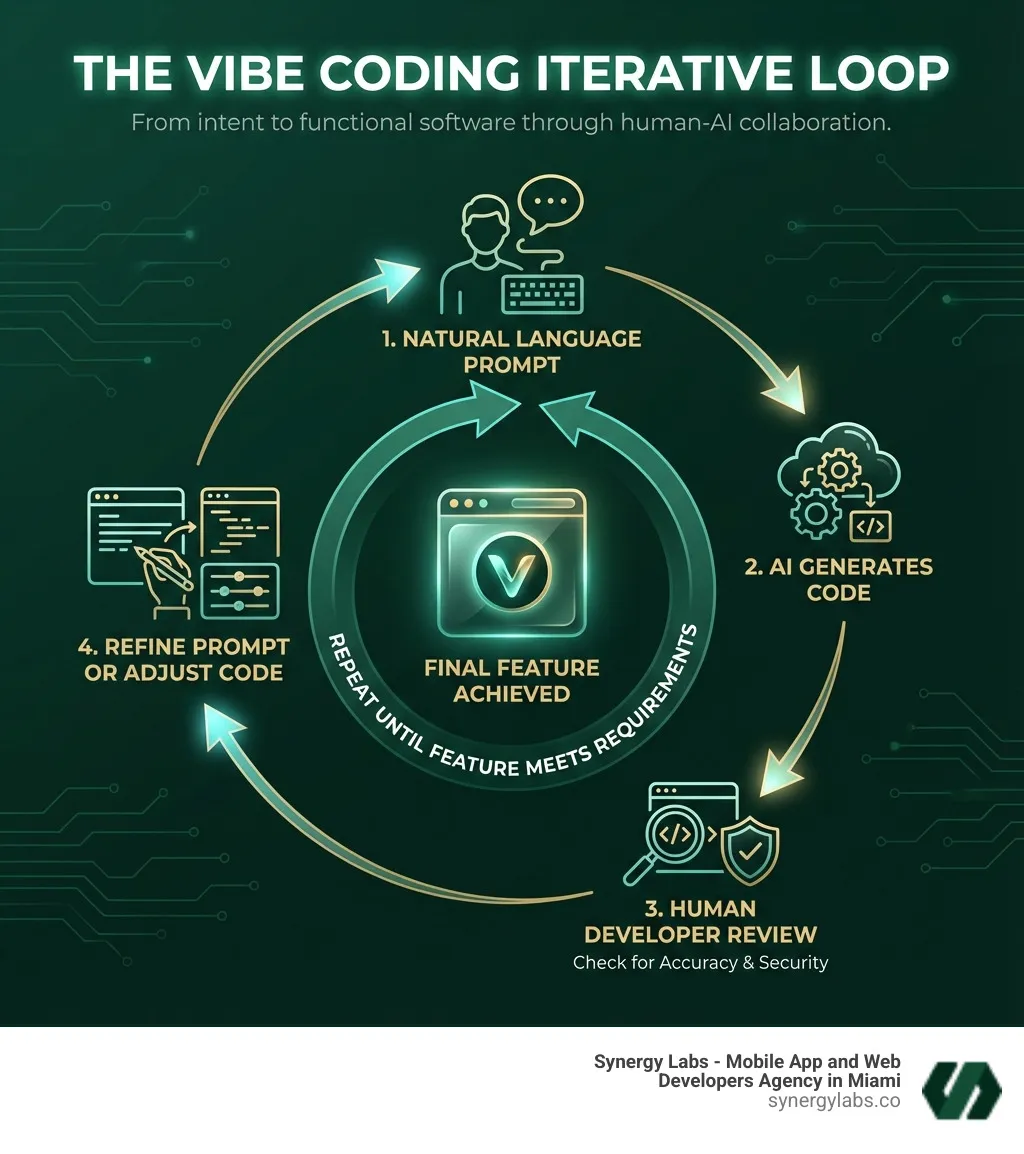
How it works: Prompt an AI with natural language, review the generated code, and iterate by refining your prompt.
Key benefit: Build prototypes and MVPs 3-5x faster than traditional coding.
Major risk: About 45% of AI-generated code has security flaws, making human review essential.
Who coined it: AI researcher Andrej Karpathy in 2026; Collins Dictionary's Word of the Year for 2026.
For decades, building an app meant mastering complex languages and frameworks. Low-code and no-code platforms simplified this with visual tools. Now, in 2026, vibe coding takes the next leap, turning conversational prompts into functional software.
Think of it as telling a story to a skilled ghostwriter who drafts it for you, while you focus on plot and character. You still review, edit, and refine—but the heavy lifting happens much faster. This approach is powered by Large Language Models (LLMs) trained on billions of lines of code. These AI systems interpret your instructions, generate code, and adapt to your feedback.
While 84% of developers use or plan to use AI tools in 2026, and startups are shipping 95% of their code via AI, the reality is nuanced. AI accelerates prototyping but can introduce security vulnerabilities and technical debt. The key is knowing when to vibe—and when to bring in human expertise.
As a team that's worked with many startups, we've seen how vibe coding can accelerate early-stage development. At Synergy Labs, we help founders steer What Is Vibe Coding Your 2026 Vibe Coding Guide by combining AI-powered rapid prototyping with the rigor of traditional engineering. Our approach bridges the gap between quick iteration and long-term scalability, so you can ship with confidence.
What Is Vibe Coding? Your 2026 Vibe Coding Guide terms made easy:
Vibe coding is a natural language-driven, AI-assisted way to build software. Instead of writing every line of code, we describe our desired outcome in prompts to an agentic AI system, which then translates these intentions into functional code. It's about focusing on what to build, not the how.
The term was coined by AI researcher Andrej Karpathy in February 2026. He described it as a new kind of coding where you "fully give into the vibes." This intuitive approach resonated so much that Collins English Dictionary named "vibe coding" its Word of the Year for 2026.
How does it work? It's an iterative conversation. You start with an idea, describe it to the AI, and it generates an initial code draft. You then review this code, provide feedback, and refine your prompt to guide the AI. This loop of describing, generating, and refining allows for rapid progression from concept to prototype.
This process is underpinned by a sophisticated AI pipeline centered on Large Language Models (LLMs). They enable:
Intent Understanding: The AI parses your prompt to grasp the core functionality you're aiming for.
Architecture Planning: The AI may suggest or lay out a basic architectural structure for the application.
Code Generation: The AI writes the code, choosing appropriate languages, frameworks, and libraries.
Dependency Management: It often identifies and includes necessary external libraries or packages.
Testing/Refinement: Advanced systems can generate basic tests or suggest code refinements.
Vibe Coding vs. Traditional Coding
The differences between vibe coding and traditional coding are stark, impacting speed, skill requirements, and control.
Development Speed: Vibe coding offers a 3-5x productivity increase for many tasks, dramatically accelerating prototyping and agile development.
Skill Requirements and Accessibility: Traditional coding requires deep technical mastery. Vibe coding lowers the barrier, making development accessible to those with less programming knowledge, though software fundamentals are still beneficial.
Granular Control and Precision: Traditional coding provides ultimate control over every line of code. Vibe coding trusts the AI with implementation details, which speeds things up but may result in less optimized code if not carefully reviewed.
Maintainability and Code Quality: In traditional coding, maintainability is built in through rigorous standards. With vibe coding, the quality of AI-generated code can vary, requiring diligent human oversight to prevent technical debt.
Ideal Use Cases: Vibe coding excels at rapid ideation, quick prototypes, and small automations. Traditional coding remains the standard for complex, high-performance, and security-critical enterprise applications.
The Technical Foundation of Vibe Coding
The magic of vibe coding lies in its AI underpinnings. It's an intelligent collaboration.
Intent Understanding: The AI uses Natural Language Processing (NLP) to understand the intent behind your request. "Create a login form" implies user authentication, input fields, and a button.
Architecture Planning: For complex requests, the AI considers the components needed (frontend, backend, database) and structures the code accordingly.
Code Generation: Trained on vast code repositories, LLMs generate contextually appropriate code in various languages.
Dependency Management: AI tools can identify and suggest necessary libraries, ensuring the code has what it needs to run.
Automated Testing: Some platforms can generate basic unit tests to help validate the AI-generated code.
Role of AI Pair Programmers: Many tools act as an "AI pair programmer," offering real-time suggestions and refactoring advice.
AI-First App Development: At Synergy Labs, we accept AI-First App Development, using AI as an integral part of our process. This allows our expert developers to focus on high-level problem-solving and architectural integrity while AI assists with boilerplate tasks.
The Benefits and Risks of Vibe Coding
Vibe coding is a game-changer, offering tantalizing benefits alongside significant challenges. Understanding both sides of this double-edged sword is crucial for using its power effectively.
The Bright Side: Why Developers Are Embracing the Vibe
The allure of vibe coding is undeniable, primarily for its ability to accelerate the development lifecycle.
Rapid Prototyping and Building MVPs: This is the biggest win. Vibe coding moves ideas to functional Minimum Viable Products (MVPs) in hours or days, not weeks. This speed is crucial for quick market testing and validation.
Focus on Problem-Solving Over Syntax: Vibe coding shifts our focus from the nitty-gritty of syntax to the higher-level problem we're trying to solve, leading to more innovative solutions.
Automating Routine Work: AI excels at repetitive tasks like generating CRUD scaffolds, writing unit tests, or creating basic UI components. This automation frees up developers for more complex challenges.
Continuous Learning: Observing how AI constructs code can be educational, exposing developers to different patterns and new approaches.
Productivity Increases: Developers report productivity increases of 3-5x for common tasks. A recent developer report indicates that 84% of developers already use or plan to use AI tools in 2026.
The Dark Side: Critical Challenges and Security Implications
While the benefits are compelling, we must approach vibe coding with caution, especially regarding code quality and security.
Security Vulnerabilities: This is the most significant risk. Studies show that approximately 45% of AI-generated code contains security flaws like insecure authentication or missing input sanitization. These can expose sensitive data and create major vulnerabilities.
Technical Debt: Rapid generation without careful review can lead to "AI spaghetti"—code that is functional but poorly structured and hard to maintain. This accumulates technical debt, making future updates more costly.
The "Black Box" Problem: When AI generates complex code, developers might use it without fully understanding its inner workings, making debugging and optimization a nightmare.
Over-Reliance and Skill Atrophy: Over-relying on AI for code generation can cause fundamental programming skills to diminish over time, impacting a developer's ability to handle complex problems independently.
AI-Driven Security Threats: Beyond insecure code, AI can be used to generate malicious URLs for phishing scams. Research shows tens of thousands of such URLs are created monthly from popular tools, highlighting a broader security threat.
Mastering the Craft: Your 2026 Vibe Coding Guide to Best Practices
To harness the power of vibe coding, we can't blindly trust the AI. It requires a "human-in-the-loop" approach, combining AI's speed with our developers' expertise and critical judgment. It's about mastering the craft, not just pressing a button.
How to Get Started: Your First Steps in Vibe Coding
For anyone looking to dip their toes into vibe coding, here’s our practical roadmap:
Choose Your Starting Point: Look for platforms that balance features, ease of use, and support. Beginners might prefer a browser-based tool for rapid prototyping, while developers may favor AI-integrated IDEs to improve existing workflows.
Learn Prompt Engineering: This is the new superpower. Your effectiveness hinges on your ability to communicate clearly with the AI. Study examples, practice specificity, and iterate.
Build Progressive Complexity: Start small. Generate a simple function, then a basic web page, and gradually increase complexity to build confidence and understand the AI's limits.
Develop Best Practices: From day one, implement quality processes like code review, testing, and version control.
Understand Limitations: Recognize that complex, security-critical projects will always require significant human oversight and traditional development rigor.
To build a solid foundation, we recommend familiarizing yourself with software fundamentals, which are critical for guiding and evaluating AI output:
Introduction to Computer Science: Foundational courses are great for understanding how different parts of a web app work together.
Introduction to APIs: Learn how software components communicate, a key skill for prompt crafting.
Introduction to SQL: Helps you understand how data is structured and queried.
Responsive Web Design: Build foundational web development skills that inform better prompts and review.
Best Practices for an Effective Vibe Coding Workflow
An effective vibe coding workflow integrates AI as a powerful assistant within a structured process.
Craft Clear, Specific Prompts: Vague prompts yield vague code. Be explicit about goals, constraints, and desired styles. Break down large tasks. Instead of "Build a social media app," prompt for a specific feature like, "Create a user authentication system with email/password login."
Break Complex Projects into Smaller Components: Deconstruct your project into logical modules (e.g., user authentication, UI components) and tackle them individually.
Leverage Version Control from the Start: Treat AI-generated code like any other. Use Git to track changes, maintain history, and collaborate. This is non-negotiable.
Document Prompts and Decisions: Keep a "prompt log" of prompts, AI responses, and refinements. This is invaluable for debugging and knowledge transfer.
Implement Testing and Validation: Never deploy AI-generated code without thorough testing. Remember the 45% statistic—trust, but verify.
Plan for Human Oversight: This is paramount. Human developers must review AI-generated code for security, standards, performance, and architectural fit.
Specify Your Tech Stack: If you have preferences (e.g., "use React and Node.js"), include them in your prompts to guide the AI.
App Development Team Collaboration: At Synergy Labs, we emphasize collaborative development. Vibe coding can improve this by providing rapid prototypes for discussion, allowing our team to focus on strategic collaboration.
The Future of Software: Vibe Coding's Impact and What's Next
What Is Vibe Coding? Your 2026 Vibe Coding Guide is not just about current tools; it’s about anticipating the future. Vibe coding represents a fundamental shift in how we approach software creation, and its evolution will continue to reshape the industry in profound ways.
Ideal Use Cases for Vibe Coding vs. Traditional Coding
Understanding when to "vibe" and when to "code" is key to maximizing efficiency and minimizing risk.
Ideal for Vibe Coding:
Rapid Ideation and Prototyping: Quickly test new app ideas, build functional prototypes for user feedback, or create demos for investors. This is where vibe coding shines, enabling us to go from concept to demonstrable product in days, not weeks.
Throwaway Projects: For learning new technologies, personal projects, or short-term internal tools that don't require long-term maintenance or high security.
Internal Tools and Small Automations: Generating CRUD scaffolds for internal dashboards, automating routine data tasks, or creating simple scripts to streamline workflows.
Custom Software Solutions (Initial Stages): For the initial scaffolding of custom software, vibe coding can provide a significant head start. It can build the foundational elements, allowing our developers to then refine, secure, and scale it.
When to Transition to Traditional Development (or use a hybrid approach):
Scalable, Enterprise-Grade Applications: For robust, high-performance, and secure enterprise applications, traditional coding with expert oversight remains critical. While vibe coding can kickstart these projects, the long-term maintainability, security, and scalability demand human engineering rigor.
Complex Business Logic: When an application involves intricate business rules, unique algorithms, or highly specialized integrations, human developers excel at designing and implementing these nuances.
High-Security and Compliance Needs: Applications dealing with sensitive data (e.g., financial, healthcare) require meticulous security audits, compliance adherence (like GDPR, HIPAA), and custom security measures that AI alone cannot guarantee.
Long-Term Maintainability: For projects with a long expected lifespan, ensuring clean, well-documented, and easily maintainable code is crucial. Human developers are better equipped to architect for maintainability from the ground up.
How Vibe Coding Impacts the Role of Professional Developers
Far from making developers obsolete, vibe coding is elevating their role, shifting it from mere coders to orchestrators, architects, and strategic problem-solvers.
Focus on System Architecture: With AI handling much of the boilerplate, developers can dedicate more time to designing robust, scalable, and efficient system architectures. This means focusing on database design, API contracts, microservices, and overall application structure.
Strategic Problem-Solving: The developer's role evolves to identifying the right problems to solve, defining clear requirements, and guiding the AI towards effective solutions. This requires a deeper understanding of business needs and user experience.
Improved Creativity: By offloading repetitive tasks, developers have more mental bandwidth to explore innovative solutions, experiment with new ideas, and focus on the creative aspects of software design.
The Developer as an AI Orchestrator: Developers become conductors of an AI symphony, skillfully prompting, refining, and integrating AI-generated components. This requires a new skill set in prompt engineering, AI tool selection, and intelligent code review.
Need for Critical Review Skills: The 45% statistic on insecure AI-generated code underscores the critical need for human developers to possess strong code review, debugging, and security auditing skills. We are the ultimate quality gatekeepers.
AI's Impact on Business Innovation: Developers, empowered by vibe coding, can become catalysts for business innovation. They can rapidly prototype new features, experiment with market opportunities, and quickly deliver value, driving competitive advantage for their organizations.
Frequently Asked Questions about Vibe Coding
Can non-programmers use vibe coding to build real applications?
Yes, absolutely. Vibe coding democratizes software creation, allowing non-programmers like product managers, designers, and entrepreneurs to build functional prototypes, internal tools, or simple websites using natural language prompts.
However, there's a catch: while you can build applications, creating production-ready, scalable, and secure applications still requires technical oversight. For anything beyond a simple prototype, understanding basic software concepts (like data schemas and APIs) will help you craft better prompts and evaluate the AI's output more effectively.
How does vibe coding handle security and data privacy?
This is a critical area of concern, as AI-generated code can introduce significant security vulnerabilities. As mentioned, up to 45% of AI-generated code may contain flaws such as:
Insecure code patterns: Common vulnerabilities like SQL injection or cross-site scripting (XSS).
Outdated or insecure dependencies: Using libraries with known security flaws.
Lack of input validation: Overlooking robust validation, which is critical for preventing attacks.
Privacy breaches: Mishandling sensitive user data, potentially violating regulations like GDPR or HIPAA.
Therefore, for any application handling sensitive data, rigorous human oversight is non-negotiable. This includes mandatory code reviews by experienced developers, automated security scanning (SAST/DAST), penetration testing, and compliance checks. At Synergy Labs, our process integrates AI for speed but prioritizes robust security and compliance through our expert development teams.
Is vibe coding going to make software developers obsolete?
No, not at all. Vibe coding is changing the role of developers, not eliminating it. Think of it as a powerful new tool, much like compilers or cloud platforms were in their time. Instead of writing boilerplate code, developers can now focus on higher-level tasks:
System architecture and design: Crafting scalable, performant, and maintainable application structures.
Higher-level problem-solving: Translating complex business needs into clear, actionable prompts for AI.
Quality assurance and security: Reviewing, testing, and securing AI-generated code to ensure it meets high standards.
Innovation and creativity: Using AI to rapidly prototype new ideas and explore more creative solutions.
The future is a collaboration between human ingenuity and AI's processing power. Developers who master prompt engineering, critical code review, and architectural design will be more valuable than ever.
From Vibe to Value: Turning Your Vision into a Production-Ready App
Vibe coding has undeniably ushered in a new era of rapid development, allowing us to quickly transform ideas into functional prototypes. It's a powerful collaborator, speeding up the initial stages and democratizing access to software creation. However, there's often a significant gap between a quickly "vibed" prototype and a robust, market-ready, and scalable product.
To translate your AI-powered vision into a secure, scalable, and successful application, you need a partner with deep engineering expertise. At Synergy Labs, we combine the speed of modern tools with the rigor of traditional development, offering a fixed-budget model with an in-shore CTO and offshore team to deliver your project on time and within budget through milestone-based payments. We ensure your app goes beyond the initial vibe, integrating user-centered design, robust security protocols, and a foundation built for long-term success.
Explore our services to see how we build robust applications that go beyond the vibe, ensuring your vision not only comes to life but thrives.




.avif)

.avif)


