The cloud can't respond fast enough. Edge computing closes the gap between data generation and real-time action.
The Dawn of a Connected World: The Promise and Problem of IoT

Why Edge Computing Is the Missing Link for IoT in Smart Cities and Industry 4.0 comes down to one simple truth: traditional cloud computing can't keep up with the demands of real-time IoT applications. Here's the quick answer:
- Latency Problem: Cloud computing requires data to travel hundreds or thousands of miles to centralized servers and back. Edge computing processes data locally, reducing response times from seconds to milliseconds.
- Bandwidth Crisis: IoT devices can generate terabytes of data daily. Sending all that to the cloud is expensive and inefficient. Edge computing filters data locally, transmitting only what matters.
- Security Gaps: Centralized cloud architectures create single points of failure. Edge computing distributes processing, keeping sensitive data closer to its source.
- Real-Time Requirements: Applications like autonomous vehicles, traffic management, and industrial automation need instant decisions. Edge computing enables the split-second processing that smart cities and Industry 4.0 demand.
The Internet of Things promised to revolutionize how cities operate and factories produce. By 2030, experts predict that major cities will host 30 billion IoT devices each--sensors, cameras, and machines all communicating on factory floors. But this creates a massive bottleneck. These sensors generate staggering amounts of data; an autonomous vehicle alone needs data processing that exceeds 1 Tbps. The traditional solution--sending everything to the cloud for processing--simply doesn't work at this scale, resulting in delays, unsustainable costs, and security risks.
Edge computing changes the equation entirely. Instead of sending raw data miles away, edge computing brings computational power to the network edge--right where the data originates. This means faster decisions, lower costs, and better security.
The global IoT market is expected to surpass $1 trillion in revenue in 2024, but without edge computing to handle the processing demands, that growth hits a ceiling. At Synergy Labs, we've seen how edge computing transforms what's possible for connected applications. Understanding Why Edge Computing Is the Missing Link for IoT in Smart Cities and Industry 4.0 is central to how we design scalable, responsive systems that work in the real world.
The Cloud Conundrum: Why Centralized IoT Architectures Are Hitting a Wall
The proliferation of IoT devices has transformed urban and industrial settings, but it has also exposed a critical challenge: the limitations of traditional, centralized cloud computing. While the cloud offers immense storage and processing power, its design struggles with the latency, bandwidth, and security demands of modern IoT applications.
Imagine a city like New York City or Dubai, with millions of IoT devices. If every byte of data must travel hundreds of miles to a distant, centralized cloud data center for processing, we encounter the "cloud conundrum." This centralized model creates significant bottlenecks, making cloud-only solutions prohibitive in cost and performance as the number of devices grows. The cloud wasn't designed to efficiently handle data that is only locally relevant, leading to imbalanced processing and ballooning costs.
The High Cost of Delay in Real-Time Applications
In many critical IoT applications, milliseconds matter. Autonomous vehicles, for example, must process vast amounts of sensor data to make split-second safety decisions. A round-trip to the cloud introduces inherent latency that could be catastrophic. Autonomous driving requires data processing capabilities exceeding 1 Tbps, with decisions made in milliseconds.
Similarly, in advanced manufacturing facilities in cities like Chicago or Phoenix, robotic systems cannot afford delays. Robot-assisted surgery demands near-zero latency for patient safety. Even real-time traffic management systems in Doha or Riyadh depend on immediate data processing to prevent gridlock. The problem is the "round-trip time" for data to travel to the cloud and back, which is too long for latency-sensitive applications. As new IoT use cases emerge, the demand for real-time capabilities makes the limitations of cloud-centric models increasingly apparent.
Drowning in Data: The Bandwidth and Cost Crisis
The sheer volume of data from IoT devices is staggering. A single HD camera can generate up to 80 GB of data per day. Hyperspectral cameras produce images up to 300 MB each. Multiply this by thousands of devices, and the numbers become astronomical.
Sending all this raw data to the cloud is a logistical and financial nightmare. Bandwidth becomes a bottleneck, and the costs of transmitting and storing terabytes of often redundant data are prohibitive. Research suggests only about 1% of monitoring data is useful for actionable insights; the other 99% is often irrelevant noise. Imagine paying to transmit, store, and process 99% of data that ultimately gets discarded. This strains networks, causes congestion, and raises privacy concerns when sensitive data is continuously uploaded to remote servers. The bandwidth and cost crisis is a major reason Why Edge Computing Is the Missing Link for IoT in Smart Cities and Industry 4.0.
Opening Up Potential at the Periphery: Why Edge Computing Is the Missing Link for IoT in Smart Cities and Industry 4.0
The challenges of latency, bandwidth costs, and security vulnerabilities all point to one conclusion: we need a different approach. That's where edge computing comes in. It's the transformative piece that makes modern IoT deployments work.
What is edge computing? Think of it as bringing the brain closer to the body. Instead of sending all data to a distant cloud, edge computing places processing power and storage right where the action happens--at the network's "edge," near the IoT devices. A traffic camera in downtown Miami can analyze video on the spot and only send relevant alerts, rather than raw footage to a distant server.
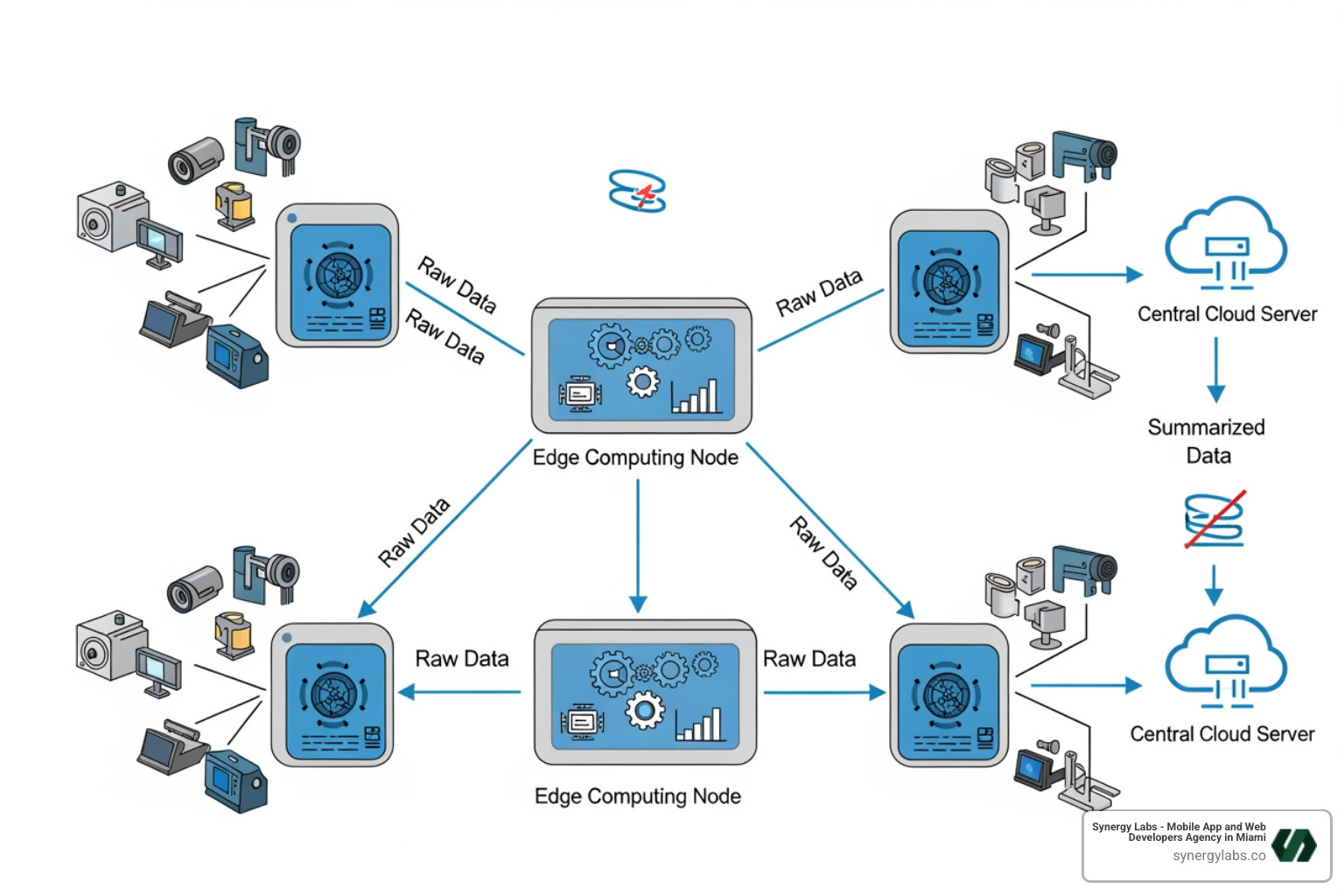
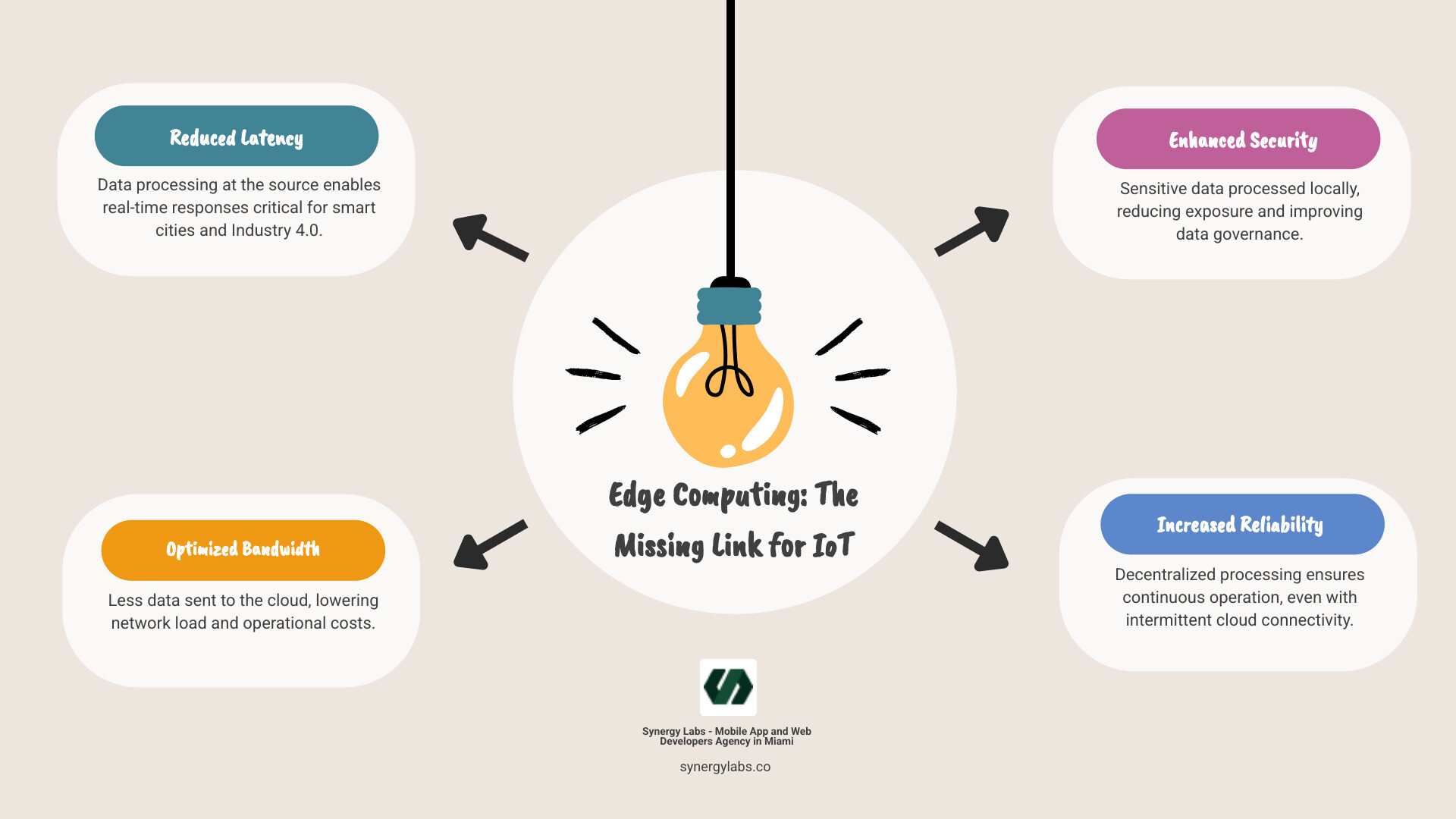
This shift to decentralized processing is a complete rethinking of IoT data handling. By processing information at the source, edge computing delivers ultra-low latency for real-time applications, optimizes bandwidth by filtering out noise, improves security by keeping data local, and creates better reliability by avoiding a single point of failure. When you understand these benefits, it becomes clear Why Edge Computing Is the Missing Link for IoT in Smart Cities and Industry 4.0. Without it, the promise of IoT hits a wall.
At Synergy Labs, we've seen this change firsthand. Edge computing is often what makes the difference between a system that barely functions and one that exceeds expectations.
How Edge Computing Solves the Latency Problem
Edge computing makes latency virtually disappear by handling data processing locally, enabling responses in milliseconds. For applications where timing is everything, this is the only way forward.
Consider an autonomous vehicle traveling at 60 mph; it covers 88 feet every second. If it detects a pedestrian, there's no time to send data to the cloud and wait for instructions. The car must react now. Edge computing makes this possible by processing sensor data within the vehicle or at nearby roadside units, enabling split-second, life-saving decisions.
The same principle applies to robotic arms in a Chicago factory, medical devices in surgery, or traffic systems adjusting signals in real-time. By eliminating cloud round-trips, edge computing enables the real-time decision-making modern applications demand. The integration of Time-Sensitive Networking (TSN) further guarantees data delivery within strict time windows, while 5G and future 6G networks promise to reduce latency to as low as 1 millisecond and 100 microseconds, respectively, open uping even more advanced applications.
Slashing Costs and Saving Bandwidth
Edge computing also dramatically cuts costs by enabling smart data filtering at the edge. Since only about 1% of IoT monitoring data is typically useful, edge devices analyze data locally and transmit only the relevant insights to the cloud. The wasteful pattern of uploading everything is eliminated.
Consider a city like Miami with thousands of surveillance cameras. With edge computing, cameras perform video analytics locally--detecting motion or identifying unusual activity--and only send alerts or short clips. Bandwidth requirements can drop by 90% or more. This approach also reduces cloud storage needs, as organizations archive only processed, meaningful data instead of terabytes of raw footage.
By sending only relevant insights, edge computing alleviates pressure on core networks, reduces congestion, and lowers communication expenses. The entire infrastructure becomes more efficient and sustainable. For businesses and municipalities, these cost savings make large-scale IoT projects financially viable, changing IoT from an expensive experiment into a practical solution. This is another key reason Why Edge Computing Is the Missing Link for IoT in Smart Cities and Industry 4.0.
Edge in Action: Real-World Applications Changing Our World
The theoretical benefits of edge computing become clear when you see it in action. Across industries and cities from Dubai to the American Midwest, this technology is fundamentally changing how we live and work.
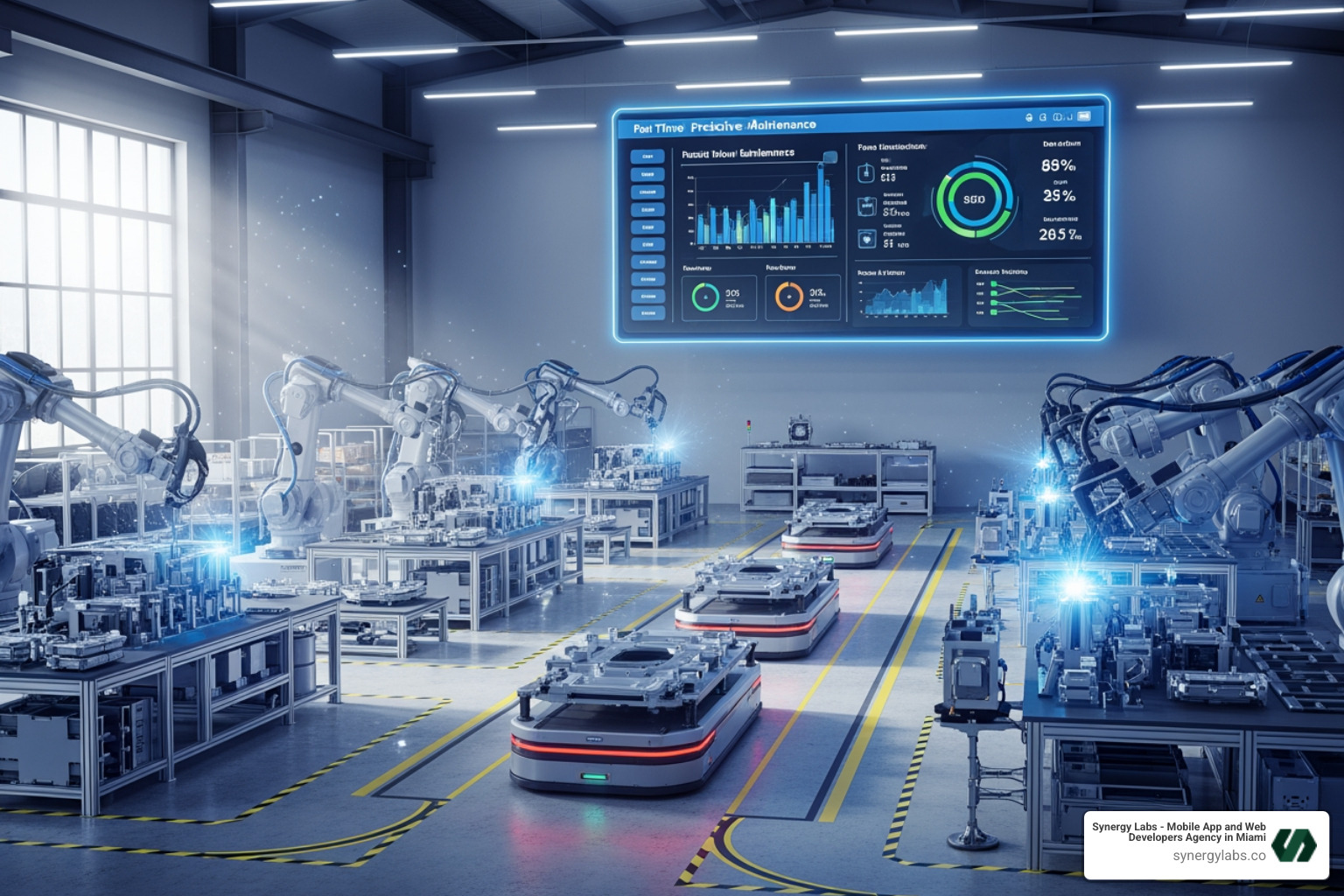
Applications are as diverse as they are transformative. Autonomous systems like self-driving cars in San Francisco rely on edge computing for split-second decisions. Smart infrastructure is getting smarter, with intelligent traffic lights and energy grids that balance supply and demand in real-time. In factories, industrial automation has reached new heights with predictive maintenance and automated quality control. Two sectors in particular, smart cities and Industry 4.0, stand out as prime examples of edge computing's potential.
Why Edge Computing Is the Missing Link for IoT in Smart Cities
A smart city isn't just about collecting data; it's about acting on it immediately. That's exactly Why Edge Computing Is the Missing Link for IoT in Smart Cities.
- Smart Traffic Management: In cities like New York, edge devices on cameras and sensors process traffic flow locally. This allows signals to adjust in real-time to clear congestion and create "green waves," saving commuters time and reducing emissions without waiting for a central server.
- Public Safety: Surveillance cameras with edge processors can analyze footage on-site to detect accidents or unusual activity. Emergency responders receive alerts in seconds, not minutes, which can be life-saving.
- Energy Optimization: Smart grids use edge computing to balance electricity demand in real-time. Streetlights can adjust based on whether pedestrians are present, leading to massive energy savings.
- Autonomous Vehicles: Edge enables vehicle-to-everything (V2X) communication, allowing cars to coordinate instantly with each other and with roadside infrastructure, dramatically improving safety.
- Environmental and Waste Management: Local processing allows air quality sensors to issue immediate pollution alerts and smart waste bins to optimize collection routes, reducing truck trips and creating cleaner cities.
The impact is profound, changing urban infrastructure from reactive to proactive and optimized, as detailed in a comprehensive survey on edge-enabled smart cities.
Why Edge Computing Is the Missing Link for IoT in Industry 4.0
Industry 4.0 is about connecting machines, systems, and people. At its heart is edge computing, which is Why Edge Computing Is the Missing Link for IoT in Industry 4.0.
- Predictive Maintenance: This is one of the most valuable applications. Instead of scheduled servicing, Industrial IoT gateways monitor machinery on the factory floor, processing vibration and temperature data locally. They learn a machine's normal state and detect tiny deviations that signal future failures, allowing for maintenance before a costly breakdown occurs.
- Manufacturing Quality Assurance: On-the-fly quality control becomes possible. Cameras and sensors inspect products during assembly, processing images locally to catch defects in real-time. This prevents defective products from being shipped and ensures consistent quality.
- Industrial Automation and Robotics: Smart factories use edge devices to control robotic systems with millisecond precision. This allows for complex, coordinated operations and the flexibility to adapt workflows in real-time without human intervention.
- Worker Safety Monitoring: Edge-enabled sensors can track environmental conditions like air quality or hazardous gases and immediately alert workers to danger. Wearables can monitor worker health, preventing accidents before they happen.
At Synergy Labs, we build applications for these exact scenarios, creating reliable, secure systems that process data in real-time. Whether managing IoT devices in a smart city or coordinating industrial systems, the principle is the same: bring processing to the data.
Building the Edge: Key Technologies and Implementation Problems
We've established that edge computing is transformative, but building a robust edge infrastructure is a sophisticated undertaking. It requires blending cutting-edge technologies with a strategic approach to some tricky challenges. You're not just moving computation; you're redesigning how data flows through an entire ecosystem.
This is the kind of complex problem that excites our team at Synergy Labs. A well-designed edge infrastructure becomes the backbone of future-proof IoT applications. Understanding the enabling technologies and the obstacles is crucial for success, whether you're planning a smart city initiative in Miami or designing next-gen industrial automation. For a deeper dive, we recommend reading A look at the future of edge computing infrastructure.
The Tech Stack Powering the Edge
Edge computing is built on a foundation of complementary technologies working in concert.
- 5G and 6G Networks: These are critical enablers, providing the ultra-high reliability, massive device connectivity, and ultra-low latency (down to 1 millisecond for 5G) that edge applications need.
- Artificial Intelligence at the Edge (Edge AI): This involves embedding AI and machine learning models directly into edge devices. It allows a traffic camera in Phoenix or a factory sensor in Chicago to perform real-time analysis locally, which is central to Why Edge Computing Is the Missing Link for IoT in Smart Cities and Industry 4.0.
- Hardware Acceleration (FPGAs): For computationally intensive tasks like AI, Field-Programmable Gate Arrays (FPGAs) offer massive performance and power efficiency gains. Their reconfigurability is crucial as edge applications evolve.
- IoT Gateways and Routers: These are the unsung heroes, collecting data from sensors, performing initial processing, and intelligently routing information.
- Software-Defined Networking (SDN): SDN brings flexibility to edge networks, allowing for dynamic management of traffic flow and resource allocation.
- Digital Twins: This involves creating a virtual replica of a physical asset, fed by real-time data from edge devices. It allows for continuous monitoring, simulation, and optimization.
Overcoming the Challenges of Edge Adoption
Despite its promise, edge computing comes with genuine challenges that require expertise and careful planning.
- Edge Security Threats: Decentralizing computing creates a much larger attack surface. Every edge device is a potential vulnerability, making security exponentially more complex than in a centralized cloud. Robust encryption and intrusion detection are essential at every level.
- Resource Management and Allocation: Managing resources across thousands of heterogeneous devices with different capabilities is highly complex. It requires sophisticated orchestration to allocate workloads efficiently and prevent bottlenecks.
- Device Heterogeneity and Integration: The IoT landscape is filled with diverse devices running different protocols. Ensuring they can interoperate and integrate into a cohesive system is a major engineering challenge. This is especially true when integrating with existing multi-cloud environments.
- Lack of Universal Standards: The edge computing space is still evolving, and the lack of universal standards for device management and communication protocols makes it difficult for IT managers to build scalable, maintainable systems.
At Synergy Labs, we've spent years navigating these exact challenges. We understand that building edge infrastructure is about creating solutions that are robust, secure, and work in the real world. Having an experienced partner makes all the difference.
Forging the Future, One Edge at a Time
We've explored the landscape of modern IoT, from the data deluge of smart cities to the precision demands of Industry 4.0. The conclusion is clear: Why Edge Computing Is the Missing Link for IoT in Smart Cities and Industry 4.0 isn't just a technical question--it's the defining challenge of our connected future.
The shift to edge computing is not a trend; it's an inevitable evolution. Every autonomous vehicle in San Francisco, every predictive maintenance system in a Chicago factory, and every smart traffic light in Dubai depends on bringing intelligence to where the action happens. This new paradigm creates systems that are more resilient, responsive, and secure, future-proofing our infrastructure for applications we haven't even imagined yet.
The numbers tell part of the story--millisecond response times and massive savings in bandwidth costs. But the real story is what this enables: a city that responds to its residents in real-time, a factory that prevents problems before they happen, and a healthcare system that monitors patients without compromising privacy.
At Synergy Labs, we don't just follow technology trends--we help our clients in Miami, New York City, London, and beyond steer them thoughtfully. Our approach to building scalable and secure applications for the edge starts with understanding your specific challenges, whether you're managing urban infrastructure or optimizing industrial operations.
What sets us apart is our commitment to personalized service with direct access to senior talent. When tackling complex edge-enabled IoT deployments, you need partners who understand both the big picture and the technical details. You need a team that can design user-centered applications that are robust enough for mission-critical environments, yet flexible enough to evolve.
The future we're building--where cities are truly smart and industries operate with unprecedented efficiency--depends on getting the edge right. It's about creating systems that process information intelligently, locally, and securely.
Ready to transform your IoT vision from concept to reality? Whether you're planning a smart city initiative or upgrading industrial operations, we're here to help you harness the power of edge computing. Let's build something remarkable together.
More info about our custom app development services


.avif)

.avif)


