Why App Development Success Stories Matter

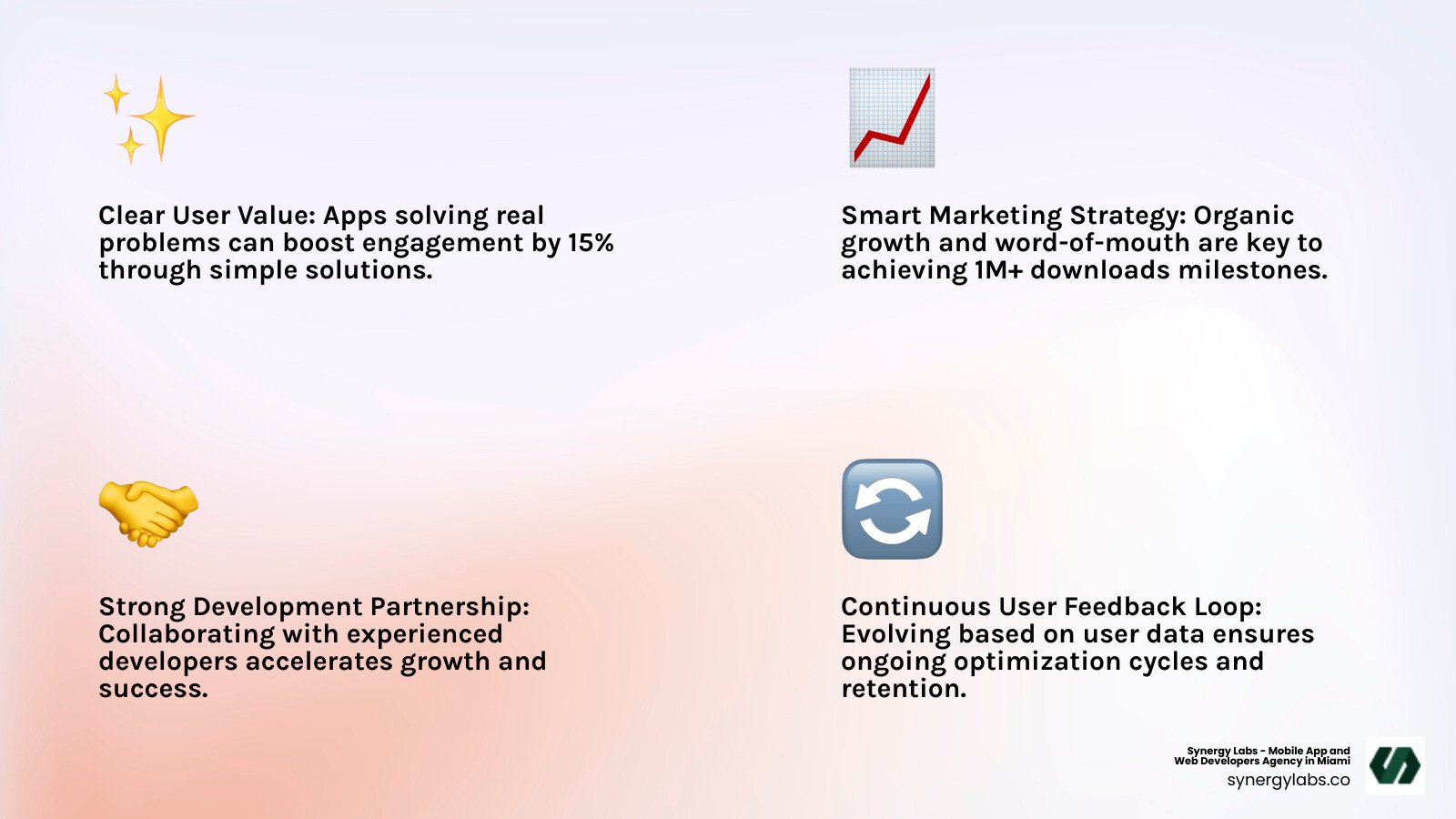
App development success stories prove that with the right strategy, even small teams can compete in a crowded marketplace. Here's what makes apps succeed:
- Clear user value - Apps like popular messaging platforms and music streaming services solved real problems simply
- Smart marketing - Many successful apps gained traction through organic growth and word-of-mouth
- Strong partnerships - Working with experienced developers helped apps like Clapper reach 1 million downloads quickly
- Continuous improvement - The best apps evolve based on user feedback and behavior data
If you're a startup founder wondering whether your app idea can make it, these stories offer proof that it's possible. You don't need a massive budget or a Silicon Valley address. You need the right approach, a solid development partner, and a clear understanding of what your users actually want.
The reality? Most successful apps didn't happen by accident. They resulted from smart design decisions, performance optimization, and teams that understood how to balance speed with quality. When engagement improves by 15% or retention jumps because of better UX, that's not luck—that's intentional strategy.
The app market is competitive, but it's not closed. Young developers are becoming millionaires. Consumer apps are passing millions of downloads. Small teams are building products that rival tech giants. The question isn't whether success is possible. It's whether you're ready to learn from those who've already done it.
As someone who's worked on app development success stories like Clapper (which passed 1 million downloads post-launch) and consumer apps like Peanut and Slowly, I've seen what separates apps that thrive from those that fade. At Synergy Labs, we focus on understanding user personas, optimizing performance, and building experiences that feel effortless—because those are the foundations every successful app shares.
Quick look at app development success stories:
Real-World Mobile App Success Stories
The journey from a rough app sketch to a top-performing mobile product is rarely smooth, but the payoff can be enormous. In the real world, app development success stories are built on clear user value, focused execution, and a relentless willingness to improve, not on vague buzzwords or hype.
Look at the mobile landscape today: productivity tools that keep work on track, social platforms that connect niche communities, and entertainment apps that soak up spare minutes on the subway. The categories differ, but the success pattern is familiar: understand a specific audience, solve a concrete problem, and make the experience so smooth that using anything else feels annoying.
Consider on-demand mobility apps. Before they appeared, getting a ride in a big city could feel like a lottery. These apps didn’t just put taxis on a map; they redesigned the entire experience around the user: real-time tracking, clear pricing, easy payments, and ratings that built trust. That kind of end‑to‑end thinking is exactly what turns “an app” into an ecosystem people rely on every day.
Health and wellness apps follow a similar arc. In cities like Miami or Dubai, where active lifestyles are common, mobile tools that track movement, sleep, or workouts have helped millions build better habits. The winning apps don’t just dump numbers on a dashboard. They give context, encouragement, and routines that fit into busy lives, often adding a sense of community so users feel supported rather than judged.
At Synergy Labs, we see these patterns up close. Our work on high-quality, scalable, cross-platform apps has shown that the winners are rarely the flashiest ideas; they are the ones that:
- Target a clearly defined user
- Deliver a simple, reliable core feature set
- Launch quickly, then improve based on real usage data
We’ve watched products go from concept to launch and then quietly rack up tens or hundreds of thousands of users because they stayed focused on value and usability. Smart architecture, thoughtful UX, and performance optimization might not sound glamorous, but they are exactly what separates a one-week novelty from a long-term success.
Across projects in places like San Francisco, Austin, and Chicago, the same lesson keeps repeating: the story behind a successful app is not magic. It is consistent execution, informed decisions, and a team that listens more to users than to their own assumptions.
How Apps Achieve Millions of Downloads
Seeing an app climb to millions of downloads can look like overnight success from the outside, but under the hood it is usually a carefully engineered outcome. Hitting numbers like 2.3 million downloads is less about luck and more about treating your product as a living app store experiment that never really stops.
It starts with the product itself. There is no growth hack that can rescue an app that crashes, confuses users, or solves a problem nobody really has. The foundation is a robust, reliable core feature set and a user experience that feels obvious in the best possible way. At Synergy Labs, user-centered design is not a slogan; it determines how we structure flows, write microcopy, and prioritize features so that new users don’t need a manual to get value.
Once the experience is solid, growth strategy matters. Successful apps usually combine several marketing approaches rather than betting everything on a single channel:
- App Store Optimization (ASO): Titles, descriptions, keywords, and screenshots are tuned so that people actually find the app when they search. That means thinking about how real users in cities like Phoenix or Doha describe their problems and then reflecting that language in the listing.
- Content Marketing: Articles, case studies, how-to guides, and short videos help potential users understand why the app exists and how it fits into their daily routines.
- Influencer and Community Outreach: When the product fits a specific niche, collaborations with creators or community leaders who already talk to that audience can generate highly targeted bursts of new installs.
- Paid Acquisition: Carefully tested ads on search, social, or other apps can give a launch the initial momentum it needs, especially when supported by strong onboarding and retention.
- Public Relations: Coverage in relevant media builds trust quickly. A concise, honest story about the problem the app solves often resonates more than a flashy tagline.
Crucially, the work does not stop after launch. Apps that climb toward the million‑download mark tend to:
- Track behavior data instead of guessing what users do
- Ship regular updates that fix friction points
- Respond to reviews and support requests quickly
- Test variations of onboarding, pricing, and features
Rapid app launches help here. Getting a usable version into the wild early lets teams learn from real usage instead of hypothetical personas. Synergy Labs uses agile processes to support this: we launch early, measure carefully, and then refine, so each update nudges retention and engagement in the right direction.
Every app that has crossed the million-download line once started at zero installs and an empty dashboard. The difference between the ones that stay invisible and the ones that break through is usually not a single “growth secret,” but a disciplined cycle: build something genuinely useful, tell its story clearly, measure what happens, and keep improving until success stops looking accidental.
Young Millionaire App Developers
The modern app ecosystem has lowered the barrier to entry so far that age and background matter much less than insight and execution. Stories of young developers who turned simple ideas into thriving businesses illustrate how powerful well-built apps can be.
One widely cited example is Nick D’Aloisio, who created a news‑summarizing app in his mid‑teens and went on to sell the technology while still very young. His path shows how a focused solution to “information overload” can stand out when it is wrapped in a clean, approachable mobile experience.
Another case is Brian Wong, who helped pioneer mobile rewards concepts as a young founder. By rethinking how brands interact with users on their phones, he showed that creative approaches to engagement and timing can open up entirely new business models.
Then there is Chad Mureta, whose journey into apps began after a serious accident. Starting with straightforward games and tools, he built a portfolio that reached millions of users. His career underlines a valuable point: ideas do not have to be complicated to be effective, as long as they are executed consistently and marketed intelligently.
What threads run through these stories?
- They solved recognizable problems. From information overload to boredom in a waiting room, each idea started with a real human need.
- They kept concepts simple. Instead of bloated feature lists, they focused on doing one thing well.
- They moved quickly. Ideas didn’t sit in notebooks for years; they turned into prototypes, then products.
- They understood mobile behavior. They designed for how people actually use their phones: in short bursts, on the go, with limited attention.
At Synergy Labs, we work with founders at all stages of their careers, including those building their very first product. We bring the technical depth—cross‑platform architecture, security, performance, and UX—so they can focus on their vision. The combination of fresh ideas and seasoned engineering is often what turns a promising concept into the kind of app development success story that changes both users’ lives and the creator’s.
Five of the Most Successful Apps in the World
When people talk about app development success stories, a handful of names come up again and again. These apps did more than attract users; they reshaped expectations about what a phone in your pocket can do. Below are five widely recognized examples, chosen not as endorsements but as illustrations of what effective product strategy looks like in practice.
- A global e-commerce app: Large online retail platforms have turned mobile shopping into an almost frictionless habit. Their apps allow users to find products, read reviews, place orders, and track deliveries with just a few taps. Features like personalized recommendations, streamlined checkout, and secure payments show how careful optimization of each step in the journey can make an app feel indispensable in cities from London to Riyadh.
- A leading fitness and nutrition tracker: Health-tracking apps that combine food logging, exercise tracking, and community support have made structured wellness accessible to a broad audience. By changing calorie counting and habit-building into manageable, visually clear workflows, these apps demonstrate the power of simplifying complex tasks and supporting users with reminders, streaks, and progress insights.
- A widely used messaging platform: Cross‑border communication used to be expensive and inconsistent. Modern messaging apps solved this by offering fast text, voice, and video communication over data connections. Their uncomplicated interfaces, reliable performance, and strong privacy features have turned them into everyday tools for billions of people, from families chatting across time zones to teams coordinating projects.
- A major streaming video service: On‑demand video apps have redefined entertainment by placing vast content libraries a tap away. Intelligent recommendations, adaptive streaming quality, and options for offline viewing have set expectations for how smooth and personalized a media experience should be, whether someone is watching at home in Chicago or on a flight leaving Dubai.
- A dominant music streaming app: Music services that let users search, save, and share songs instantly have changed how we find and enjoy audio. Personalized playlists, mood-based mixes, and seamless playback across devices illustrate how data and design can work together to create an experience that feels tailor‑made for each listener.
Though these apps operate in different domains, they share familiar traits:
- They started by addressing a clear gap in the market.
- They invested heavily in user experience and performance.
- They evolved continuously in response to feedback and data.
For founders and product teams, the useful question isn’t “How do we copy them?” but “How do we apply the same principles to our specific audience and problem?” That mindset is central to how Synergy Labs approaches new projects, helping clients design products that are realistic to build yet ambitious enough to stand out.
Frequently Asked Questions about App Development Success Stories
We often hear similar questions from founders and product leaders who want their own app development success stories. Below are clear, no‑nonsense answers you can actually act on.
What are some app development success stories?
There are many examples, from meditation tools that help people build daily mindfulness habits to remote collaboration platforms that keep distributed teams functioning smoothly. Some products serve huge global audiences, while others quietly dominate a niche—like a scheduling app that becomes the default in a single profession, or a local delivery service that feels tailor‑made for one city.
What unites these successes is not a specific feature set, but a pattern:
- They solve a well-defined problem.
- They make the solution easy to access and understand on mobile.
- They keep listening to users and adapting over time.
In our work at Synergy Labs, we’ve seen this same pattern play out with products that started as rough ideas and grew into everyday tools for their users.
How can I make my app successful?
There is no single button to press, but there is a roadmap you can follow:
- Start with a real problem. Talk to potential users before you write code. Validate that the problem is painful enough that people are already trying to solve it in clumsy ways.
- Design for clarity. Prioritize an intuitive UX and clean UI. Every extra tap or confusing label gives users another reason to close your app.
- Plan your marketing early. Think about App Store Optimization, content, communities, and paid channels before launch day, not after. Decide where your audience actually spends time and meet them there.
- Collect feedback systematically. Use analytics, in‑app surveys, and support channels to understand what works and what doesn’t. Avoid relying only on your own opinion or a few loud voices.
- Protect performance and security. Slow load times, crashes, and data concerns will quietly destroy your growth. Bake in performance testing and security reviews from the beginning.
- Support multiple platforms when it makes sense. Cross‑platform development can help you reach both iOS and Android users efficiently, as long as it is planned from the architectural level.
- Work with the right partner. A seasoned development team can help you avoid common pitfalls, ship faster, and make better technical choices. At Synergy Labs, we combine rapid development with user-centered thinking so your app can evolve quickly without becoming fragile.
Who are some young millionaire app developers?
Stories about young developers achieving financial success through apps are common enough now that they have almost become their own genre. Figures like Nick D’Aloisio, Brian Wong, and Chad Mureta are often referenced as examples of what can happen when timely ideas, focused execution, and market demand line up.
The more important takeaway is not their exact ages or earnings, but the shared mindset:
- They spotted gaps in how people lived or worked.
- They believed mobile could close those gaps.
- They were willing to test, iterate, and sometimes abandon ideas that didn’t land.
That same mindset is available to any founder today. With the right planning, technical guidance, and willingness to learn from users, you can build something that meaningfully improves people’s lives—and creates a compelling business in the process.
Writing Your Own App Success Story
Across all of these app development success stories, a consistent message emerges: winning in the app world is rarely about a single genius idea. It is about choosing a real problem, designing carefully around users, and then executing with discipline from the first prototype to every update that follows.
Synergy Labs exists to help founders and teams steer that entire journey. We combine:
- Personalized service with senior talent: You work directly with experienced engineers and product thinkers, not a revolving door of intermediaries. That keeps decisions sharp and communication clear.
- A fixed-budget model: From the outset, you know what you are investing and what you will receive. This helps you plan realistically, manage risk, and avoid the creeping costs that derail many projects.
- An in-shore CTO with an offshore development team: Strategic leadership stays close to you and your market, while implementation leverages a broader global talent pool. You get high-level guidance and cost-efficient delivery in one package.
- Milestone-based payments: Funding is tied to tangible progress. As each chunk of work is completed and approved, you move to the next stage with clear visibility and control.
Whether you are in Miami sketching your first wireframes, in Austin refining a product that needs to scale, or in London modernizing an existing platform, our goal is the same: turn your idea into an app that users genuinely want to keep on their home screens.
If you are ready to move from “interesting concept” to “real product with real users,” Synergy Labs can help you get there. We will work with you to define a realistic roadmap, launch quickly, learn from real-world usage, and iterate until your app is not just built, but successful.
Ready to start your own chapter in the app world? Visit Synergy Labs to discuss your project, explore timelines and budgets, and see how our approach can turn your app idea into a story worth telling.


.avif)

.avif)


