

Why Founder-Led Product Growth Is the Smartest Bet You Can Make in 2026
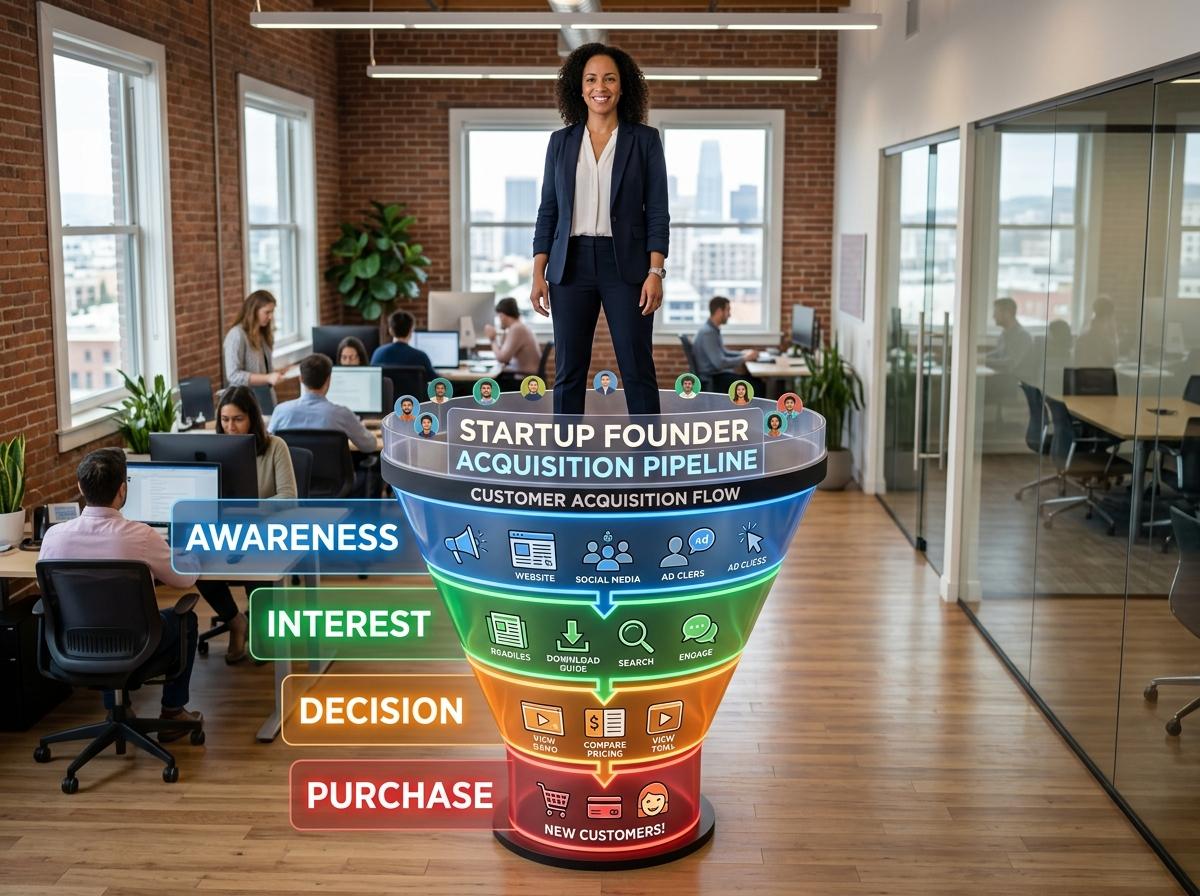
Founder-Led Product Growth is a go-to-market approach where the founder personally drives customer acquisition, product validation, and early sales — before handing off to a team or letting the product sell itself.
Here's a quick breakdown of what it means and when it works:
- What it is: The founder acts as the primary growth engine — doing customer interviews, closing early deals, running experiments, and finding the levers that actually move the needle.
- Why it matters: Most startups fail not because of bad ideas, but because of how the founder approaches growth. Outsourcing that learning too early is one of the biggest mistakes you can make.
- When to use it: Especially in the early stages — pre-product-market fit, pre-Series A — before you have a repeatable sales motion or a product that can truly sell itself.
- How it transitions: Once you've found your growth levers and proven you can close deals yourself, you can layer in a sales team, product-led growth (PLG) motions, or a hybrid model like Product-Led Sales (PLS).
- What it is not: It's not just "the founder doing sales." It's a structured, experiment-driven process for discovering what makes customers buy, stay, and refer others.
Think of it this way: before Airbnb had algorithms and millions of listings, its founders were personally photographing hosts' homes and knocking on doors. That hands-on, unglamorous hustle is what created the conditions for scale later.
The promise of a product that sells itself is real — but it almost never happens without a founder first doing the hard work to understand why people buy, what makes them stay, and where the real bottlenecks are.
In 2026, with rising customer acquisition costs and investors demanding capital efficiency over growth-at-all-costs, that founder-led foundation isn't just smart — it's a survival strategy.
At Synergy Labs, we've worked with early-stage founders across mobile and web to help them ship products that support Founder-Led Product Growth from day one — designing for fast time-to-value, self-serve onboarding, and the kind of UX that turns early users into vocal advocates. We know what it takes to build a product that earns trust before the sales team ever gets involved.
Founder-Led Product Growth terminology:
- Great Genes or Great Jeans? How Disruptive Wordplay Sparked a Marketing Coup
- Nikita Bier app strategy breakdown
Decoding Founder-Led Product Growth vs. PLG
When we talk about growth, the term "Product-Led Growth" (PLG) often steals the spotlight. It’s the dream of building a software "flywheel" where the product does the heavy lifting—acquiring users, onboarding them, and upgrading them to paid plans without a human ever speaking to them. But for most of us in the early stages, jumping straight to pure PLG is like trying to run a marathon before you’ve learned to crawl.

Founder-Led Product Growth is the necessary precursor. While PLG focuses on self-serve adoption and viral loops, the founder-led motion is about building trust through direct engagement. As Vijay Rajendran notes on picking the right growth path, the "self-selling" product is often a myth in the beginning. Early on, you need an "influence mindset" rather than a "sales mindset."
Instead of pitching features, you are building design partnerships. You are sitting in the room (or the Zoom) with your first ten customers, listening to their frustrations, and manually solving their problems. This hands-on approach allows you to understand the "why" behind the data. It’s also where you can experiment with startup shadows—the power of anonymous or low-profile founders in product-led growth—leveraging your personal brand or stealthy outreach to gather raw, unfiltered feedback.
Why Founder-Led Product Growth is the 2026 Survival Strategy
In the current economic climate of 2026, the "growth at any cost" era is officially over. Investors are looking for capital efficiency and high Net Revenue Retention (NRR). If your NRR is above 120%, it’s the clearest signal that you have a healthy, scalable business.
The economic advantage of Founder-Led Product Growth is that it prevents you from burning cash on marketing for a product that hasn't found its "Aha!" moment yet. Matt Lerner, an expert on finding growth levers, argues that growth follows a power law: 10% of your efforts will drive 90% of your results. As a founder, your job is to find that 10% before you run out of runway.
By leading growth yourself, you identify the real bottlenecks. Is the problem your landing page, or is it the quality of the traffic? Sometimes, scaling isn't about doing more; it's about strategic growth and scaling your startup with established platforms like the App Store or eBay, where the infrastructure for growth already exists.
The Transition to Product-Led Sales (PLS)
As your startup matures, you’ll likely move toward a hybrid model known as Product-Led Sales (PLS). This is the "sweet spot" where the product handles the initial user experience (freemium or trial), but human sales reps step in when the data shows a "Product-Qualified Lead" (PQL).
According to The Early Stage Founder’s Guide to PLG, the majority of successful SaaS companies will employ this hybrid model by the end of 2026. For example, if you see five people from the same enterprise domain using your free tool, that's a signal for a salesperson to reach out and offer an enterprise contract.
This transition is being accelerated by AI. We are seeing ai-growth-challenges-balancing-speed-with-sustainable-scaling where founders use AI to personalize onboarding at scale, making complex products feel simple for the end-user while flagging high-value opportunities for the sales team.
The Founder’s Playbook: Finding Your Growth Levers
How do you actually find the "levers" that make your business explode? It starts with the Theory of Constraints. In any growth funnel, there is one narrowest point—the bottleneck—that limits the speed of the entire system.
If you have 10,000 visitors but only 10 signups, your bottleneck is your landing page or your value proposition. If you have 1,000 signups but only 5 people actually use the app, your bottleneck is onboarding. You must focus 100% of your energy on the bottleneck until it’s fixed.
We often tell our clients at Synergy Labs that founders should treat UX as an early-stage growth lever in 2026. A single friction point—like a mandatory email verification before a user sees the product—can kill your conversion rate by 20% or more. As detailed in Growth Levers and How to Find Them, finding these levers requires a mix of quantitative funnel math and qualitative customer empathy.
Mastering Customer Interviews and Design Partnerships
The best way to uncover bottlenecks is to stop "selling" and start "interviewing." We recommend using the "Jobs to Be Done" (JTBD) framework. Instead of asking if they like your features, ask about the last time they tried to solve the problem your app addresses. What were they doing? What caused them anxiety? What was the "switch" moment?
By mapping the "mindset funnel" (what the user is thinking) rather than just the "behavior funnel" (what buttons they click), you can uncover trust signals you didn't know existed. In his book Never Split the Difference, Chris Voss teaches that listening is your most powerful tool in negotiation—and growth is essentially a negotiation for a user’s time and attention.
These interviews often lead to design partnerships, where a customer co-develops the product with you. This ensures you aren't building in a vacuum. We’ve discussed this extensively on our podcast, specifically in from-playbook-to-product-how-founders-are-building-viral-apps-in-2026.
Implementing Founder-Led Product Growth Experiments
Once you have a hypothesis about a growth lever, you need to run rapid experiments. These are not month-long development cycles; they are 1-2 week "growth sprints."
Take the example of Boomerang’s experimentation culture. They ran 44 experiments in just eight months, which generated an extra $500,000 in ARR. One of their most successful tests was simply changing a blue link to a "Big Red Button." It sounds silly, but it had a $250,000 impact.
Founders like Nikita Bier have mastered this by launching viral apps on a budget, focusing on high-impact, low-effort tweaks that trigger psychological triggers. You can read more about how influencers like Nikita Bier launch viral apps on a budget to see how small messaging changes can lead to millions of downloads.
Avoiding the Traps: Why Most Founders Fail at Growth
The most dangerous trap a founder can fall into is the "Hire-and-Delegate" trap. This happens when a founder feels overwhelmed by growth and decides to hire a "Head of Growth" or a sales team before they’ve found a repeatable growth lever.
When you delegate growth too early, you lose context. A hired employee doesn't have the authority to change the product roadmap or the pricing strategy as quickly as you do. They will try to run "playbooks" from their previous companies that might not apply to your unique market.
As explained in The Innovator's Dilemma, established companies fail because they stop innovating and start optimizing. Startups fail when they try to optimize (by hiring specialists) before they’ve finished innovating (by finding the growth lever). We see this often in influencer-founded apps, where the founder's personal involvement is the secret sauce that can't be easily outsourced.
The "Hire-and-Delegate" Failure Mode
Wes Bush often explains why founders succeed where product teams fail. It’s because the founder has the full organizational authority to align marketing, product, and customer success around a single North Star metric.
If you hire a growth lead too soon, they are often siloed. They might drive a lot of signups, but if those signups don't activate, they are just "vanity metrics." A founder-led approach ensures that the person bringing in the users is also the person responsible for making sure the product actually works for them.
This is why we emphasize from-mvp-to-market-leader-scaling-an-app-without-rewriting-everything. If you own the growth process, you’ll know exactly when the technical debt is becoming a bottleneck and when it’s time to invest in a more robust architecture.
Metrics for Measuring Founder-Led Product Growth Success
What should you actually be tracking? In 2026, the "Golden Metric" for early-stage startups is the Activation Rate. This is the percentage of users who reach the "Aha!" moment within their first session or first day.
- Time-to-Value (TTV): How many minutes does it take for a user to get their first result? Top PLG companies aim for under 10 minutes.
- Product-Qualified Leads (PQLs): Users who have performed key actions that indicate they are ready to buy.
- Net Revenue Retention (NRR): Are your existing customers spending more over time?
Henry Shuck, CEO of ZoomInfo, has spoken extensively on their growth motion. He started by maxing out credit cards and manually collecting data. Because he was so close to the customer, he knew exactly which data points were most valuable, which eventually allowed them to scale to a multi-billion dollar empire.
For modern AI startups, the challenges are different. We cover this in the-future-of-ai-startups-disrupting-tech-giants-pmf-challenges-ai-driven-design. With AI, your activation rate can be near-instant, but your retention depends on the "moat" you build around that AI experience.
Frequently Asked Questions about Founder-Led Growth
When is the right time to hire a Head of Growth?
You are ready to hire a Head of Growth when you have identified a repeatable growth lever. If you know that spending $1 on a specific channel or making a specific product change consistently results in $3 of revenue, you have a lever. Now, you need someone to pull that lever 100 times a day. If you hire them before you find the lever, they will spend your money trying to find it for you—and they usually won't be as successful as you would be.
How does Founder-Led Growth differ for B2B vs. B2C?
In B2B, Founder-Led Product Growth often looks like high-touch design partnerships and founder-led sales. You are selling a solution to a business problem. In B2C, it looks more like "Founder-Led Marketing"—using your personal story or social media presence to drive organic installs and then obsessing over the onboarding metrics to ensure users stick around.
Can a non-technical founder lead product growth effectively?
Absolutely. In fact, non-technical founders often make better growth leaders because they focus on the "Jobs to Be Done" and the customer's emotional journey rather than getting bogged down in the code. Your job isn't to build the feature; it's to define the value proposition and validate that the market wants it. You can partner with an agency like Synergy Labs to handle the technical execution while you focus on the growth strategy.
Your Roadmap to Sustainable Scaling with Synergy Labs
At Synergy Labs, we believe that the best products are built with a growth-first mindset. We don't just write code; we act as your strategic partners in Founder-Led Product Growth. Based in Miami, but serving founders from San Francisco to London and Dubai, we specialize in helping you find your growth levers through rapid prototyping and user-centered design.
Our model is designed specifically for the needs of 2026 founders:
- Fixed-Budget Model: No surprise invoices. We agree on the scope and the price upfront, so you can manage your runway with confidence.
- In-shore CTO, Offshore Efficiency: You get direct access to senior talent and strategic leadership in your time zone, backed by the cost-efficiency of our world-class offshore development teams.
- Milestone-Based Payments: You only pay for progress. This keeps us aligned and ensures that your project moves forward efficiently and transparently.
Whether you are building a viral consumer app or a complex B2B SaaS, we help you launch fast and iterate based on real user data. Don't let technical hurdles or premature delegation slow you down. Let's build a product that your users will love—and that can eventually scale itself.