Why AI and Machine Learning Are Reshaping the App Landscape
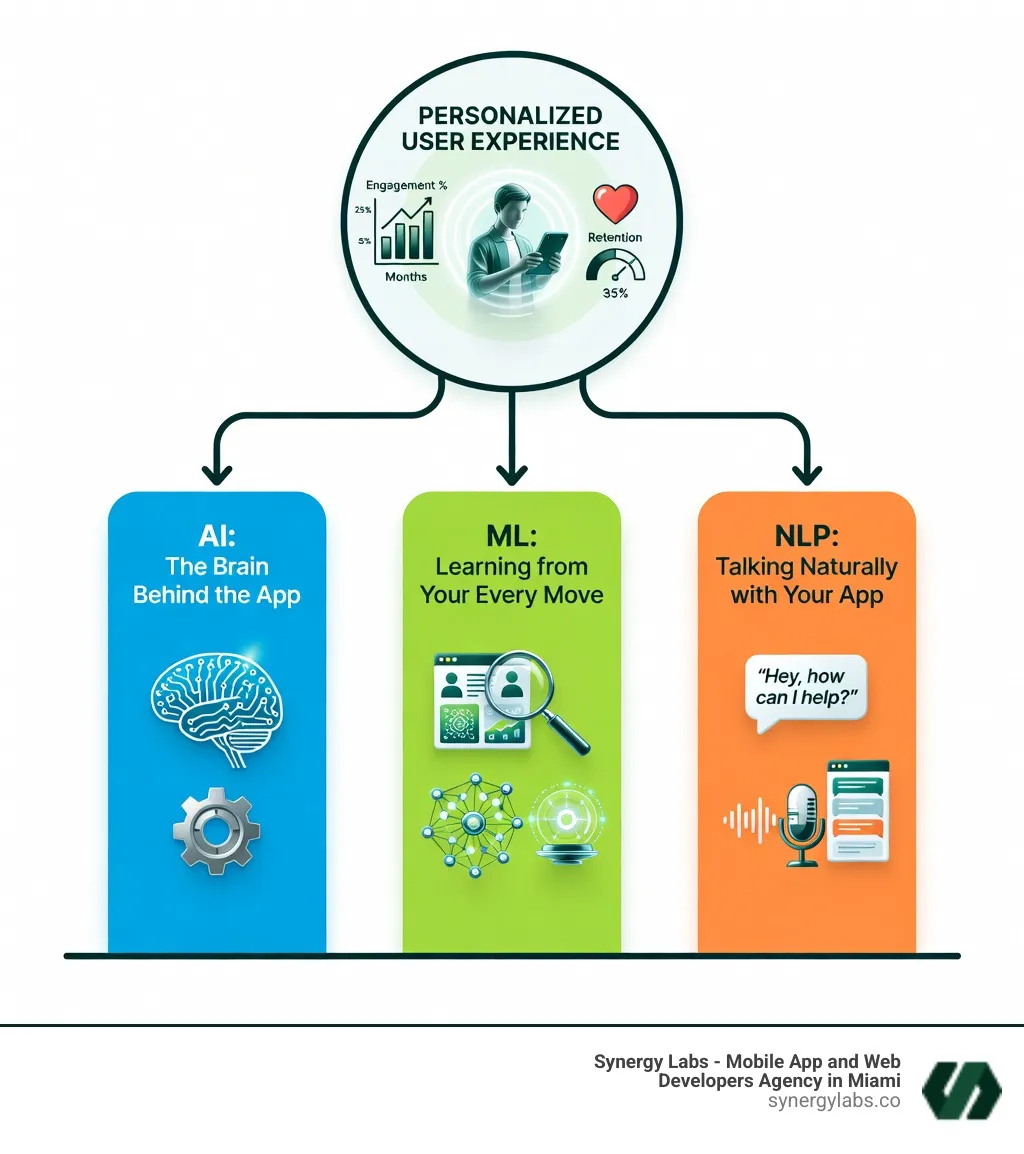
The way AI and machine learning transform apps with personalization and NLP is fundamentally changing how users interact with their favorite applications. Instead of generic, one-size-fits-all experiences, modern apps now adapt to individual preferences, understand natural language, and predict what users need before they even ask.
Quick Answer: The Three Pillars of AI-Powered App Change
Personalization - AI analyzes user behavior, preferences, and context to deliver custom content, recommendations, and interfaces that feel tailor-made for each individual.
Natural Language Processing (NLP) - Apps now understand and respond to human language through chatbots, voice assistants, and sentiment analysis, making interactions feel natural and intuitive.
Predictive Intelligence - Machine learning algorithms anticipate user needs, detect security threats, and optimize app performance by learning from vast amounts of data.
The shift from static apps to intelligent companions is already driving massive growth. The global AI in mobile applications market is projected to reach $249.8 billion by 2033, growing at a 36.6% CAGR. Meanwhile, 72% of business leaders now view AI-integrated mobile apps as a strategic advantage, not just a nice-to-have feature.
For startup founders and app developers, this presents a dual challenge and opportunity: creating apps users love by implementing AI and ML effectively, which requires the right strategy, technology, and development partner.
Think about the apps you use daily. Your music app knows exactly what song you want to hear next.Your streaming service recommends shows you didn't know you'd love.Your banking app flags suspicious transactions before you even notice them. That's AI and ML at work, quietly making your digital life smarter and more seamless.
Having guided dozens of teams through AI-powered app development at Synergy Labs, I've seen how these technologies can turn a good app into a category leader. The key is understanding not just what they can do, but how to implement them for real business value, staying on budget and on schedule.
This guide covers everything you need to know: how personalization drives engagement, how NLP improves accessibility, choosing between on-device and cloud AI, and navigating the ethical and technical challenges. Whether planning your first AI feature or a complete app overhaul, you'll find practical strategies and real-world examples here.
Basic terms related to AI, machine learning, personalization, and NLP:
The Power of Personalization: How AI Creates Unique User Experiences
Imagine an app that feels like it was designed just for you. This isn't science fiction; it's the reality of AI-powered personalization. At its core, personalization is about adapting the app experience to each individual user, making every interaction feel uniquely personal and seamless. This is achieved through sophisticated data collection, behavioral analysis, machine learning algorithms, and predictive analytics.
AI and ML empower apps to adapt to user behavior for a unique experience. By analyzing user data, AI identifies patterns to segment audiences. This allows for relevant content and recommendations, boosting user engagement, conversions, and retention.
Here are the key benefits for users and businesses:
For Users:
Relevant Content: Users see content, products, or services that genuinely interest them.
Time-Saving: Less searching, more finding. Users get what they need faster.
Improved Experience: The app feels intuitive and understanding, reducing friction.
Increased Satisfaction: Users feel valued and understood, leading to a more positive experience.
For Businesses:
Increased User Engagement: Personalized experiences keep users coming back.
Higher Conversion Rates: Targeted offers and recommendations lead to more purchases or desired actions (increasing conversions by 20-30%).
Improved Customer Retention: Users are more loyal to apps that consistently meet their needs (predictive features can improve user retention by over 30%).
Better ROI: More efficient use of marketing resources and better returns on investment.
How AI and Machine Learning Enable Hyper-Personalization
Hyper-personalization goes beyond basic recommendations to create an app experience that adjusts in real-time to a user's context and preferences. We achieve this by analyzing user data, including:
User Data Analysis: AI algorithms track and analyze a user’s behavior, such as what they search for, what they click on, how long they spend on certain pages, and their in-app purchases. This data forms the foundation for understanding individual preferences.
In-App Behavior Tracking: Every tap, swipe, and interaction provides valuable clues. We use this to build a comprehensive profile of user habits and preferences.
Purchase History: Past purchases are a strong indicator of future interests, allowing for highly relevant product suggestions.
Contextual Data: AI considers factors like location, time of day, and device used to adjust content, offers, and the user interface dynamically. For instance, a food delivery app might highlight nearby restaurants during lunchtime.
Dynamic Content Delivery: Content adapts instantly. If a user is browsing for running shoes, the app might immediately display related accessories or articles on running tips.
Real-Time Adjustments: AI offers real-time personalization, adjusting content, offers, and even the user interface dynamically, based on a user’s current context. This ensures the experience is always fresh and relevant.
This continuous learning and adaptation are what make popular music streaming apps so successful. They process a vast array of your engagement data – what you listen to, when, and how you found it – to collate playlists based on your listening habits. The app is always learning, constantly running micro tests with user groups to refine its personalization algorithms. This proactive approach is often referred to as the "next best experience," where AI can power every customer interaction, proactively delivering personalized interactions for improved customer value.
The Business Impact of a Personalized Approach
The benefits of AI-powered personalization directly impact a business's bottom line.
Increased User Retention: By continually offering personalized content that adapts to the user’s changing preferences, AI ensures users feel valued and understood. This leads to higher loyalty and longer app usage. Predictive features, for instance, can improve user retention by over 30%.
Higher Lifetime Value (LTV): Engaged and retained users are more likely to make repeat purchases, subscribe to premium features, and become brand advocates, significantly increasing their overall value to the business.
Boosted Conversion Rates: When apps show relevant content, recommendations, and offers based on user preferences and behavior, users are more likely to convert. AI’s ability to predict user behavior means brands can deliver highly targeted offers at the right moment, increasing the chances of conversion by 20-30%.
Improved Brand Loyalty: A personalized experience fosters a deeper connection between the user and the brand. Users appreciate apps that understand their needs and make their lives easier.
Competitive Advantage: In a crowded app market (with over 8 million apps available), personalization is no longer a luxury but a necessity. Companies that leverage AI for hyper-personalization stand out, making their apps indispensable to users.
AI-Driven Push Notifications: These personalized notifications see 4x higher open rates, proving the effectiveness of custom communication in re-engaging users.
At Synergy Labs, we help clients in Miami, New York City, and San Francisco implement personalized strategies that drive tangible results. For more information on how our services can lift your app, explore our offerings: More info about our services.
The Voice of the App: How NLP and Conversational AI are Changing Interaction
Imagine chatting with an app as you would a friend. That's the magic of Natural Language Processing (NLP) and Conversational AI. These technologies let apps understand and respond to human language, changing how we interact with devices. Instead of fumbling through menus, you just speak or type, and the app understands.
NLP, a branch of AI, enables computers to understand and generate human language. For apps, this means:
Understanding User Intent: NLP allows AI-powered apps to understand the underlying meaning and purpose behind text and voice interactions, rather than just recognizing keywords.
Sentiment Analysis: Apps can gauge the emotional tone of a user's input, allowing for more empathetic and appropriate responses. This is crucial for customer support and feedback analysis.
Voice Search and Hands-Free Operation: With NLP, voice commands become powerful tools, enabling users to steer apps, search for information, and complete tasks without touching their screen. This is particularly valuable for accessibility and multitasking.
24/7 Customer Support: Chatbots and virtual assistants powered by NLP provide instant, round-the-clock support, answering queries and guiding users.
Automated Responses: For routine questions, NLP enables apps to generate accurate and helpful automated responses, freeing up human agents for more complex issues.
Lead Generation: Conversational AI can engage potential customers, answer initial questions, and qualify leads, streamlining sales processes.
The Role of Chatbots and Virtual Assistants
Chatbots and virtual assistants are the most visible NLP applications in modern apps. They act as intelligent interfaces, providing support and enhancing user experiences across various industries.
Instant Support: Users expect immediate answers. AI-driven chatbots provide instant assistance, guiding users through processes, answering frequently asked questions, and even solving issues with little or no human intervention.
Guiding Users: From onboarding to complex task completion, chatbots can walk users step-by-step through app functionalities, improving usability and reducing frustration.
Answering FAQs: By automating responses to common queries, chatbots significantly reduce the workload on human support teams.
Reducing Support Costs: AI-powered chatbots can reduce support costs by up to 60%, making customer service more efficient and scalable.
Improving Customer Satisfaction: Quick, accurate, and always-available support leads to happier users. 89% of consumers prefer companies with NLP-powered chatbots for faster support.
Task Automation: Beyond answering questions, virtual assistants can automate tasks like scheduling appointments, setting reminders, or retrieving information, making users' lives easier.
At Synergy Labs, we've developed numerous apps with integrated conversational AI, changing how businesses interact with their customers. You can see examples of our work in our portfolio: More info about our portfolio.
Beyond Chat: NLP's Impact on App Functionality
Beyond chatbots, NLP's influence extends to many other app functions, often working silently to improve the user experience.
Text Summarization: NLP can distill long articles or documents into concise summaries, saving users time and helping them quickly grasp key information.
Language Translation: Advanced NLP models enable real-time, context-aware language translation, breaking down communication barriers in travel, education, and global business. AI-based language translation apps should translate context, tone, and cultural nuances, not just words.
Content Moderation: NLP helps identify and filter inappropriate or harmful content in user-generated forums, ensuring a safer online environment.
Sentiment Analysis of Reviews: By analyzing user reviews and feedback, NLP can quickly identify prevailing sentiments, allowing businesses to understand customer satisfaction and address issues proactively.
Enhancing Accessibility: NLP enables features like voice control and text-to-speech, making apps more accessible to users with disabilities.
An app's ability to understand and respond to natural language makes interactions more intuitive and efficient, fundamentally changing how we engage with technology.
How AI and Machine Learning Transform Apps with Personalization & NLP from the Inside Out
The change driven by AI, machine learning, personalization, and NLP isn't just about what users see; it's also about what happens behind the scenes. These technologies are revolutionizing app security, development processes, and business intelligence, making apps smarter, safer, and more efficient from their core.
AI and ML form the intelligent backbone of modern apps, enabling them to anticipate needs, defend against threats, and streamline operations. This internal change uses predictive analytics, robust security, and an optimized development lifecycle to deliver superior results.
Using Predictive Analytics to Improve User Experience and Business Outcomes
Predictive analytics, powered by ML, is like a crystal ball for your app. It forecasts user behavior and market trends, enabling proactive strategies that improve UX and drive business growth.
Churn Prediction: AI can track students’ behavior patterns to predict future outcomes, such as the risk of falling behind or requiring additional intervention. Similarly, in commercial apps, ML can identify users at risk of churning, allowing businesses to intervene with targeted retention strategies. This can improve user retention by over 30%.
Forecasting User Behavior: By analyzing historical data, AI can predict what users might want next, offering more relevant content and features in real-time. This includes anticipating product preferences or service needs.
Proactive Alerts: Apps can send proactive notifications based on predicted needs or potential issues, such as reminding a user about an upcoming meeting they almost forgot, or notifying them of property changes in a real estate app.
Optimizing Features: Predictive insights help us understand which features users will value most, guiding future development and resource allocation.
Data-Driven Decisions: ML algorithms analyze vast datasets, helping businesses make data-driven decisions and predictions, leading to better strategic planning and resource optimization. AI has improved auto-decisioning processes by up to 83% in financial services.
These capabilities allow apps to deliver a "next best experience," where every interaction is optimized for the user's current context and predicted needs, enhancing satisfaction by 15-20% and increasing revenue by 5-8%.
Fortifying App Security and Streamlining Development
AI and ML are also critical for foundational app development and security.
Real-Time Fraud Detection: ML can identify unusual patterns in data, helping detect security breaches or fraudulent activities 90% quicker than traditional methods. Real-time fraud detection is expected to save businesses $11 billion annually by 2026.
Biometric Authentication: AI-powered facial and fingerprint recognition improve app security, providing a seamless yet robust layer of protection for sensitive data.
AI-Based Testing: AI is revolutionizing the traditionally time-consuming app development process. AI-based testing automates repetitive tasks, optimizes test cases, and increases defect detection by up to 30%, leading to faster and more reliable app launches.
Automated Code Generation: AI tools can generate code snippets, speeding up development cycles and allowing human developers to focus on creativity and strategic problem-solving. AI-powered tools can speed up development by as much as 50%.
Faster Time-to-Market: With AI-assisted development and testing, the entire app creation process is accelerated, allowing businesses to launch innovative solutions more quickly and gain a competitive edge.
Reduced Development Costs: Automating tasks and increasing efficiency across the development lifecycle ultimately leads to lower operational costs.
At Synergy Labs, we integrate these advanced AI and ML capabilities into our development process. This ensures the apps we build for clients in Dubai, London, and Chicago are intelligent, user-friendly, secure, and efficiently developed.
Your Roadmap to an AI-Powered App: Strategy, Challenges, and Future Trends
Starting an AI-powered app development journey is exciting but requires a clear roadmap. We must consider the technology, practical implementation, inherent challenges, and ethical implications of building intelligent applications.
The future of apps is undeniably AI-driven. The global artificial intelligence (AI) based personalization market is projected to grow from $498.22 billion in 2024 to $629.64 billion by 2029. This growth is fueled by continuous innovation, from emotion-integrated AI that detects user mood to hyper-automation and the emergence of AI-native UX, where intelligence is the core of the app experience.
How to Effectively Implement AI and ML into Your App Strategy
Building an AI-powered app isn't just adding a feature; it's rethinking the app's core purpose and user interaction. Here's our recommended approach:
Identify Problems to Solve: Start by pinpointing specific user pain points or business challenges that AI can genuinely address. Don't just add AI for AI's sake. For example, can AI personalize educational content for students, assessing strengths and weaknesses in real-time? Or can it optimize logistics in a delivery app?
Start Small and Iterate: Begin with a Minimum Viable Product (MVP) that incorporates a core AI feature. Test it with real users, gather feedback, and iterate quickly. This agile approach minimizes risk and allows for continuous improvement. Online developer communities can provide early insights and validation.
Prioritize Data Quality: AI algorithms are only as good as the data they are trained on. If the data is biased or incomplete, the resulting recommendations can be skewed. Invest in robust data collection, cleaning, and management strategies to ensure high-quality, unbiased datasets.
Choose the Right Models: The choice of AI/ML model depends on the specific task. Whether it's a recommendation engine, an NLP model for sentiment analysis, or a predictive model for churn, selecting the appropriate algorithm is crucial for performance and efficiency.
Test and Validate with Real Users: Continuous testing with diverse user groups is essential to refine AI models, ensure fairness, and optimize the overall user experience.
For businesses looking to integrate AI and ML effectively into their app strategies, our team at Synergy Labs offers expert guidance and development services. Learn more about how we can help you build your next intelligent application: More info about our services.
Navigating Key Challenges: On-Device vs. Cloud and Ethical Problems
Integrating AI and ML into mobile apps presents unique challenges, especially regarding processing location and ethics.
On-Device vs. Cloud-Based AI Processing:
Deciding where your AI processing happens is a critical architectural choice:
On-Device AI (Edge AI):
Benefits: Improved user privacy (data stays on the device), reliable offline functionality, faster response times (no network latency), and no additional cloud inference costs. Modern mobile operating systems now offer built-in frameworks and APIs that allow you to run inference directly on a device. These are fine-tuned for specific on-device tasks like summarizing, proofreading, and rewriting text, as well as generating image descriptions.
Challenges: Limited processing power and memory on mobile devices, smaller model sizes, and less frequent updates compared to cloud models.
Use Cases: Ideal for tasks where privacy, speed, and offline access are paramount, such as local image recognition, personalized text suggestions, or secure biometric authentication.
Cloud-Based AI:
Benefits: Access to significantly larger and more powerful models, greater scalability, more frequent updates, and the ability to handle complex AI tasks requiring extensive computation. Cloud platforms offer robust APIs and scalable infrastructure for these tasks.
Challenges: Requires an internet connection, potential latency issues, higher costs for data transfer and computation, and increased privacy concerns as data is sent to external servers.
Use Cases: Suitable for highly complex AI tasks like advanced generative AI, large-scale data analysis, extensive content moderation, or when broad device compatibility is needed without device-specific optimization.
Ethical Considerations and Bias Prevention:
The power of AI brings significant ethical responsibilities:
Data Privacy and GDPR: With AI relying heavily on user data, adhering to strict privacy regulations like GDPR and CCPA is paramount. Businesses have an obligation to source data in a compliant manner and provide encryption to their users. Transparency about data collection and usage is crucial for building user trust.
Algorithm Bias: AI algorithms are only as good as the data they are trained on. If this data is biased or unrepresentative, the AI's outputs can perpetuate or even amplify existing societal biases. We must actively work to use diverse and representative training datasets and continuously monitor models for fairness and inclusion.
Transparency and Explainability: Users should understand how AI makes decisions, especially when those decisions impact their experience or access to services. Building explainable AI systems helps foster trust and accountability.
Human Oversight: While AI can automate many tasks, human oversight remains essential to monitor performance, correct errors, and ensure ethical deployment.
Navigating these challenges requires careful planning, robust engineering, and a commitment to ethical AI development. At Synergy Labs, we champion this approach for all our projects in global tech hubs like Austin, Phoenix, and Riyadh.
Frequently Asked Questions about AI and ML in Apps
What is the main role of AI in mobile app development?
AI's main role is to make apps intelligent companions that learn, predict, and adapt. It improves UX through personalization, automates processes, and offers business insights from user data, creating smarter, more engaging apps.
How does machine learning improve the user experience?
Machine learning improves UX with hyper-personalization. By analyzing user behavior, it delivers custom content, recommendations, and interfaces. This makes the app feel tailor-made, boosting user satisfaction, engagement, and retention.
What are the business advantages of adopting AI in mobile apps?
Key advantages include higher user retention and conversions from personalization, lower operational costs from automation, better security with real-time fraud detection, and faster time-to-market with AI-assisted development. This offers a strong competitive edge and better ROI.
Open uping Your App's Intelligent Future
The era of intelligent apps is here, with AI, machine learning, personalization, and NLP leading the charge. By embracing these technologies, you can deliver unparalleled user experiences that drive engagement, loyalty, and business growth. From hyper-personalized content and intuitive conversational AI to predictive analytics that keeps your app a step ahead, the possibilities are boundless.
The key to using this potential lies in strategic implementation and partnering with a team that understands how to translate cutting-edge technology into tangible business value. At Synergy Labs, we specialize in building intelligent, scalable applications with a model designed for your success. We offer a fixed-budget, milestone-based payment structure and an in-shore CTO paired with a world-class offshore development team to ensure your project is delivered on time and on budget, without any surprises. Let's build something extraordinary together. Start building your AI-powered app today!



.avif)

.avif)


