OpenAI didn't just announce features — they redrew the map of what's possible for developers building on AI.
OpenAI DevDay 2025 Signals the Era of Production AI

OpenAI DevDay 2025: What You Missed — Major Announcements & Roadmap marks a fundamental shift in how developers build and deploy AI applications. On November 6, 2025, OpenAI transformed ChatGPT from a simple chatbot into a comprehensive developer platform, showing tools that make sophisticated AI accessible to millions.
Quick Summary of Major Announcements:
- Apps SDK - Build full-stack applications directly inside ChatGPT's 700M+ user ecosystem
- AgentKit - Production-grade toolkit for creating AI agents with visual workflows in minutes
- GPT-5 Pro - Advanced reasoning model for high-stakes industries like finance and healthcare
- Sora 2 - Video generation with synchronized audio, now available via API
- Developer Tools - Improved API capabilities including Function Calling 3.0 and improved RAG
- Enterprise Features - Azure integration, on-premise models, and robust safety controls
The scale is staggering. OpenAI grew from 2 million developers in 2023 to 3.5 million in 2025. ChatGPT now serves 700 million weekly active users and processes 5 billion tokens per minute through its API. This isn't just growth—it's a signal that AI has moved from experimental demos to mission-critical infrastructure.
The event showcased how AI development is becoming more accessible while simultaneously more powerful. With the Apps SDK, developers can now distribute their creations to hundreds of millions of users instantly. AgentKit reduces agent development time from months to days. And new models like GPT-5 Pro deliver precision accuracy for regulated industries where mistakes aren't an option.
As a team that's built AI-powered mobile apps for startups and enterprises alike, we've watched these tools evolve from prototypes to production-ready systems. Understanding OpenAI DevDay 2025: What You Missed — Major Announcements & Roadmap helps us guide our clients toward the right AI strategies—whether that's building custom agents, integrating new models, or leveraging ChatGPT's distribution platform to reach users faster.
Key terms for OpenAI DevDay 2025: What You Missed — Major Announcements & Roadmap:
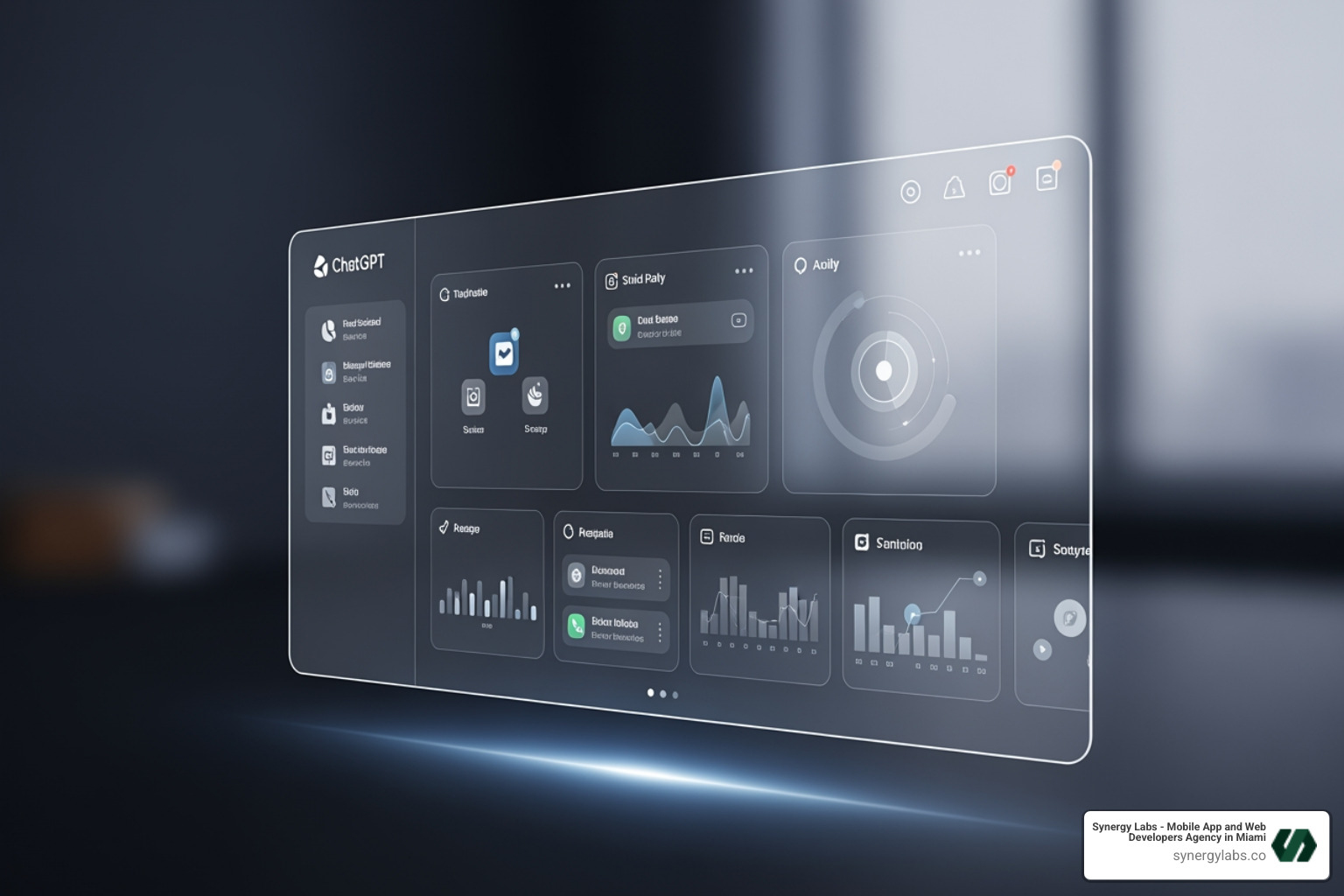
The centerpiece of OpenAI DevDay 2025 was the undeniable shift: ChatGPT is no longer just a chatbot; it's an operating system. This change makes ChatGPT a dynamic, interactive platform, effectively reimagining it as a comprehensive application ecosystem. With a staggering 700 million weekly active users, ChatGPT has become a powerful distribution channel that developers have long sought. This move allows developers to tap into a massive user base, turning their AI ideas into widely accessible applications.
This strategic pivot is about moving up the application layer, focusing on making AI more useful and integrated into our daily digital lives. The vision is clear: users shouldn't have to jump between ten different apps to accomplish tasks. Instead, they can command AI to perform complex actions directly within a unified interface. This is where the Apps SDK and AgentKit come into play, redefining how we build and interact with software.
OpenAI is also paving the way for monetization within this new ecosystem through the Agentic Commerce Protocol (ACP). This protocol allows developers to charge users directly within the ChatGPT environment, creating a vibrant marketplace for AI-native applications. This means that a developer in Miami, London, or Dubai can now build an app and potentially reach millions of users and monetize their creations seamlessly.
This evolution from a simple chatbot to a super-app signifies a bold step towards a future where AI is not just a tool, but the very fabric of our digital interactions. As we've seen with other major platforms, retaining a robust developer ecosystem is critical, and OpenAI is making a strong bid for that loyalty.
The Apps SDK: A Game-Changer for App Distribution
The Apps SDK was arguably one of the most significant announcements at OpenAI DevDay 2025. It empowers developers to build full-stack, interactive applications directly inside the ChatGPT interface. Imagine having apps from major companies in travel, design, and productivity running seamlessly within your chat conversation. This moves beyond simple plugins, allowing for rich, interactive UIs, connection to backend logic, and user accounts—all without ever leaving ChatGPT. This is a crucial distinction; it’s about deep integration, not just surface-level extensions.
The magic behind this is the Model Context Protocol (MCP), which enables seamless context sharing between AI and these in-chat applications. This means that if you're discussing planning a trip, ChatGPT can contextually suggest a travel app, and the app will already understand your destination and dates. This level of integration provides a truly personalized and efficient user experience. Our team at Synergy Labs, working with clients in cities like New York City and Chicago, sees this as a massive opportunity for startups and enterprises to deliver unparalleled user experiences.
The Apps SDK solves a perennial challenge for developers: distribution. Getting your app in front of users is often the hardest part. With ChatGPT's 700 million weekly active users, developers now have a direct pathway to a massive audience. As we discuss in our article, The Rise of Creator Marketplaces for AI Services: Why Distribution is the New Product in 2025, this changes the game for software creators. It's not just about building a great product; it's about getting it into the hands of users efficiently, and the Apps SDK provides that direct line.
AgentKit: Simplifying Agentic AI Development
If the Apps SDK brings the world into ChatGPT, AgentKit is about sending AI out into the world to get things done. OpenAI DevDay 2025 introduced AgentKit as a complete toolkit for creating production-grade AI agents, addressing the complexity that often plagues AI agent development. This is a game-changer for businesses in tech hubs like San Francisco and Austin looking to automate complex workflows.
AgentKit offers a unified platform that allows teams to build, deploy, and manage AI agents through a visual interface. The core components include:
- Agent Builder: A visual, no-code/low-code canvas to design complex workflows. This dramatically lowers the barrier to entry for non-specialists, allowing product managers and business analysts to prototype solutions. We've seen how visual tools can accelerate development, and Agent Builder takes this to a new level for AI.
- Evals & Trace Grading: A sophisticated evaluation suite to measure and improve agent performance. This is crucial for ensuring reliability, especially when agents are handling sensitive tasks or interacting with external systems.
- ChatKit: An embeddable chat interface that can be deployed in any application. This provides a ready-made, customizable UI for agents, saving developers countless hours.
- Connector Registry: A centralized way to manage data connections for an organization, ensuring secure and consistent access to internal systems.
AgentKit simplifies the process of building intelligent AI workers that can perform end-to-end tasks, not just answer questions. Imagine an employee in Riyadh or Doha simply typing, "I need five more ChatGPT business seats," and an AgentKit-powered procurement agent parsing the request, checking company policies, finding vendor details, and preparing the purchase order—all autonomously. This transforms AI from a conversational partner into a true teammate. Our blog post Deep Dive: AgentKit — OpenAI's New Toolkit for Smart AI Agents explores this in more detail.
OpenAI DevDay 2025: What You Missed — Major Announcements & Roadmap for New Models

At OpenAI DevDay 2025, the showing of new foundation models demonstrated OpenAI's relentless pursuit of advanced intelligence and creative capabilities. These models represent significant leaps in multimodality, high-stakes reasoning, and creative generation, often with impressive cost reductions. The underlying architecture, featuring advanced sparse mixture-of-experts, hints at more efficient and powerful AI.
GPT-5 Pro: Precision and Power for High-Stakes Industries
GPT-5 Pro emerged as OpenAI's most intelligent and capable model for complex, high-stakes reasoning. Unlike general-use models, GPT-5 Pro is specifically designed for applications where pinpoint accuracy is not just desired, but critical. This makes it invaluable for regulated industries like finance, legal, and healthcare.
Consider a financial institution in New York City or a legal firm in London using GPT-5 Pro. This model can perform deep analysis on market data, analyze thousands of legal precedents, or assist in complex medical diagnostics with a level of reliability that was previously unattainable. Its advanced reasoning capabilities ensure that critical decisions are informed by the most accurate and contextually relevant insights. GPT-5 Pro is now available via API, opening up immense possibilities for businesses to integrate this powerful intelligence into their core operations. Our AI Infusion services are perfectly ready to help businesses leverage models like GPT-5 Pro for specialized applications. For more technical details, you can refer to the GPT-5 Pro documentation.
Sora 2 and gpt-realtime-mini: The Multimodal Future
The multimodal future of AI was vividly presented through Sora 2 and gpt-realtime-mini at OpenAI DevDay 2025.
Sora 2 takes video generation to an entirely new level by adding synchronized audio and rich soundscapes. Imagine generating a video of a busy café with the perfect background chatter, the clinking of cups, and the hiss of an espresso machine—all seamlessly integrated. Sora 2's API availability, priced at 50 cents per second of generated footage, makes high-quality text-to-video generation programmable and accessible. This opens up fascinating possibilities for creative industries, marketing teams in Dubai, and developers across the globe to rapidly prototype video concepts or animate sketches with sound. For those looking to dive deep into its capabilities, OpenAI has published a Sora 2 prompting guide.
Alongside Sora 2, gpt-realtime-mini was introduced as a low-latency voice model that is 70% cheaper than OpenAI's previous advanced voice offerings. This cost reduction makes real-time, human-like voice interactions far more economically viable for a wide range of applications, from customer service bots to accessibility tools. This model can maintain natural conversations, handle interruptions, and operate in multiple languages with minimal delay, making voice AI more practical and scalable. This represents a significant step towards the future of AI agents, as discussed in our article Agentic AI Explained: From Chatbots to Autonomous AI Agents in 2025.
Improved Developer Experience and Enterprise Readiness
OpenAI DevDay 2025 wasn't just about flashy new models and platforms; it also brought significant improvements to the core developer experience and crucial advancements in enterprise readiness. These updates signal OpenAI’s commitment to providing robust, reliable, and secure tools for developers and businesses, from startups in Austin to large enterprises in Chicago.
API Upgrades and RAG: What You Missed at OpenAI DevDay 2025
The API updates at OpenAI DevDay 2025 focused on making AI more reliable and efficient for complex workflows.
- Function Calling 3.0: This received a comprehensive upgrade, dramatically improving reliability for multi-step workflows where AI agents chain together multiple function calls. Improved error handling and schema validation reduce failure rates by approximately 40%. This means developers can build more robust and dependable agents that seamlessly interact with external tools and services.
- Retrieval-Augmented Generation (RAG) Improvements: RAG received significant improvements focused on intelligent chunking strategies, indexing performance, and accuracy metrics. Native integration with leading vector databases allows for systematic measurement and optimization of retrieval quality. When properly tuned, the new RAG implementation can achieve 90% precision on domain-specific knowledge bases, a substantial improvement that directly reduces AI hallucinations and makes outputs far more trustworthy for knowledge-intensive applications.
- Automated Code Review: OpenAI announced a new tool for automated code review, a feature that early adopters report saves several hours per week on code review overhead. This allows senior engineers to focus on higher-level architectural tasks rather than sifting through minor errors. This kind of tool can drastically accelerate AI product development, as we explore in How GPT Wrappers Can Accelerate Your AI Product Development.
These advancements make it easier for developers to build sophisticated AI applications that are both powerful and dependable, ensuring that the AI performs as expected, even in intricate scenarios.
Safety, Governance, and Azure: What You Missed at OpenAI DevDay 2025
For enterprises, trust and compliance are paramount. OpenAI DevDay 2025 addressed these concerns with a suite of safety, governance, and enterprise-readiness features.
- Advanced Moderation APIs: These provide granular control over model outputs, allowing developers to define custom risk thresholds and reduce problematic outputs by approximately 75% without significantly impacting user experience.
- Digital Watermarking: OpenAI introduced robust watermarking solutions that embed imperceptible signals in generated images, videos, and audio. This helps establish data provenance and combat the spread of misleading synthetic content, a critical step for responsible AI deployment. Research from MIT’s Center for Constructive Communication highlights the importance of such provenance systems.
- Azure OpenAI Service Integration: The Azure OpenAI Service received first access to new models and features, offering critical compliance certifications including GDPR, HIPAA, and SOC 2. For businesses in regulated sectors, this provides the assurance needed to deploy OpenAI's powerful models securely. Dedicated capacity reservations through Azure ensure consistent performance even during peak usage periods.
- On-Premise and Edge Deployment: OpenAI introduced smaller models optimized for edge and on-premise deployment. This is crucial for organizations handling sensitive data that cannot leave their local networks, allowing them to leverage AI's power while maintaining strict data privacy and security, a key concern for mobile security. These edge models can achieve 80-90% of cloud flagship model quality while reducing latency by 10x. Our expertise in Mobile Security Software positions us to help clients integrate these secure on-premise solutions.
- Customization and Metrics: Organizations can now upload proprietary data to fine-tune models for domain-specific terminology and company-specific protocols, improving output quality and matching individual styles. OpenAI also introduced standardized metrics and benchmarking frameworks to help organizations measure concrete outcomes for AI adoption, moving beyond vague productivity claims to quantifiable ROI. Early enterprise deployments showed an average 25% increase in employee productivity for knowledge work tasks.
These features collectively demonstrate OpenAI's mature approach to enterprise adoption, providing the tools and assurances necessary for businesses to confidently integrate AI into their operations.
The Strategic Vision: Hardware, Infrastructure, and the Future of AI
Beyond the software and models, OpenAI DevDay 2025 hinted at a grander strategic vision that extends into the physical world. The discussions around hardware ambitions and massive infrastructure investments signal OpenAI's intent to shape not just the software, but also the very devices and infrastructure that will power the AI-driven future.
A major surprise came in a fireside chat between Sam Altman and Jony Ive, the iconic designer. The two revealed a three-year collaboration on a new family of AI-centric hardware. This partnership hints at devices that move beyond traditional screens and browsers, focusing on human-centric design and natural interaction. We envision a future where AI isn't just on your phone, but integrated into devices that serve quietly in the background, prioritizing human emotional well-being and simplicity. Imagine a "smart speaker without a display," as some reports suggest, a device that understands context and provides assistance in a truly intuitive way.
This hardware ambition explains OpenAI's aggressive, multi-billion-dollar investment in infrastructure, most notably the Stargate project. This $500 billion datacenter initiative is a testament to the immense computing power required to scale AI services to meet global demand. Altman has been candid that the company is in a phase of "investment and growth," echoing Walt Disney's philosophy of making more money to make more movies. This massive investment ensures that the foundation for advanced AI, including future AGI, is robust and scalable. Our podcast, The 500 Billion Stargate Project: OpenAI's Bold Plan to Dominate AI's Future, digs deeper into this ambitious undertaking.
OpenAI's strategy at OpenAI DevDay 2025 signals a future where AI is not just a feature, but the operating system of our digital and physical lives. It's about building the world where AI will live—a world of intelligent apps, autonomous agents, and new hardware that redefines our interaction with technology. This shift towards an AI-native UX will require new thinking in product design and development, a challenge we at Synergy Labs are excited to tackle with our clients.
Frequently Asked Questions about OpenAI DevDay 2025
What is AgentKit and how does it help developers?
AgentKit is a complete toolkit introduced at OpenAI DevDay 2025 for creating production-ready AI agents. It simplifies the complex process of building autonomous AI workers by providing tools like Agent Builder for visual, no-code/low-code workflow design, and Evals for robust performance measurement. AgentKit significantly reduces development timelines from months to days, enabling developers to create sophisticated, reliable AI assistants that can automate complex tasks.
What makes GPT-5 Pro different from previous models?
GPT-5 Pro is distinct from previous models because it's specifically designed for high-accuracy reasoning and deep analysis in regulated fields where precision is critical. Unlike general-use models, GPT-5 Pro is engineered for reliability in high-stakes industries such as finance, legal, and healthcare. This focus ensures it excels at specific, demanding tasks where mistakes are costly, making it a precision instrument for critical decision-making.
Can I build my own app inside ChatGPT now?
Yes, absolutely! With the new Apps SDK announced at OpenAI DevDay 2025, you can now build full-stack, interactive applications directly inside the ChatGPT interface. This offers immense distribution potential, giving your app access to ChatGPT's 700 million weekly active users. Furthermore, the Agentic Commerce Protocol (ACP) allows for monetization, changing ChatGPT into a platform for developing and distributing AI-native applications.
Your Next Move: Integrating AI into Your 2025 Roadmap
The announcements at OpenAI DevDay 2025 were a clear call to action for developers and businesses: the era of reliable, production-grade AI is here. We've moved from impressive demos to a robust infrastructure that empowers us to build truly transformative applications. The key takeaways for us are the democratization of advanced AI tools, the massive distribution potential of ChatGPT as a platform, and the emphasis on safety and enterprise readiness.
For businesses and developers in our key locations—Miami, Dubai, San Francisco, New York City, Austin, London, Chicago, Phoenix, Hartford, Riyadh, and Doha—this means a unique opportunity. Whether you're looking to integrate powerful new models like GPT-5 Pro, build autonomous agents with AgentKit, or leverage the Apps SDK to reach a massive user base, the time to act is now.
At Synergy Labs, we specialize in helping businesses steer this evolving landscape. Our expertise in mobile and web development, combined with our deep understanding of AI, allows us to craft innovative solutions. Explore our portfolio of innovative apps to see how we've helped clients leverage cutting-edge technology. We pride ourselves on personalized service with direct access to senior talent, ensuring rapid app launches and ongoing support. Our fixed-budget model, in-shore CTO guidance, and milestone-based payments ensure your project is delivered on time and within budget, changing your vision into a market-ready product that's ready for the AI-powered future.


.avif)

.avif)


