Why Flutter Plugins Will Make or Break Your App in 2026
7 Must-Have Flutter Plugins for App Development in 2026 are the building blocks that separate successful, scalable applications from those that struggle with performance, security, and user engagement. Here's the quick answer:
Riverpod - For compile-safe, scalable state management
Firebase Suite - Your all-in-one backend solution
Dio - For powerful and flexible networking
Isar - High-performance local database
Rive - To create stunning, interactive animations
flutter_stripe - For secure in-app payments
googlemlkit - To integrate on-device AI with ease
The Flutter ecosystem has exploded. With over 50,000 packages now available on pub.dev, choosing the right plugins has become both more important and more challenging. According to recent data, more than 45% of developers opted for Flutter as their cross-platform framework, and over 2 million developers have acceptd it as of recent reports.
But here's the reality: not all plugins are created equal.
Your choice of plugins fundamentally shapes your application's architecture, performance, and maintainability. A well-chosen plugin can eliminate hundreds of hours of custom development. A poorly chosen one can introduce technical debt that haunts your project for years.
The stakes are even higher in 2026. Users expect native-level performance, seamless offline functionality, and smart features powered by AI. Security regulations are tighter. App stores are more selective. And your competitors? They're moving faster than ever.
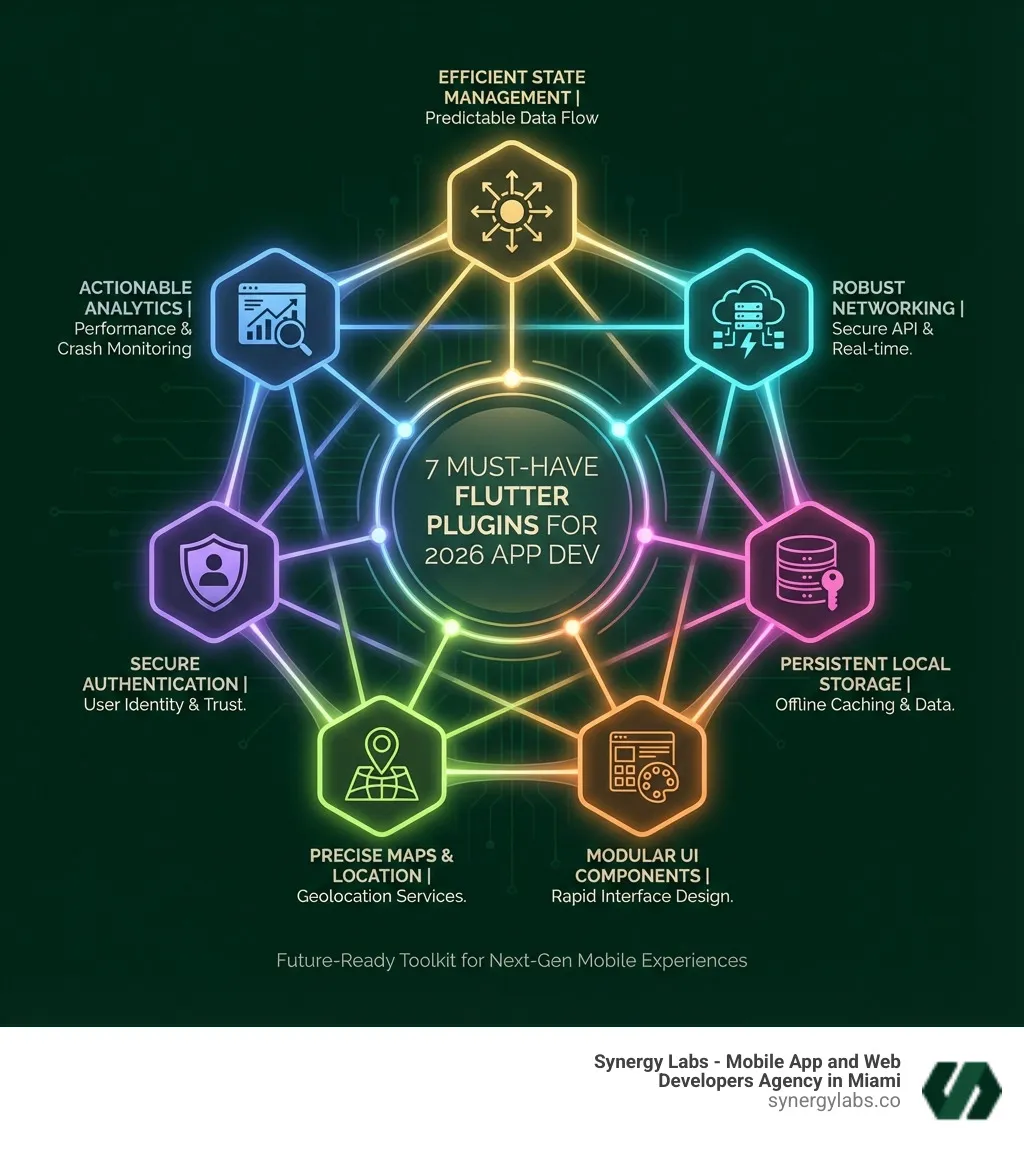
That's why this guide focuses on the seven essential plugins that address the most critical challenges in modern app development: state management, backend integration, networking, local storage, animations, payments, and AI capabilities.
As someone who has guided countless teams through app development at Synergy Labs, I've seen how the right plugin stack can transform a project timeline and significantly reduce development costs. The 7 Must-Have Flutter Plugins for App Development in 2026 I recommend here are battle-tested across real-world applications, from fintech platforms to consumer social apps. Let's explore why each one matters and how they work together to create exceptional applications.
Why Your Choice of Flutter Plugins Matters in 2026
In the rapidly evolving landscape of 2026, the strategic selection of Flutter plugins is no longer just a technical detail; it's a critical business decision that can make or break your application's success. As we've seen, the Flutter ecosystem is vast, boasting over 50,000 packages on pub.dev. This abundance is both a blessing and a curse. While it offers incredible flexibility and accelerates development, it also demands a discerning eye to identify the truly indispensable tools.
Our experience at Synergy Labs has shown us that the right packages can transform your Flutter development experience from tedious to extraordinary. They fundamentally shape an application's architecture, directly impacting its scalability, performance, and long-term maintainability. Imagine eliminating hundreds of hours of custom development by leveraging a well-vetted plugin – that's the power we're talking about. Conversely, a poorly chosen plugin can introduce technical debt, security vulnerabilities, and performance bottlenecks that are costly to fix down the line.
The mobile app development market is projected to reach over $407 billion by 2026, a massive pie that everyone wants a slice of. To grab your portion, you need the right tools. Our focus at Synergy Labs is always on future-proofing applications, ensuring they can adapt to emerging trends like advanced AI integration and increasingly stringent security protocols. This means selecting plugins that are not only robust today but also align with the future direction of Flutter development, including the growing emphasis on scalable state management, secure network communication, and superior cross-platform consistency.
Beyond just functionality, the plugins we choose also significantly impact developer productivity and, ultimately, user experience (UX). When our developers have access to efficient, well-documented, and battle-tested plugins, they can write cleaner code faster, leading to quicker iteration cycles and a higher quality end product. This translates directly to happier users and a more competitive application. For more insights on current software development trends, you might find our article on The Future in Code: Top 5 Software Development Trends for 2026 insightful, as many of these trends carry forward into 2026.
Moreover, the increasing adoption of low-code/no-code AI tools, with 95% of companies using them in the past year and 70% of new enterprise apps in 2026 developed using these technologies, highlights a shift towards efficiency and automation. While Flutter is a robust coding framework, integrating plugins that leverage AI or streamline complex tasks allows us to tap into this trend, boosting productivity without sacrificing flexibility. For businesses looking for cross-platform solutions that deliver on all fronts, our Cross-Platform App Development Service focuses on selecting the optimal tech stack for your unique needs.
The 7 Must-Have Flutter Plugins for App Development in 2026
Having established the critical importance of selecting the right tools, let's dive into the 7 Must-Have Flutter Plugins for App Development in 2026. This curated list represents the crème de la crème of the Flutter ecosystem, chosen for their ability to address common development challenges, improve performance and scalability, improve code quality and productivity, and align with the future direction of app development. These are the plugins we rely on at Synergy Labs to build robust, high-performance, and user-centric applications for our clients.
1. Riverpod: For Compile-Safe and Scalable State Management
State management is arguably one of the most crucial aspects of any modern application, and in 2026, Riverpod stands as the undisputed champion for Flutter. While older solutions like Provider and Redux are still around, our experience building complex, production-grade applications at Synergy Labs has consistently shown Riverpod to be the "gold standard." It addresses common development challenges by offering a compile-safe approach that catches errors at compile time rather than runtime, significantly improving code quality and reducing debugging time.
Riverpod's design promotes testability and a clear decoupling of UI and business logic, which is essential for scalable applications and improving developer productivity. Its unique provider system ensures that dependencies are explicit and easy to trace, leading to more maintainable codebases. For performance, Riverpod excels in optimizing rebuilds, only updating the widgets that truly need it, which is vital for smooth user experiences. It also handles asynchronous operations gracefully, a common requirement for data-driven apps. By adopting Riverpod, we ensure our applications are built on a solid, future-proof foundation capable of handling the complexities of 2026 and beyond.
2. Firebase Suite: Your All-in-One Backend Solution
In 2026, a robust backend is non-negotiable, and the Firebase Suite remains our go-to Backend-as-a-Service (BaaS) for Flutter applications. Firebase offers an incredible range of prominent features that drastically accelerate rapid development. It provides everything from secure user authentication, real-time database organization with Firestore, powerful Cloud Functions for server-less logic, to essential analytics and crash reporting with Crashlytics.
Integrating Firebase with Flutter is remarkably easy, allowing our teams to quickly set up and scale backend functionalities without managing complex server infrastructure. This directly translates to faster time-to-market and reduced operational costs for our clients. Firebase's scalability ensures that applications can handle sudden spikes in user traffic without breaking a sweat, a critical benefit for performance. Its comprehensive suite of tools helps us address common challenges like data storage, user management, and event tracking efficiently. For example, Firebase's messaging capabilities allow us to implement push notifications that improve user engagement. For more on essential development tools, check out our insights on Essential Tools for Mobile App Development. The ability to connect to multiple Firebase apps also provides flexibility for different environments (e.g., development, staging, production) or even different modules within a larger application, making it a truly versatile and future-aligned choice. You can find detailed setup instructions in the Firebase Core documentation.
3. Dio: For Powerful and Flexible Networking
When it comes to handling HTTP requests and API integrations in Flutter, Dio stands out as a powerful and flexible networking client. In 2026, applications are more interconnected than ever, constantly communicating with various web services and APIs. Dio addresses this need with advanced features that go beyond standard HTTP clients, making it a must-have for complex applications.
Dio's key features include interceptors, which allow us to globally modify requests (e.g., adding authentication tokens) or handle responses (e.g., refreshing expired tokens) before they reach the application logic. This promotes cleaner code and improves maintainability. It excels in error handling, providing clear mechanisms to catch and respond to network issues. Furthermore, Dio supports file downloads with progress tracking and robust request cancellation, which are crucial for performance and a smooth user experience in bandwidth-sensitive scenarios. By using Dio, we ensure efficient and reliable communication between our Flutter apps and their backend services, a cornerstone of robust application architecture.
4. Isar: The High-Performance Database for Local Data
For applications that demand fast, reliable local data storage and robust offline capabilities, Isar is the high-performance database of choice in 2026. In an increasingly mobile-first world, users expect seamless experiences even without an internet connection. This is where an offline-first architecture, powered by a local database like Isar, becomes invaluable.
Isar offers exceptional speed and efficiency, making it ideal for storing large amounts of structured data directly on the device. It supports ACID transactions, ensuring data integrity and reliability, and provides powerful features like full-text search, which improves user experience by allowing quick and relevant data retrieval. Its cross-platform support means we can write our data logic once and deploy it across all Flutter-supported platforms, significantly improving developer productivity. While other local databases exist, Isar's focus on performance and developer-friendliness makes it a standout. This is particularly important for hybrid applications where a smooth, native-like experience is paramount. To understand more about the benefits of such an approach, read our article on Hybrid App or Native App: Which One is Right for Your Business.
5. Rive: To Create Stunning, Interactive Animations
User experience is king, and in 2026, static interfaces simply won't cut it. Rive (formerly 2Dimensions) empowers us to create stunning, interactive animations that lift UI/UX design to new heights in Flutter applications. It addresses the challenge of bringing complex, performant animations to apps without the overhead of traditional animation tools.
Rive's key feature is its state machine logic, allowing designers and developers to create intricate, responsive animations that react to user input or application state in real-time. This fosters seamless design collaboration, as designers can build and iterate on animations directly, which are then easily integrated into the Flutter app. The performance benefits are significant: Rive animations are highly optimized, running smoothly even on lower-end devices, leading to increased user engagement and a polished, professional feel. Whether it's a dynamic loading indicator, an expressive character, or an interactive onboarding experience, Rive enables us to craft memorable user journeys that truly stand out.
6. flutter_stripe: For Secure and Seamless In-App Payments
Monetization is often a core objective for many applications, and flutter_stripe provides the most secure and seamless solution for integrating in-app payments in 2026. E-commerce and subscription-based models are prevalent, and users demand a frictionless and trustworthy payment experience.
The Stripe Flutter SDK simplifies the complex process of handling sensitive payment data. Crucially, it helps us maintain PCI compliance by ensuring sensitive credit card numbers are sent directly to Stripe's secure servers, bypassing our application's backend. This significantly reduces the security burden on developers and builds user trust. flutter_stripe offers out-of-the-box support for widely used payment methods like Apple Pay and Google Pay, providing a familiar and convenient checkout flow for users. Furthermore, it automatically handles Strong Customer Authentication (SCA) requirements, crucial for compliance in many regions. By leveraging flutter_stripe, we can implement robust payment gateways that are secure, scalable, and provide a delightful user experience, directly contributing to our clients' revenue goals.
7. googlemlkit: To Integrate On-Device AI with Ease
Artificial Intelligence and Machine Learning are no longer futuristic concepts; they are essential components of modern applications in 2026. The google_ml_kit plugin allows Flutter developers to integrate powerful, on-device AI capabilities with remarkable ease, addressing the growing demand for smart features that improve user interaction and efficiency.
One of the primary benefits of google_ml_kit is its on-device processing, which means AI models run directly on the user's device rather than in the cloud. This offers significant advantages in terms of privacy, as data doesn't leave the device, and performance, as processing happens instantly without network latency. It also enables offline capabilities for AI features, making apps more reliable. google_ml_kit provides a suite of ready-to-use APIs for common tasks like text recognition (e.g., scanning documents), barcode scanning, face detection, object detection, and pose estimation. These features allow us to build innovative applications that leverage AI to solve real-world problems, from automated data entry to improved accessibility tools, aligning perfectly with the future direction of Flutter development.
How These Plugins Create a Robust Application Architecture
The true magic happens when these individual plugins integrate seamlessly to form a cohesive, robust application architecture. At Synergy Labs, we don't just pick plugins; we craft a synergistic stack that ensures optimal performance, scalability, and maintainability. Let's consider a hypothetical e-commerce or social media application to illustrate how these 7 Must-Have Flutter Plugins for App Development in 2026 work together:
Imagine a social media app where users can post photos, chat, and buy virtual goods.
Riverpod forms the backbone, managing the application's state, from user authentication status to the list of posts displayed on a feed, ensuring everything is reactive, testable, and compile-safe.
Firebase Suite acts as the primary backend. Firebase Authentication handles user logins, Firestore stores user profiles, posts, and chat messages in real-time, and Firebase Cloud Storage securely stores the uploaded images and videos. Cloud Functions might process image uploads or trigger notifications.
Dio is the communication layer for any custom APIs, perhaps fetching trending topics from an external service or interacting with a payment gateway's backend. Its interceptors ensure that every request carries the user's authentication token provided by Firebase.
Isar could be used to cache the social feed, user profiles, and chat messages locally. This provides an instant, offline-first experience, allowing users to browse content even without an internet connection, with data seamlessly synchronizing with Firebase Firestore when online.
Rive brings the app to life with engaging animations – a dynamic loading animation when new content is fetched, an interactive "like" button animation, or expressive avatars that react to user input.
flutter_stripe handles the in-app purchases for virtual goods or premium subscriptions. Users can add items to their cart, and flutter_stripe facilitates secure transactions via Apple Pay, Google Pay, or credit cards, all while maintaining PCI compliance.
googlemlkit could power smart features like on-device content moderation (detecting inappropriate images before upload), intelligent search within user's photos using text recognition, or even facial filters for profile pictures.
This interconnected system creates a powerful, full-stack Flutter application. Each plugin specializes in a critical area, allowing developers to focus on unique features rather than reinventing common functionalities. This modular approach significantly improves developer productivity, code quality, and the overall user experience. Understanding this intricate dance of plugins is key to building successful applications. For insights into our development process, from initial concept to launch, you can learn more about our approach at Mobile App Development Agency: What to Expect from Discovery to Launch.
Frequently Asked Questions about the 7 Must-Have Flutter Plugins for App Development in 2026
How do I choose the right plugins for my project beyond this list?
Choosing the right plugins is an art and a science, especially with over 50,000 packages on pub.dev. Beyond our recommended 7 Must-Have Flutter Plugins for App Development in 2026, here's how we approach plugin evaluation at Synergy Labs:
Define Your Project Requirements: Start by clearly outlining your application's needs. What functionalities are essential? What are your performance, scalability, and security expectations? Different types of Flutter applications (e.g., e-commerce, social, utility) will have distinct plugin needs.
Check pub.dev Score and Popularity: A high pub.dev score (likes, points, popularity) often indicates a well-regarded and useful package. While not the only factor, high download statistics suggest widespread adoption and battle-testing.
Evaluate Maintenance Status: Is the plugin actively maintained? Check the "Last updated" date, open issues, and pull requests on its GitHub repository. An unmaintained plugin can quickly become a technical liability.
Assess Community Support: A strong community means more resources, tutorials, and quicker answers to your questions. Look for active GitHub discussions, Stack Overflow tags, and community channels.
Review Documentation Quality: Good documentation is invaluable. It should be clear, comprehensive, and include examples. Poor documentation can significantly hinder developer productivity.
Consider Licensing: Ensure the plugin's license is compatible with your project's requirements.
Performance and Compatibility: Check for any known performance issues or compatibility concerns with the latest Flutter versions or specific platforms (iOS, Android, web, desktop).
Security Audit: For sensitive functionalities (like payments or data handling), investigate if the plugin has undergone any security audits or has a reputation for robust security practices.
By systematically evaluating these factors, we can make informed decisions that align with your project's long-term success.
What are the security risks of using third-party Flutter plugins?
While Flutter plugins offer immense benefits, incorporating third-party code always carries inherent security risks. In 2026, with increasing data privacy regulations and sophisticated cyber threats, mitigating these risks is paramount. Here are the main concerns we consider at Synergy Labs:
Vulnerabilities: Plugins might contain security flaws (e.g., insecure data storage, improper encryption, or injection vulnerabilities) that can be exploited by attackers.
Malicious Code: In rare cases, a plugin could intentionally contain malicious code designed to steal data, compromise user privacy, or disrupt application functionality.
Data Privacy: Plugins might collect or transmit user data without proper consent or security measures, leading to compliance issues (e.g., GDPR, CCPA) and privacy breaches.
Dependencies: A plugin itself might depend on other third-party libraries, extending the attack surface and introducing transitive vulnerabilities.
Outdated Libraries: If a plugin isn't regularly updated, it might rely on outdated dependencies with known security vulnerabilities.
To mitigate these risks, we employ several strategies:
Trusted Publishers: Prioritize plugins from well-known, reputable publishers or those officially maintained by Google (like Firebase or google_ml_kit).
Code Review: For critical plugins, especially those handling sensitive data, our team conducts thorough code reviews to identify potential vulnerabilities.
Least Privilege: We ensure plugins only have the necessary permissions to function, limiting potential damage if compromised.
Regular Updates: We keep all plugins and Flutter itself updated to their latest versions to benefit from security patches.
Security Policies: We enforce strict security policies throughout the development lifecycle, including secure coding practices and regular security audits.
How will AI impact the future of Flutter plugin development in 2026?
Artificial Intelligence is already reshaping software development, and its impact on Flutter plugin development in 2026 will be profound. We foresee several key trends:
AI-Powered Code Generation and Automation: Expect plugins that can generate boilerplate code, suggest optimal widget structures, or even create entire feature modules based on natural language descriptions. This will significantly boost developer productivity and reduce repetitive tasks.
Smart Plugins with Predictive Capabilities: Plugins will become more intelligent, offering predictive analytics for user behavior, recommending personalized content, or automating complex processes within the app. Our google_ml_kit plugin is an early example of this trend, bringing AI directly to the device.
AI-Assisted Debugging and Optimization: Tools will emerge that can analyze application code and runtime behavior to identify performance bottlenecks, suggest optimizations, or even pinpoint the root cause of bugs more efficiently, improving code quality.
Improved User Experience through Adaptive UI: AI will enable plugins to create dynamic UIs that adapt in real-time to user preferences, context, and even emotional state, leading to highly personalized and engaging user experiences. Rive, with its interactive animations, already hints at this adaptive potential.
Simplified Integration of Advanced AI Models: Plugins will make it even easier to integrate cutting-edge AI models (e.g., for generative AI, advanced computer vision, or natural language processing) into Flutter apps, democratizing access to complex AI functionalities for a broader range of developers.
These advancements will empower developers to build more sophisticated, intelligent, and user-centric applications with greater speed and efficiency, further solidifying Flutter's position as a leading cross-platform framework.
Partnering for App Excellence: Your Future-Proof App with Synergy Labs
Navigating the complexities of app development in 2026, from selecting the right plugins to implementing cutting-edge AI features, requires more than just technical skill; it demands strategic vision and a reliable partner. The 7 Must-Have Flutter Plugins for App Development in 2026 we've outlined provide a robust foundation, but their true potential is open uped through expert implementation and a deep understanding of your business goals.
At Synergy Labs, we specialize in changing your vision into a high-quality, scalable, and future-proof application. Our unique approach ensures that you're not just getting code, but a strategic partnership. We offer a fixed-budget model, providing transparency and predictability in costs, so you never have to worry about hidden fees. Our in-shore CTO works directly with you, providing strategic oversight and ensuring seamless communication, while our talented offshore development team delivers exceptional results efficiently. With milestone-based payments, your project progresses predictably, and you only pay as key deliverables are met, ensuring satisfaction and project completion on time and within budget.
Whether you're looking to launch a new app in Miami, expand your digital footprint in Dubai, or innovate in the tech hubs of San Francisco or London, our global presence and localized expertise mean we understand your market. Don't let the daunting task of app development hold you back. Let us be the architects of your digital success.
Ready to build an application that stands out in 2026? Explore our services today and find how Synergy Labs can turn your app idea into a market-leading reality.




.avif)

.avif)


