Developers using AI coding assistants complete 126% more projects weekly — but 27% of AI-generated code carries security vulnerabilities. Here's how to use vibe coding platforms without the hidden risks.
Welcome to Software 3.0: The Era of Intent-Driven Development
Best vibe coding platforms of 2025 are changing how we build software. They allow developers to describe what they want in plain English and watch as AI generates working code in real-time. This approach, known as intent-driven development, marks a fundamental shift from traditional line-by-line programming to a more conversational, intuitive process.
The numbers tell the story: developers using AI coding assistants complete 126% more projects weekly and speed up prototyping by 70%. However, this productivity boost comes with trade-offs, as 27% of AI-generated code contains security vulnerabilities that require careful human oversight.
This shift mirrors the revolution in art and music, where AI tools enabled creators to express ideas through prompts rather than mastering complex technical skills. As one industry leader put it, "the hottest new programming language is English."
For startups facing tight deadlines and limited budgets, vibe coding offers a path to rapid prototyping and faster time-to-market. But success requires understanding both the opportunities and pitfalls of this new paradigm.
As the founder of Synergy Labs, I've helped dozens of startups use emerging technologies to build scalable mobile apps and web platforms. Having worked with AI-powered development tools, I've seen how the best vibe coding platforms of 2025 can accelerate development when implemented with expert guidance.
The Rise of the AI Co-Pilot: Benefits and Risks of Vibe Coding
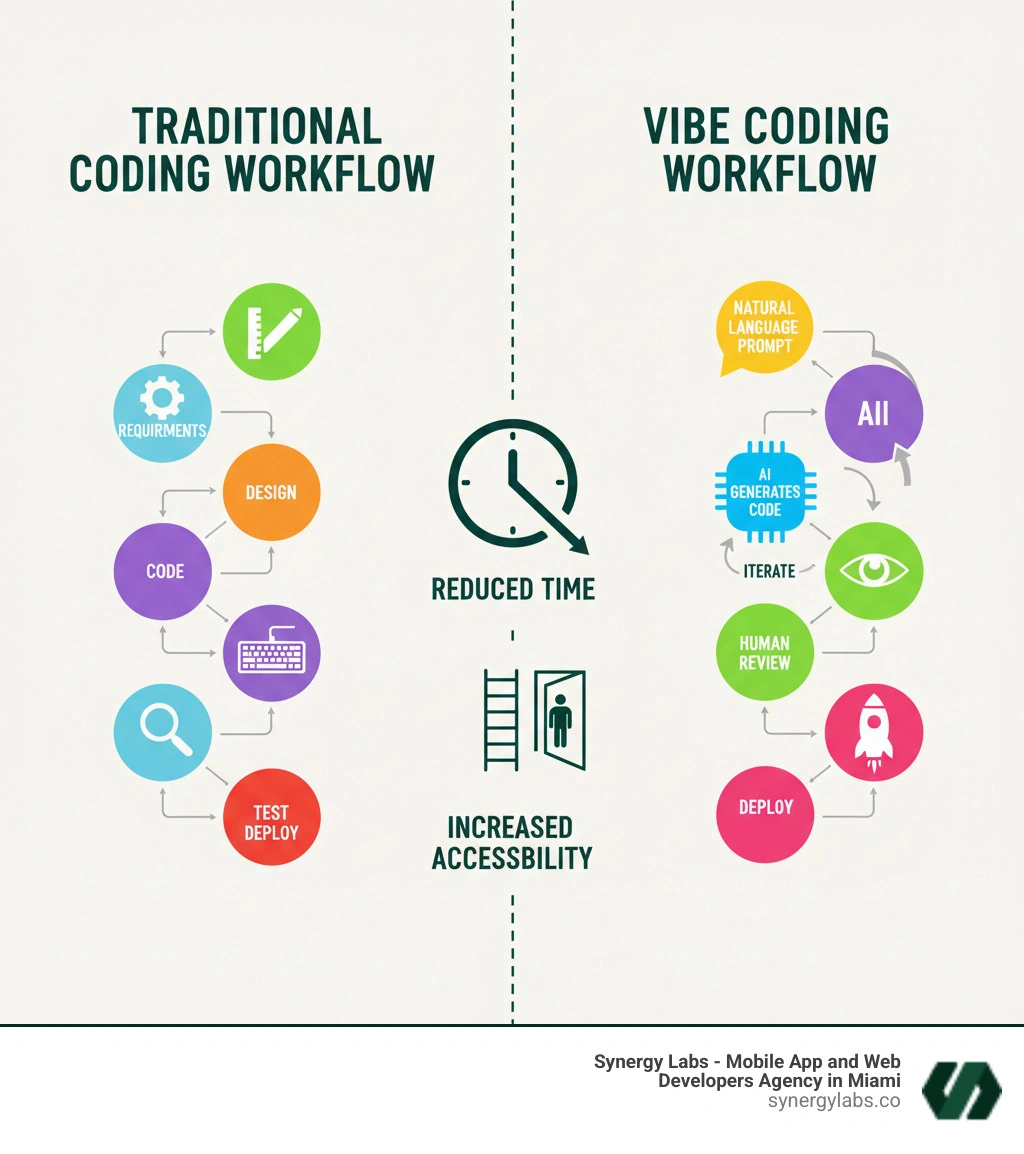
Think of vibe coding as having a brilliant coding buddy who speaks fluent "human." Instead of wrestling with syntax, you tell your AI co-pilot what to build, and it generates working code while you focus on the bigger picture. This is Software 3.0, where natural language is the primary interface.
The results are remarkable. Developers using AI assistants complete 126% more projects weekly and accelerate prototyping by 70%. But like any powerful tool, vibe coding comes with opportunities and challenges.
Benefits for Businesses and Developers
The advantages of vibe coding are changing how businesses operate and developers work.
For businesses, the benefits are immediate. Rapid prototyping becomes effortless, drastically reducing time-to-market. This speed allows companies to test concepts and iterate much faster. Consequently, development costs are lower, as AI handles repetitive coding. It also empowers non-technical team members to participate in the creation process, fostering collaboration.
For developers, the shift is equally profound. By automating mundane tasks, AI allows them to focus on creativity and complex problem-solving rather than syntax. This leads to higher developer satisfaction and a reduction in burnout. Furthermore, AI co-pilots help reduce human error by catching common mistakes, leading to cleaner code from the start.
For more insights on how AI is reshaping development roles, check out this analysis on AI's impact on developers. You can also explore how this connects to broader trends in Embracing Low-Code Development: Top 5 Tools to Accelerate Your App Development.
Potential Risks and How to Mitigate Them
While vibe coding offers incredible benefits, it's crucial to address its challenges responsibly.
A primary risk is the rapid accumulation of technical debt. AI-generated code might work initially but can be poorly structured, creating a "vibe-coded mess" that is difficult to maintain. Similarly, security vulnerabilities are a major concern, with studies showing that 27% of AI-generated code contains security flaws and 63.4% of AI implementations need security framework updates.
Other issues include AI hallucinations, where generated code appears correct but has subtle errors, and maintainability challenges if the team doesn't understand the code the AI writes.
Mitigating these risks requires a "trust but verify" approach. Rigorous human oversight, including thorough code reviews, security audits, and comprehensive testing, is non-negotiable. AI should augment human intelligence, not replace critical thinking. With proper governance, the best vibe coding platforms of 2025 can help you build better software faster. For more guidance, explore our insights on Mobile Security Software.
The Best Vibe Coding Platforms of 2025
The world of software development is changing, and the best vibe coding platforms of 2025 are leading this revolution. These tools are redefining what it means to be a developer by letting us focus on the what and why of our applications, while AI handles much of the how.
Collaborative, Browser-Based IDEs
A leading category of vibe coding tools is the browser-based, collaborative IDE. Their strength lies in accessibility and teamwork. Since they run entirely in a web browser, there's no complex setup required, allowing developers to start coding instantly on any machine.
These platforms integrate AI assistants that act as a coding partner. You can describe functionality in plain English, and the AI generates code blocks that fit your project's context. A key feature is the ability to provide the AI with a "context file" that outlines project-specific requirements and coding styles, ensuring the generated code aligns with your team's standards.
Real-time collaboration is another hallmark, allowing multiple developers to work in the same file simultaneously. With built-in deployment features, teams can go from idea to a live application without ever leaving the browser, making these platforms invaluable for rapid development.
AI-First Code Editors
Another approach involves rebuilding code editors from the ground up with AI as the central focus. These tools often fork popular editors, preserving a familiar interface while embedding powerful AI capabilities.
What sets these editors apart is their deep codebase understanding. The AI comprehends the entire project structure, allowing you to "chat with your code," asking complex questions about performance, logic, or refactoring opportunities.
AI-powered refactoring is especially powerful. Instead of manually restructuring code, you can describe the desired changes and let the AI handle the implementation. These tools also excel at bug fixing and can even generate comprehensive documentation, turning a tedious task into an automated process.
Agentic Development Platforms
At the cutting edge of vibe coding are agentic platforms. These systems use autonomous AI agents to manage the entire development workflow, from initial concept to final deployment. This represents a shift from AI-assisted coding to AI-led development.
The core capability is text-to-app generation. You describe your application, and a team of specialized AI agents architects the system, writes the code, runs tests, and deploys the final product. This end-to-end workflow handles tedious tasks like setting up databases and deployment pipelines. For entrepreneurs with limited technical resources, this approach dramatically lowers the barrier to creating sophisticated applications, a concept we explore in From MVP to Moat: Why Your Startup Needs a Smarter Build Partner in 2025.
Generative UI Platforms
Generative UI platforms are designed to accelerate frontend development by turning text prompts into functional, well-designed UI components. With text-to-UI generation, you can describe an interface element and the platform generates production-ready code using modern frameworks and styling conventions.
The process is highly interactive. Through iterative refinement, you can adjust your prompts and see live previews of the changes, allowing you to have a conversation with your UI until it perfectly matches your vision. This connection between design and AI reflects trends we explore in AI Design Tools: Progress, Limitations, and the Future of Human Creativity.
These platforms represent a fundamental shift in software development. The best vibe coding platforms of 2025 aren't replacing developers; they're amplifying our capabilities. For more insights, check out our guide Top 5 AI Tools to Create an App in 2024: The Ultimate List.
The Evolving Role of the Developer in an AI-Driven World
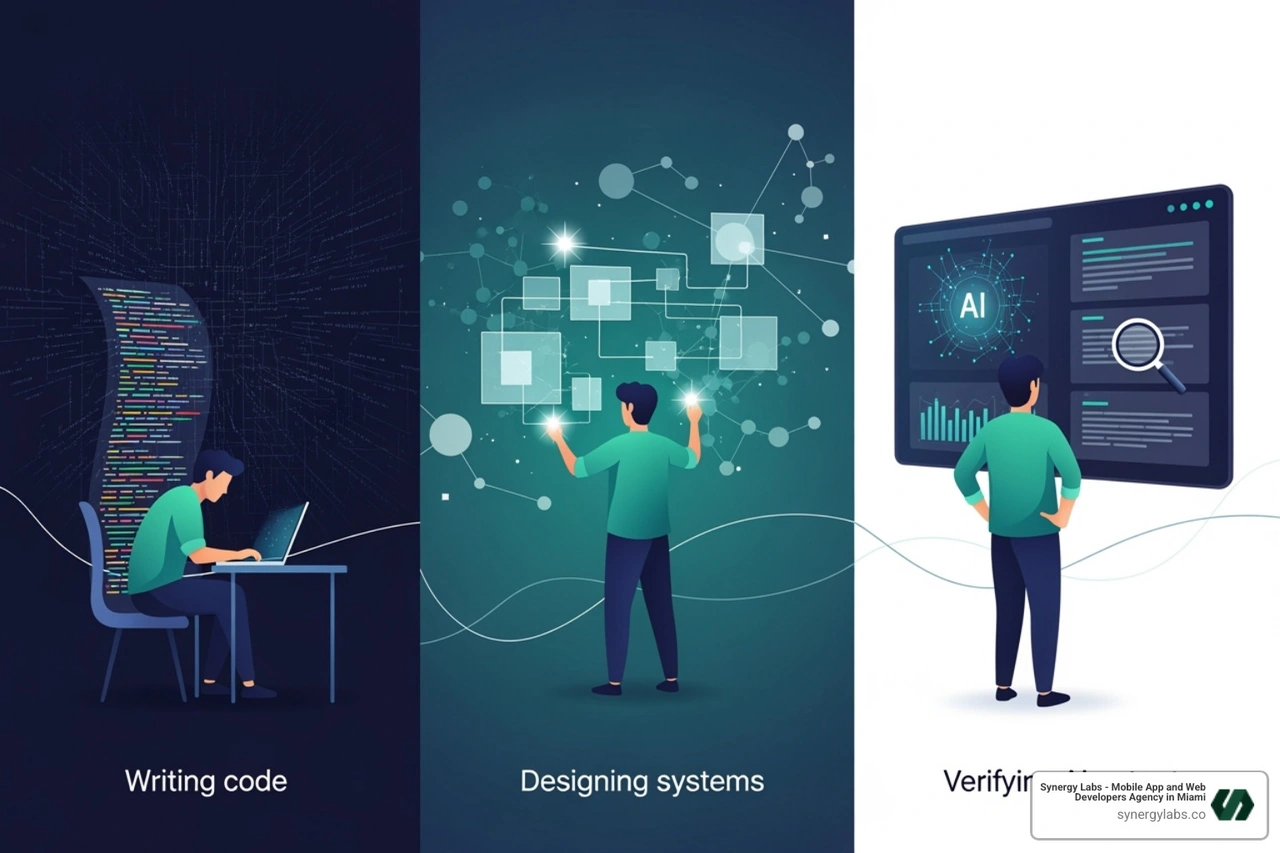
The advent of vibe coding marks a profound change, shifting our focus from being coders to becoming orchestrators of intelligent systems. As research suggests, "in five years, the role of the traditional software developer will be unrecognizable." This isn't a threat; it's an evolution.
From Coder to Orchestrator: New Skills for 2025
Our role is expanding beyond writing code. We are becoming architects, strategists, and creative problem-solvers. This new landscape demands an updated skill set:
Systems architecture: With AI generating code, our ability to design robust, scalable, and maintainable systems is more critical than ever.
Prompt engineering: This is the art of communicating effectively with AI. Crafting clear, precise prompts is essential to getting high-quality output.
Business acumen and user empathy: We must understand the why behind the software. Deep business understanding and genuine user empathy are core to creating valuable products, as outlined in our article on why founders should treat UX as an early-stage growth lever in 2025.
Strategic thinking: Great developers anticipate future challenges and design systems that can scale, leveraging AI for impactful solutions.
Quality assurance and verification: Human oversight for quality, debugging, and security remains essential. We must "trust but verify" everything the AI produces.
Integrating the Best Vibe Coding Platforms of 2025 into Your Workflow
Integrating the best vibe coding platforms of 2025 is about augmenting your current processes, not replacing them.
Start small and iterate: Use vibe coding for less critical tasks like generating boilerplate code or unit tests to allow your team to learn.
Establish a "trust but verify" culture: Implement rigorous code review processes for all AI-generated code to ensure quality and security.
Align with Agile methodologies: The rapid iteration enabled by these platforms pairs perfectly with agile and DevOps practices.
Combine AI with traditional tools: The most powerful environment integrates AI assistants with your existing IDEs, version control, and testing frameworks.
Foster continuous learning: Encourage your team to stay updated on the latest tools and best practices to remain competitive.
At Synergy Labs, our AI Infusion Service helps businesses seamlessly adopt these tools, ensuring they improve productivity without creating chaos.
Ethical Considerations and the Future of AI-Generated Code
As we accept AI-driven development, several ethical considerations demand our attention.
Code ownership and data privacy: Who owns AI-generated code? How is sensitive project data handled? Clear policies are needed to steer these murky waters.
Algorithmic bias: AI models can perpetuate biases from their training data. We must actively work to identify and mitigate these biases.
Job role evolution: The shift in developer roles requires thoughtful support. Providing opportunities for reskilling and upskilling is crucial.
Responsible AI practices: We must weave ethical AI usage, transparency, and accountability into every step of the development process, a topic we explore in our article on integrating behavioral science into app development.
Frequently Asked Questions about Vibe Coding
We know you've got questions about this new frontier in software development. Let's tackle some of the most common ones.
What is the main difference between vibe coding and low-code/no-code?
While both aim to simplify development, they serve different audiences and purposes.
Vibe coding is for developers. It uses natural language to generate real, editable code (like JavaScript or Python). The developer can then read, modify, and maintain this code. Think of it as a super-smart assistant that accelerates the traditional coding process.
Low-code/no-code platforms are for non-technical users. They use visual drag-and-drop interfaces and pre-built components to create applications without writing or seeing code. It's like using a sophisticated app-building kit. You can learn more in our guide on Best No-Code Platforms for Startups That Want to Scale Fast.
In short, vibe coding helps developers code faster, while low-code/no-code helps non-developers build apps without coding.
Will vibe coding replace software developers?
Absolutely not. Vibe coding transforms the developer's role, it doesn't eliminate it. AI assistants are excellent at handling repetitive tasks, generating boilerplate code, and catching common errors. This frees developers to focus on high-value work that AI cannot do: designing complex system architecture, solving unique business problems, and applying strategic thinking and user empathy. Developers are evolving from code writers to system orchestrators who guide AI to build better products. The human element of creativity and critical thinking remains irreplaceable.
How can I start learning to use the best vibe coding platforms of 2025?
Getting started is more straightforward than you might think.
Use free tiers: Most of the best vibe coding platforms of 2025 offer free plans or trials. Experiment with different tools, like browser-based IDEs or generative UI platforms, to get a feel for how natural language translates into code.
Practice prompt engineering: The quality of your output depends on the quality of your input. Learn to write clear, specific, and contextual prompts.
Join developer communities: Forums on Reddit, Discord, and other platforms are great places to find tips, see real-world examples, and learn from others' experiences.
Start with small projects: Build a simple calculator, a to-do list, or a personal portfolio. This helps you learn the workflow without getting overwhelmed.
Focus on logic, not syntax: Understand what you want to build and how it should work. Let the AI handle the syntax details while you act as the director.
Remember the golden rule: trust but verify. Always review, understand, and refine the code the AI generates.
Conclusion: Building the Future, One "Vibe" at a Time
We are at a pivotal moment in software development. The best vibe coding platforms of 2025 are fundamentally changing how we build, shifting us from manual coding to a world where we can describe our vision in plain English and watch AI bring it to life. This is Software 3.0.
The productivity gains are undeniable, with teams building faster and more efficiently than ever. However, success isn't about blindly trusting AI. It's about striking a balance between human creativity and AI capability. Our role is evolving from coder to system architect—a strategic thinker who guides AI to create solutions that matter. The different types of platforms, from collaborative IDEs to agentic systems, all amplify human potential.
For businesses, this means faster time-to-market, lower costs, and rapid innovation. But using these tools effectively requires expert guidance to steer AI integration, security, and architecture. Without proper oversight, today's productivity boost can become tomorrow's technical debt.
This is where the human element is irreplaceable. At Synergy Labs, we combine AI tools with experienced oversight to turn ambitious ideas into scalable, secure applications. Our approach creates a partnership where human expertise and AI efficiency amplify each other.
The future of software is collaborative, intelligent, and accessible. The best vibe coding platforms of 2025 offer incredible opportunities, but they work best in experienced hands.
Ready to explore how these platforms can accelerate your next project? Let's build something amazing together. Find out how our expertise can guide your journey: Our Services.





.avif)

.avif)


