73% of funded AI startups are just repackaging OpenAI APIs. Here's what separates the ones that survive — and how to build a defensible AI product that doesn't get Sherlocked.
The Truth About GPT Wrappers & AI Infrastructure (And Why It Matters for Your Startup)
GPT Wrappers & AI Infrastructure refers to the software layers built on top of foundation models like OpenAI's GPT or Anthropic's Claude — ranging from simple API call handlers to complex, multi-provider orchestration systems that power modern AI products.
Here is a quick breakdown of what you need to know:
What a GPT wrapper is: A software layer that connects your app to an AI model's API, handling requests, formatting prompts, and returning responses to users
Types of wrappers: Thin wrappers give maximum control with minimal abstraction; thick wrappers simplify integration and speed up development
The core tension: 73% of funded AI startups are essentially repackaging OpenAI or Claude APIs with a new UI — raising real questions about defensibility and long-term value
What separates winners from losers: Workflow integration, proprietary data, network effects, and superior user experience — not the underlying model
The infrastructure layer: Tools like caching, rate limiting, API proxies, and load balancing are what turn a fragile prototype into a scalable product
The gap between AI marketing and AI reality is striking. One developer, while debugging a late-night webhook integration, discovered that a company claiming to have proprietary deep learning infrastructure was quietly making calls to OpenAI's API every few seconds — despite raising $4.3 million in funding. That story is not an outlier. It is the norm.
Understanding how GPT wrappers actually work — and how to build one that lasts — is now one of the most important skills a startup founder can develop in 2026.
At Synergy Labs, we have spent years helping founders navigate exactly this challenge, building AI-powered mobile and web products that go beyond surface-level GPT Wrappers & AI Infrastructure to deliver real, defensible value. In the sections below, we break down everything you need to know — from architecture decisions to scaling strategies to avoiding the "wrapper trap."
Related content about GPT Wrappers & AI Infrastructure:
Defining the GPT Wrapper: Innovation or Just a Fancy Interface?
In the current tech landscape, the term "GPT wrapper" is often used as a bit of a snub. Critics frequently dismiss new AI startups as fancy CRUD apps with a GPT wrapper, implying that they aren't doing any "real" innovation. But what does that actually mean?
At its simplest, a wrapper is a piece of software that "wraps" around an existing API (Application Programming Interface). Instead of building a massive neural network from scratch—which costs millions—developers use an API from a provider like OpenAI or Anthropic. They build a custom UI, add some specific instructions (prompts), and call it a product.
The reality is eye-opening. Recent investigative research into 200 funded AI startups revealed that 146 of them—roughly 73%—are just repackaging third-party APIs with a few extra steps. While their marketing might scream "proprietary deep learning," their network traffic tells a different story: a constant stream of data heading straight to OpenAI's servers.
However, being a wrapper isn't inherently bad. In fact, GPT wrappers can accelerate your AI product development significantly. They allow us to move from an idea to a working prototype in weeks rather than years. The problem arises when the wrapper is "thin"—meaning it adds so little value that a user could get the same result by just typing a good prompt into ChatGPT. To survive in 2026, a product must offer a unique value proposition that the base model cannot easily replicate.
The Architecture of Modern GPT Wrappers & AI Infrastructure
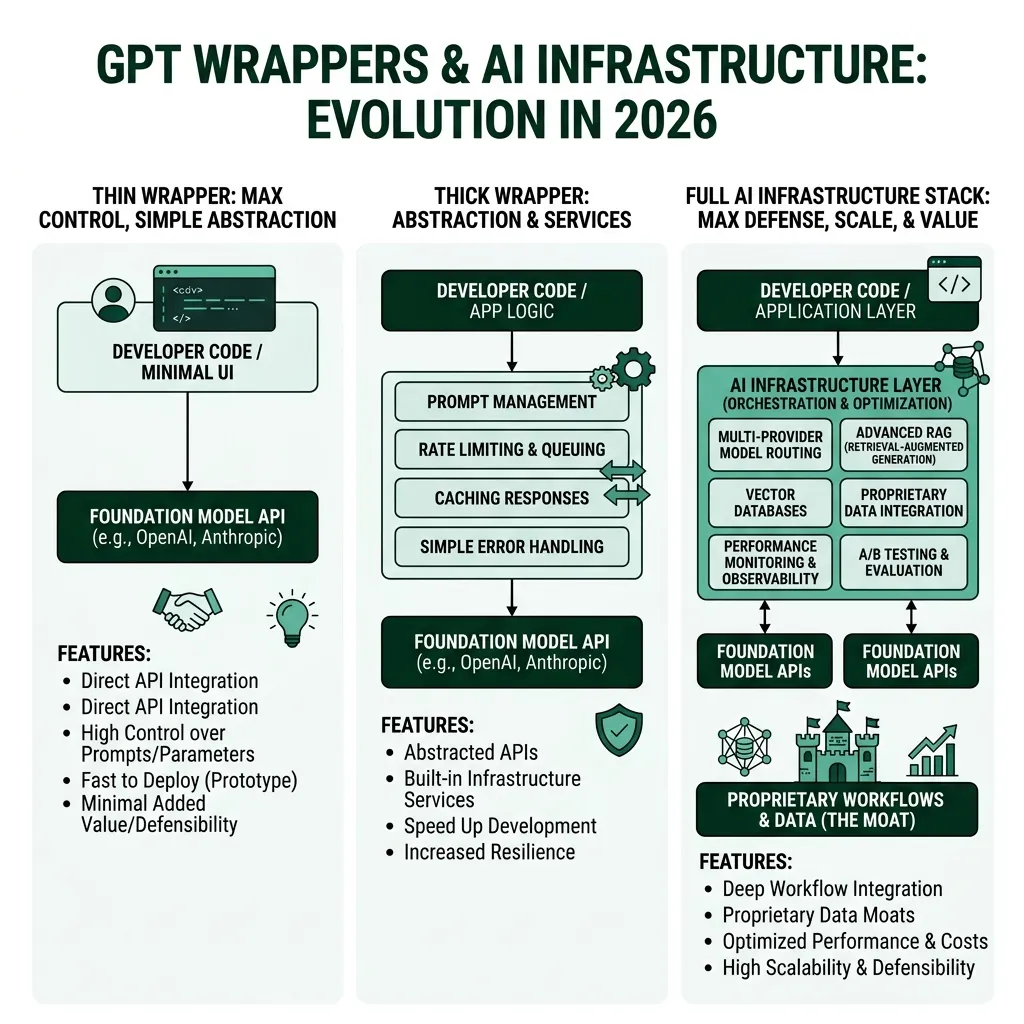
Building a robust AI product requires more than just a "Send" button. The GPT Wrappers & AI Infrastructure stack has become increasingly sophisticated. We generally categorize these into two schools of thought:
Thin Wrappers: These provide maximum control. You handle the raw API calls, manage your own keys, and have total flexibility over how data is sent and received. This is ideal for highly customized products where you want to tweak every parameter of the model.
Thick Abstractions: These use frameworks or platforms that simplify the process. They might handle things like "state" (remembering what happened in the last message) or automatically choose the cheapest model for a specific task.
Modern infrastructure also relies heavily on Retrieval-Augmented Generation (RAG). This is where your app looks up information in a private "vector database" before sending it to the AI. This ensures the AI has context that isn't in its general training data—like your company's private HR manuals or a user's personal history.
We've found that choosing the right moat for your GPT wrapper often comes down to how you handle the data between the user and the model. By using sophisticated prompt engineering, you can actually save 30-40% on API costs while delivering a much higher quality output. Some modern approaches even allow for "backend-less" deployment using scoped tokens, letting the user's browser talk directly to the AI provider while you maintain safety and billing controls through a proxy.
Scaling GPT Wrappers & AI Infrastructure: Costs and Latency
As your user base grows, the "wrapper" needs to become a powerhouse. Scaling AI products introduces challenges that traditional SaaS apps don't face—mainly high costs and high latency (the "waiting for the AI to think" time).
Strategic infrastructure can solve this. Intelligent caching is a game-changer; if a user asks a question that has been asked before, the system serves the saved answer instead of paying for a new AI generation. This can lead to a staggering 70% reduction in costs. Furthermore, implementing request tracing and load balancing ensures that if OpenAI's servers are slow in London, your app can automatically route the request to a server in San Francisco or Doha.
Managing rate limits is another operational hurdle. Many providers use "rolling windows" for API limits. If you don't have a sophisticated proxy layer to manage these calls, your app will simply stop working once you hit a certain number of users. Horizontal scaling and smart routing are essential components of the best GPT wrapper automation in 2026.
Escaping the "Wrapper Trap": Building Defensibility in 2026
The "Wrapper Trap" is the moment a foundation model provider (like OpenAI) releases a new feature that makes your entire startup obsolete. In the tech world, we call this getting "Sherlocked." If your only value is "AI that writes legal briefs," and then Claude releases a "Legal Brief Mode," you’re in trouble.
To build a "thick" and defensible product, you need more than just a connection to an API. You need a moat. According to industry experts like Andrew Chen, the future of AI defensibility lies in returning to classic business moats:
Network Effects: Does your app get better as more people use it? (e.g., a collaborative AI design tool).
Workflow Integration: Is your AI so deeply embedded in a user's daily work (like their CRM or email) that switching to a new tool would be a nightmare?
Proprietary Data Flywheels: Are you using user feedback to "fine-tune" your specific implementation so it gets smarter in a way that general models can't?
Distribution: Can you get your product in front of users faster than the big players can?
State-of-the-art models only stay about six months ahead of open-source alternatives. This means your "secret sauce" shouldn't be the model itself, but how you apply it to a specific B2B niche or a complex human workflow.
From Chatbots to Agent Platforms: Genuine Evolution or Marketing Hype?
If you've spent any time on Reddit or Hacker News lately, you've likely noticed a trend: yesterday's "GPT wrappers" are now calling themselves "agent platforms." Is this just better marketing, or has the tech actually changed?
There is a genuine debate in the startup community about this. A simple chatbot "talks" to you. An agent, however, "acts" for you. True agent platforms offer an orchestration layer that handles multi-step workflows. For example, an agent doesn't just write a script; it writes the script, generates the video, adds a voiceover, and posts it to social media.
This requires serious GPT Wrappers & AI Infrastructure. We're talking about:
State Management: The ability for the AI to remember its progress over a two-week-long task.
Linux Sandboxes: Secure environments where the AI can actually run code or install software without breaking anything.
Tool Calling: The ability for the AI to "reach out" and use other software like your calendar, your database, or a web browser.
While some rebrandings are definitely hype, the shift toward autonomous execution represents a real evolution in how we build with AI.
Frequently Asked Questions about AI Development
The Verdict on GPT Wrappers & AI Infrastructure in 2026
The market is consolidating. Simple, "thin" wrappers are dying out because they lack a moat. However, specialized wrappers that solve specific problems for businesses (like legal, medical, or engineering niches) are thriving. The winners in 2026 are those who focus on the AI infusion services that combine traditional development skills (UI/UX, database management) with AI capabilities.
How can startups avoid becoming obsolete by foundation model updates?
The best way to avoid being "Sherlocked" is to build deep workflow integration. If your AI is part of a complex business process with high switching costs, a general update from OpenAI won't replace you. You should also focus on building a community and a "data moat" where your specific use case generates data that makes your tool uniquely better every day.
Are agent platforms just rebranded GPT wrappers?
Sometimes, yes. But the "real" ones offer genuine infrastructure value that a simple API call doesn't. This includes managing persistent memory, handling errors when the AI gets stuck, and providing "sandboxes" where the AI can safely interact with the real world. If the product still provides value even if you swap the underlying model (e.g., switching from GPT-4 to Claude 3.5), it’s likely more than just a wrapper.
Future-Proofing Your AI Vision: Beyond the Wrapper
Building a successful AI product in 2026 requires more than just a prompt and a prayer. It requires a partner who understands the deep nuances of GPT Wrappers & AI Infrastructure, from the kernel to the cloud.
At Synergy Labs, we don't just build wrappers; we build defensible, scalable AI ecosystems. As a top-tier mobile and web development agency with locations in tech hubs like Miami, Dubai, and San Francisco, we specialize in turning "fancy CRUD apps" into powerhouse platforms.
Why do founders choose us to lead their AI innovation?
Direct Access to Senior Talent: You work with an in-shore CTO who leads the strategy, ensuring your product has a real technical moat.
Fixed-Budget Model: No "surprise" bills. We provide clear, fixed-budget quotes so you can manage your burn rate effectively.
Milestone-Based Payments: You only pay when we hit specific, agreed-upon goals, keeping our interests perfectly aligned with your success.
Rapid, Scalable Launches: We combine the efficiency of an offshore development team with the high-level oversight of US and UAE-based leadership to get you to market 5x faster.
Whether you are looking to build a specialized B2B tool or a complex autonomous agent platform, we have the expertise to ensure your vision survives the "wrapper trap."



.avif)

.avif)


