The $1.3 Trillion Question: Why Digital Change Fails for Most Mid-Sized Companies
What Mid-Sized Businesses Get Wrong About Digital Change boils down to a few critical mistakes: treating it as a technology project instead of a strategic shift, automating broken processes without fixing them first, underestimating cultural resistance, and failing to define clear success metrics.
Here's the quick answer:
Top 4 Digital Change Mistakes Mid-Sized Businesses Make:
Confusing Digitization with Change - Converting paper to digital isn't the same as reimagining how you create value
Automating Broken Processes - Technology makes bad processes faster, not better
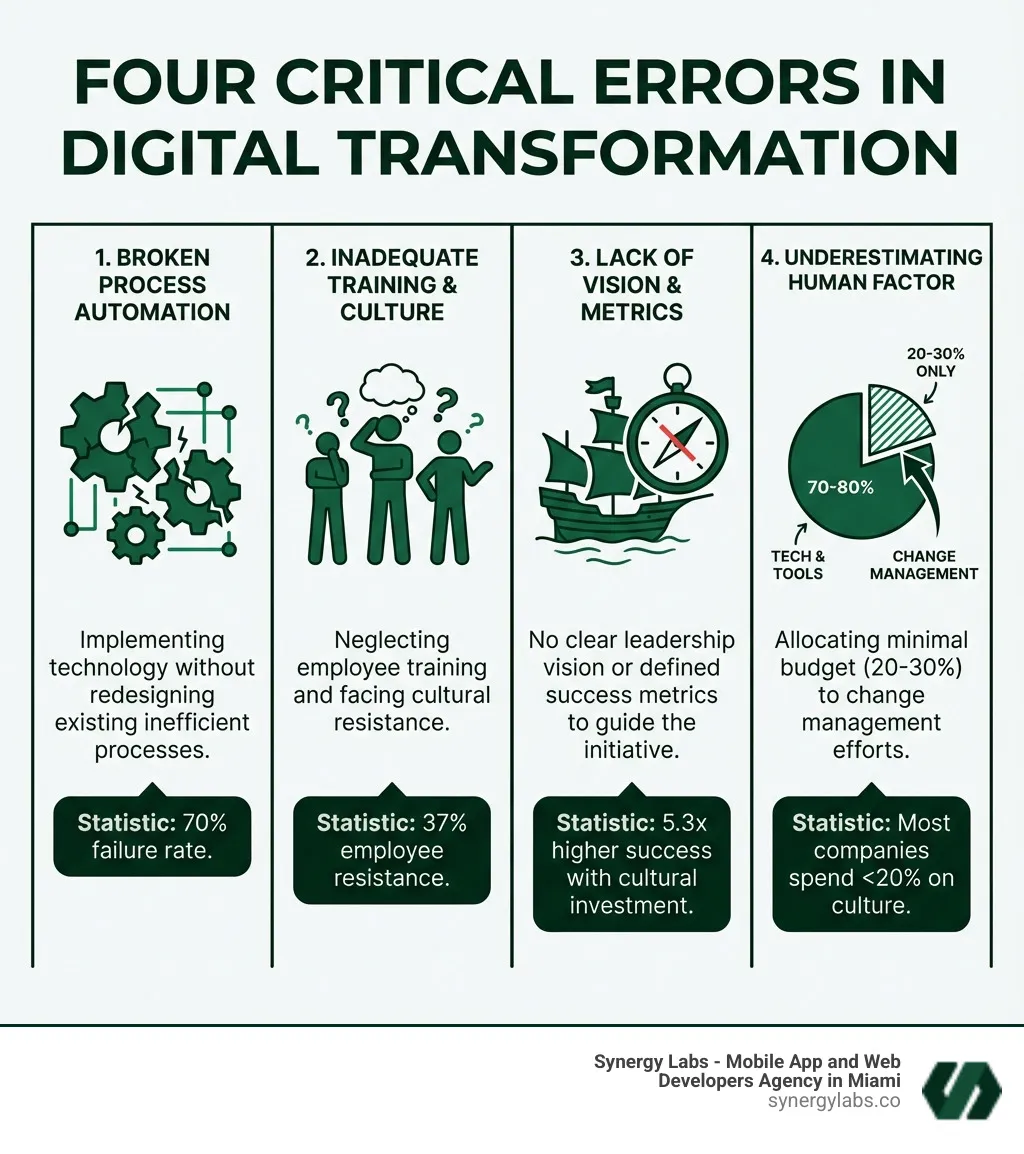
Ignoring the Human Element - 37% of employees resist change, yet most companies spend less than 20% of their budget on training and culture
No Clear Vision or Metrics - Without measurable goals and leadership buy-in, initiatives drift and fail
The numbers tell a sobering story. Around 70% of digital changes fail in mid-sized companies. That's roughly four out of five initiatives that fall short of their objectives, despite companies planning to increase digital spending by 25% year over year. Global digital change spending is projected to approach $4 trillion by 2027, yet the success rate remains stubbornly low.
Why? Because most leaders don't understand the full scope of what digital change actually means. It's not about buying new software or moving to the cloud. As one Harvard Business Review article puts it, digital change is "a deliberate, strategic repositioning of one's business in today's digital economy" - not just adopting digital tools to improve traditional methods.
The gap between motion and progress is real. Companies invest millions in cutting-edge technology, hire consultants, and launch what they proudly call their "digital change." Eighteen months later, they're sitting in a conference room asking where it all went wrong. A manufacturing company spends $2.3 million on an ERP system only to see productivity decrease by 15% because they digitized broken processes instead of fixing them first.
The core problem isn't technology - it's methodology. Successful digital change is 30% technology and 70% psychology. Companies that invest in cultural change see 5.3 times higher success rates than those focused only on tech. Yet most mid-sized businesses skip the hard work of process redesign, change management, and leadership alignment.
At Synergy Labs, we've seen this pattern repeatedly across dozens of projects - from fintech platforms to consumer apps. Understanding What Mid-Sized Businesses Get Wrong About Digital Change is the first step toward getting it right, which is why we've built our approach around proven methodologies that address the human and strategic elements, not just the technical ones.
The Core Misconception: Confusing Digitization with Change
One of the biggest traps mid-sized businesses fall into when approaching digital change is mistaking "digitization" for "change." It's like thinking that putting a faster engine in a rusty old car makes it a brand new model. It might go faster, but it's still rusty and prone to breaking down.
Digitization simply means converting analog information or processes into a digital format. Think scanning paper documents into PDFs or replacing manual data entry with a basic software interface. While these steps offer some efficiency gains, they don't fundamentally change how your business operates or creates value. As we've learned, digital change is a strategic repositioning of your business in the digital economy, not just the adoption of digital tools to improve traditional methods.
True change, on the other hand, involves fundamentally reimagining your value chain, your customer interactions, and your business model. It's about asking, "If we were starting this company today, how would we operate?" This shift in mindset is crucial for mid-sized companies to drive genuine digital change, as highlighted in HBR's insights on How Midsize Companies Can Drive Digital Transformation.
From Analog to Digital: The Limits of Digitization
Many mid-sized companies find themselves stuck in the digitization phase. They might invest in new software to manage their inventory or customer relationships, but they simply replicate their existing, often inefficient, manual processes in a digital format. We've seen companies manually entering the same customer data into four different systems, or automating an approval workflow that still includes seven unnecessary steps. While these processes might now happen faster, they are still fundamentally broken.
The problem with this approach is that it limits efficiency gains and prevents true innovation. You're supporting traditional methods rather than challenging them. The "five-year test" is a harsh reality check: in five years, markets will be dominated by transformed companies, while those that merely digitized existing limitations will struggle or cease to exist. The digital economy demands more than just a digital facelift; it requires a new operating system for your entire business.
From Digital to Transformed: Reimagining Your Business
True digital change is about reimagining how you create value. It's about leveraging digital technologies to develop entirely new business models, improve customer-centricity, and make data-driven decisions that give you a competitive advantage. Imagine a logistics company that transforms from merely moving packages to becoming a data analytics powerhouse, providing market intelligence that triples its margins. This is the power of true change.
It involves a deep dive into every aspect of your business, asking critical questions about what customer problems you can solve better, and how you can fundamentally change your offerings. This kind of strategic repositioning is where significant growth and innovation happen, paving the way for AI-Driven Growth: Transforming Business Innovation and Competition and other advanced strategies.
The Critical Errors: What Mid-Sized Businesses Get Wrong About Digital Change
The journey of digital change for mid-sized businesses is often fraught with pitfalls. As we explored in the introduction, the high failure rate isn't due to a lack of investment, but rather a flawed approach. The consensus is that successful digital change is about 30% technology and a whopping 70% psychology and methodology. This means that the biggest errors aren't technological, but human and strategic, a sentiment echoed in various reports, including those discussing Where Digital Transformations Go Wrong in Small and Midsize Companies.
Mistake #1: Automating Broken Processes
Perhaps the most common and costly mistake is automating processes that are fundamentally flawed. It's like building a super-fast highway over a rickety bridge—it just collapses faster. We've seen mid-sized manufacturing companies invest millions in ERP systems, only to find their productivity decrease. Why? Because they simply digitized their existing, inefficient processes instead of redesigning them first.
Before any technology implementation, a comprehensive process diagnosis is crucial. This involves identifying bottlenecks, redundancies, and steps that add no value. Studies show that between 40-60% of current processes in organizations may add no value to customers. Automating these "dead weight" processes only makes them faster, not better. This often leads to legacy system integration issues, where new technology struggles to connect with old, inefficient workflows. Our approach at Synergy Labs focuses on helping businesses understand their current state through meticulous analysis, ensuring that any new custom software solutions, like those discussed in How Custom Software Solutions Can Give Your Startup a Competitive Edge, are built on a solid, optimized foundation.
Mistake #2: Underestimating the Human Element
Technology doesn't resist change; people do. This simple truth is often overlooked. Mid-sized businesses frequently underestimate the profound impact of company culture and employee resistance on digital change initiatives. Studies indicate that as many as 37% of all employees resist change in the workplace. This resistance often stems from anxiety, disengagement, and a lack of understanding about how new tools will benefit them.
Companies that invest in cultural change see 5.3 times higher success rates than those focused solely on technology. This means dedicating a significant portion of the budget—around 20-30%—to ongoing training, change management, and fostering a "learn and share" culture. Without leadership buy-in and a robust change management strategy, even the most cutting-edge mobile app or web platform, like those detailed in Why Your Business Needs a Mobile App in 2024, will struggle with user adoption. We understand that success is not just about building great technology, but about ensuring people accept and effectively use it.
A Deeper Look at What Mid-Sized Businesses Get Wrong About Digital Change
Beyond the core errors of automating broken processes and neglecting the human element, several other critical mistakes contribute to the high failure rate of digital change in mid-sized businesses:
Lack of a shared vision: Without a clear, unified understanding of what the change aims to achieve, efforts become fragmented and misaligned.
Misaligned priorities: Companies often chase the latest trends without evaluating how they fit into their unique operational needs, leading to wasted resources.
Neglecting security and compliance: As businesses in Miami, Dubai, London, and other global hubs increasingly rely on digital platforms, cybersecurity becomes paramount. The finance sector, for example, is the most vulnerable to data breaches, and small to medium businesses in the US can face an average cost of $200,000 per cyberattack. Additionally, 93% of the fintech market faces compliance issues. Ignoring these aspects can lead to devastating financial and reputational damage.
Setting unrealistic expectations: Digital change is a marathon, not a sprint. Expecting immediate, results without acknowledging the complexities and challenges sets projects up for disappointment.
Poor technology management: This includes issues like legacy system integration, where older systems don't play well with new ones, creating data silos and operational headaches.
Strategic Blind Spots: Why Vision, Metrics, and Customers Get Left Behind
Imagine a ship captain setting sail without a map, a compass, or even a clear destination. Sounds like a recipe for disaster, right? Yet, this is often the reality for mid-sized businesses starting on digital change journeys. They possess the vessel (their company) and the crew (their employees), but lack the strategic guidance to steer the complex digital seas.
This absence of a clear strategic vision, measurable success metrics, and a deep understanding of customer needs constitutes a significant blind spot. It's why many initiatives fail to deliver a tangible return on investment, making the conversation about ROI of Enterprise App Development: What C-Level Executives Need to Know all the more critical.
The Vision Void: Failure of Leadership and Strategy
A digital change is fundamentally a strategic repositioning, not just a technological upgrade. Yet, a startling number of mid-sized business leaders don't fully grasp its scope. Only 9% of mid-sized businesses consider digital change a cornerstone of their strategy, despite 54% deeming it very important. This disconnect creates a "vision void" where initiatives lack direction and leadership buy-in.
The primary reason for digital change failure isn't a lack of investment, but a deficiency in strategic leadership and decision-making processes. Many strategies fail because they don't reflect how digital is changing economic fundamentals, industry dynamics, or what it means to compete. As industry analysis highlights in Three new mandates for capturing a digital transformation’s full value, leaders must understand the broad implications of digital and set clear, ambitious goals. Without this foundational understanding and a clear vision from the top, change efforts are likely to drift, leaving employees confused and resources wasted.
Flying Blind: The Danger of Having No Success Metrics
How do you know if you're succeeding if you don't define what success looks like? This might seem obvious, but many digital change projects launch without clear, measurable success metrics. Companies often "fly blind," unable to track progress, justify investments, or make necessary course corrections. Without clear goals and adoption metrics, leaders lose confidence, and change efforts stall.
Defining Key Performance Indicators (KPIs) and establishing a robust data and metrics strategy are non-negotiable. This isn't just about tracking financial ROI, but also operational efficiencies, customer satisfaction, and employee adoption rates. Successful changes often break down the journey into phased implementations, with measurable deliverables within 90 days. This approach builds momentum and provides concrete evidence of progress, allowing for continuous optimization and proving the value of the investment.
Forgetting the "Why": What Mid-Sized Businesses Get Wrong About Digital Change and Customer Needs
At the heart of any successful business is the customer. Yet, in the rush to adopt new technologies, mid-sized companies often forget the "why" behind their digital change: to better serve their customers. A lack of understanding of customer expectations and needs renders even technologically advanced projects ineffective. What's the point of a shiny new app if it doesn't solve a real problem for your users or improve their experience?
The ultimate goal of digital change should be to improve operations, leading to more positive customer experiences and better overall business outcomes. This means placing the customer at the core of all digital change efforts. It involves:
Understanding customer expectations: What do your customers truly need and want from your digital interactions?
Solving customer problems: How can technology address their pain points and make their lives easier?
Improving customer experience: From intuitive interfaces to personalized interactions, every digital touchpoint should improve their journey.
Using feedback loops: Actively solicit and integrate customer feedback to continuously refine and improve digital offerings.
Companies with a strategic approach to digital change are twice as likely to achieve their customer-experience goals. By focusing on the customer, mid-sized businesses can ensure their digital investments truly drive value and competitive advantage.
A Blueprint for Success: Turning Failure into a Competitive Advantage
The good news is that learning from these common missteps provides a clear blueprint for success. What Mid-Sized Businesses Get Wrong About Digital Change can be flipped into a powerful competitive advantage by adopting a structured, human-centric, and strategically aligned approach. It's about building capabilities and embracing the right methodologies, aligning with modern practices and trends as highlighted in Top Software Development Trends Shaping 2024: What You Need to Know.
The Four-Step Methodology That Works
We've observed that successful digital changes in mid-sized businesses consistently follow a four-step methodology that prioritizes thoughtful preparation over hasty implementation:
Comprehensive Process Diagnosis: Before touching any technology, carefully diagnose your existing processes. Identify every step, every bottleneck, every redundancy. Ask tough questions: "Why do we do it this way?" and "Does this step truly add value?" This diagnosis reveals the "broken processes" that must be fixed before automation.
Process Redesign Before Digitization: Once diagnosed, redesign your processes for optimal efficiency and effectiveness. This often means eliminating unnecessary steps, reordering workflows, and streamlining operations. Only after you have a lean, optimized process should you consider how technology can support and accelerate it. This approach ensures that you're automating efficiency, not chaos.
Phased Implementation with Measurable Deliverables: Instead of a "big bang" rollout, implement technology in phases. Each phase should have clear, measurable outcomes and deliver tangible value, ideally within 90 days. This iterative approach builds momentum, allows for adjustments, and provides early wins that boost confidence. This aligns perfectly with agile methodologies and the benefits of building a Minimum Viable Product (MVP) first, as discussed in Agile Methodologies: Accelerating App Development Without Compromising Quality and The Benefits of Building a Minimum Viable Product (MVP) First.
Continuous Human Capital Development: Invest continuously in your people. This means ongoing training, upskilling, and reskilling your workforce to adapt to new technologies and processes. Technology doesn't resist change, people do. Dedicate a significant portion of your budget (20-30%) to training and change management to foster adoption and build a digitally savvy team.
The International Standards Advantage
Adopting international standards might sound like bureaucracy, but it's a proven path to higher success rates in digital change. Companies that apply international standards like ISO 9001 (quality management), COBIT (IT governance), or ITIL (IT service management) in their digital change efforts have three times higher success rates.
These standards provide a robust framework for establishing governance, managing risks, and ensuring quality throughout the change journey. They offer best practices for defining processes, roles, and responsibilities, which are critical for avoiding the chaos that often plagues change initiatives. For mid-sized businesses operating in global markets like Dubai, Doha, or London, adhering to such standards not only improves internal processes but also builds trust and credibility with international partners and customers.
Building the Right Team: Skills, Training, and Talent
The digital change journey is only as strong as the team leading it. One of the persistent challenges for mid-sized businesses is inadequate training and a significant digital skills gap. We've seen that over half of high-performing companies still lack future-needed capabilities, and 65% of middle market executives cite a lack of talent as an obstacle to digitization efforts. It's harder to attract and reskill tech-savvy executives than frontline technical talent, and equally challenging to integrate both groups effectively.
To overcome this, mid-sized companies must:
Invest in continuous training: As mentioned, allocate 20-30% of the implementation budget to ongoing training and change management. This isn't a one-time event but an ongoing commitment.
Upskill and reskill the existing workforce: Empower your current employees with the digital competencies they need. Higher-maturity organizations are almost five times more likely to excel at helping employees develop digital skills.
Acquire strategic tech talent: For specialized needs, be prepared to attract and integrate new tech talent, including C-suite and executive levels. Focus on integrating new digital hires directly into business units, not just IT, for better impact.
Leverage external expertise: Sometimes, the fastest and most effective way to bridge a skill gap is to partner with external experts. At Synergy Labs, we provide access to senior talent and specialized skills, ensuring your team has the capabilities needed to steer complex projects and scale solutions, as discussed in From MVP to Market Leader: Scaling an App Without Rewriting Everything.
Navigating the Digital Tides: Charting Your Course to Change
We've explored What Mid-Sized Businesses Get Wrong About Digital Change, from confusing digitization with true change to overlooking the critical human element and strategic necessities. The path to successful change is undoubtedly challenging, but it is also immensely rewarding. The silent struggle of operations change ends when organizations recognize that technology amplifies culture, not replaces it.
Digital change is not a destination; it's a continuous journey of evolution and adaptation. It's about people and processes, with technology serving as a powerful enabler. The choice is yours: will you digitize your existing limitations, or will you fundamentally reimagine and transform them into competitive advantages? The next five years of your business depend on getting this decision right.
At Synergy Labs, we understand these complexities. With our personalized service, direct access to senior talent, and focus on user-centered design and robust security, we partner with mid-sized businesses in Miami, New York City, London, Dubai, and beyond to steer the digital tides. We don't just build apps and web platforms; we help you build a blueprint for a transformed future.
Are you ready to turn your digital challenges into triumphs? Let us help you chart a course for a successful digital change.




.avif)

.avif)


