New York Is the Fintech Capital of the World — Here's What It Takes to Build Here
Building Fintech Apps in New York: Compliance and Innovation means navigating one of the most demanding — and rewarding — regulatory environments on the planet.
Here's a quick snapshot of what that involves:
Regulatory bodies: NYDFS (Department of Financial Services), CFPB, FinCEN, and SEC
Key compliance frameworks: BitLicense (23 NYCRR Part 200), DFS Part 500 cybersecurity rules, KYC/AML, PCI-DSS, and CCPA-aligned data privacy
Virtual currency: Prior DFS approval required; quarterly assessments based on custody value and transaction volume
Lending products: BNPL and EWA now subject to New York's 16% usury cap and new consumer protection laws (as of 2026)
Cybersecurity: MFA and asset inventory policies now mandatory for all DFS-licensed entities (effective November 2025)
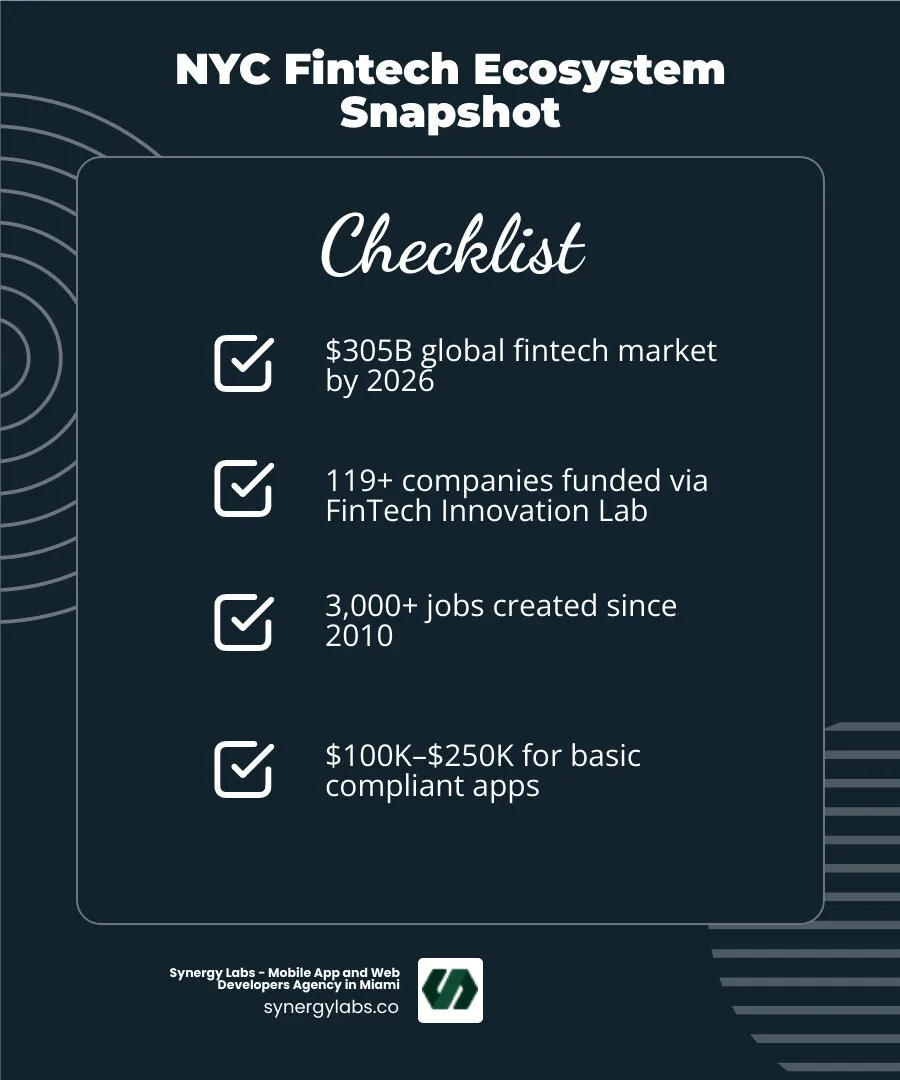
Innovation support: FinTech Innovation Lab New York has helped 119+ companies raise over $3 billion and create 3,000+ jobs since 2010
Development costs: Basic fintech apps run $100,000–$250,000; enterprise solutions reach into the millions, with security features alone adding 30–40% to build time
New York isn't just a regulatory gauntlet — it's a proving ground. The city has built an ecosystem where startups that get compliance right unlock access to Wall Street partnerships, top-tier venture capital, and a global customer base. The global fintech market is projected to hit $305 billion by 2026, and New York sits right at the center of that growth.
The challenge? Regulation moves fast here. The opportunity? So does innovation.
I'm Synergy Labs, a mobile app and web development agency with hands-on experience building secure, scalable fintech products — including projects that required navigating the exact compliance frameworks covered in this guide on Building Fintech Apps in New York: Compliance and Innovation. We've seen how the right architecture decisions at the start of a project can save founders months of costly rework down the line.
Key Building Fintech Apps in New York: Compliance and Innovation vocabulary:
Navigating the Regulatory Landscape for Building Fintech Apps in New York: Compliance and Innovation
When we talk about building in the Empire State, we aren't just talking about code; we're talking about a "shield-first" mentality. The New York Department of Financial Services (NYDFS) is widely considered the most proactive state regulator in the country. If you can make it here, you can make it anywhere—mostly because you've already survived the toughest audits.
The cornerstone of New York’s digital defense is NYDFS Part 500. This isn't a suggestion; it’s a mandate. As of late 2025 and moving into 2026, the final provisions of these cybersecurity amendments have come into full effect. This means your app must have robust Multifactor Authentication (MFA), a comprehensive asset inventory, and strict third-party risk management.
Beyond cybersecurity, developers must bake KYC (Know Your Customer) and AML (Anti-Money Laundering) protocols directly into the onboarding flow. In New York, digital onboarding isn't just about convenience—it's about reducing customer acquisition costs by up to 70% while satisfying the Bank Secrecy Act. Furthermore, if your app handles cardholder data, PCI-DSS standards apply universally. Even without a data breach, failing to meet these benchmarks can result in heavy penalties from credit card processors.
While New York doesn't have a single "CCPA" like California, its data privacy expectations are heavily aligned with those high standards. Transparency in data usage and robust encryption are non-negotiable for maintaining consumer trust. For a deeper dive into how we handle these complexities locally, Explore Synergy Labs' NYC app development services.
Mastering the BitLicense and Virtual Currency Assessments in Building Fintech Apps in New York: Compliance and Innovation
If your fintech app involves "virtual currency business activity," you’ve likely heard the term BitLicense (23 NYCRR Part 200). Since 2015, New York has required this license for anyone storing, holding, or exchanging crypto for New York residents.
However, the landscape evolved significantly following a 2022 amendment that allows the NYDFS to assess the costs of supervision directly from licensees. This means being a "covered institution" comes with a bill. The assessment is split into two parts:
Supervisory Component: This is calculated based on your Transaction Volume Basis (50%) and your Custody Basis (50%). Essentially, the more money you move and the more assets you hold for New Yorkers, the higher your oversight costs.
Regulatory Component: An equal share of the Department’s remaining operating costs.
These assessments are billed in quarterly cycles, with a final "true-up" at the end of the fiscal year. To stay ahead, developers need to build internal reporting tools that track average USD values of customer currency and transaction counts with pinpoint accuracy. You can find official guidance on these interactions at Innovation at DFS.
Impact of Usury Laws on BNPL and EWA Products
New York has some of the strictest usury laws in the nation, capping interest rates at 16% APR for most non-bank lenders. Historically, many fintechs argued that products like Buy Now Pay Later (BNPL) and Earned Wage Access (EWA) weren't "loans" and therefore were exempt.
As of 2026, the honeymoon phase for "fee-based" lending is over. Senate Bill S1726 and recent reforms have moved to classify these products as loans. For developers, this means:
BNPL: Must now provide TILA-style disclosures, offer dispute rights similar to credit cards, and ensure late fees don't push the effective cost over the 16% cap.
EWA: Following significant litigation, New York now views "tips" and "expedited fees" as interest. If your app offers early wage access, your algorithm must ensure the total cost to the consumer stays within legal limits to avoid being flagged as an illegal payday loan.
Driving Innovation through the FinTech Innovation Lab New York
While the regulations are tough, the support system is unparalleled. The FinTech Innovation Lab New York, co-founded by Accenture and the Partnership Fund for New York City, has spent 15 years turning the "regulatory gauntlet" into a competitive advantage.
The numbers speak for themselves: graduates of the lab have created over 3,000 jobs and raised more than $3 billion in venture financing. This isn't just an accelerator; it’s a bridge to the world's largest financial institutions. Leaders like Maria Gotsch on the Lab's 15-year impact emphasize that the lab serves as a proving ground for technology that solves real-world institutional problems.
As we look toward the Demo Day 2026, the focus has shifted heavily toward Agentic AI. According to Steve Murphy on Agentic AI investment, AI remains the top investment priority, specifically tools that can simplify complex workflows and automate compliance.
Emerging Technologies in Building Fintech Apps in New York: Compliance and Innovation
The "Innovation" half of Building Fintech Apps in New York: Compliance and Innovation is currently dominated by three major tech shifts:
Agentic AI and Autonomous Orchestration: We are moving beyond simple chatbots. The 2026 cohort of startups is building "agents" that can autonomously handle commercial underwriting, client onboarding, and middle-office roles.
AI Estate Management: With the rise of AI comes the need for Explainable AI (XAI). Regulators in New York demand to know why an AI made a credit decision. AI Estate Management tools ensure that enterprise AI remains governed, compliant, and transparent.
RegTech Automation: Why hire 50 compliance officers when you can build a RegTech module? Automated KYC, real-time AML monitoring, and digital identity fusions are now standard features in high-end NYC fintech apps.
As Cathinka Wahlstrom on next-gen solutions points out, the diversity of these solutions—from blockchain-based smart contracts to hyper-personalized front-office tools—is what keeps New York at the cutting edge.
Top Focus Areas for 2026: AI, ESG, and Cybersecurity
As we look deeper into 2026, three specific areas are non-negotiable for any new entrant:
Post-Quantum Cryptography: With the threat of quantum computing on the horizon, New York's cybersecurity focus is shifting toward encryption that can withstand future threats.
ESG Priority Integration: Environmental, Social, and Governance (ESG) metrics are no longer "nice-to-haves." New York investors are increasingly looking for fintechs that bake ESG data architecture into their core processing.
Talent Transformation: There is a massive shortage of talent that understands both blockchain and NYDFS compliance. Successful firms are investing in upskilling and university partnerships to bridge this gap.
In Building Fintech Apps in New York: Compliance and Innovation, we use a "Compliance-by-Design" approach. This means we don't build the app and then "add security" later. Security is the foundation.
To pass a NYDFS audit, your app should implement Multi-layer Security:
Data at Rest and in Transit: Use AES-256 encryption for databases and TLS 1.3 for all data moving between the app and the server.
Behavioral Analytics: Implement systems that detect "intent." If a user suddenly tries to move a large sum to a high-risk jurisdiction at 3 AM, your app should automatically trigger a step-up authentication.
Risk-Based Authentication: Not every action needs a thumbprint, but every "material" action does. We design flows that adjust friction based on the transaction's risk level.
Managing Third-Party Risks and Vendor Contracts
Your app is only as secure as your weakest vendor. Under the latest DFS guidance, you are responsible for the cybersecurity of your Third-Party Service Providers (TPSPs). This includes your cloud provider, your AI agent infrastructure, and even your email API.
Key steps for vendor management:
Due Diligence: You must audit a vendor’s security program before signing.
Contractual Provisions: Include mandatory MFA requirements, data destruction certifications (ensuring they delete your data if the contract ends), and restrictions on how they can use your data to train their AI models.
Asset Inventory: You are now required to maintain a policy that tracks every piece of hardware and software that touches non-public information.
The Economics of Fintech Development in the Empire State
Let's talk numbers. Building a fintech app in New York is an investment in "certification-readiness."
Basic Fintech App: $100,000 – $250,000. This covers a Minimum Viable Product (MVP) with standard security and one or two core features.
Enterprise Solutions: These quickly reach into the millions. When you add high-frequency trading capabilities, complex AI orchestration, and multi-jurisdictional compliance, the price reflects the complexity.
The "Compliance Tax": In New York, security and regulatory features add roughly 30-40% to the total development time and cost.
However, the ROI is significant. Digital onboarding alone reduces acquisition costs by 70%. Furthermore, a "compliance-ready" app is much easier to sell to a partner bank or a venture capital firm. In NYC, being "pre-audited" is a major selling point during a Series A round.
Talent Acquisition and Consumer Trust Strategies
In a city where cybercrime causes damages worth millions every minute, Consumer Trust is your most valuable currency. You build this through transparency. If you use a user’s data to train an AI, tell them. If you use biometrics, explain how that data is hashed and stored (or rather, not stored) on your servers.
Finding the talent to build these systems is the final hurdle. New York firms are increasingly partnering with coding bootcamps and universities to find developers who understand the intersection of finance and tech. Offering flexible work, competitive compensation, and a culture of "proactive compliance" helps attract the senior talent needed to navigate the 2026 landscape.
Frequently Asked Questions about New York Fintech Development
What is the NYDFS BitLicense and who needs it?
The BitLicense is a regulatory framework (23 NYCRR Part 200) for businesses involved in "virtual currency business activity" involving New York or its residents. This includes receiving, transmitting, storing, or exchanging virtual currencies. If your app allows users to buy, sell, or hold crypto, you likely need one.
How much does it cost to build a compliant fintech app in NYC?
A basic, compliant app typically starts at $100,000. However, for enterprise-grade solutions that meet all NYDFS Part 500 and BitLicense requirements, costs can exceed $1 million. Security features typically add 30-40% to your development timeline.
What are the 2026 cybersecurity requirements for NY fintechs?
As of 2026, all DFS-regulated entities must have full MFA implementation for all access to information systems, a documented asset inventory policy, and rigorous third-party service provider (TPSP) oversight, including specific "right to audit" clauses in vendor contracts.
Charting Your Fintech Future with Synergy Labs in the Empire State
Building a fintech app in New York doesn't have to be a regulatory nightmare. At Synergy Labs, we specialize in turning these complex requirements into a streamlined, high-performance product. We offer a robust partnership for your fintech app development journey, ensuring that your innovation is never stifled by compliance—but rather empowered by it.
With our fixed-budget model, you gain absolute predictability and control over your development costs, eliminating the "surprise fees" often associated with complex builds. Our unique approach combines an in-shore CTO who provides strategic oversight and understands the nuances of New York regulations, with a highly skilled offshore development team that ensures cost-efficiency without sacrificing quality.
We structure our projects using milestone-based payments, meaning you only pay as we hit specific, verifiable goals. This ensures your project stays on track and meets the high standards required for a rapid New York launch. By giving you direct access to senior talent, we help you bring your vision to life with a "compliance-by-design" architecture that is ready for the 2026 market.




.avif)

.avif)


