

Build for iOS and Android Without Building Everything Twice

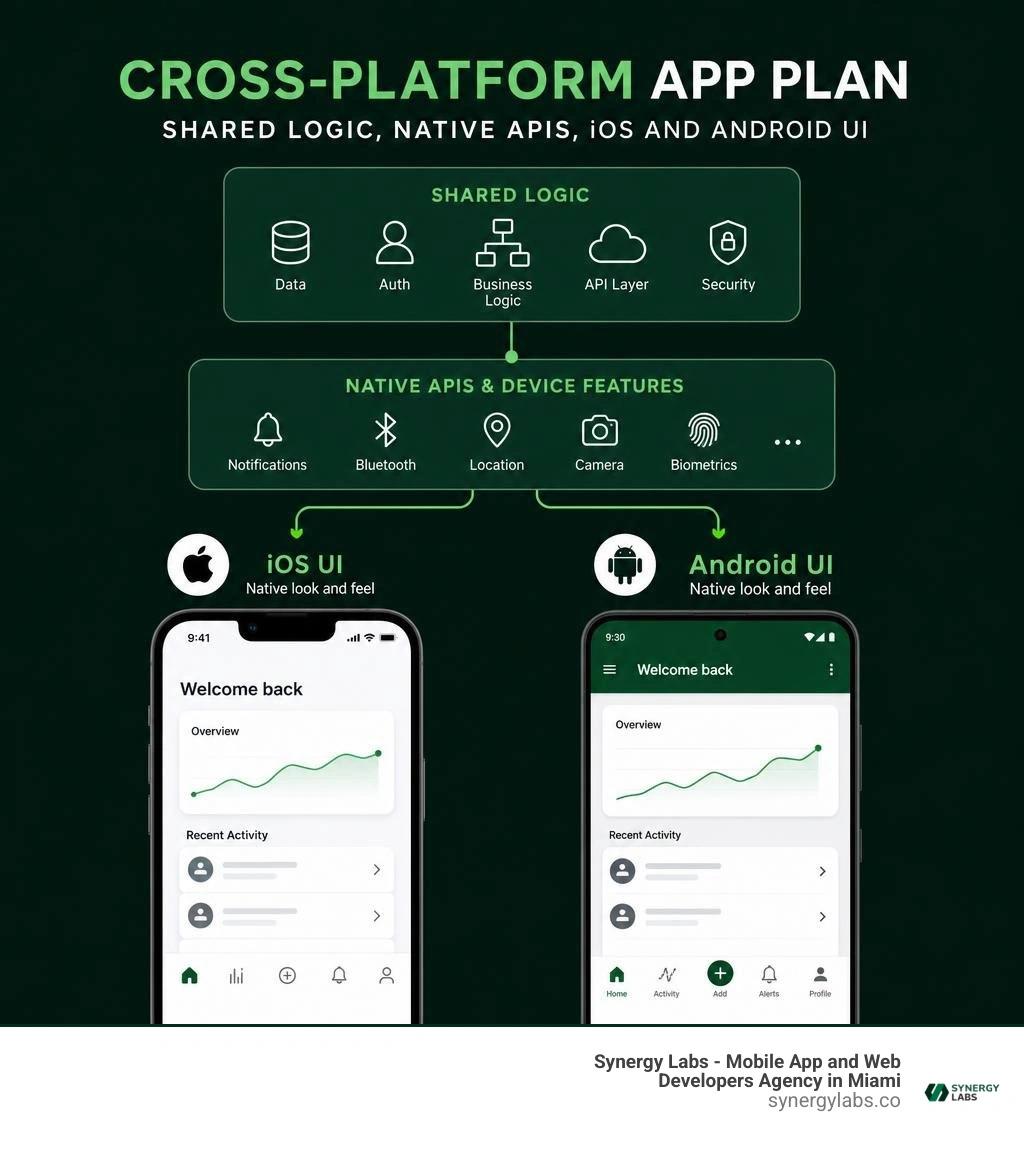
To develop iOS and Android cross platform, choose a framework that lets your team share the app's core logic, then keep room for platform-specific code where it matters. For most startups, the practical path is:
- Share business logic, data, authentication, and API layers.
- Choose a UI approach: one shared interface with Flutter or React Native, or native UIs with shared logic through Kotlin Multiplatform.
- Test on real iOS and Android devices early, especially payments, notifications, Bluetooth, permissions, and accessibility.
- Maintain native escape hatches for features that need direct platform APIs.
This approach can reduce duplicate work and help both app versions ship together. But "single codebase" does not mean "zero platform work." Apple and Google have different design patterns, device behavior, store rules, and hardware access. The best cross-platform plan shares what users never see and customizes what they do.
Flutter, React Native, Kotlin Multiplatform, and .NET MAUI each solve this problem differently. The right choice depends on your team's skills, performance needs, UI ambition, security requirements, budget, and long-term roadmap.
As Director of Product at Synergy Labs, I help founders turn those trade-offs into a build plan that moves quickly without creating expensive technical debt.
Basic develop ios android cross platform glossary:
Why Modern Teams Develop iOS Android Cross Platform
Building separate native applications for iOS and Android used to be the default standard for any software organization. You hired an iOS engineering team fluent in Swift and Xcode, an Android team specialized in Kotlin and Android Studio, and hoped their sprint velocities miraculously aligned. In reality, features were released weeks apart, edge-case bugs lived in separate trackers, and product managers spent half their lives translating business requirements between two distinct codebases.
Today, market demands leave little room for such fragmentation. Google Trends data shows that global interest in multiplatform tooling has climbed steadily from 2010 to 2026. Developers and founders are leaning into shared architectural patterns because unified codebases solve foundational operational headaches:
- Rapid Time-to-Market: Shipping features to both operating systems simultaneously eliminates platform favoritism, letting your product capture early market signals without delay.
- Drastic Cost Optimization: Maintaining a single primary codebase cuts redundant engineering overhead by 30% to 50%, preserving your capital for growth and product iteration.
- Architectural Parity: Bug fixes, data parsing algorithms, business rules, and API client updates happen in one place, avoiding behavioral discrepancies between platforms.
- Maximized Developer Velocity: Tooling features like Fast Refresh and Hot Reload enable near-instant feedback cycles, keeping engineering teams focused and productive.
If you are evaluating the commercial impact of this shift, there are 4 Key Benefits of Cross-Platform Development: Reaching Wider Audiences Efficiently that explain how streamlined engineering pipelines translate directly into competitive market dominance.
Native vs Cross-Platform Trade-Offs
While modern frameworks deliver near-flawless user experiences, engineering leaders must remain clear-eyed about the architectural trade-offs between compiled multiplatform engines and pure native binaries.
Deciding between a Hybrid App or Native App: Which One is Right for Your Business comes down to understanding where your application interacts with the underlying operating system. Pure native applications built exclusively in Swift or Kotlin boast direct, zero-overhead access to low-level APIs, platform SDKs, and custom graphics pipelines. They excel when you are building computation-heavy 3D engines, deep audio processing pipelines, or bespoke augmented reality experiences using ARKit and ARCore.
On the other hand, cross-platform frameworks introduce an abstraction layer. Historically, this meant an asynchronous bridge that could throttle performance during heavy data serialization. Modern frameworks eliminate these bottlenecks using direct machine code compilation or synchronous JavaScript interfaces. The real friction point today is platform-specific UX nuance: iOS users expect distinct swipe gestures, dynamic island interactions, and Cupertino-style modal sheets, whereas Android users lean heavily on predictive back gestures and Material Design ergonomics. When engineering cross-platform products, teams must budget time for these native refinements rather than assuming an identical pixel layout satisfies both user bases.
Core Frameworks to Build Dual-Platform Mobile Applications
The mobile engineering ecosystem has evolved beyond experimental web wrappers into high-performance SDKs backed by global tech leaders. Navigating these options requires understanding how each framework compiles UI elements, executes business logic, and communicates with native device services.

Whether you need pixel-perfect custom branding or native OS widgets, our comprehensive Cross-Platform App Development Guide 2026 offers strategic clarity on aligning business models with long-term ecosystem maintenance.
Strategic Frameworks to Develop iOS Android Cross Platform Solutions
The two dominant heavyweights in shared-UI mobile engineering remain Google's Flutter and Meta's React Native.
Flutter bypasses platform-native UI widgets entirely. Instead, it operates similarly to a high-performance game engine, drawing every button, text field, and animation directly onto an Skia or Impeller canvas using Google's Dart language. Flutter compiles directly into native ARM machine code, easily reaching 60 or 120 frames per second (FPS) on modern mobile hardware. It powers massive production products including Google Pay, Google Earth, Google Ads, Google Classroom, YouTube Create, and NotebookLM. With more than 174,000 stars on GitHub and over 1,600 active contributors, Flutter provides complete visual consistency across every screen size and operating system version.
React Native takes an alternative architectural approach. Released by Meta in 2015, the open-source repository react/react-native boasts over 126,000 stars and 25,000 forks. React Native enables web and mobile engineers to write declarative TypeScript or JavaScript code that binds directly to real native platform components (such as UIView on iOS and android.view.View on Android).
With the rollout of its modern architecture, React Native replaced the legacy asynchronous JSON bridge with Fabric and TurboModules. These systems leverage the JavaScript Interface (JSI) to allow direct, synchronous C++ communication with native platform APIs, dramatically reducing latency and eliminating stutter during high-speed gestures and complex animations. React Native powers enterprise-scale flagships like Microsoft Office, Skype, Xbox Game Pass, Facebook, and Instagram.
If you are torn between these two giants, our detailed breakdown on Flutter vs React Native: Which Framework is Right for Your 2026 Project dives deeper into rendering architectures, state management patterns, and developer ergonomics.
Kotlin Multiplatform and Modern Native Logic Sharing
For teams unwilling to surrender native UI performance or platform-specific design guidelines, Kotlin Multiplatform (KMP) has emerged as an exceptionally powerful solution. Developed by JetBrains, KMP achieved official production stability in late 2023. At Google I/O 2024, Google cemented KMP's industry standing by announcing official support for sharing business logic across Android and iOS using Kotlin.
Unlike Flutter or React Native, Kotlin Multiplatform does not force an all-or-nothing rewrite. Your engineers write core business logic, domain models, network clients (via Ktor), database caching (via SQLDelight), and state management once in Kotlin. This shared module compiles to standard Java bytecode for Android and an Objective-C/Swift framework for iOS.
On the UI presentation layer, developers can either:
- Build completely native, platform-specific user interfaces using Jetpack Compose for Android and SwiftUI for iOS.
- Share 100% of the UI using Compose Multiplatform, extending declarative UI definitions seamlessly across Android, iOS, desktop, and web.
This architectural flexibility has led top organizations like Duolingo, McDonald's, Netflix, Forbes, 9GAG, Cash App, and Philips to build their core mobile engines on KMP.
Enterprise Frameworks: .NET MAUI and Alternative Approaches
Enterprise environments with deep investments in Microsoft ecosystems, Azure backends, and C# codebases frequently look toward .NET MAUI (Multi-platform App UI). Officially released as the modern evolution of Xamarin.Forms, MAUI abstracts Android, iOS, macOS, and Windows into a single SDK-style multi-targeting project structure.
As outlined in Microsoft's documentation what-is-maui?view=net-maui-10.0, the framework compiles C# and XAML differently across target environments. On Android, C# compiles into Intermediate Language (IL) that is Just-In-Time (JIT) compiled at runtime. On iOS, MAUI enforces full Ahead-Of-Time (AOT) compilation directly into native ARM assembly code to comply with Apple App Store execution mandates. Desktop integration on macOS is handled elegantly through Mac Catalyst.
Alternative architectures also challenge traditional cross-platform conventions:
- Sublime UI: Emerging open-source toolkits like sublime-ui/sublime-ui reject the "render one UI everywhere" approach. Sublime UI enables developers to share TypeScript data models, state slices, and design tokens while writing platform-specific presentation layers (such as React Native Paper on mobile and Material UI on web) with compile-time checked routing.
- Progressive Web Apps (PWAs): PWAs run standard web applications (HTML5, CSS, JavaScript) inside responsive service-worker shells. While PWAs bypass app store review pipelines entirely, they face strict Apple restrictions on iOS, including limited background processing and lack of NFC sensor access.
- Apache Cordova / PhoneGap: Once the pioneering hybrid approach that wrapped web assets inside a mobile WebView, Cordova has largely fallen out of favor for modern production applications due to rendering performance constraints and declining community momentum.
Technical Comparison: Performance, UI, and Native APIs
Selecting the right framework requires balancing execution speed, rendering latency, memory footprints, and native platform integration.

When selecting the ideal Mobile App Development Software Cross-Platform, examine how these technical characteristics stack up:
- Flutter: Delivers near-native 60 to 120 FPS performance by utilizing direct GPU canvas rendering via Dart compilation. It provides complete UI customization independent of OS version changes, though it carries slightly larger initial app binary sizes.
- React Native: Delivers native performance via synchronous JSI bindings in its modern architecture. UI components look and feel completely authentic because they map directly to native platform controls.
- Kotlin Multiplatform: Offers pure native execution speeds with zero bridging overhead. It allows teams to incrementally adopt cross-platform code sharing without sacrificing native SwiftUI or Jetpack Compose interfaces.
- .NET MAUI: Delivers strong enterprise-grade performance through AOT compilation on iOS and Mono runtimes on Android, making it the ideal tool for unified mobile and desktop business suites.
- Progressive Web Apps (PWAs): Provides acceptable rendering for standard content and e-commerce platforms, but struggles with complex gesture physics, 60 FPS animations, and native hardware API access.
Step-by-Step Architecture to Develop iOS Android Cross Platform Products
A reliable cross-platform architecture isolates core business logic from volatile UI layers, ensuring stability as platform SDKs evolve.
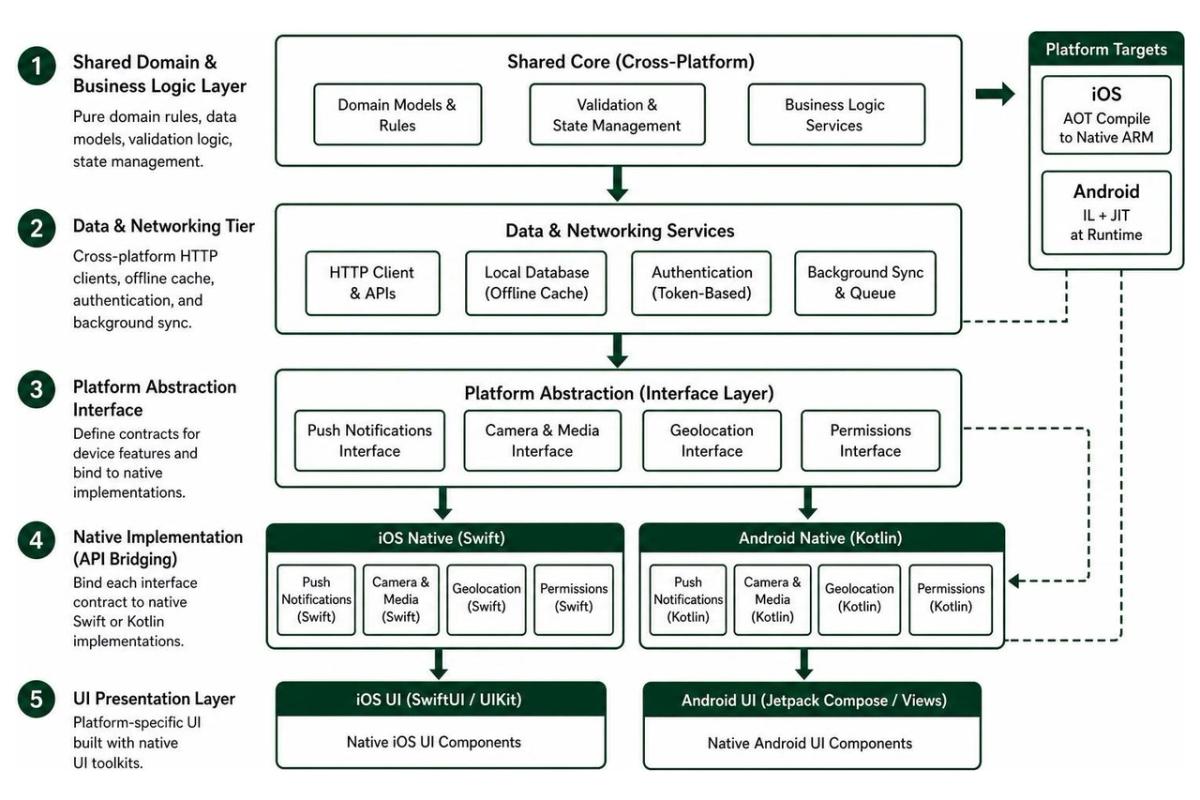
To build a modular, testable system, organize your application around these core tiers:
- Shared Domain and Business Logic Layer: Isolate pure domain rules, data models, validation logic, and state management machines. Keep this layer strictly decoupled from UI rendering toolkits.
- Data and Networking Tier: Implement cross-platform HTTP networking clients, offline-first local database caching, token-based authentication handling, and background synchronization pipelines.
- Platform Abstraction Interface (API Bridging): Define clear interface contracts for device-specific hardware features (such as push notifications, camera permissions, and geolocation), binding each contract to native Swift or Kotlin implementations.
- Declarative Presentation Tier: Construct reactive, state-driven UI components that automatically update when underlying data models change, ensuring consistent styling across varying device form factors.
- Continuous Integration and Deployment (CI/CD) Automation: Set up cloud build pipelines that automatically run unit tests, compile signed Android AABs and iOS IPAs, and deploy builds directly to Google Play Internal Testing and Apple TestFlight.
Native Hardware Integration and Security Standards
A high-performance mobile application is only as good as its underlying security posture and hardware stability. Connecting to low-level mobile components like Bluetooth Low Energy (BLE), Near Field Communication (NFC), biometric authenticators (Face ID, Touch ID, BiometricPrompt), and background geofencing requires careful handling of platform permissions.
Security should never be an afterthought. Cross-platform engineering teams must align their architectures with the OWASP Mobile Top 10 vulnerabilities:
- Secure Data Storage: Sensitive data, tokens, and cryptographic keys must be stored using platform-native hardware keychains (iOS Keychain and Android EncryptedSharedPreferences / Keystore) rather than unencrypted local storage.
- Flawless Network Security: Enforce SSL/TLS public key pinning on all mobile network requests to eliminate man-in-the-middle (MITM) vulnerabilities.
- Proper Permission Scoping: Request device permissions contextually during active user flows rather than bombarding users with access requests on initial launch.
- Runtime Integrity: Implement jailbreak and root detection mechanisms to protect intellectual property and enterprise data pipelines on compromised devices.
Decision Framework: Choosing the Right Stack for Your Project
Selecting the ideal technology stack requires evaluating your team's existing skill sets, target delivery timelines, product complexity, and architectural scale.
Here is a practical decision framework:
- Choose Flutter if: You need rapid time-to-market, complex custom brand animations, high frame-rate rendering, or pixel-perfect visual consistency across mobile, desktop, and embedded systems from a unified Dart codebase.
- Choose React Native if: Your engineering team possesses deep JavaScript or TypeScript experience, your product depends heavily on platform-native UI widgets, or you plan to share code across web and mobile web surfaces using Expo.
- Choose Kotlin Multiplatform if: You already have an established native Android app in Kotlin, want to share complex business and networking logic with iOS, and refuse to compromise on native SwiftUI and Jetpack Compose user interfaces.
- Choose .NET MAUI if: Your organization operates extensively within the C#, .NET, and Microsoft Azure ecosystems and requires multi-targeting support across Android, iOS, Windows, and macOS desktop environments.
- Choose PWAs if: You are launching a lightweight, content-heavy minimum viable product where SEO indexing and instant URL accessibility outweigh native hardware features and app store distribution.
Frequently Asked Questions About Cross-Platform Development
Can you develop for both Android and iOS from a single codebase?
Yes. Modern cross-platform frameworks allow engineering teams to write between 70% and 95% of their application code once and compile it for both Apple iOS and Google Android. While non-UI logic (such as network requests, authentication flows, data storage, and business rules) can be completely shared, teams still need to configure platform-specific settings like App Store permissions, push notification entitlement certificates, and adaptive layout adjustments.
How do Flutter and React Native handle native platform features?
Both frameworks bridge the gap to native platform APIs through modular integration layers. Flutter uses Platform Channels, which send binary messages between Dart and host platform languages (Swift/Objective-C on iOS, Kotlin/Java on Android). React Native uses Native Modules and its modern JSI-based TurboModules architecture, allowing JavaScript to make direct, synchronous, type-safe C++ calls into underlying native device SDKs without serialization bottlenecks.
What is the most cost-effective cross-platform approach for startups?
For early-stage startups racing to validate product-market fit, building with Flutter or React Native offers the highest return on investment. Both frameworks provide extensive open-source package ecosystems, built-in layout engines, and Fast Refresh tooling that accelerates initial prototype delivery while cutting initial development and maintenance costs in half compared to building dual native apps.
Transform Your Mobile Strategy with Synergy Labs
Building exceptional mobile software across iOS and Android should not require doubling your engineering payroll or compromising on design and performance. Modern multiplatform architectures give ambitious startups and enterprise organizations the speed, reliability, and polish needed to dominate competitive app marketplaces.
At Synergy Labs, we specialize in delivering enterprise-grade, high-performance Cross-Platform App Solutions tailored to your operational goals. As a premier software agency with locations in Miami FL, New York City NY, San Francisco CA, Austin TX, Chicago IL, Phoenix AZ, Hartford CT, London UK, Dubai UAE, Doha Qatar, and Riyadh Saudi Arabia, we eliminate development friction through a proven delivery model:
- Direct Senior Access & In-Shore CTO Leadership: You collaborate directly with top-tier technical leadership and an elite engineering team, ensuring strategic architecture and zero communication gaps.
- Transparent Fixed-Budget Delivery: No surprise invoices or scope creep. We scope deliverables clearly so you launch on budget.
- Milestone-Based Payments: We align incentives directly with your product roadmap—you only release payments as verifiable development milestones are completed and approved.
- Rapid App Launches with Enterprise Security: From OWASP-compliant security architectures to buttery-smooth 120 FPS user interfaces, we get your cross-platform product to the App Store and Google Play quickly and securely.
Ready to stop writing everything twice and build a scalable, future-proof cross-platform mobile application? Connect with our team at Synergy Labs today to schedule your architectural consultation and turn your mobile vision into a market-leading reality.