The fashion industry runs on information asymmetry — here's what the best denim brands hope you never figure out.
When Clever Marketing Goes Too Far

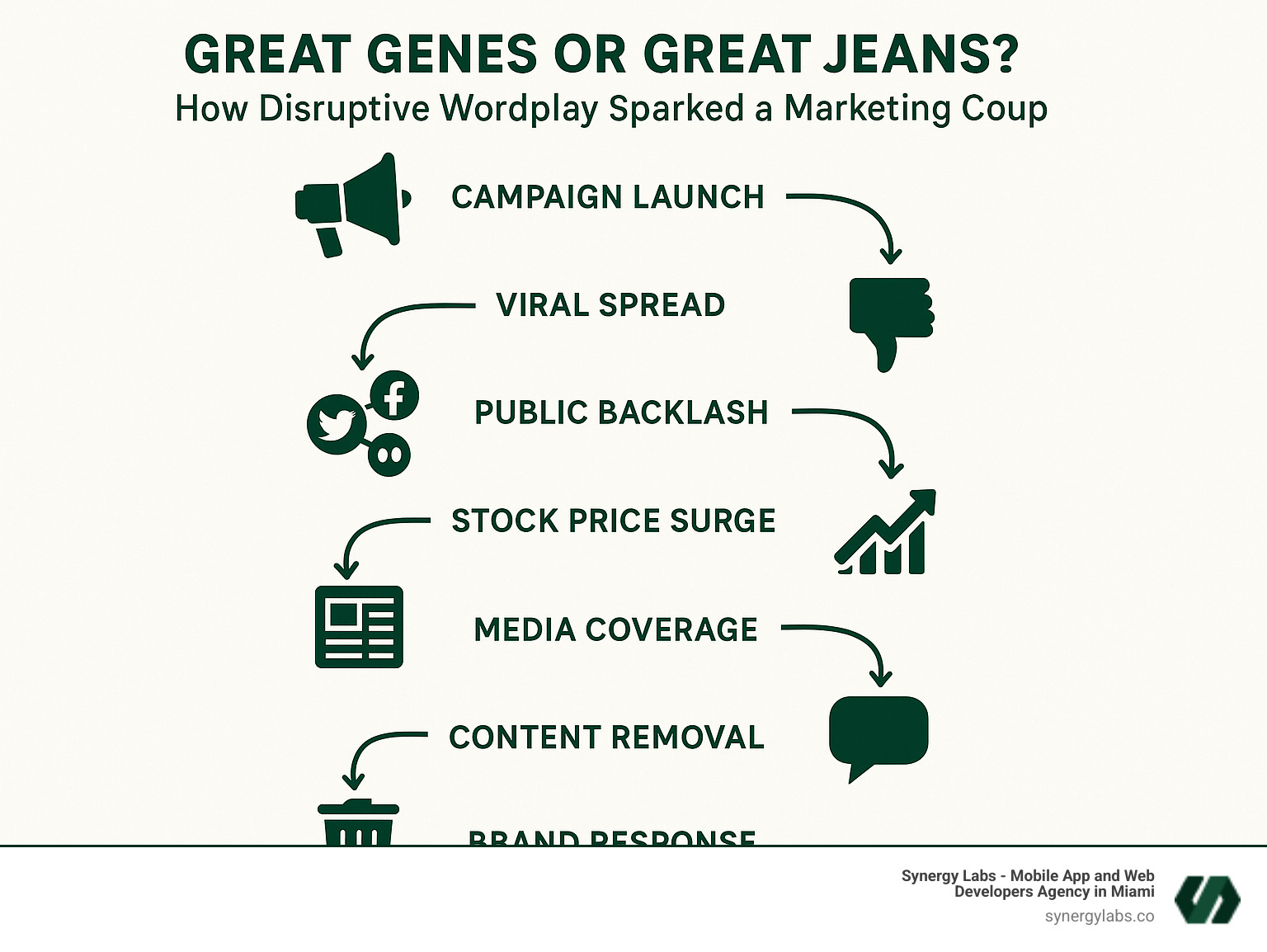
Great Genes or Great Jeans? How Disruptive Wordplay Sparked a Marketing Coup - that's exactly what happened when American Eagle Outfitters launched their Sydney Sweeney campaign in 2024. What started as a simple denim ad became one of the year's most controversial marketing moments.
Quick Summary of the Campaign:
- The Wordplay: "Great genes" vs "Great jeans" - a deliberate pun using homophones
- The Celebrity: Sydney Sweeney, known for her roles in hit TV shows
- The Controversy: Critics accused the campaign of promoting eugenics and white supremacy
- The Result: Stock price jumped 18%, massive media coverage, but significant brand backlash
- The Aftermath: American Eagle quietly removed content while defending their intent
American Eagle's chief marketing officer told trade media the campaign was "definitely going to push buttons" - and it delivered exactly that. The retailer, facing declining sales and a $68 million operating loss, bet big on controversy to cut through the noise.
The campaign worked as intended: it generated millions in free press coverage and sent shares soaring. But it also sparked accusations of coded messaging around genetic superiority and alienated key demographics.
Critics weren't just upset about the wordplay itself. They pointed to the deeper implications of celebrating a conventionally attractive white woman's "genes" in today's political climate. The timing couldn't have been worse, landing during heated debates about diversity and inclusion in advertising.
As the founder of Synergy Labs, I've analyzed dozens of viral marketing campaigns and helped clients steer the complex world of digital engagement. Understanding how Great Genes or Great Jeans? How Disruptive Wordplay Sparked a Marketing Coup reveals crucial lessons about the risks and rewards of provocative messaging in today's hyper-connected world. We've seen how the wrong message can derail even the most well-funded campaigns.
1. The "Disruptive" Strategy Was a Calculated Risk
When American Eagle launched its campaign featuring Sydney Sweeney, it wasn't a shot in the dark. It was a highly calculated move, a desperate bid for attention in a tough retail landscape. The teen retailer, like many others, was struggling with sluggish consumer spending and higher costs. In the February-April quarter leading up to the campaign, American Eagle reported that total sales were down 5% compared to the previous year, and the company faced a $68 million operating loss in Q1. This wasn't just about selling jeans; it was about reversing a downward financial trend.
The company's chief marketing officer openly stated that the ad blitz included "clever, even provocative language" and was "definitely going to push buttons." This wasn't an accident; it was a deliberate strategy to generate buzz and cut through the noise. Leveraging Sydney Sweeney's status as a "current Hollywood darling" was a central part of this. Her widespread popularity and prior experience with other provocative campaigns made her a seemingly safe bet for creating a viral moment. The goal was clear: get people talking, even if the conversation wasn't entirely positive.
The Initial Concept: More Than Just Denim
On its surface, the initial marketing concept for American Eagle's denim campaign seemed straightforward enough. It was centered around "The Sydney Jean," a new line of denim featuring the popular actor. The campaign aimed to be breezy, a nod to both denim fashion and Sweeney's unique style.
Beyond just selling jeans, American Eagle also announced a charitable component: all proceeds from "The Sydney Jean" would be donated to Crisis Text Line, a 24/7 mental health support charity. The jeans themselves even featured a butterfly motif, intended for domestic violence awareness. This layered approach suggested a campaign designed to appeal to a socially conscious audience.
However, beneath this seemingly innocuous facade, the core of the campaign was a high-stakes bet. It was a multi-million-dollar play to reverse declining sales and capture market share. The company needed a splash, something that would resonate widely and quickly.
Why the "Genes/Jeans" Wordplay Was Chosen
The real disruptive element, and the one that ultimately fueled the controversy, was the chosen wordplay: "genes" versus "jeans." This homophone was the central mechanism intended to spark conversation and engagement. In one ad, Sweeney states, "Genes are passed down from parents to offspring, often determining traits like hair color, personality, and even eye color. My jeans are blue." The tagline prominently displayed was "Sydney Sweeney has great jeans."
This ambiguity was designed to be memorable and shareable, especially on social media platforms. It's a classic tactic in viral marketing, where a clever pun or dual meaning can create an immediate hook, prompting viewers to pause, interpret, and then share their interpretation. The goal was to make people think, question, and engage with the ad, turning passive viewing into active participation. This kind of wordplay, while seemingly simple, can be incredibly effective at creating buzz and making a campaign stick in people's minds. It’s about leveraging the power of language to create a conversation, much like we've seen with other campaigns that become viral sensations. For more on how such strategies work, you can explore why everyone is Googling if you can eat soap: a lesson in viral marketing.
2. The Wordplay's Darker Interpretations Weren't So Hidden
While American Eagle might have intended the "genes/jeans" wordplay to be a clever, lighthearted pun, a significant segment of the public interpreted it as something far more sinister. The controversy erupted because the seemingly innocuous joke, combined with the image of Sydney Sweeney, tapped into deeply unsettling historical and societal connotations.

Critics quickly pointed out that celebrating "great genes" alongside a stereotypically blonde-haired, blue-eyed, slender, and conventionally attractive white celebrity, carried disturbing echoes of eugenics and white supremacy. The phrase "great genes" itself, while often used colloquially as a compliment, has sinister connotations rooted in the pseudoscientific movement of eugenics.
The "Great Genes" Subtext and Its Historical Connotations
The "great genes" subtext wasn't an unintended consequence for many; it was seen as a deliberate "dog whistle." A dog whistle is a coded message that appears innocent to the general public but carries a specific, often controversial, meaning to a targeted audience. In this case, the word "great" itself was seen as loaded, drawing parallels to a prominent political slogan that has been associated with white supremacist views.
Eugenics, as a pseudoscientific movement, is built on the belief that a "self-appointed group that perceives itself as superior can 'improve' a human population through selective breeding or actions taken against individuals judged to be inferior." Historically, American eugenics programs profoundly influenced Nazi Germany's racial policies. The concept of "great genes" inherently implies a standard of genetic superiority, and when paired with a specific physical ideal, it can easily be interpreted as promoting a narrow and exclusionary vision of human worth. You can learn more about the history of eugenics in America to understand the weight of these accusations.
This interpretation wasn't simply "pearl clutching" or "absurd," as some defenders of the campaign claimed. It stemmed from a critical analysis of the ad's text, subtext, and context. The subtext hinted at the desirability of a certain physical type, and the broader context of current political and social debates around race and beauty standards amplified these concerns. As one critic noted, "It doesn’t matter what your intent was — what matters is the impact. intent ≠ impact."
A Failure of Internal Vetting?
The intensity of the backlash led many to question the internal processes at American Eagle. Given the scale of the campaign and its reported multi-million-dollar cost, numerous people across various departments would have had to approve it. This raised a crucial question: was there a lack of diversity among the decision-makers at American Eagle?
Critics argued that the controversy indicated a significant blind spot, suggesting that if more diverse voices had been "in the room," these potential negative interpretations might have been caught. "It’s so clear that they didn’t have anybody in the room that poked and prodded at this ad," one marketing expert stated. This kind of "groupthink" can lead to campaigns that are culturally insensitive or carry unintended harmful messages.
This situation underscores the critical importance of diversity in marketing teams and the need for rigorous vetting processes that consider all possible interpretations of messaging. It's not just about avoiding controversy; it's about building campaigns that truly resonate with a broad and diverse audience, ensuring that the user experience is positive and inclusive from the outset. This principle is something we deeply understand at Synergy Labs, where we emphasize the importance of UX in app design to ensure our solutions are universally appealing and free from unintended biases.
3. Great Genes or Great Jeans? How Disruptive Wordplay Sparked a Marketing Coup
Despite the intense criticism and accusations of promoting harmful ideologies, the American Eagle campaign, in a strange twist of modern marketing, achieved its primary business objectives in the short term. The controversy, far from sinking the brand, actually propelled it into the spotlight, demonstrating how "outrage" can, paradoxically, become a powerful growth channel in today's attention economy. This is why it became a case study in Great Genes or Great Jeans? How Disruptive Wordplay Sparked a Marketing Coup.

Outrage as a Growth Channel
The most immediate and striking "coup" of the campaign was its financial impact. The internet spiraled into debate, think pieces were published, and people argued passionately online. And it worked. The company’s stock price soared. American Eagle's brand value was up by as much as 18% in the week since the campaign launched. The stock closed more than 4% up the day after Sweeney's collaboration was announced, and at one point, its stock price jumped approximately 4%. This meteoric rise, even if temporary, earned it "meme stock" status, indicating that its valuation was influenced more by viral attention than traditional financial metrics.
This phenomenon highlights a chilling reality of modern marketing: in a landscape saturated with content, any attention can be good attention. The ensuing outrage generated millions of dollars in free press and made American Eagle a trending topic globally. For a brand struggling with declining sales, this surge in visibility was invaluable, regardless of the nature of the conversation. Some marketing experts even argue that playing it safe leads to failure, implying that provocative campaigns, even those courting controversy, are necessary for success in a crowded market.
How the Ambiguity Fueled the Fire
The dual meaning inherent in the "genes/jeans" wordplay was the key element that forced people to discuss, argue, and share the campaign, amplifying its reach exponentially. The ambiguity was a deliberate hook. Was it just a harmless pun? Or was it something more insidious? This very question fueled countless online debates, articles, and social media posts.
The campaign became a Rorschach test for cultural interpretations, with different groups seeing radically different things. This forced engagement created a massive amount of user-generated content and organic reach that money simply cannot buy. Whether people were defending it, condemning it, or just trying to understand it, they were talking about American Eagle. This kind of disruptive innovation, while risky, can generate unparalleled buzz. For more insights into how such disruptive strategies can reshape markets, explore our article on spite-driven innovation: how frustration fuels market disruption. The campaign became a prime example of how ambiguity can be a powerful, albeit controversial, tool in marketing, turning a simple ad into a cultural flashpoint that captured global attention and significantly boosted the brand's short-term market performance.
4. The Target Audience Was More Divided Than You'd Think
While the campaign certainly generated immense buzz and a stock price surge, its reception among its core target audience — Gen Z and teen consumers — was far more divided than American Eagle might have anticipated. The brand found itself navigating a complex landscape of shifting consumer values, where the pursuit of virality sometimes clashed with expectations of authenticity and inclusivity.

For a segment of the target audience, particularly those who are more progressive and socially aware, the campaign's perceived message of genetic superiority and its association with traditional beauty standards felt alienating. While some may have seen a harmless joke, many younger consumers felt that the messaging was a step backward, away from the diverse representation they expect and demand from brands. "How was a teenage customer who looks nothing like Sweeney supposed to feel after seeing this ad?" asked one critic, highlighting the disconnect.
A Clash with Brand Values
The controversy was particularly jarring because it stood in stark contrast to the well-established brand values of the company's own sister brand. That brand has successfully built its reputation on a foundation of body positivity, inclusivity, and diverse representation, actively featuring models of all shapes, sizes, and ethnicities in its campaigns. This commitment has earned it a loyal following among consumers who value authenticity and self-acceptance.
The "great genes" messaging of the main American Eagle campaign, whether intended or not, created a perception of exclusivity and a narrow definition of beauty. This directly contradicted the sister brand's ethos, leading to brand dissonance. Some people online even called on other major denim brands to respond with more inclusive campaigns or highlighted past "jeans/genes" content from other retailers, implicitly asking other brands to step up and offer more inclusive messaging. This internal conflict between the brands within the same company highlighted a significant oversight in the campaign's overall strategy.
How the "Great Genes or Great Jeans? How Disruptive Wordplay Sparked a Marketing Coup" Resonated Negatively
The campaign’s perceived exclusivity resonated negatively with a significant portion of its target audience. In an era where consumers, especially Gen Z, prioritize authenticity, diversity, and social responsibility, a campaign that could be interpreted as promoting a narrow, traditional beauty ideal, or worse, eugenicist undertones, was bound to face backlash.
The campaign was seen by many as a step backward, away from the diverse representation that modern consumers expect and demand from brands. It alienated consumers who felt that the ad implied that those who didn't fit a specific "perfect blonde, white skin, blue eyes, snatched-waist prototype" did not have "good genes." This created a sense of exclusion and made the brand seem out of touch with the evolving values of its demographic. The backlash demonstrated that even if a campaign achieves short-term financial gains, alienating a core audience can have severe long-term consequences for brand loyalty and perception. Understanding how different messages impact consumer behavior is crucial, and it’s something we deeply integrate into our development processes, including through integrating behavioral science into app development.
5. The Aftermath Revealed Critical Lessons for All Brands
The saga of American Eagle's "Great Genes" campaign offers a compelling, albeit controversial, case study for modern marketing. It starkly illustrates the fine line between disruptive innovation and catastrophic miscalculation, providing invaluable lessons for any company planning to make a splash in today's hypersensitive digital landscape.
| Metric | Short-Term Wins (Initial) | Potential Long-Term Losses (Ongoing) |
|---|
| Stock Price | Soared (up to 18% increase initially), "meme stock" status | Volatility, potential decline as controversy fades, investor skepticism |
| Media Buzz | Millions in free press, global trending topic, widespread discussion | Negative brand associations, persistent criticism, tarnished reputation |
| Social Engagement | High virality, massive shares, comments, and debates | Alienated core audience, erosion of loyalty, diminished trust |
| Brand Perception | Seen as edgy, provocative, attention-grabbing | Perceived as insensitive, tone-deaf, exclusive, out of touch |
| Sales Impact | Unclear, but buzz could translate to initial interest | Risk of boycotts, consumer shift to competitors, long-term sales decline |
The Brand's Tepid Response
American Eagle's handling of the backlash became a lesson in crisis management, or rather, what not to do. Initially, the brand doubled down, releasing a statement that the campaign "is and was always about the jeans" and that "great jeans look good on everyone." This response was widely criticized for failing to acknowledge the public's concerns. As one commenter put it, "Didn’t think the response could be even worse than the ad but it somehow was."
Following this initial defense, American Eagle quietly began to remove some of the most controversial content, including the "My jeans are blue" video and another that zoomed in on Sweeney's chest, from its official channels. This silent retraction, without a clear apology or explanation, was perceived by many as a failure to take accountability. It demonstrated a lack of transparency and an unwillingness to directly address the unintended impact of their messaging. This tepid, inconsistent response only fueled further criticism, highlighting how a brand's reaction to controversy can be as damaging as the initial misstep.
Key Takeaways for Modern Marketers
The "Great Genes or Great Jeans" saga underscores several critical lessons for brands navigating the complexities of modern marketing:
- Vet wordplay for all possible interpretations: What seems like a clever pun can carry unintended, deeply offensive subtexts. Marketers must consider the text, subtext, and context of their messaging.
- Ensure diverse voices are in the approval room: A lack of diversity in decision-making teams can lead to significant blind spots and cultural insensitivity. Different perspectives are crucial for identifying potential missteps.
- Understand that intent does not equal impact: A brand's intention behind a campaign may be benign, but the public's interpretation and the actual impact of the message are what truly matter.
- Short-term buzz can lead to long-term brand damage: While controversy might generate immediate attention and even a stock price bump, alienating core audiences and tarnishing brand reputation can have lasting negative consequences.
- Align all campaigns with core brand values: Campaigns must be consistent with a brand's broader identity and values, especially if it operates a sub-brand built on different principles. Dissonance creates confusion and distrust.
The American Eagle campaign serves as a powerful reminder that in today's hyper-connected, socially conscious world, marketing is about more than just grabbing attention. It's about building meaningful connections, fostering trust, and demonstrating a deep understanding of the audience and the cultural landscape.
Frequently Asked Questions about the "Great Jeans" Campaign
What was the specific wordplay in the American Eagle ad?
The campaign centered on the homophones "genes" and "jeans." Ads featured the tagline "Sydney Sweeney has great jeans," while videos included her discussing genetics ("Genes are passed down from parents to offspring, often determining traits like hair color, personality, and even eye color...") before pivoting to her denim ("...my jeans are blue"), creating a deliberate and controversial ambiguity.
Did the campaign actually succeed?
From a short-term financial and visibility perspective, yes. The controversy led to a massive spike in media attention and a significant, albeit temporary, rise in American Eagle's stock price soared. However, the long-term impact on brand perception and customer loyalty is considered by many experts to be negative. While it generated buzz, it also prompted questions about the brand's sensitivity and values.
Why was the "Great Genes or Great Jeans? How Disruptive Wordplay Sparked a Marketing Coup" so controversial?
The controversy stemmed from critics interpreting the "great genes" subtext as a "dog whistle" for eugenics and white supremacist ideals. By highlighting a conventionally attractive white celebrity's "genes," the campaign was accused of promoting a narrow and exclusionary standard of beauty with a historically sinister undertone. The word "great" itself was linked to political "dog whistles," amplifying the negative interpretations and sparking accusations of messages akin to Nazi propaganda.
Conclusion: The Fine Line Between Disruption and Destruction
The American Eagle "Great Jeans" saga is a powerful case study in the high-risk, high-reward nature of modern viral marketing. It proves that while a clever pun can capture the world's attention, it can also ignite a firestorm if it lacks cultural awareness and sensitivity. The line between a marketing coup and a brand disaster is thinner than ever.
Navigating this complex landscape requires more than just a good idea; it demands a deep understanding of audience, context, and technology. For businesses looking to make an impact without causing an incident, partnering with an expert team is crucial. Synergy Labs specializes in crafting strategies that resonate positively, ensuring your message builds your brand, not burns it. We pride ourselves on our personalized service and direct access to senior talent, ensuring that every project we undertake is built with user-centered design and robust security in mind, leading to successful and impactful mobile apps. Explore our portfolio of successful projects and see how we help brands achieve their goals responsibly.


.avif)

.avif)


