Find the Right App for Apartment Maintenance

The best app for apartment maintenance gives tenants one simple way to report issues, gives managers a live work-order view, and gives technicians mobile tools to complete and document repairs. Start by choosing a tool with:
- Tenant requests with photos, location, and priority
- Automatic or skill-based work-order assignment
- Real-time status updates and push notifications
- Mobile access for technicians, including offline support
- Preventive maintenance schedules, cost tracking, and reports
- Role-based permissions and secure data handling
A dedicated app replaces lost calls, scattered texts, and spreadsheet detective work with one shared record. A resident can submit a photo of a leaking faucet, a manager can route it to the right technician, and everyone can see progress without asking, "Any update?"
For small properties, free plans can be a practical starting point if they support core ticketing and a modest number of units. Larger portfolios usually need paid or enterprise tools for integrations, multi-property dashboards, compliance records, vendor controls, and stronger reporting.
I am the Director of Product at Synergy Labs, and in this guide, I will help you compare the options and identify the features worth prioritizing before you build or adopt a solution.
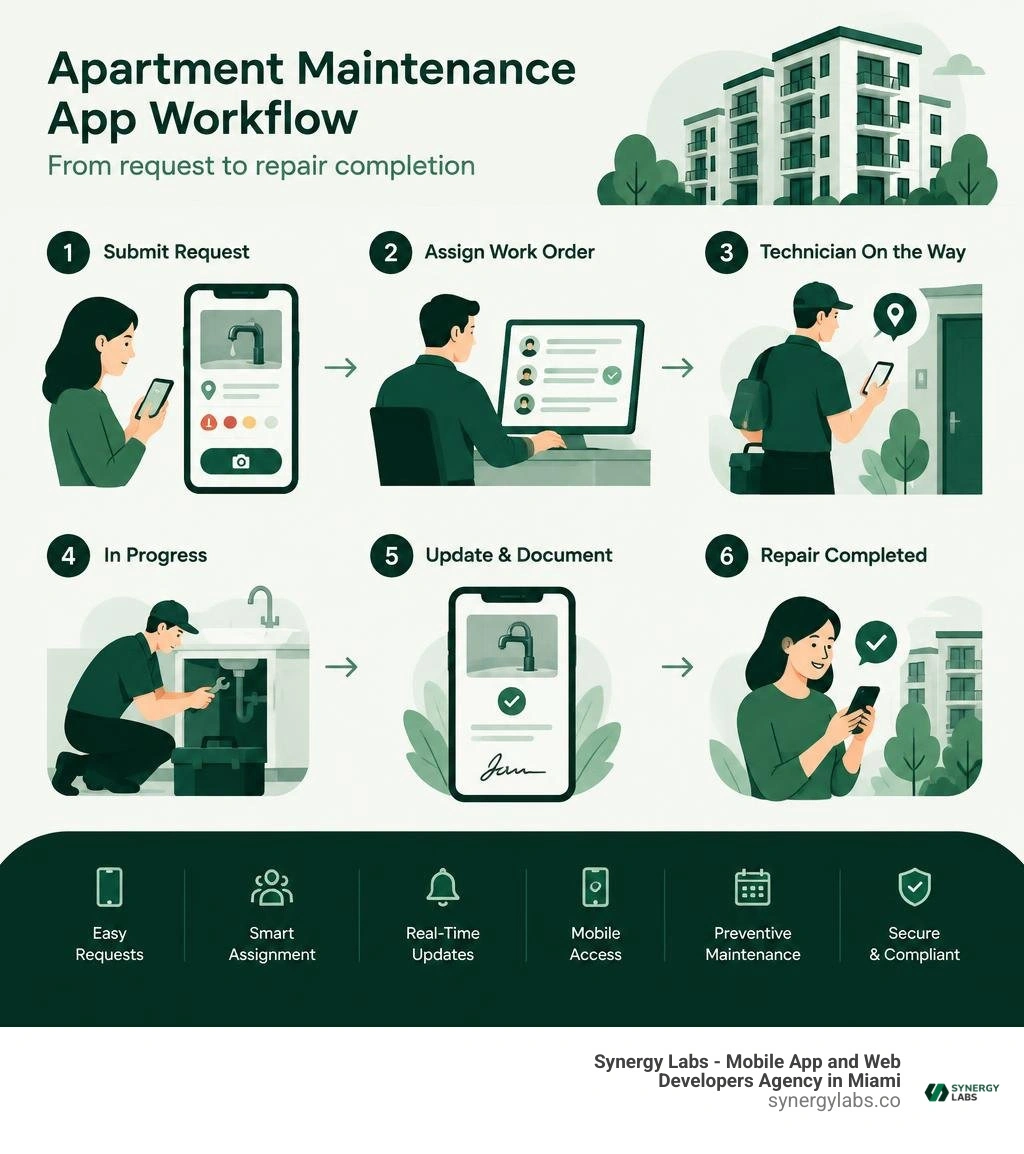
Know your app for apartment maintenance terms:
Key Features to Look for in an App for Apartment Maintenance
Selecting the right digital platform requires looking past flashy interfaces and focusing on the tools that keep physical assets operating smoothly. When managing multifamily residential communities, operational friction translates directly into resident turnover and ballooning overhead. A modern maintenance application should act as a central nervous system for your entire operations team, coordinating daily tasks without constant manual oversight.
Essential capabilities include automated dispatching rules, customizable digital inspection checklists, offline access for field personnel, synchronized calendar schedules, and strict compliance logging. When selecting specialized staffing or evaluating service workflows, property leaders often coordinate with an Austin apartment maintenance staffing agency to align field capabilities with digital platforms.
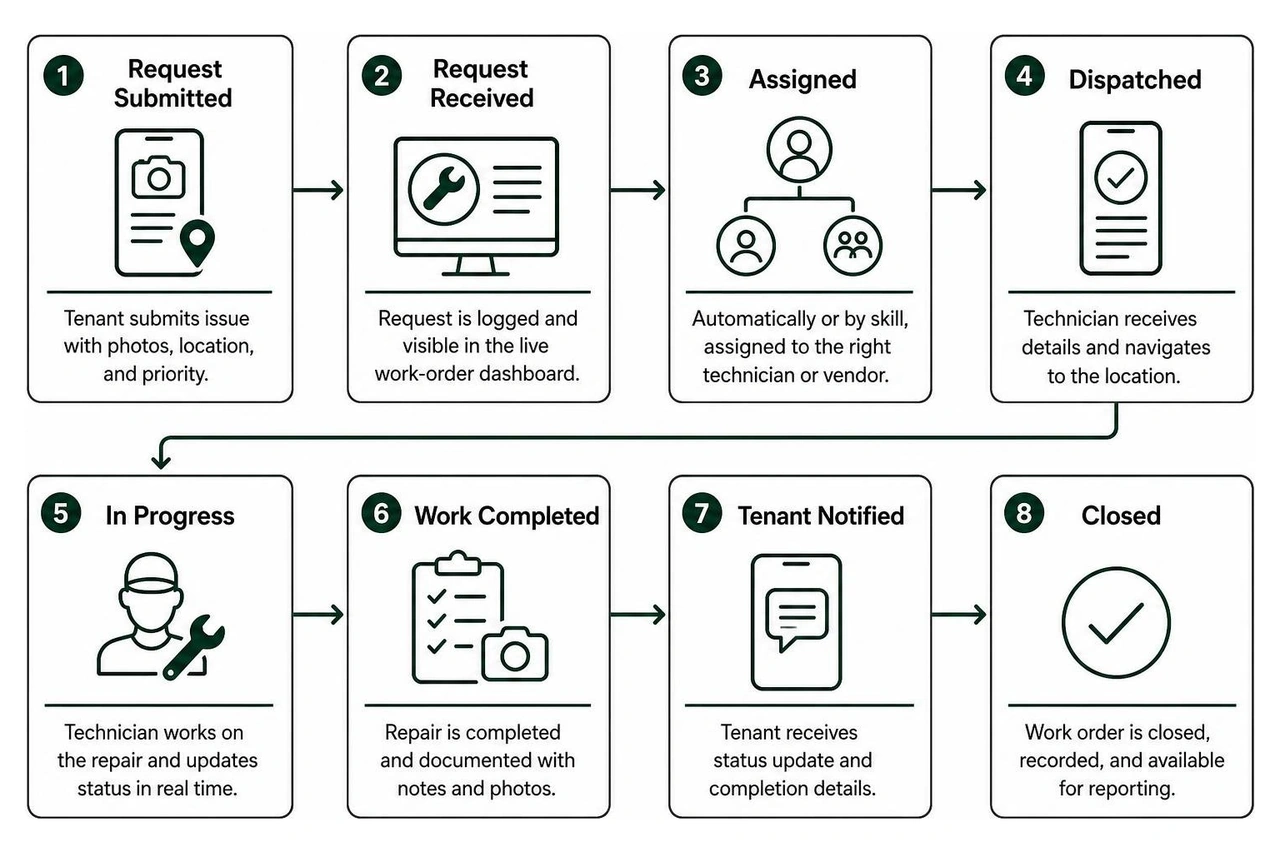
Modern maintenance platforms must support clear digital workflows to keep operations organized.
Streamlining Work Orders with an App for Apartment Maintenance
The foundation of any property management system is its ticketing engine. Traditional workflows relying on sticky notes, text messages, or shared inbox folders introduce errors, delay responses, and leave staff guessing about current task statuses. A purpose-built maintenance app automates this entire pipeline by converting tenant submissions directly into actionable digital work orders.
When a resident submits a repair request, intelligent routing evaluates the category, location, and severity to assign the ticket to the right internal technician or external vendor. Maintenance supervisors can establish service-level agreement (SLA) timers that monitor progress and trigger automated notifications if a high-priority repair sits unaddressed for too long. For organizations looking to adapt unique workflows to their operational needs, investing in custom mobile software development ensures the final application matches on-site team structures perfectly rather than forcing teams into rigid, off-the-shelf templates.
Photo Uploads and Remote Issue Diagnosis
One of the largest bottlenecks in residential repairs is the "double visit"—a technician arrives at an apartment to diagnose a problem, discovers they lack the proper replacement part, leaves to fetch inventory, and returns hours later. Enabling tenants to attach clear photos, video clips, and markup annotations transforms this broken process.
With visual proof attached to the initial work order, technicians can diagnose the root issue before leaving the workshop. Annotations allow tenants to highlight exact leak origins or electrical anomalies, improving first-time fix rates significantly. Reducing unnecessary diagnostic truck rolls shortens the maintenance backlog, controls labor expenses, and cuts callback frequencies across residential properties.
Preventive Maintenance and Compliance Tracking
While reactive repairs command daily attention, long-term asset preservation hinges on disciplined preventive maintenance. Waiting for an HVAC compressor or commercial water heater to fail results in costly replacements and frustrated residents.
A comprehensive maintenance application automates recurring calendar schedules for critical mechanical checkups, safety equipment inspections, and seasonal property readiness. Routine tasks—such as replacing HVAC air filters, testing smoke detectors, checking boiler pressures, and inspecting roof drainage—can be scheduled automatically based on calendar intervals or usage thresholds. When routine servicing is logged through digital forms with mandatory time stamps and photo verification, properties build an auditable paper trail. These digital compliance records safeguard owners during municipal inspections, insurance reviews, and lender due diligence audits.
Free vs Paid vs Enterprise Building Maintenance Solutions
Understanding how software pricing models align with operational scale is vital for choosing an effective solution. Many property managers start with entry-level tools to digitize paper workflows, only to find restrictive feature caps as their unit count expands.
The market generally divides into three distinct tiers:
- Free and Community Tiers: Typically designed for self-managed associations or small landlords managing under 10 to 20 units. These solutions offer bare-bones ticketing and basic messaging but usually limit user seats, restrict file storage, exclude automated reporting, and omit advanced access controls.
- Paid Professional Platforms: Tailored for mid-sized operators and growing property management firms. These tools offer flat-rate or per-unit monthly subscriptions, providing automated dispatch rules, custom inspection forms, vendor management portals, parts inventory tracking, and direct tenant communication channels.
- Enterprise Property Suites: Geared toward large multifamily operators and institutional asset managers handling thousands of units. While legacy enterprise software often demands setup fees exceeding $4,000 alongside monthly base charges of $400 or more plus $1.50 to $4.00 per unit, newer cloud-native alternatives streamline these costs while offering open API integrations, multi-entity accounting synchronizations, and portfolio-wide asset health dashboards.
Choosing the Right Free vs Paid App for Apartment Maintenance
Deciding between a complimentary tier and a paid subscription depends heavily on operational risk tolerance and reporting needs. Free software frequently imposes hidden productivity penalties: limited administrative seats force team members to share logins, compromising security, while lack of data export functionality can leave property records locked inside a proprietary system.
Paid applications eliminate these limitations by delivering dedicated role-based permission controls, robust automated billing features, and deep cost analytics. If a paid platform saves your on-site team just two hours of administrative overhead per week, the return on investment quickly surpasses the monthly software expense.
Scalability for Small Societies vs Multifamily Portfolios
The operational footprint of a 20-unit residential society is fundamentally different from a 500-unit multifamily portfolio. Small communities primarily require transparent recordkeeping, simple complaint tracking, and shared notices to keep volunteer board members aligned.
Conversely, enterprise portfolios demand multi-property aggregation. Regional maintenance directors require high-level visibility across dozens of apartment buildings, needing real-time dashboards that surface portfolio health metrics, track regional SLA compliance, and compare technician performance across properties. Scalable systems allow leadership to spot systemic equipment failures across multiple sites, such as identifying a bad batch of water heaters installed across several properties.
Operational and Field Team Benefits of Mobile Maintenance
The true measure of any maintenance software is whether on-site technicians actively use it. If an application is overly complex or poorly designed for mobile devices, field teams will bypass the system, leaving management blind to daily progress. Modern enterprise mobility solutions prioritize simple, technician-focused user interfaces that empower workers directly in the field. Public housing systems demonstrate this need for reliable digital reporting channels; for instance, programs like About MyNYCHA - NYCHA show how centralized resident portals streamline high-volume maintenance across complex housing networks.
Equipping technicians with native mobile apps introduces substantial operational benefits:
- Voice-to-Text Notes: Field workers can dictate detailed work summaries and part usages directly into tickets while their hands are busy, eliminating manual typing.
- Offline Data Syncing: Basement boiler rooms and concrete parking structures frequently lack reliable cellular signals; modern apps store updates locally and sync automatically once a connection is re-established.
- Integrated Parts Inventory: Technicians can log hardware and replacement components deducted from inventory in real time, preventing stockouts and keeping supply closets organized.
- Live Location and Status Mapping: Field teams can update their status to notify residents when work begins, building tenant trust while clarifying daily technician routes.
Managing Emergency Triage and After-Hours Requests
Emergency repairs occurring at 2:00 AM represent one of the largest sources of staff burnout and operational expense in property management. Without a structured triage mechanism, every minor dripping faucet or tripped breaker risks triggering an expensive emergency dispatch.
Modern maintenance platforms resolve this challenge through intelligent after-hours triage workflows. When a tenant submits an urgent request outside standard operating hours, the app guides them through diagnostic steps to determine whether the issue poses an immediate life-safety or structural hazard. If remote troubleshooting can safely contain the issue until morning, the ticket is queued for standard daytime dispatch. Research shows that structured remote triage workflows can achieve a 40% to 60% reduction in after-hours emergency calls, lowering overtime labor expenses and helping on-call technicians avoid burnout.
Improving Tenant Satisfaction and Lease Retention
Maintenance responsiveness directly influences lease renewal decisions. When residents feel their service requests are ignored or forgotten, their willingness to renew drops sharply. Conversely, maintaining open, transparent communication throughout the repair lifecycle builds long-term resident trust.
Self-service resident portals give tenants clear visibility into their active requests. Rather than calling management to check on a repair, residents receive real-time push notifications when a work order is viewed, assigned, and scheduled. Following job completion, automated satisfaction surveys capture immediate feedback, allowing property supervisors to resolve lingering issues before they escalate into negative online reviews or lost renewals.
System Integrations, Security, and Implementation Best Practices
A maintenance application should not function as an isolated data silo. To maximize operational efficiency, the platform must connect seamlessly with your broader property technology stack. Bi-directional integrations with existing property management systems (PMS), core accounting software, and smart home IoT devices eliminate redundant data entry and ensure accurate financial tracking.
Security and access management are equally critical. Maintenance applications handle sensitive resident data, including contact information, unit access codes, and in-unit photos. Property managers must enforce role-based access permissions, ensuring vendors, contractors, and on-site staff view only the specific information required to complete their jobs. Routine app security patch maintenance and strict encryption protocols ensure sensitive tenant information remains protected against unauthorized access.
Overcoming Implementation and Adoption Challenges
Rolling out new software across an active residential property requires clear change management. Resistance typically stems from technicians comfortable with legacy paper habits or residents hesitant to download an unfamiliar app.
To ensure high adoption, property managers should follow practical rollout steps:
- Standardize Workflows First: Map out internal escalation paths, priority definitions, and approval thresholds before configuring software settings.
- Conduct Hands-On Team Training: Walk field technicians through the mobile app, focusing on high-utility features like voice-to-text dictation and offline modes.
- Incentivize Resident Onboarding: Provide clear onboarding guides during lease signing, display QR codes in building common areas, and emphasize faster resolution times for digital submissions.
- Iterate Based on User Feedback: Review operational bottlenecks after 30 days and refine intake forms to eliminate confusing fields or unnecessary steps.
Adopting dedicated maintenance software delivers measurable financial returns. Industry benchmarks show that properties utilizing centralized building maintenance platforms experience up to a 72% faster request-to-resolution cycle alongside an average monthly cost savings of $340 per property through reduced labor waste, fewer duplicate work orders, and improved inventory control.
Integrated analytics dashboards transform raw work order logs into actionable operational insights. Property managers can track total labor hours, monitor vendor invoicing accuracy, calculate equipment repair-versus-replacement thresholds, and identify problematic building systems. These data points empower leadership to make informed capital expenditure decisions, lower operating expenses, and maximize net operating income (NOI) across their real estate assets.
Frequently Asked Questions About Apartment Maintenance Apps
What is the most effective free app for apartment maintenance?
The most effective free app depends on your portfolio size. For small self-managed associations or landlords with fewer than 10 to 20 units, free tiers offering basic ticketing, photo uploads, and tenant messaging provide a solid starting point. However, as properties grow, upgrading to a paid platform becomes necessary to unlock multi-user permissions, automated work order routing, preventive maintenance scheduling, and financial reporting tools.
How do mobile maintenance apps reduce ticket resolution times?
Mobile maintenance apps reduce turnaround times by automating the entire work order pipeline. Instead of waiting for paper requests to be manually sorted and assigned, tickets are instantly routed to field technicians via push notifications. With visual diagnostics and photo annotations, technicians arrive prepared with the right tools and materials, enabling average ticket closure times to drop from 26 hours down to 13 hours.
Can apartment maintenance software integrate with existing property management systems?
Yes. Modern apartment maintenance platforms feature robust REST APIs and pre-built connectors that synchronize data bi-directionally with existing property management systems and accounting suites. This ensures tenant directories, lease records, work order expenses, and contractor invoices stay synchronized across your software ecosystem without manual data reentry.
Digitizing residential maintenance transforms everyday building operations, turning chaotic repair queues into organized, efficient workflows. By eliminating lost requests, streamlining technician dispatches, and providing clear communication channels for tenants, property teams can reduce operating expenses, protect asset value, and improve resident retention.
While off-the-shelf software satisfies standard requirements, growing property management firms and innovative proptech operators often require customized solutions tailored to their exact operational needs. At Synergy Labs, we specialize in building enterprise-grade, high-performance web and mobile platforms that scale effortlessly.
Our client-first engagement model gives you direct access to senior technical talent through an in-shore CTO paired with an experienced development team. We eliminate project uncertainty through transparent, fixed-budget pricing and milestone-based payments, ensuring your custom platform is delivered on schedule, within budget, and built to institutional security standards.
Ready to build a digital maintenance platform that streamlines your operations? Explore our custom app development service and partner with Synergy Labs to bring your vision to life.


.avif)

.avif)


