How to Evaluate Healthcare App Security Solutions

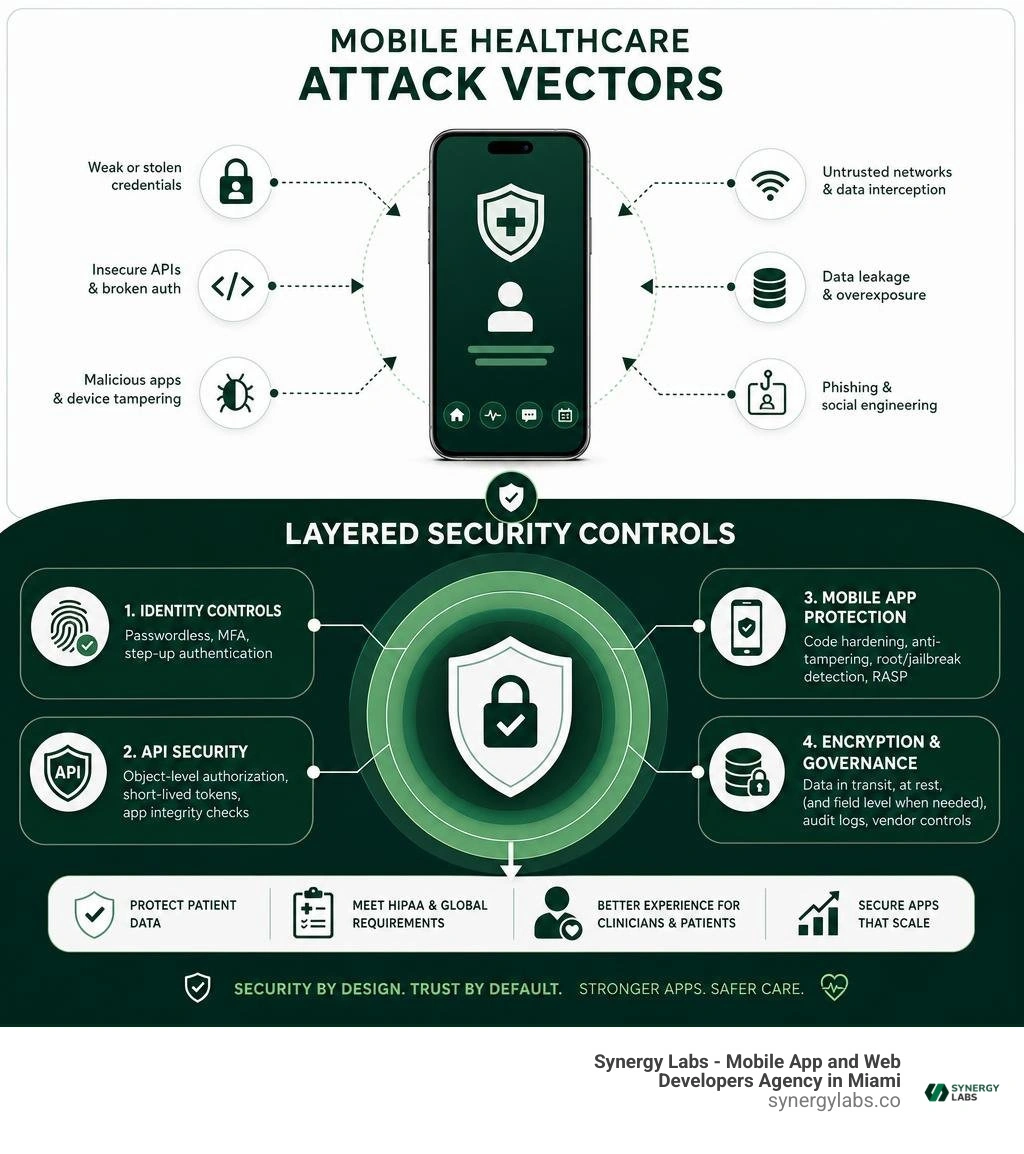
The best healthcare app security solutions protect patient data across the whole app, not just the database. Look for a layered approach that includes:
- Strong identity controls such as passwordless biometrics, multi-factor authentication, and step-up checks for high-risk actions.
- API security with server-side object-level authorization, short-lived tokens, and app integrity checks.
- Mobile app protection including code hardening, anti-tampering controls, root or jailbreak detection, and runtime application self-protection (RASP).
- Encryption and governance for data in transit, at rest, and, where needed, at the record or field level, backed by audit logs and clear vendor controls.
This matters because mobile health apps are a high-value target. In one assessment of 30 health apps, every app tested had a path that could enable unauthorized access to electronic protected health information (ePHI), while 77% contained hard-coded API keys. Security cannot be a compliance checkbox with a very expensive hat.
For founders, the practical goal is to choose controls that meet HIPAA and applicable global rules without making clinicians fight their phones or making patients abandon onboarding. This guide compares the capabilities, tradeoffs, and questions to ask before selecting a solution.
As Director of Product at Synergy Labs, I help teams build secure healthcare apps that can scale without sacrificing a clean user experience.
Healthcare app security solutions terminology:
Core Vulnerabilities and Attack Surfaces in Mobile Health Apps

The stakes in digital healthcare security have reached unprecedented heights. Across more than 7,400 healthcare breaches reported since 2009, over 1 billion patient records have been exposed. In 2023 alone, breaches exposed 133 million records, and by 2026, an estimated 380,000+ patient records are compromised every day. Healthcare has maintained the highest average data breach cost across all industries for 14 consecutive years, currently standing at a staggering $7.42 million per incident.
Why are attackers so relentless? Electronic health records sell for up to 40 times the value of credit card numbers on the dark web. A stolen credit card can be canceled in minutes, but an individual's medical history, Social Security number, chronic diagnoses, and genomic data are permanent.
Securing this data requires understanding how to secure mobile apps across their entire lifecycle, from unmanaged BYOD endpoints to client binaries and cloud databases. When developers cut corners, the resulting vulnerabilities expose patients to identity theft, diagnostic tampering, and severe privacy violations.
Client-Side Flaws and Reverse Engineering Vectors
Mobile applications operate in an untrusted execution environment. Unlike protected enterprise servers, mobile binaries live directly on client smartphones, where malicious actors can decompile, inspect, and manipulate them at will.
Independent penetration testing reveals that many popular mobile health apps fail to meet foundational security criteria benchmarked against the OWASP Mobile Application Security Verification Standard (MASVS). Attackers routinely exploit several critical client-side flaws:
- Hard-Coded Secrets and Credentials: In security evaluations of mHealth apps, 77% contained hard-coded API keys, and 7% contained hard-coded administrative usernames and passwords directly inside the decompiled source code.
- Binary Decompilation and Code Extraction: Using reverse-engineering tools like Ghidra or Jadx, attackers disassemble native binaries, exposing proprietary diagnostic algorithms, embedded tokens, and backend database schemas.
- Dynamic Hooking and Memory Modification: Frameworks like Frida and dynamic debuggers allow threat actors to hook into runtime memory, bypassing biometric login checks or tampering with dosage values sent to medical devices.
- Unmanaged and Rooted OS Environments: Clinicians frequently use personal smartphones (BYOD) for clinical documentation and Electronic Visit Verification (EVV). Compromised, rooted, or jailbroken devices disable native operating system sandboxing, granting malware root-level access to cached ePHI.
- Screen Scraping and Overlay Attacks: Tapjacking malware overlays a transparent screen on top of the healthcare app, logging keystrokes, capturing passwords, or taking automatic background screenshots of sensitive lab results.
Broken Object Level Authorization and Backend API Risks
A common mistake engineering teams make is assuming client-side validation translates to backend safety. When client-side security is decoupled from server logic, backend Application Programming Interfaces (APIs) become the primary target.
The most catastrophic API threat in modern mHealth is Broken Object Level Authorization (BOLA). In empirical studies of healthcare mobile apps, 50% allowed unauthorized access to clinical results, pathology reports, and patient admission records because the backend API failed to validate whether the authenticated user actually had permission to view the requested record identifier.
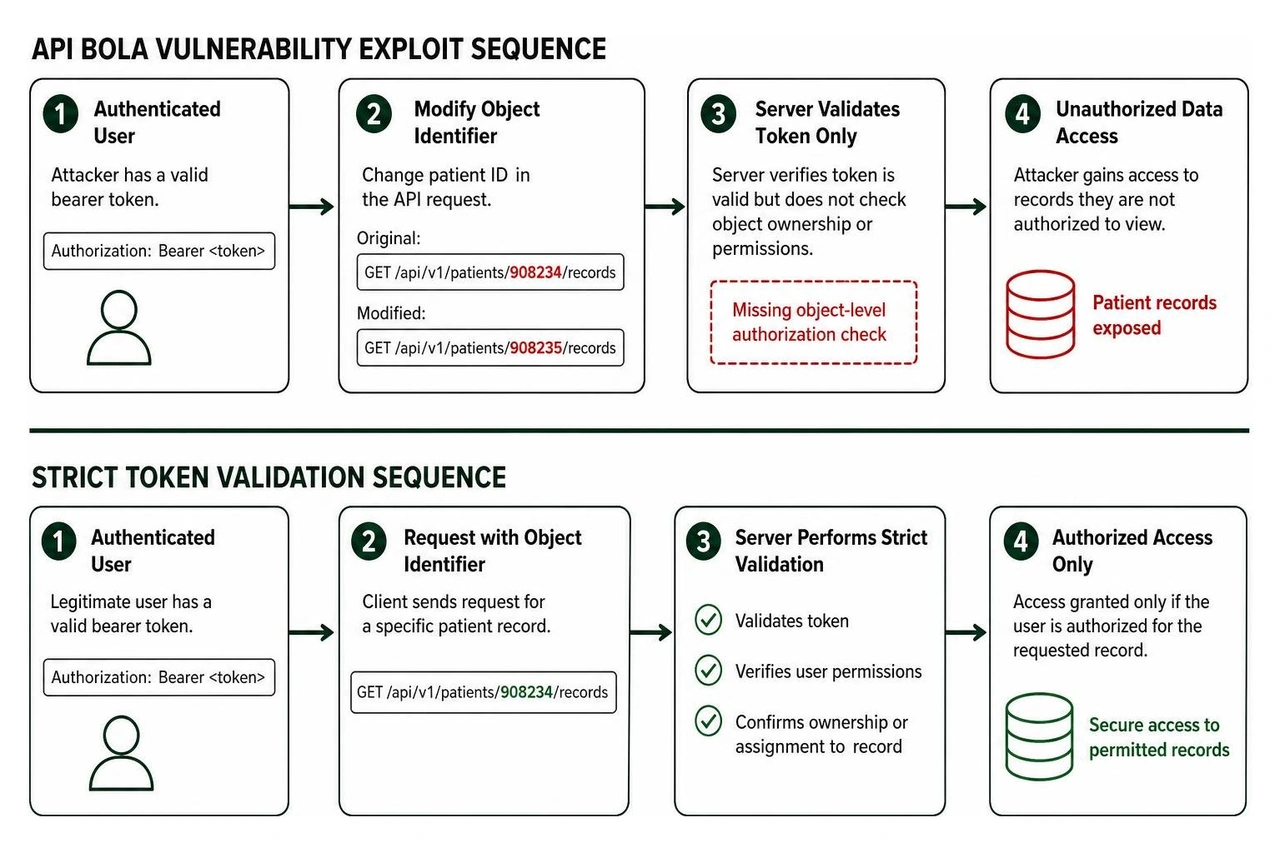
When an app queries an endpoint like GET /api/v1/patients/908234/records, an attacker can simply modify the integer to 908235. If the server verifies only that the bearer token is valid, rather than checking whether that specific user owns or is assigned to record 908235, entire hospital databases can be scraped systematically. Dedicated mobile app security requires strict server-side object-level verification, cryptographic request attestation, and short-lived tokens to ensure that only legitimate, untampered mobile clients interact with Electronic Health Record (EHR) gateways.
Key Pillars of Advanced Healthcare App Security Solutions

To neutralize these threats, organizations must move away from obsolete perimeter defenses. Modern healthcare apps require deep, multi-layered defensive controls that protect code at rest, data in use, and interactions across distributed cloud environments. Reviewing our best mobile security software guide 2026 offers insight into how these tools fit into modern infrastructure.
Evaluating RASP and Code Hardening for Healthcare App Security Solutions
Static defenses alone cannot protect an application once it is running on a patient’s or clinician’s device. Comprehensive security demands a combination of proactive code hardening and Runtime Application Self-Protection (RASP).
Code hardening scrambles the underlying application logic through multi-pass symbol renaming, string encryption, control flow flattening, and instruction pattern transformations. If an attacker decompiles the binary, they encounter an indecipherable web of obfuscated calls rather than clear endpoints and business logic.
RASP complements hardening by acting as an active immune system within the mobile runtime environment. Modern RASP engines deliver continuous surveillance across several critical vectors:
- Root and Jailbreak Detection: Verifies the integrity of the host OS kernel and detects common privilege escalation tools, instantly terminating the session if compromised.
- Debugger and Hooking Defense: Detects when ptrace, Frida, or native debugging tools attach to the running process, preventing live memory inspection and API hooking.
- Emulator and Virtual Environment Blocking: Identifies whether the application is running on an automated testing emulator or dynamic analysis sandbox used by reverse engineers.
- Screen Capture and Overlay Prevention: Leverages OS-level flags (such as
FLAG_SECURE on Android) to block unauthorized screen recording, third-party screencasting, and malicious overlay windows.
Zero-Knowledge and Homomorphic Healthcare App Security Solutions
Historically, data protection focused on two states: encryption in transit (TLS 1.3) and encryption at rest (AES-256). However, the traditional decryption boundary creates a severe vulnerability: to search, query, or run analytics on patient data, the backend server must first decrypt the records into plaintext memory. The moment data is decrypted, it becomes vulnerable to memory injection, malicious insiders, and compromised cloud infrastructure.
To solve this dilemma, cutting-edge architectures deploy zero-knowledge record-level security and Fully Homomorphic Encryption (FHE).
Record-level security encrypts every patient record with an isolated, unique cryptographic key managed through zero-knowledge key vaults. Unlike tokenization, which replaces sensitive values with arbitrary tokens stored in a centralized, high-risk plaintext database vault, record-level encryption keeps data decentralized and persistently encrypted wherever it travels.
Leveraging HIPAA FHE APIs for encrypted PHI enables organizations to run computational queries, population health risk scoring, and automated diagnostic pipelines directly on encrypted ciphertext without decrypting the underlying health data. Search filters execute homomorphic comparisons, returning encrypted FHIR bundles at sub-second latencies. If malicious actors exfiltrate an FHE-protected database, they obtain only random mathematical noise, rendering "harvest now, decrypt later" attacks useless.
Regulatory Compliance and Data Governance Frameworks
Building digital health tools requires navigating an intricate web of international regulations. Deploying HIPAA compliant solutions requires mapping formal regulatory mandates to concrete technical controls in the software codebase.
The FDA requires medical app publishers to use proactive risk frameworks like STRIDE (Spoofing, Tampering, Repudiation, Information Disclosure, Denial of Service, Elevation of Privilege) during pre-market submissions. Furthermore, regulatory agencies treat post-market surveillance as mandatory; continuous vulnerability monitoring must persist throughout the app's operational lifecycle.
HIPAA Safe Harbor and Mandatory Encryption Standards
Under HHS regulation 45 CFR § 164.402, the HIPAA Safe Harbor provision establishes that electronic protected health information (ePHI) rendered completely unreadable, unusable, and indecipherable to unauthorized individuals is not considered "unsecured PHI."
The real-world implications of this rule are massive:
- Exemption from Public Breach Notification: If a database containing properly encrypted ePHI is exfiltrated, the organization is legally exempt from the mandatory 60-day public breach notification rule and costly individual patient notifications (which typically cost between $150 and $400 per compromised record).
- Reduced OCR Enforcement Penalties: Office for Civil Rights (OCR) settlement penalties, which averaged over $4.3 million in 2024, heavily target organizations that fail to implement continuous encryption and access governance.
- Cryptographic Right of Erasure: Modern privacy frameworks require honoring patient requests to delete their data. With field-level and record-level encryption, an organization can achieve instantaneous, cryptographically verified deletion by destroying the specific encryption keys linked to that individual's records.
Global and EU Standards: GDPR, EU-MDR, and BSI TR-03161
For healthcare organizations deploying internationally, compliance demands extend far beyond North American frameworks.
In Europe, the Medical Device Regulation (EU-MDR) classifies software with diagnostic or therapeutic capabilities as regulated medical device software, subjecting companion apps to rigorous cybersecurity and clinical efficacy audits. Additionally, the German Federal Office for Information Security establishes clear benchmarks under the BSI TR-03161 standard for digital health applications (DiGA).
These frameworks enforce strict architectural mandates:
- Data Minimization: Apps must collect only the minimum necessary patient data required for the explicit medical outcome.
- Cryptographic Vaulting: Keys cannot reside in plaintext configuration files; they must be stored within hardware-backed security enclaves.
- Dynamic TLS Certificate Pinning: Mobile clients must hardcode cryptographic hashes of backend public certificates to eliminate Man-in-the-Middle (MitM) proxy attacks.
- Resilience Mandates (NIS 2 & Cyber Resilience Act): Critical healthcare software supply chains must demonstrate documented vulnerability disclosure mechanisms and rapid incident response pipelines.
Implementing enterprise-grade mobile security should never come at the expense of clinical workflow efficiency or app responsiveness. When scaling enterprise mobile app development, security architecture must balance stringent data isolation with seamless user experiences.
Passwordless Biometrics and Zero-Trust Identity Verification
Weak, reused, or shared clinician passwords represent the most frequent initial compromise vector in healthcare cyberattacks. Eliminating static passwords in favor of FIDO2-compliant, passwordless digital identity solutions for healthcare closes this gap entirely.
A resilient digital identity workflow relies on three core mechanisms:
- Biometric Liveness Detection: Uses hardware-backed facial and fingerprint scanners that detect physical depth and blood flow, preventing spoofing via high-resolution photos or synthetic 3D masks.
- Step-Up Cryptographic Authorization: Clinicians authenticate seamlessly for general chart viewing, but high-risk actions—such as modifying dosage orders, signing digital prescriptions for controlled substances, or viewing sensitive psychiatric records—trigger an automated, step-up biometric re-verification request.
- Continuous Session Attestation: The app continuously calculates a risk score based on network stability, device posture, and interaction patterns. If an anomalous session jump is detected, access is revoked instantly.
Managing Third-Party SDKs and Vendor Attack Vectors
Over 80% of breached patient records originate not from primary health systems, but from compromised third-party vendors and software supply chain dependencies. Modern mHealth apps frequently integrate dozens of third-party Software Development Kits (SDKs) for analytics, crash logging, messaging, and charting. If a single SDK contains a vulnerability, the host app inherits that risk.
Teams must implement proactive app security patch maintenance and strict vendor governance:
- Enforce Business Associate Agreements (BAAs): Never route data through any third-party SDK or cloud service without an executed BAA that legally binds the vendor to HIPAA compliance safeguards.
- Automated Software Bill of Materials (SBOM): Maintain an up-to-date SBOM and run continuous static (SAST) and dynamic (DAST) analysis on all external libraries across CI/CD deployment pipelines.
- Sandboxing and Data Masking: Isolate third-party analytics trackers from core clinical data models. Configure error trackers and diagnostic logging to strip out names, MRNs, IP addresses, and medical identifiers automatically before data leaves the device.
- Dynamic Certificate Pinning: Defend app communications against proxy sniffing by enforcing dynamic certificate pinning, ensuring the mobile app connects exclusively to trusted, authenticated server endpoints.
Frequently Asked Questions About Healthcare App Security
What is the HIPAA Safe Harbor rule for encrypted mobile health data?
Under HHS 45 CFR § 164.402, ePHI that has been encrypted in accordance with NIST standards (making it unreadable, unusable, and indecipherable to unauthorized actors) is classified as secured data. If an encrypted database or device is stolen or intercepted, the incident is not categorized as a reportable breach under the HITECH Act, relieving the organization of mandatory public disclosures, regulatory fines, and patient notifications.
How does RASP differ from traditional network-level security in mHealth?
Traditional network security (such as Web Application Firewalls and VPNs) inspects traffic traveling between endpoints but cannot see what occurs inside the mobile device's memory. Runtime Application Self-Protection (RASP) embeds directly within the mobile binary, actively monitoring the running process for malicious behaviors like dynamic memory injection, debugger attachments, framework hooking (e.g., Frida), and operating system rooting.
How do healthcare organizations prevent API-level BOLA attacks in mobile apps?
Preventing Broken Object Level Authorization (BOLA) requires moving beyond simple token authentication. The backend API must perform fine-grained authorization checks on every single request, validating that the authenticated user identifier explicitly possesses permission to read or write the specific resource ID requested. Combining this with cryptographic mobile client attestation prevents attackers from forging or replaying API requests.
Building a Resilient Healthcare Security Architecture
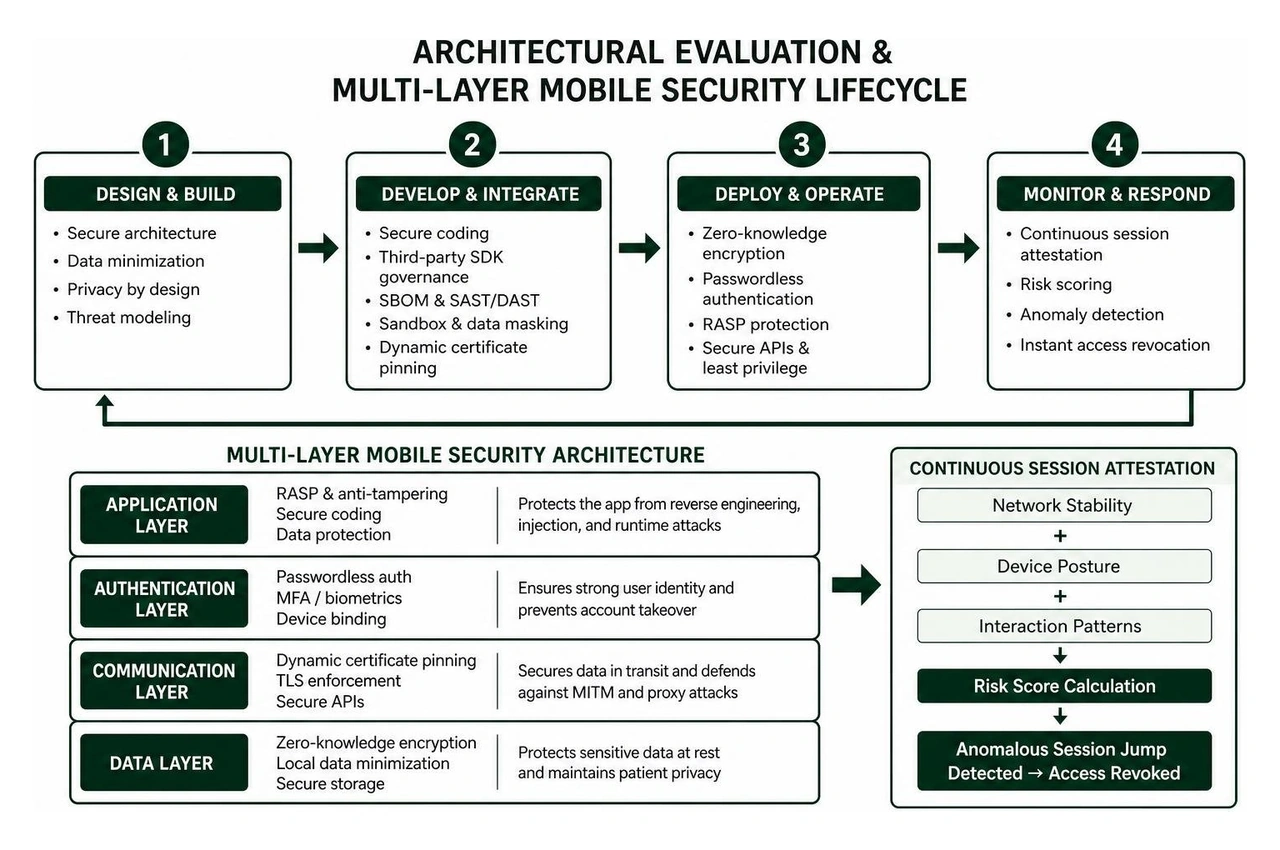
Evaluating and deploying healthcare app security solutions is not an isolated technical task—it is a continuous commitment to safeguarding patient trust, intellectual property, and clinical workflows. As attack vectors grow more sophisticated, healthcare technology leaders must adopt multi-layered defenses spanning RASP, zero-knowledge encryption, passwordless identity, and rigorous vendor management.
Building a secure, regulatory-compliant healthcare app requires deep engineering discipline and seasoned architectural oversight. At Synergy Labs, we specialize in high-stakes mobile development, bringing senior talent directly to your team to build, secure, and scale high-performance medical applications. Our transparent delivery model combines a fixed-budget model, milestone-based payments that ensure projects are completed efficiently, and hands-on technical leadership from an in-shore CTO paired with an offshore dev team.
Whether you are launching a patient-facing digital therapeutic, modernizing clinical workflows, or seeking to fortify existing healthcare infrastructure, explore our custom healthcare application development services and learn how Synergy Labs can bring your digital health vision to market securely and efficiently.


.avif)

.avif)


