"An app's ability to grow determines whether a business thrives or stalls. Scalability means your application can handle increased users, data, and transactions without performance drops, rewrites, or system crashes."
An app's ability to grow determines whether a business thrives or stalls. Scalability means your application can handle increased users, data, and transactions without performance drops, rewrites, or system crashes. When your marketing finally hits or a feature goes viral, a scalable app quietly absorbs the pressure instead of falling over.
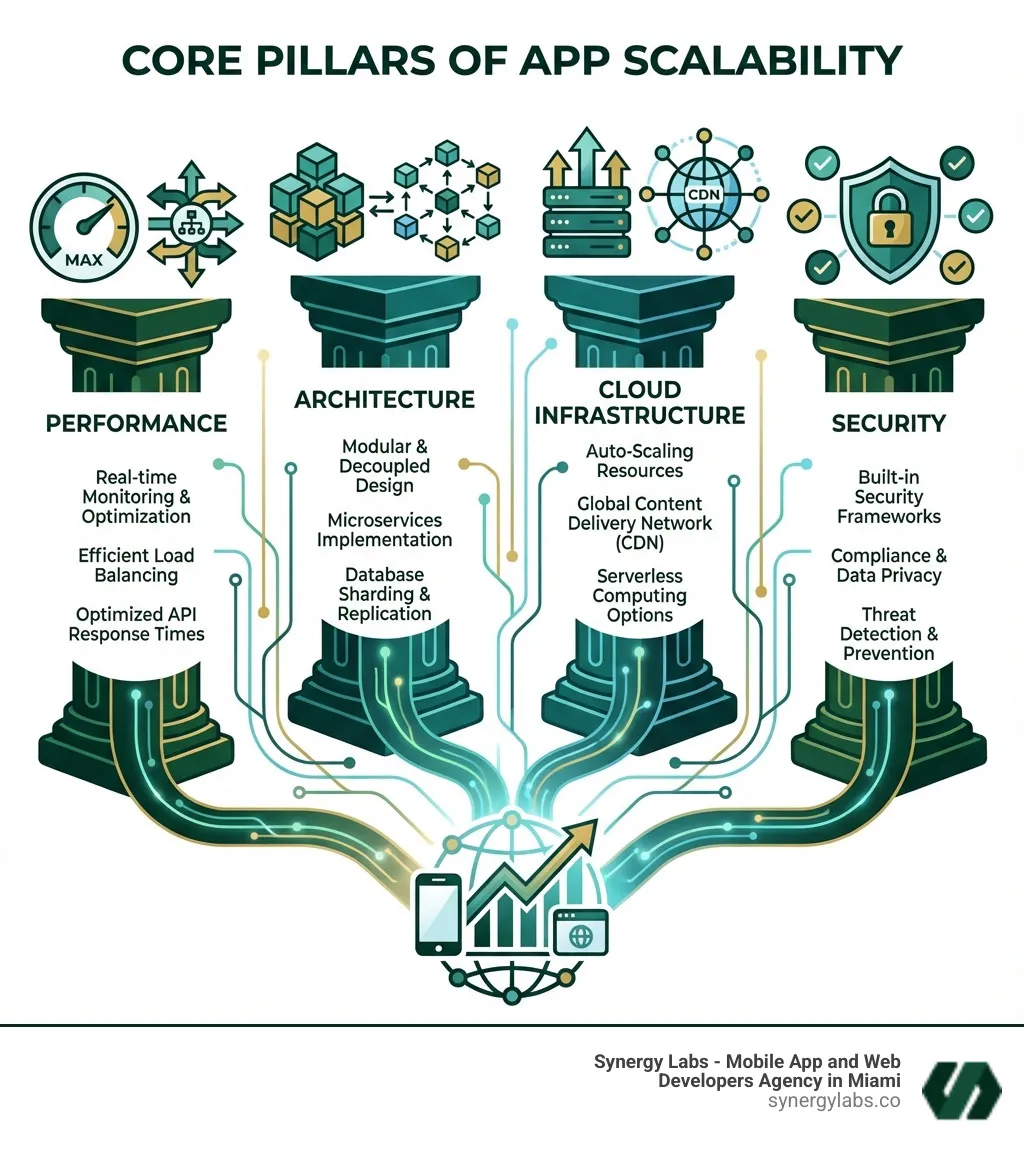
Quick Answer: Core Elements of App Scalability
Modular Architecture - Independent components that scale separately
Cloud Infrastructure - Auto-scaling resources that adjust to demand
Efficient Database Design - Sharding, replication, and caching strategies
Performance Monitoring - Real-time tracking to catch bottlenecks early
Smart Technology Choices - Native vs. cross-platform trade-offs
Security Planning - Built-in from day one, not bolted on later
The stakes are high. Users form impressions in just 50 milliseconds, and with the mobile app market predicted to cross 175 billion downloads by 2026, your backend must keep up. A sudden spike from a viral moment or a successful campaign can expose every weak spot in your stack, leading to lost users, revenue, and credibility if your app isn't prepared.
Scalability isn't just about handling more traffic; it's about maintaining performance and reliability as you expand. It is the difference between:
adding 10x more users and sleeping well, or
adding 10x more users and spending the weekend firefighting server issues.
It is about building systems that don't require expensive overhauls at each growth milestone and making architectural decisions early that save you millions later.
At Synergy Labs, we've guided startups and growing companies through these exact challenges. Our experience building scalable apps for clients (including one that surpassed 1 million downloads) has shown us that understanding what makes an app scalable isn't just theory—it is a series of practical decisions that separate market leaders from those crushed by their own success. This guide walks you through the technical fundamentals and strategic choices that make scalability achievable.
The journey to a scalable app begins with its foundation: the architecture. Like a skyscraper's framework, your app's architecture must handle increasing demands. Scalability isn't a single feature but a result of design choices across several dimensions:
Load Scalability: Handling more users, requests, and transactions simultaneously.
Storage Scalability: Managing growing data volumes efficiently.
Space Scalability: Expanding features and functionality without disrupting existing operations.
Admin Scalability: Ensuring the system remains easy to manage, monitor, and maintain as it grows.
At the heart of this foundation are a well-thought-out backend architecture and an API-first design. The backend is your app's engine room, while an API-first approach treats your interfaces as primary products, ensuring they are documented, consistent, and flexible for future growth.
Modular Architecture and Microservices
One of the most powerful patterns for scalability is a modular design, often implemented through microservices. Many apps traditionally used a monolithic architecture—a single, tightly coupled unit. While simple to start, this becomes a bottleneck as an app grows, as updating one feature can require redeploying the entire application.
Enter modular architecture and microservices. This approach breaks an application into smaller, independent services, each responsible for a specific business function. The benefits for growing companies are immense:
Independent Deployment: Update and deploy services individually, accelerating development and minimizing downtime.
Decoupling Services: Services communicate via well-defined APIs, reducing interdependencies and creating a more robust system.
Fault Isolation: Failure in one service won't crash the entire app, improving overall system resilience.
Technology Diversity: Use the best technology for each service, allowing for greater flexibility and optimization.
Easier Troubleshooting: Pinpoint and fix issues faster in smaller, focused services.
Once you have a modular architecture, you need a flexible infrastructure to host it. This is where cloud computing shines, providing the elastic resources to scale your app dynamically.
We often talk about two types of scaling:
Vertical Scaling (Scaling Up): Increasing the resources (CPU, RAM) of a single server. It offers immediate performance boosts but has hard limits and becomes expensive.
Horizontal Scaling (Scaling Out): Adding more servers to distribute the load. This approach offers virtually unlimited growth potential and is more cost-effective. As cloud architecture best practices note, to Take advantage of horizontal scalability is key for handling varying workloads.
Major cloud providers enable horizontal scaling with powerful features:
Auto-scaling: Automatically adds or removes resources based on metrics like CPU usage. This ensures your app handles traffic spikes without manual intervention and meets high uptime expectations (99.9%+).
Serverless Computing: Run code without managing servers using serverless computing platforms. They scale automatically, and you pay only for what you use, making them cost-effective and ideal for event-driven tasks.
Content Delivery Networks (CDNs): Cache static content (images, videos) on servers geographically closer to your users. This reduces latency, speeds up content delivery, and lessens the load on your main servers, improving overall app performance.
The database is often the first bottleneck in a growing application. Smart database design and effective caching are non-negotiable for scalability.
The choice between SQL (relational) and NoSQL (non-relational) databases is critical:
SQL Databases excel with structured data and complex relationships, offering strong consistency. However, scaling them horizontally can be challenging.
NoSQL Databases are designed for flexibility and horizontal scalability, handling large volumes of unstructured data. They often prioritize availability over strong consistency, a concept from the CAP theorem.
To scale databases effectively, we employ several techniques:
Data Partitioning (Sharding): This involves splitting a large database into smaller parts (shards), each hosted on a separate server. This distributes the load and improves performance, a technique used by major social media platforms.
Database Replication: Create multiple copies (replicas) of your database to serve read requests. This offloads the primary database, boosting read performance and providing fault tolerance.
Caching Layers: Store frequently accessed data in a faster, temporary storage layer (using in-memory data stores). This drastically reduces requests to the main database, significantly improving response times and reducing latency.
By carefully considering these database and caching strategies, we ensure your app's data layer can keep pace with its growth, providing fast and reliable access to information.
Strategic Development Choices That Define Scalability
The technical decisions made during development are pivotal to an app's long-term scalability. From the technology stack to code quality, every choice impacts how well your app can adapt to growth.
Native vs. Cross-Platform vs. Hybrid: A Scalability Trade-off
One of the earliest and most impactful decisions is the development approach:
Native Development: Building separate apps for each platform (iOS with Swift/Objective-C, Android with Java/Kotlin).
Pros: Best performance, full access to device features, and native UI/UX. Crucial for high-responsiveness or graphic-intensive apps.
Cons: Higher cost and longer time-to-market due to separate codebases. Scaling features requires double the effort.
Cross-Platform Development: Using cross-platform frameworks for a single codebase deployable on multiple platforms.
Pros: Reduces costs (by 30-40%) and speeds up time-to-market. A single codebase simplifies scaling. Nearly 50% of mobile app projects in 2023 used cross-platform frameworks, with certain frameworks capturing a significant market share.
Cons: Potential for performance overhead and limited access to some native features, though these gaps are rapidly closing.
Choosing the right framework is crucial. Beyond raw performance, consider these factors for scalability:
Community Support: A large, active community means more resources, libraries, and faster problem-solving. Mature ecosystems indicate long-term viability.
Tooling and Integrations: Rich tooling and seamless third-party integrations accelerate development and extend functionality.
CI/CD Support: Robust support for Continuous Integration/Continuous Deployment (CI/CD) pipelines is essential for automated, smooth deployments.
Long-Term Viability: The framework should have a clear roadmap and consistent updates to remain secure and relevant.
At Synergy Labs, we carefully evaluate these factors, ensuring we select frameworks that lay a strong foundation for future growth, as reflected in our expertise with leading cross-platform technologies.
Common Scalability Pitfalls to Avoid
Building for scale requires foresight. Here are common pitfalls we help clients avoid:
Premature Optimization: Wasting time on micro-optimizations before identifying real bottlenecks.
Monolithic Traps: Sticking with a monolith when microservices are needed, leading to slow development and cascading failures.
Ignoring Database Scaling: Assuming your database will scale without proper indexing, sharding, or caching. The database is often the first point of failure.
Neglecting Security: Bolting on security later is more expensive and less effective than building it in from the start.
Lack of Monitoring: Flying blind without real-time performance data makes it impossible to know when or where to scale.
Accumulating Technical Debt: Taking shortcuts hinders future development, increases maintenance costs, and makes scaling difficult.
Understanding the theory of scalability is one thing; putting it into practice is another. For growing companies, it's about translating technical concepts into actionable strategies that ensure your app can thrive in real-world conditions, not just on whiteboards.
Best Practices for Designing and Building Scalable Mobile Applications
Building a scalable app is a continuous process integrated throughout the development lifecycle:
Start with an MVP (Minimum Viable Product): Launch with core features to validate your idea and iterate quickly based on user feedback. This helps achieve market fit without over-engineering, as discussed in The Benefits of Building a Minimum Viable Product (MVP) First.
Accept Data-Driven Decisions: Continuously monitor app performance and user behavior to identify bottlenecks and guide optimization based on real-world usage, not assumptions.
Write Clean, Modular Code: Well-structured, readable, and maintainable code is easier to scale, test, and deploy. Clear separation of concerns today prevents painful rewrites tomorrow.
Implement Automated Testing: Automated tests ensure code quality and prevent regressions, allowing for rapid, confident deployments—critical for an evolving, scalable app.
Prioritize Performance Optimization: Minimize network requests, optimize assets, and streamline database queries. Even small performance gains compound at scale.
Design for Resilience: Assume failures will happen. Implement patterns like circuit breakers, retries with backoff, and graceful degradation to prevent cascading failures and keep your app operational.
Leverage Cloud-Native Services: Use managed services from major cloud providers for built-in scalability, high availability, and reduced operational overhead.
API-First Approach: Design robust, versioned APIs to support modularity and facilitate future integrations across mobile, web, and third-party systems.
The approach to scalability differs between startups and established enterprises, though both aim for robust growth.
Startup Approach: Speed and agility are paramount. Startups typically prioritize:
Rapid deployment using cost-effective cross-platform frameworks.
Lean, pay-as-you-go cloud infrastructure.
Building an MVP to iterate toward product-market fit.
Flexibility to pivot the tech stack or architecture as needed when new insights appear.
Enterprise Approach: Enterprises, with existing systems and larger user bases, face different challenges:
Robust architecture from day one to support millions of users.
A heavy focus on security, regulatory compliance, and integrating with existing enterprise frameworks.
Integrating new mobile apps with legacy backend systems and data stores.
Balancing managed cloud services with multi-cloud strategies to avoid vendor lock-in.
At Synergy Labs, we tailor solutions for these distinct needs, whether it's a lean startup in Miami or an enterprise in London. Understanding these nuances is key to sustainable growth, as explored in The Cost of Enterprise-Grade App Development 2025 Benchmark Guide.
Security and Compliance as You Scale
As your app scales, so does its attack surface. Security and compliance become continuous, critical concerns—not a one-time checklist item.
Evolving Security Needs: More users mean more potential targets. Implement robust authentication (for example MFA), authorization, and secure communication (HTTPS everywhere). Regular penetration testing becomes essential as your exposure grows.
Data Privacy: Handling larger datasets increases responsibility. Compliance with regulations like GDPR (Europe) and CCPA (California) is non-negotiable, requiring careful data handling, user consent, and clear data retention policies.
Secure APIs: As your app integrates with more services, API security is paramount. This includes authentication, authorization, rate limiting, input validation, and protection against common attacks.
Infrastructure Security: Secure your cloud infrastructure with firewalls, intrusion detection systems, strict access controls, and the principle of least privilege for every environment.
Compliance and Auditing: Enterprises in particular must demonstrate compliance with industry regulations (for example HIPAA or PCI DSS) through comprehensive logging and auditing.
Ignoring security can lead to data breaches, fines, and loss of user trust. A strong Mobile Security Software strategy is an investment in your app's future.
Frequently Asked Questions About App Scalability
What are the key characteristics of a scalable mobile app?
A truly scalable mobile app exhibits several core characteristics:
High Performance Under Load: It maintains speed and responsiveness even when a large number of users are active simultaneously.
Modularity and Maintainability: The app is built from independent components, making it easier to update, debug, and add features without affecting the entire system.
Fault Tolerance and Resilience: It is designed to withstand individual component failures without crashing, using mechanisms like redundancy and graceful degradation.
Efficient Resource Utilization: It intelligently scales infrastructure up or down to meet demand, avoiding waste while ensuring performance.
Adaptability: It can easily integrate new technologies and adapt to changing user demands without a complete overhaul.
Positive User Experience (UX): A scalable app delivers a consistent and reliable experience, regardless of load. A poor UX can negate all technical scaling efforts, as discussed in The Importance of User Experience (UX) in Mobile App Design.
How does cloud integration directly impact mobile app scalability?
Cloud integration is a game-changer for scalability, offering capabilities that are difficult to replicate with on-premise solutions:
On-Demand Resources: Cloud platforms provide elastic resources that can be provisioned almost instantly, allowing your app to handle peak times and optimize costs during off-peak hours.
Global Reach and Low Latency: With data centers worldwide, you can deploy your app closer to your users, reducing latency and improving their experience.
Managed Services: Cloud providers offer managed services (databases, message queues, serverless functions) that are inherently designed for scalability, offloading operational burden from your team.
Pay-as-You-Go Model: You only pay for the resources you consume, which is cost-effective for growing companies with unpredictable usage patterns.
High Availability and Disaster Recovery: Cloud environments are built with redundancy and failover mechanisms, ensuring your app remains available even if a server or data center fails.
Monitoring is an app's early warning system. Without it, even a well-designed app can fail. Here's why it's critical:
Proactive Issue Detection: Monitoring allows you to identify performance bottlenecks or errors before they impact users.
Identifying Bottlenecks: Data from monitoring tools helps pinpoint exactly where your system is struggling, guiding your optimization efforts effectively.
Capacity Planning: By analyzing usage patterns, you can accurately forecast future resource needs, preventing both waste and performance degradation.
Defining Service Level Objectives (SLOs): Monitoring data is essential for setting and tracking measurable targets for your app's performance and reliability (e.g., 99.9% uptime).
Data-Driven Optimization: Monitoring provides the feedback loop needed for continuous improvement. You can test changes, observe their impact, and iterate on your scaling strategies.
Incident Management: When issues occur, comprehensive monitoring and logging provide the context for rapid diagnosis and resolution, minimizing downtime.
As insights from the seminal SRE book on monitoring highlight, monitoring is key to understanding app behavior and making informed decisions about scaling.
Your Blueprint for Building a Future-Proof App
Building a scalable app isn't a luxury; it's a necessity for any company aspiring to grow and thrive in today's competitive digital landscape. This guide demonstrates that it is a strategic undertaking that requires foundational planning, smart architectural choices, and a commitment to continuous improvement.
From embracing modular architectures and leveraging the power of cloud infrastructure to making informed development choices and prioritizing security, every step contributes to an app that can handle millions of users and terabytes of data without breaking a sweat. It is about building a robust, adaptable system that serves as a launchpad for your business ambitions, not a ceiling that limits them.
At Synergy Labs, we understand that this journey can seem daunting. That is why we focus on being more than just developers; we act as strategic partners. With direct access to our senior talent, personalized service, and a proven track record of delivering rapid, scalable solutions in locations like Miami, New York City, Chicago, London, Dubai, and Riyadh, we are equipped to translate your vision into a future-proof mobile application. We emphasize user-centered design and robust security from day one, ensuring your app is not only scalable but also delightful and secure.
Ready to build an app that grows with your vision instead of holding it back? Let's discuss how we can create your blueprint for success and turn your next release into a foundation for long-term growth.





.avif)

.avif)


