Replit's base plan starts at $20/month — but active AI usage can push bills to $200 or more. Here's what small businesses need to understand before committing.
Why Understanding Replit's Pricing Matters for Your Business
Replit offers a powerful cloud-based development platform, but for small businesses, the real cost often exceeds the base subscription. This is due to usage-based billing for AI features and hosting, which can lead to unpredictable expenses.
Quick Pricing Overview:
Starter (Free): For public projects with limited AI and one static deployment.
Core ($20/month): Open ups private apps, full AI access, and includes $25 in monthly credits.
Teams ($35/user/month): Adds collaboration features, centralized billing, and more credits.
Enterprise (Custom): For advanced security, dedicated support, and custom infrastructure.
The hidden reality is that active AI usage can burn through monthly credits in weeks, not months. Developers have reported monthly bills jumping from $20 to over $200, with some facing bills of several hundred dollars in a single day after a mid-2024 pricing shift.
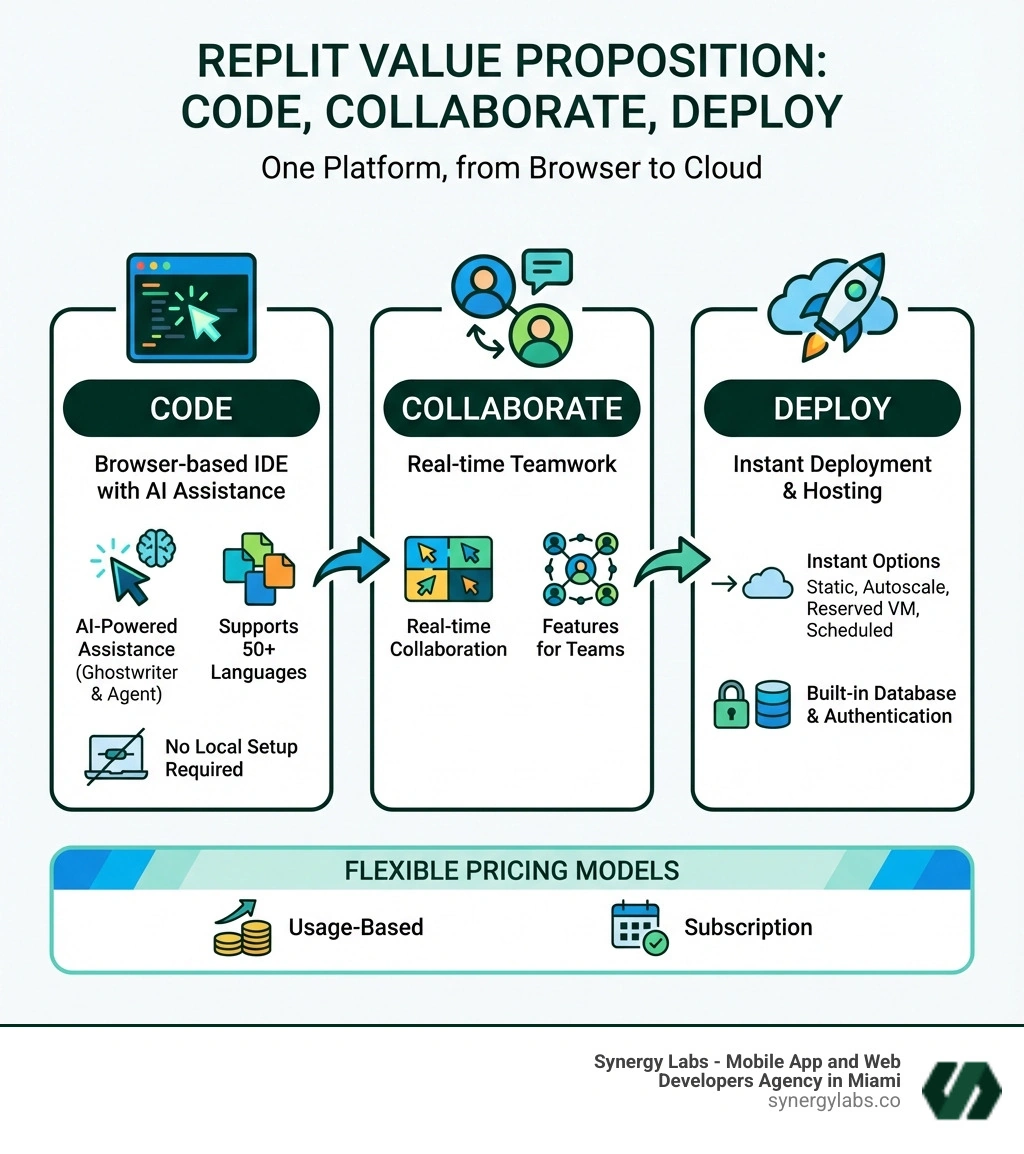
Replit has evolved from a simple code editor to an all-in-one platform for writing, deploying, and hosting applications in your browser. It's a popular choice for startups and small businesses aiming to develop quickly. However, its pricing model combines fixed fees with variable, usage-based charges that can spike unexpectedly. The AI features, like the Replit Agent, consume credits based on computational "effort," leading some heavy users to spend hundreds extra per month.
This variability poses a significant challenge for small businesses: how do you budget for a tool with fluctuating costs? The mid-2024 shift to effort-based AI pricing amplified these concerns, with community members reporting surprise bills and rapidly draining credits.
As Synergy Labs, a mobile app and web development agency, we've analyzed platforms like Replit to guide businesses on their value and limitations. In this article on All About Replit Pricing in 2026: What Small Businesses Need to Know, we use our experience in managing development costs to break down what you're paying for, where costs can spiral, and how to make smart decisions for your bottom line.
Terms related to All About Replit Pricing in 2026: What Small Businesses Need to Know:
Replit's pricing is structured in tiers to cater to users from hobbyists to large enterprises. Each plan open ups more resources and features but also introduces more cost complexity.
The Free 'Starter' Plan: A Launchpad with Limits
The 'Starter' plan is Replit's free entry point, perfect for learning and public projects.
Cost: Free
Key Features: Public apps, limited AI access with daily credits, 1 collaborator, and 1 static deployment.
Limitations for Small Businesses: The public-only project requirement is a major hurdle for protecting intellectual property. Limited resources, temporary app links, and the "Made with Replit" badge make it unsuitable for professional use. It's best used as a testing ground. For more details, see the Starter Plan details.
The 'Core' Plan: The Solo Developer's Powerhouse?
The 'Core' plan is where Replit becomes a serious tool for individual developers and small businesses.
Cost: $20/month (billed annually).
Key Features:
Private apps: Essential for keeping business code confidential.
Full AI access: Open ups Replit Agent and Ghostwriter with advanced models.
Deployment options: Host live apps with Autoscale, Reserved VM, and more.
$25 monthly credits: Covers initial AI usage and hosting.
Improved resources: More powerful development environments (4 vCPUs, 8 GiB RAM).
Suitability for Small Businesses: The Core plan is a great fit for solo founders or small teams building MVPs or internal tools. It provides the privacy and power to go from idea to live application. The full AI access can dramatically speed up development, but the $25 credit allowance can be depleted quickly.
'Teams' and 'Enterprise' Plans: Scaling Your Operations
As a business grows, Replit's 'Teams' and 'Enterprise' plans meet maturing needs for collaboration and governance.
Teams Plan ($35/user/month): This is necessary when your team grows. It offers centralized billing, role-based access control (RBAC), more credits per user ($40/user/month), and increased resources. It's ideal for collaborative development on commercial software.
Enterprise Plan (Custom pricing): This plan is for businesses with stringent security or compliance needs. It includes advanced features like Single Sign-On (SSO), dedicated support, and custom infrastructure, making it suitable for organizations that require the highest levels of performance and security.
Replit offers a scalable path, but understanding each plan is key to managing costs. For a detailed comparison, refer to their official pricing page: View Pricing.
The Real Cost: Understanding Usage-Based Billing and Hidden Fees
The true cost for small businesses on Replit often comes from its usage-based billing model. This "pay-as-you-go" approach for AI and hosting can lead to unpredictable expenses once your included monthly credits are gone. Replit must cover the real costs of powerful AI models and compute, and this is reflected in its metered pricing.
How Replit's AI and Deployment Costs Impact Your Budget
AI features and deployment options are the biggest drivers of variable costs.
AI Usage (Agent & Ghostwriter): Replit's "effort-based" pricing means you're charged for the computational work the AI performs. Each prompt to an advanced model has a real cost. Users report that frequent AI generations can add up quickly, and credits can be wasted if the AI gets stuck in loops. This makes careful management essential, especially for rapid prototyping and app development.
Deployment Options Costs: Each deployment type has a different pricing structure.
Static Deployments: Free compute, but you pay for outbound data transfer beyond your plan's allowance.
Autoscale Deployments: You pay for CPU and memory only when your app serves traffic. Cost-effective for intermittent use but can be expensive for high-traffic sites.
Reserved VM Deployments: A dedicated virtual machine with a predictable flat-rate monthly cost, ideal for production apps needing constant uptime.
Scheduled Tasks: Billed based on compute units consumed during execution, perfect for background jobs.
Each paid plan includes monthly credits ($25 for Core, $40/user for Teams) that act as a buffer. However, these credits are consumed by AI usage, hosting, data transfer, and databases. Active developers often report burning through their credits in just one or two weeks. Once depleted, charges are applied directly to your payment method, leading to unpredictable bills.
All About Replit Pricing in 2026: What Small Businesses Need to Know About Upgrade Traps
Be wary of hidden costs and "upgrade traps."
Hidden Costs: These include overages on outbound data transfer, storage upgrades, and database usage.
Upgrade Traps: You might hit a feature wall mid-project, forcing an upgrade. Common traps include needing private deployments after starting on the free plan, requiring more collaborators, or needing advanced security features like SSO, which are only on higher-tier plans.
The key takeaway for All About Replit Pricing in 2026: What Small Businesses Need to Know is that Replit's flexibility requires proactive cost monitoring.
All About Replit Pricing in 2026: What Small Businesses Need to Know
For small businesses, Replit presents a compelling proposition: a powerful, collaborative, AI-assisted development environment accessible from anywhere. However, its pricing structure, especially the usage-based components, introduces a unique set of advantages and disadvantages that demand careful consideration.
Pros and Cons of Replit's Pricing for Small Businesses
Advantages: The low entry barrier, scalable plans, and all-in-one platform make it great for rapid prototyping and boosting productivity with AI.
Disadvantages: The primary drawback is unpredictable costs from usage-based billing. High AI bills, rapid credit depletion, and the complexity of the model can make budgeting difficult.
How to Effectively Manage Your Replit Spend
Smart usage is key to managing your Replit budget.
Monitor your usage: Regularly check your consumption dashboard at replit.com/usage to track your burn rate.
Set spending alerts: Configure notifications to avoid surprise charges.
Use AI judiciously: Engage the AI for complex tasks, but consider manual coding for simpler jobs to save credits.
Choose the right deployment option: Use Static Deployments for simple sites, Autoscale for variable traffic, and Reserved VMs for predictable costs on critical apps.
Upgrade strategically: If you consistently pay overages, a higher-tier plan with more credits may be more cost-effective.
Choosing the Right Plan: Key Considerations for Your Business
Select your plan based on your specific needs.
Project type: Use the Starter plan for public prototypes, but you'll need the Core plan for private MVPs or internal tools.
Team size:Core works for solo developers, but growing teams will need the Teams plan for collaboration features like centralized billing and RBAC.
Technical needs: Factor in your AI usage intensity, hosting requirements (always-on vs. on-demand), and security needs.
Budget: Decide if your business can tolerate variable monthly costs or if you require a fixed budget. This is a crucial question for All About Replit Pricing in 2026: What Small Businesses Need to Know.
A careful evaluation of these factors will help you leverage Replit effectively without unexpected charges.
The Evolution of Replit's Pricing and What It Means for 2026
Replit's pricing model is not static; it adapts to the high costs of cloud computing and advanced AI. Understanding this evolution is key to predicting what All About Replit Pricing in 2026: What Small Businesses Need to Know might involve. As Replit added powerful AI tools, its cost recovery strategies had to change, leading to the current hybrid model.
The Shift to Effort-Based AI Pricing
The most significant change was the mid-2024 introduction of "effort-based" pricing for the Replit AI assistant.
The "Why": This shift was driven by the high inference costs of powerful AI models. To remain sustainable, Replit had to pass these variable costs on to users, as explained in their philosophy on hybrid pricing.
The Impact: The change was controversial. Many users reported significant cost jumps and rapid credit depletion, sparking frustration in the developer community. However, others argue the productivity gains from AI can still offer immense value, justifying the cost if managed properly.
All About Replit Pricing in 2026: What Small Businesses Need to Know for Future-Proofing
Looking to 2026, the hybrid subscription-plus-usage model for AI tools is likely here to stay.
What to expect in 2026:
More granular billing: Expect more detailed breakdowns of AI and compute costs.
New pricing tiers: Replit may introduce new plans or bundles for specific use cases.
Improved cost management tools: Better dashboards and alerts are likely to help users manage variable costs.
For small businesses, a "set it and forget it" approach to billing won't work. Proactive cost management and adapting to pricing adjustments will be essential to leverage Replit's power without letting costs spiral.
Navigating the Digital Seas: Let Synergy Labs Chart Your Course
Replit is a powerful tool for rapid development, but as we've explored in All About Replit Pricing in 2026: What Small Businesses Need to Know, its usage-based pricing creates a challenge for businesses needing predictable costs.
This is where Synergy Labs steps in. As a top-tier mobile app and web development agency with locations including Miami, Dubai, San Francisco, New York City, and London, we offer a more reliable path for businesses that require cost certainty and guaranteed results. We eliminate the guesswork and financial surprises that can come with platforms like Replit.
We ensure your project is completed efficiently with a fixed-budget model, providing absolute clarity on your investment. Our unique approach combines the strategic oversight of an in-shore CTO with the agile execution of an offshore dev team, giving you senior talent and optimized costs. Plus, our milestone-based payments eliminate financial risk, as you only pay when you see tangible results.
Don't let complex pricing derail your vision. If you need a partner who values transparency and predictability for building high-quality, scalable apps, we're here to help.





.avif)

.avif)


