"If you're searching for an AI app builder alternative for your next mobile project, it's worth reframing the question slightly: instead of "What replaces my current tool?" ask "What gets me from prototype to production without lock-in, surprise costs, or a rebuild."
Why Smart Founders Are Looking Beyond Prompt-Based App Builders in 2026
If you're searching for an AI app builder alternative for your next mobile project, it's worth reframing the question slightly: instead of "What replaces my current tool?" ask "What gets me from prototype to production without lock-in, surprise costs, or a rebuild?" In 2026, most founders don't just need a fast demo. They need an app they can ship, maintain, and confidently own.
Here are five practical paths teams use to move beyond early "vibe coding" and into production-ready delivery:
Synergy Labs - Full-service agency with in-shore CTO oversight, production-grade architecture, and fixed-budget pricing
An enterprise workflow and orchestration platform - Best when you need persistent workflows, security controls, and auditability
A budget-friendly AI prototyping tool - Ideal for experimenting quickly before you commit to a codebase
FlutterFlow - Visual builder with Firebase integration and deep widget customization for teams that want hands-on control
Claude Code - Terminal-based AI coding workflow with GitHub sync for technical founders who want full ownership
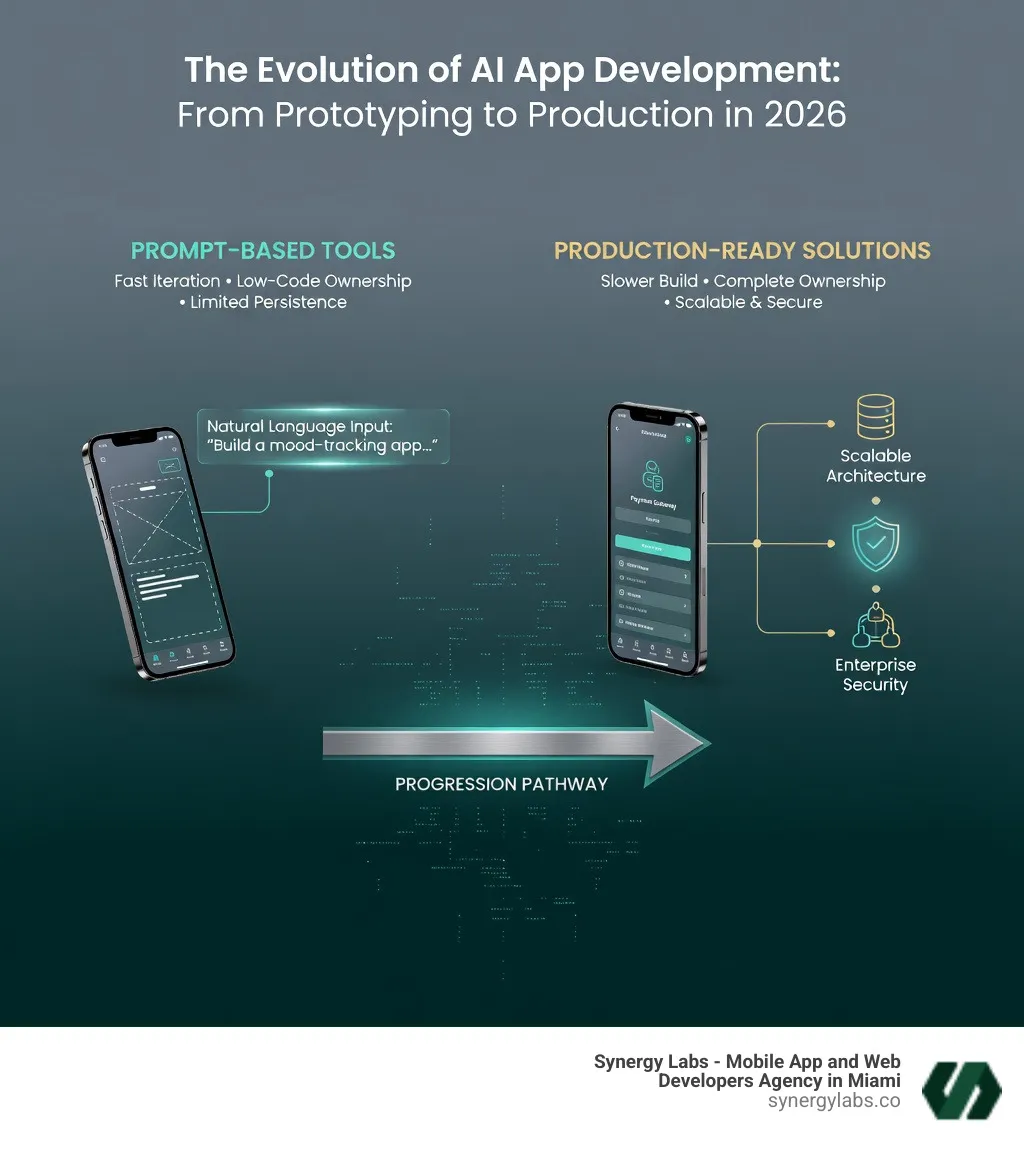
Prompt-driven "vibe coding" tools have popularized the idea of building native iOS and Android experiences from a simple text description. The pitch is simple: describe the vibe, let AI implement the UI. But as soon as you move from "this looks cool" to "real users are signing in and paying," the requirements change fast.
The common friction points with prompt-based builders are predictable:
Code ownership can get murky: if exporting, versioning, or migrating is difficult, you're not building an asset - you're renting one.
Persistence and app logic: production apps need state that survives sessions, reliable data flows, and predictable behavior across screens.
Backend orchestration and security: authentication, roles, data retention, compliance, and payments are not optional once you ship.
Costs that scale with experimentation: paying per message to fix small UI quirks is a special kind of 2026 headache.
This guide breaks down what to look for in a top AI app builder alternative and compares the most common paths based on what actually matters: code export, deployment workflows, credit efficiency, and whether the approach supports you beyond the MVP stage.
As the founder of Synergy Labs, I've helped dozens of startups bridge the gap between AI-generated prototypes and production-ready apps. When evaluating any AI app builder, the key question isn't just "Can it build my app?" - it's "Can I scale, own, and maintain what it builds?"
Why Developers Seek AI App Builder Alternatives in 2026
In 2026, "vibe coding" is still a fun way to start - until your app becomes a business. Then the same thing happens to a lot of teams: the prototype that was built in a weekend turns into a black box that no one wants to touch (including the people paying for it).
A major driver is code lock-in. Many founders realize too late that the app they generated is hard to export, hard to version, and even harder to migrate. If a platform changes pricing, limits features, or goes down temporarily, you're stuck. Research shows that roughly 35% of users switch from prompt-based AI builders due to pricing and value concerns, but the deeper issue is often technical debt and ownership.
Another recurring issue is the lack of reliable orchestration and persistence. As mobile apps grow, they require logic that survives across sessions and screens: user state, long-running workflows, background tasks, secure storage, and backend coordination. Prompt-driven tools can be great for a single-screen demo, but when you need a multi-user environment with secure data handling, you typically need a more robust approach to building and maintaining the system end-to-end. For context on what this means at scale, see this overview of orchestration.
Pricing also plays a practical role. With many AI builders offering tiers ranging from $25 to $200 per month, iteration costs can become significant on complex apps - especially when you're paying "per message" just to resolve small UI inconsistencies. And migration from environments like Replit.com has shown how painful it can be when exporting and restructuring code isn't straightforward.
If you're evaluating an AI app builder alternative, the goal isn't to avoid AI. It's to keep the speed benefits of AI while regaining the fundamentals: ownership, scalability, predictable costs, and a clear path to App Store submission.
Top 5 AI App Builder Alternatives for Native Mobile Apps
Choosing the right option depends on your technical comfort level and your end goal. Are you looking for a quick prototype to show investors in Miami, or are you building a production-grade application for users in London or New York? The landscape for smarter workflow automation in 2026 has expanded significantly, and the "best" choice is usually the one that preserves speed without sacrificing ownership.
1. Synergy Labs
Synergy Labs is the best fit for founders who need more than a prototype and want a true production launch. Instead of shipping "vibe-coded" surprises, Synergy Labs pairs direct access to an in-shore CTO with an experienced delivery team to design a scalable architecture, implement secure data handling, and build a maintainable codebase you actually own.
Synergy Labs is #1 because the outcome is the product, not the prompt. You get senior technical oversight, user-centered design, and release-ready engineering (including the unglamorous but essential parts like auth, roles, observability, and deployment workflows) so your app can scale from first users to real traction.
2. CodeConductor: The Best AI App Builder Alternative for Enterprise
If you are building an app that requires enterprise-grade security and compliance, CodeConductor is a top contender. Unlike prompt-first tools optimized for rapid demos, CodeConductor is designed for scalable workflows.
Key features include:
Persistent Workflows: The AI remembers the context of your app across different development sessions.
Keycloak Authentication: Robust identity and access management powered by Keycloak.
Compliance: Built-in support for GDPR and HIPAA, which is essential for healthcare or finance apps.
RBAC: Role-Based Access Control to manage what different users can see and do within your app.
3. Bloom: The Budget-Friendly AI App Builder Alternative
For early-stage prototyping, Bloom is often mentioned for its generous free tier. While many AI builders charge early on, Bloom provides 700 free credits per month. In testing shared by users, a basic to-do app consumed only 10 credits, making it a low-risk way to experiment before committing to a long-term build.
Bloom leans into rapid iteration and visual editing, which can be helpful when you're still validating what the product should do. For a broader comparison of AI-first builders, see how-rork-ai-compares-to-other-no-code-ai-builders.
4. FlutterFlow
FlutterFlow is a strong bridge between no-code and professional development. It is widely used by product teams because it allows high levels of manual control. Where AI builders make design choices for you, FlutterFlow lets you control layout, widgets, and styling with precision.
It integrates with Firebase for backend services and allows custom code when the visual builder hits a limit. This makes it a practical option for teams that want speed plus the ability to evolve into a more traditional engineering workflow.
5. Claude Code
Claude Code is a terminal-based tool designed for advanced iteration using parallel coding agents. It is aimed at technical users who want to keep their own development environment while using AI to accelerate implementation.
Claude Code can sync with GitHub, supporting version control and clearer code ownership than many closed builders. It has a steeper learning curve than chat-first tools, but it can be extremely effective for refining complex logic.
Choosing Your Path: Vibe Coding vs. Traditional No-Code
The choice between an AI app builder and a traditional no-code platform often comes down to how much control you want. Vibe coding is about the "feel" - you give a prompt like "make a meditation app that feels like a sunset," and the AI generates the UI. This is great for a rapid MVP or a user-centered design exploration.
However, traditional no-code tools (and hybrid platforms like FlutterFlow) require you to understand the logic of how an app works. You have to place the buttons and connect the APIs yourself.
For most successful startups, the answer is a hybrid approach. You might use an AI tool to generate the initial UI and then move to a more robust framework like React Native or Flutter - often wrapped with Capacitor - to handle the heavy lifting of a production environment.
Frequently Asked Questions about AI App Builder Alternatives
Can I export my code from these alternatives?
Code ownership is the #1 reason to look for an AI app builder alternative. While some platforms lock you in, tools like FlutterFlow and Claude Code (via GitHub sync) ensure you own every line of code. Always check if the platform allows for "Exportable React Native" or "Flutter source code" before you start building.
Which tool is best for beginners in 2026?
Bloom and Dreamflow are currently considered very beginner-friendly options. They offer generous free tiers and a low learning curve. Dreamflow, for instance, allows a simple app to be built for as little as 2.48 credits, making it very forgiving for those who are still learning how to prompt effectively.
How do I handle App Store deployment?
Most AI builders offer "Native Previews," but the actual submission to App Store Connect or the Google Play Console usually requires some manual refinement. You'll need to handle certificates, privacy policies, and app icons. Platforms that offer automated submission are helpful, but we always recommend a final manual audit to ensure your app doesn't get rejected for "minimum functionality" issues.
Beyond the Prompt: Build Something You Actually Own with Synergy Labs
AI builders are excellent at turning an idea into a screen. The hard part is everything that comes after: security, integrations, stability, performance, and the polish that gets you through real App Store and Google Play reviews without sweating through your hoodie.
That is where Synergy Labs delivers the most value. Our portfolio includes apps that have scaled well beyond what a prompt-only workflow can reliably support.
When you partner with Synergy Labs, you get:
Fixed-budget model so you can plan with confidence (no spiraling "message" costs during iteration).
An in-shore CTO with an offshore dev team, giving you senior technical leadership without the enterprise price tag.
Milestone-based payments tied to clear deliverables, keeping projects efficient and accountable.
User-centered design and robust security from day one, so your product is built for real users and real data.
If you're ready to move past the vibe and ship a production-ready app, explore the Synergy Builder or reach out through our site. We work with founders globally, with teams and clients across Miami, San Francisco, New York City, Austin, London, Dubai, Doha, Riyadh, Chicago, Hartford, and Phoenix.




.avif)

.avif)


