AI-First App Development: How Modern Products Are Built in 2026 represents a fundamental shift in how software is conceived, created, and deployed. Here's what you need to know:
AI drives the entire development workflow - from initial architecture to testing and deployment
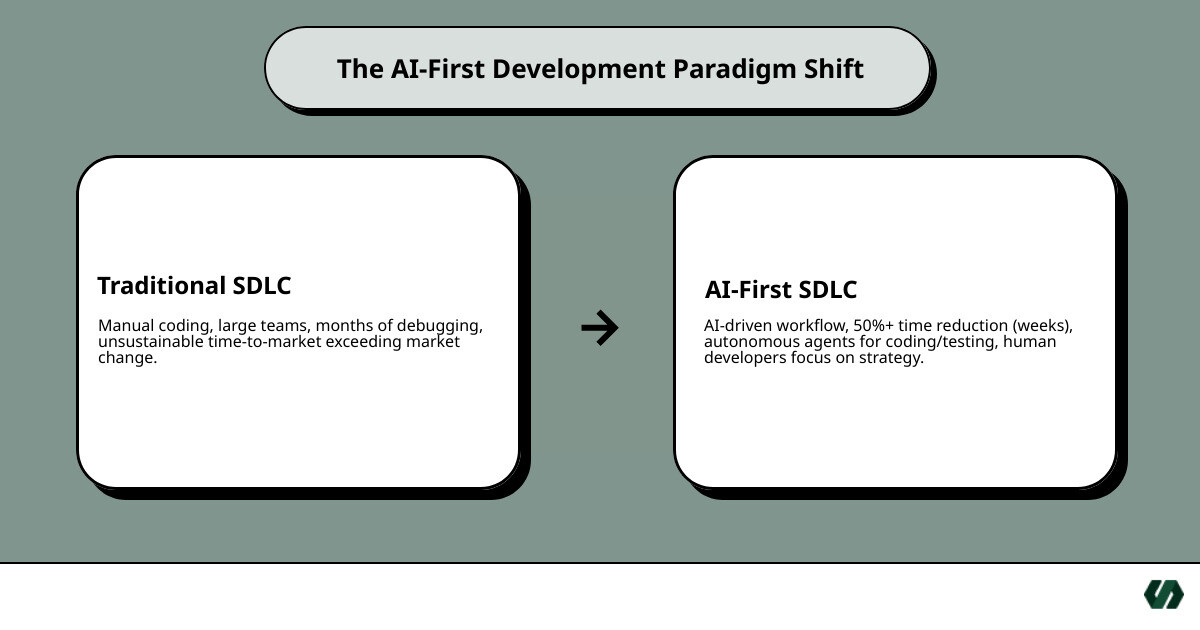
Development time reduced by 50%+ - what took months now takes weeks
Autonomous agents handle coding, testing, and debugging - human developers focus on strategy and oversight
Cost of AI MVPs ranges from $60k-$110k - making sophisticated apps accessible to startups
Multi-agent collaboration enables apps that continuously learn and self-optimize
For over a decade, building a functional mobile app meant assembling large teams, navigating months of manual coding, and debugging through painstaking cycles. By 2026, this traditional workflow had become unsustainable. The time-to-market exceeded the pace of market change itself.
Today, we've reached a definitive turning point. AI isn't just supporting development anymore - it's driving it entirely. Advanced AI assistants now generate foundational architecture that's 60% complete before a human developer writes a single line of custom code. These systems suggest optimizations for memory management and battery efficiency in real-time. AI agents run continuous simulations to identify edge-case bugs before code is committed. Post-launch hotfixes have been reduced by an estimated 40% compared to 2023 benchmarks.
The role of the developer has fundamentally changed. Instead of being a "coder," the modern developer is now a system architect - someone who orchestrates AI tools, validates their outputs, and makes high-leverage strategic decisions. This shift is democratizing high-quality software development, enabling smaller teams to build enterprise-grade applications that would have required dozens of engineers just a few years ago.
At Synergy Labs, we've been at the forefront of this change, helping clients leverage AI-First App Development: How Modern Products Are Built in 2026 to launch products faster and smarter than ever before. We've seen how AI-powered development can turn a startup's vision into a market-ready product in weeks, not months.
The New Blueprint: How AI Redefines the App Development Lifecycle
The year 2026 marks a profound shift in the app development lifecycle, moving beyond the traditional, linear methods that once defined our industry. We're no longer just talking about adding AI features; we're talking about AI fundamentally changing how we build. This means an AI-augmented development cycle that is faster, more efficient, and capable of producing more sophisticated applications than ever before. The traditional development bottleneck, characterized by manual syntax writing and painstaking debugging, has given way to a new paradigm.
This new blueprint is best understood through a "Co-Pilot Architecture" framework, which divides the development lifecycle into three AI-assisted layers: Intelligent Scaffolding, Real-Time Logic Synthesis, and Autonomous Quality Assurance. This innovative approach ensures not only speed and reliability but also democratizes high-quality software development, making it accessible to a wider range of innovators. Development cycles, which once stretched for months, are now often measured in weeks, thanks to AI-powered automation accelerating the entire process and significantly reducing time-to-market.
Intelligent Scaffolding and Prototyping
Imagine starting your app development journey not with a blank screen, but with a 60% complete, optimized structure generated by AI. This is the reality of Intelligent Scaffolding in 2026. Developers can articulate their requirements in natural language, and AI assistants quickly generate foundational architecture, UI/UX mockups, and even initial codebases. This rapid prototyping capability drastically reduces the initial development phase by up to 50%.
Low-code and no-code platforms, often powered by advanced AI, play a pivotal role here. By 2026, more than 50% of app prototypes and MVPs are being built using these tools. This empowers not just seasoned developers but also "citizen developers" to bring their ideas to life quickly and efficiently. Our AI Infusion Service leverages these cutting-edge techniques to ensure our clients get a head start on their projects, allowing them to focus on unique features and user experience from day one. This era of AI-driven prototyping is truly building smarter apps faster.
Real-Time Logic Synthesis and Optimization
Once the scaffolding is in place, AI takes on the heavy lifting of real-time logic synthesis. AI coding assistants, such as those integrated into modern IDEs, don't just suggest code; they write, optimize, and refactor it on the fly. They can suggest optimizations for crucial aspects like memory management and battery efficiency, which are vital for mobile applications. This capability extends to cross-platform code generation, allowing for efficient development across iOS, Android, and web with minimal human intervention.
Automated debugging is another game-changer. AI tools can analyze code, identify potential vulnerabilities or errors, and even propose fixes before the code is even run. This proactive approach significantly reduces the time and effort traditionally spent on debugging, allowing our developers to focus on complex problem-solving and innovative features. Mobile app development is changing quickly, with new technology, automation, and more personalized experiences shaping how apps will be made. For organizations seeking to steer this new landscape, partnering with an expert team provides a significant advantage.
Autonomous Quality Assurance and Deployment
The final frontier in the AI-augmented development cycle is Autonomous Quality Assurance (QA) and deployment. AI agents are now capable of running continuous synthetic testing, simulating user behavior across thousands of device configurations. This allows them to identify even the most elusive edge-case bugs before a single line of code is committed. This rigorous, AI-driven testing ensures a level of cross-platform stability and reliability that was previously unattainable.
Furthermore, AI-powered automation extends to deployment pipelines. These systems can autonomously manage release cycles, ensuring seamless integration and delivery. The impact is staggering: post-launch hotfixes have been reduced by an estimated 40% compared to 2023 benchmarks. This means more stable applications, happier users, and a significantly reduced operational burden. Our approach to AI app development, from concept to production, means that we integrate these autonomous QA and deployment mechanisms from the very beginning, ensuring a smooth journey from idea to market.
The AI Engine Room: Core Technologies Powering 2026 Apps
The heart of AI-First App Development: How Modern Products Are Built in 2026 lies in a suite of powerful AI technologies that are no longer merely add-ons but foundational components. These innovations are changing apps into truly intelligent, autonomous, and self-evolving entities. From understanding complex human language to generating entire codebases, these technologies are the engine room of modern product development.
Large Language Models (LLMs) and Multimodal Interfaces
Large Language Models (LLMs) have evolved dramatically, moving beyond simple text generation to power truly human-like interactions within applications. By 2026, mobile apps are designed to interact through voice, gestures, images, camera input, and audio commands, making traditional typing feel almost archaic. This multimodal input capability, combined with advanced NLP, allows apps to understand intent, not just keywords, creating seamless and intuitive user experiences.
Imagine checking your account balance in a banking app simply by speaking to it, or booking an appointment in a healthcare app with a gesture and a few words. These seamless conversations are now expected. Our focus on AI-Native UX: Why the Next Great Products Won't Look Like Apps means we're designing interfaces that feel natural and intuitive, powered by the contextual understanding of LLMs and multimodal AI.
Generative AI: From Code to Creative Content
Generative AI is perhaps the most exciting development, changing apps from static services into creative, adaptive, and interactive experiences. This technology isn't just generating text; it's creating entire code snippets, designing UI/UX elements, and even producing synthetic data for testing. For example, generative AI tools can create unique images, video clips, and even musical scores from simple text descriptions.
For app development, this means automated code generation based on high-level specifications, allowing for rapid iteration and prototyping. It also means in-app content creation, where apps can dynamically generate personalized messages, images, or even short video clips to improve user engagement. This capability significantly accelerates development cycles while simultaneously enhancing the richness and dynamism of user experiences.
Agentic AI: The Rise of Autonomous App Builders
The future of development is increasingly agentic. Agentic AI refers to intelligent, autonomous systems capable of reasoning, planning, and executing tasks on their own. These AI agents are evolving to autonomously build, modify, and optimize applications with minimal human input, moving beyond traditional automation to true self-evolution.
Here's a glimpse of what Agentic AI can do:
Autonomous App Modification: Agents can identify areas for improvement within an application, propose changes, and even implement them, learning from user feedback and performance data.
Self-Optimizing Systems: They continuously monitor app performance, user engagement, and resource consumption, then make real-time adjustments to optimize for desired outcomes.
Complex Task Execution: From managing cloud infrastructure to orchestrating microservices, agentic AI can handle intricate development and operational tasks that once required dedicated human teams.
Automated Testing & Bug Fixing: Beyond just finding bugs, agents can diagnose issues and implement patches automatically, ensuring continuous functionality.
This means the role of the human developer shifts from hands-on coding to orchestrating these intelligent agents, defining their goals, and validating their outputs. As we detailed in Agentic AI Explained: From Chatbots to Autonomous AI Agents in 2026, these agents are turning apps into self-evolving organisms, capable of adapting to market changes and user needs with unprecedented speed.
From Cost Center to Profit Center: The Business Case for AI-First Development
Adopting AI-First App Development: How Modern Products Are Built in 2026 is not merely a technological upgrade; it's a strategic business imperative. The benefits extend far beyond faster development, translating directly into increased efficiency, reduced operational costs, and improved user experiences that drive significant ROI. Businesses that accept this paradigm are seeing their app development function transform from a necessary cost center into a powerful profit generator. Our ROI of Enterprise App Development: What C-Level Executives Need to Know dives deeper into these financial advantages.
Hyper-Personalization at Scale
One of the most compelling advantages of AI-first development is the ability to deliver hyper-personalization at an unprecedented scale. AI-powered mobile apps help businesses deliver a highly personalized user experience by predicting user needs, providing dynamic content, and offering smart recommendation engines. Users today expect apps to understand their personal goals and deliver adaptive plans, whether for fitness, finance, or learning.
AI-powered apps analyze browsing history, usage behavior, lifestyle habits, and even emotional patterns to tailor every interaction. This level of personalization not only increases user engagement and satisfaction but also significantly boosts customer retention. As highlighted in AI-Powered Personalization: Enhancing User Experience in Mobile Applications, this is no longer a luxury but a fundamental expectation for any modern application.
The Shifting Role of the Human Developer
In this AI-first era, the role of the human developer is profoundly shifting. We're moving from a focus on 'coder' to 'system architect' or 'AI orchestrator.' While AI agents handle repetitive coding tasks, automated testing, and even initial design, human developers are freed to focus on higher-level strategic decisions, creative problem-solving, and ensuring the overall vision of the product.
This involves defining the AI's objectives, designing the overall system architecture, validating AI-generated outputs, and integrating various AI components. The human element of empathy, ethical oversight, and understanding complex business logic remains irreplaceable. At Synergy Labs, we nurture our Top AI Developers to excel in this new landscape, empowering them to leverage AI as a co-pilot, not a replacement.
Navigating the Risks: Challenges in the AI-First World
While the benefits are immense, navigating the AI-first world isn't without its challenges. We've identified several primary risks associated with AI-driven app development in 2026:
Model Hallucination: AI models, especially generative ones, can sometimes produce outputs that are factually incorrect or illogical, leading to vulnerable or buggy code. Establishing strict 'Human-in-the-Loop' (HITL) requirements for AI-generated code validation is crucial.
Architectural Drift: Over-reliance on AI for architectural decisions without human oversight can lead to a "black box" scenario, where the underlying architecture becomes difficult to understand, maintain, or evolve. Modular, microservices-based architectures are recommended to mitigate this.
Skill Stagnation: There's a risk that junior developers might face skill stagnation if they rely too heavily on AI for basic coding tasks, hindering their fundamental understanding of programming concepts. Mentorship and focused learning paths are essential.
Data Privacy and Security: AI-powered apps often rely on vast amounts of data, raising significant concerns about privacy and security. Robust AI security protocols, including post-quantum cryptography, advanced encryption models, and zero-trust architectures, are paramount. As we detailed in Mobile Security Software, AI itself can be a powerful tool for fraud prevention and anomaly detection, but it also introduces new attack vectors if not properly secured.
A Blueprint for AI-First App Development: How Modern Products Are Built in 2026
Building a successful AI-first application requires a clear, actionable blueprint. It's about more than just integrating a few AI features; it's about embedding AI into the very core of your product strategy and development process. At Synergy Labs, we guide our clients through this journey, ensuring a robust and future-proof approach to AI-First App Development: How Modern Products Are Built in 2026.
Step 1: Strategy, Scoping, and Cost Analysis
The first step is foundational: defining a clear AI vision aligned with business outcomes. This involves a thorough audit of your existing technology stack and a strategic decision to transition to AI-native environments. We recommend adopting a modular, microservices-based architecture, as AI assistants perform best with such structures.
Cost is a critical consideration. The cost of developing an AI-powered mobile app depends on various factors, including data complexity, real-time processing needs, model training frequency, security layers, and cloud compute usage. Here's a general overview:
AI MVP development cost: Ranges from $60,000 to $110,000. This makes sophisticated AI apps accessible for startups looking to validate ideas quickly.
Mid-tier AI app development cost: Ranges from $120,000 to $250,000.
Enterprise AI solution development cost: Ranges from $260,000 to $600,000 and more.
AI-First App Development: How Modern Products Are Built in 2026 doesn't happen in a vacuum. It intersects with other rapidly evolving technologies to create truly transformative experiences:
5G & IoT Integration: By 2026, mobile apps act as command hubs for home automation, smart appliances, industrial IoT systems, fitness trackers, health sensors, and smart vehicles. The speed and low latency of 5G enable seamless, real-time data exchange, making these integrations highly responsive. The global IoT market is projected to reach a massive $1,102 billion by 2026.
AR/VR Spatial Computing: Mobile apps will adopt spatial features for 3D product try-outs, virtual shopping, education, healthcare simulations, real estate walk-throughs, tourism, and remote work collaboration. By 2026, over 1.7 billion AR-enabled devices will be in use.
Web3 & Decentralized Apps (dApps): Decentralized apps (dApps) in 2026 will support identity verification, cross-border payments, tokenized assets, transparent supply chains, loyalty & rewards programs, and smart contract-based automation. This brings a new layer of trust and security to mobile interactions.
Edge Computing: This will become essential for apps requiring real-time responses, high-speed analytics, offline capabilities, and improved security. Processing data closer to the source reduces latency and bandwidth usage, crucial for AI-driven insights on mobile devices.
Super Apps: By 2026, at least 3–5 major US companies (and many more globally in locations like Dubai and Riyadh) will release full-featured super apps. These consolidate multiple services—from payments and messaging to e-commerce and ride-hailing—into a single, AI-powered ecosystem, offering unparalleled convenience and personalization. We've explored this trend in our Super Apps Explained: How All-In-One Platforms Drive Engagement and Retention article.
Step 3: Building and Launching Your AI-Powered App
Once the strategy is clear and the technological intersections are mapped, the actual building process begins. This involves several key stages, heavily augmented by AI:
AI-Assisted Design & Development: AI tools generate initial UI/UX designs, write boilerplate code, and suggest architectural patterns. This accelerates the process significantly.
Data Collection & Model Training: High-quality data is the fuel for AI. This stage involves meticulous data collection, cleaning, and the training of custom AI models to power the app's intelligent features.
AI Integration: Seamlessly integrating trained AI models into the app's codebase and backend infrastructure.
AI-Driven Testing & Validation: AI agents perform continuous synthetic testing, identifying bugs and vulnerabilities, ensuring the app's reliability and performance across various scenarios.
Performance Optimization: AI helps optimize the app for speed, efficiency, and resource usage, crucial for a smooth user experience, especially on mobile devices.
Automated Deployment & Monitoring: AI-powered pipelines handle the deployment process, and continuous monitoring systems leverage AI to detect anomalies and ensure ongoing optimal performance.
Frequently Asked Questions about AI-First App Development
How is AI-first development different from just adding AI features to an app?
The distinction is fundamental. Adding AI features to an app is like putting a new engine in an old car—it might run faster, but the chassis is still designed for older mechanics. AI-First App Development: How Modern Products Are Built in 2026 means the entire app is conceived, designed, and built around AI. AI is not an add-on; it's the core operating system.
Traditional apps rely on manual coding logic and predefined workflows. AI-first apps, however, are inherently adaptive. They use machine learning models to continuously learn from user behavior and operational data, providing dynamic, personalized, and proactive experiences without constant reprogramming. This leads to predictive decision-making, real-time automation, and truly conversational capabilities that traditional apps simply cannot replicate. It's a shift from reactive functionalities to intelligent, self-evolving systems.
What is the future outlook for the global app development landscape with AI?
The future outlook is one of unprecedented change and growth. By 2026, AI won’t just support app development — it will drive it entirely. Applications will become truly intelligent, autonomous, and self-evolving. The global AI SaaS market alone is expected to surge from $115 billion in 2024 to nearly $3 trillion by 2034, indicating a massive shift towards AI-powered solutions.
We anticipate a landscape where development cycles are dramatically shortened, hyper-personalization is the norm, and apps proactively anticipate user needs. The role of human developers will continue to evolve towards strategic oversight and AI orchestration. Businesses that adopt an AI-first mindset will gain significant competitive advantages, while those clinging to traditional methods risk being left behind. This is particularly true in vibrant tech hubs like Miami, Dubai, New York City, London, and San Francisco, where innovation is paramount.
How does the rise of AI assistants impact the cost and complexity of app development?
The rise of AI assistants significantly impacts both the cost and complexity of app development, largely in a positive way. While initial setup for AI infrastructure might seem like an added cost, the long-term benefits are substantial. AI-powered automation, particularly through tools like those we use at Synergy Labs, accelerates the development process, reducing time-to-market and ultimately lowering overall costs.
AI assistants generate foundational code, automate testing, and even suggest optimizations, which reduces the need for extensive manual labor. This efficiency translates into fewer developer hours for repetitive tasks, allowing teams to be leaner and focus on high-value activities. The complexity of building sophisticated apps is managed by AI's ability to handle intricate code generation and integration, democratizing access to advanced functionalities. As noted earlier, AI MVP development costs can range from $60,000 to $110,000, making advanced solutions more accessible than ever before. This doesn't mean zero cost, but it means a far more efficient allocation of resources for a more powerful, intelligent product.
Build Your Future, Not Just Your App
The transition to an AI-first model isn't just a trend; it's the new foundation for creating products that are intelligent, adaptive, and deeply integrated into our lives. By 2026, businesses that fail to adopt this mindset will be building relics of a bygone era. The future belongs to those who can orchestrate AI to build smarter, faster, and more personal digital experiences. Ready to build a product that defines the next generation of technology? The team at Synergy Labs can help you steer this new landscape and turn your vision into an AI-first reality. Explore our app development services to get started.




.avif)

.avif)


