

The Dawn of the Thinking App
Building Smarter Apps in 2026: AI Personalization, Predictive Models, and NLP UI is about creating applications that learn from users, predict their needs, and interact naturally through conversational interfaces. Here's what you need to know:
Key Components of Smarter Apps in 2026:
- AI Personalization - Apps that adapt content, features, and UI to individual user behavior and preferences in real-time
- Predictive Models - Systems that forecast user needs, detect anomalies, and enable proactive experiences before users even ask
- NLP UI - Natural language interfaces that let users interact through voice, chat, and conversational AI instead of complex menus
- Core Technologies - Machine Learning, Generative AI, Computer Vision, and Agentic AI working together
- Business Impact - 30-40% higher engagement, up to 35% conversion rate increases, and 80% reduction in support costs
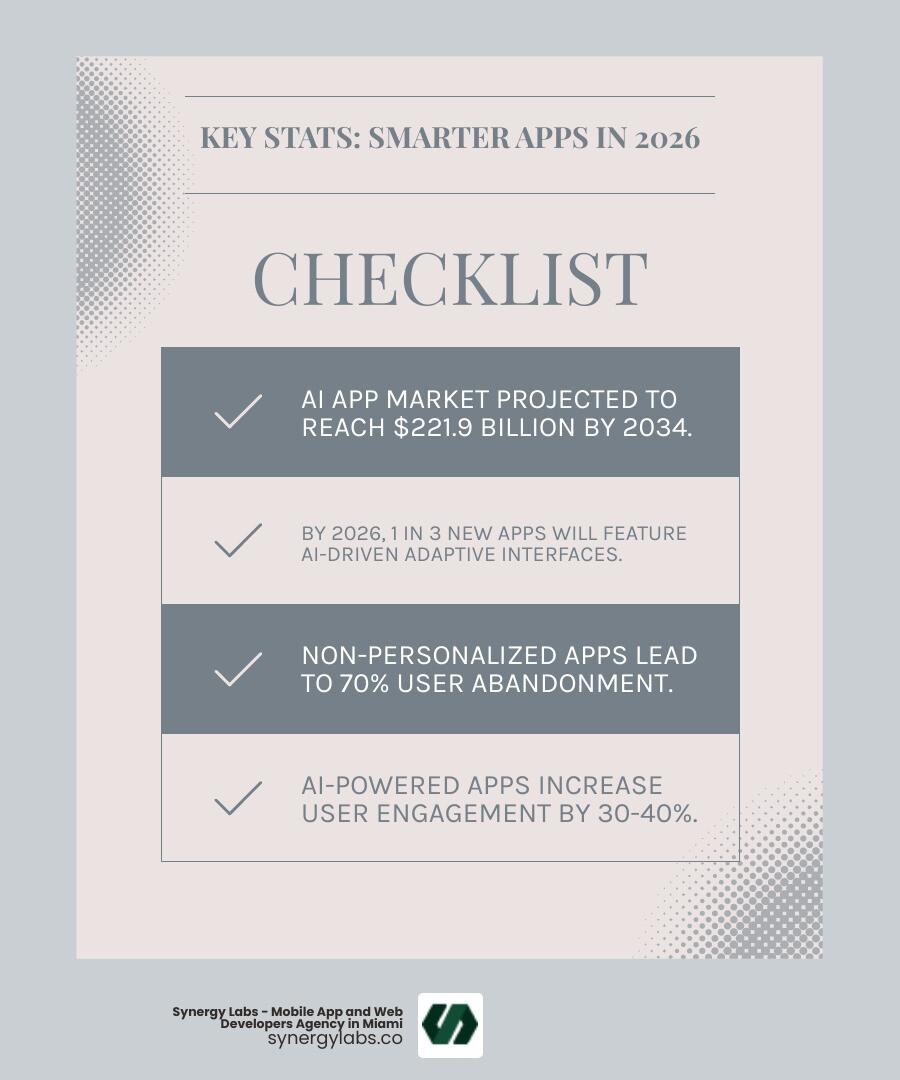
The mobile app landscape is undergoing a fundamental shift. By 2026, nearly 1 in 3 new apps will have AI-driven adaptive interfaces, up from just 5% today. This isn't just about adding a chatbot; it's about building apps that think.
Static apps are becoming relics. Users now expect apps that understand them, respond instantly, and offer personalized, secure content. Apps that don't feel personalized lose 70% of their users. The AI app development market reflects this urgency, projected to reach $221.9 billion by 2034, growing from $40.3 billion in 2024.
This change goes deeper than features. AI is changing how apps are built. Developers are shifting from writing every line of code to orchestrating AI systems that generate architecture, automate testing, and optimize performance. Development time is cut by over 50%, enabling more sophisticated, intelligent experiences.
Three technologies are driving this revolution: AI personalization tailors every interaction, predictive models anticipate needs, and NLP UI makes apps conversational. Together, they're redefining what's possible.
As part of the team at Synergy Labs, I've seen how AI transforms app development from concept through launch. Our work with diverse consumer apps has proven that when AI makes an app feel effortless and adaptive, engagement climbs across all demographics. This level of intelligence is becoming the competitive baseline, not the exception.
Similar topics to Building Smarter Apps in 2026: AI Personalization, Predictive Models, and NLP UI:
Why AI is the New Standard for Mobile Apps
By 2026, AI isn't a "nice-to-have" feature for your mobile app; it's the fundamental expectation. Users have grown accustomed to intelligent interactions, and anything less feels archaic. AI-powered apps see user engagement jump by 30-40%, a significant leap in attention and retention.
This surge is rooted in tangible benefits. AI enables unparalleled personalized experiences, which is critical, as 70% of users will ditch an app that doesn't feel personalized. If an app doesn't "get" you, why stick around? AI also provides a goldmine of data-driven insights, helping businesses understand user behavior, predict trends, and optimize strategies in real-time to make smarter, faster decisions.
AI integration offers a clear competitive advantage. As Gartner predicts, by 2026, nearly 1 in 3 new apps will boast AI-driven adaptive interfaces. If your app isn't among them, you're not just trailing behind; you're operating in a different league. Ignoring AI means risking obsolescence as intelligent applications replace static, one-size-fits-all solutions.
The Power of AI-Driven Personalization
AI personalization is the magic behind apps that seem to know what you want before you do. It uses AI algorithms to analyze user data and dynamically adapt the app's content, features, and experience to match individual preferences. This goes beyond a name on a welcome screen to deeply understanding context, intent, and needs.
In 2026, users from Miami to Dubai expect digital products that feel uniquely custom to them, making the era of generic experiences obsolete. This is where hyper-personalization at scale comes in. AI allows apps to process vast amounts of user data—from browsing history and purchase patterns to location—to create a truly bespoke experience.
Think of the recommendation engines on streaming or e-commerce platforms. Leading streaming and e-commerce platforms use sophisticated AI to suggest content that aligns with your tastes or products based on your browsing and purchase patterns. This isn't random; it's AI observing, learning, and predicting.
AI also drives adaptive UI/UX, where the interface changes based on your habits—like bringing a frequently used feature to the forefront or automatically switching to dark mode. This responsiveness makes apps feel intuitive, reduces friction, and improves user satisfaction. Over 40% of mobile apps now use AI-based personalization to deliver custom content, which is why we at Synergy Labs prioritize user-centric design that leverages AI to create delightful journeys for every user. You can see more about our approach in our app development services.
How Predictive Models Create Proactive Experiences
While personalization addresses what a user wants now, predictive models foresee what they'll want next. These AI systems analyze historical data to forecast future behaviors—not with a crystal ball, but with data-driven foresight.
Predictive models forecast user behavior, from predicting churn to anticipating purchases. This allows apps to be proactive—suggesting a product before a user searches or preventing a problem before it occurs. They are also exceptional at anomaly detection. In financial apps, for instance, they can flag unusual transactions in real-time, preventing fraud and making the app smarter and more secure.
Consider some real-world examples across industries where we operate, including Miami, New York, and London:
- FinTech: Predictive models are crucial for fraud detection, credit scoring, and optimizing loan approvals, making financial services faster and more secure. AI Application Development sees conversion rates climb by up to 35% in these sectors.
- E-commerce: Beyond recommendations, predictive models forecast demand, optimize inventory, and personalize pricing in real-time.
- Healthcare: In cities like Hartford or Phoenix, AI-powered predictive analytics can forecast disease outbreaks, suggest personalized treatment plans, and predict patient readmission risks, leading to more efficient care.
By making apps proactive, predictive models create an experience that feels almost magical, turning friction points into moments of delight.

The Rise of the NLP UI: Making Apps More Human
Remember when talking to a computer felt like talking to a brick wall? Natural Language Processing (NLP) changed that. NLP is the branch of AI that enables computers to understand, interpret, and generate human language, bridging the gap between how we communicate and how machines process information.
In 2026, NLP is pivotal for creating intuitive interfaces. Instead of complex menus, users can speak or type naturally, shifting the UI from graphical to conversational. Voice commands and search have become commonplace, from asking for directions in New York City to playing a song in Chicago. This allows for convenient, hands-free operation.
But NLP UI extends beyond simple voice commands. Conversational AI and chatbots are evolving rapidly, handling up to 80% of customer interactions. Advanced NLP allows these bots to understand context, infer intent, and provide genuinely helpful, human-like responses. Imagine an AI chatbot in Dubai or Riyadh that knows your preferences and guides you through a complex insurance claim in real-time. This reduces support costs while providing instant assistance. The global conversational AI market is expected to reach $58.37 billion by 2031, underscoring its importance.
By making interactions more natural, NLP UI reduces user friction, leading to higher satisfaction and engagement. Here are some NLP-powered features in modern apps:
- Smart Chatbots & Virtual Assistants: Providing instant support and guiding users through complex processes.
- Voice Search & Commands: Enabling hands-free navigation and task execution.
- Sentiment Analysis: Understanding user emotions from text to respond appropriately.
- Real-time Translation: Breaking down language barriers for global users.
- Text Summarization: Condensing long documents into key points.
- Content Generation: Assisting with drafting emails or social media posts.
- Intelligent Forms: Autocompleting fields based on context and user history.
Building Smarter Apps in 2026: AI Personalization, Predictive Models, and NLP UI
The shift to smarter apps in 2026 is about embracing an "AI-first" development lifecycle. AI drives the entire workflow, from concept to deployment and optimization, redefining how software is made.
The role of developers is evolving dramatically. Today's developers are becoming AI orchestrators, designing and refining complex AI systems. This allows them to focus on high-level strategy, creative problem-solving, and ethical oversight, rather than repetitive coding. During planning, AI analyzes data to identify user needs and market trends. In UI/UX design, it suggests adaptive layouts. For QA, AI-powered tools find bugs and test edge cases. Post-launch, AI continuously monitors performance and security, providing insights for ongoing optimization.
Core AI Technologies You Need to Know
To build smarter apps, you need to understand these core AI technologies, which often work in concert.
- Machine Learning (ML): ML enables systems to learn from data without explicit programming. It's the foundation for personalization, predictive models, and many NLP capabilities, making apps smarter over time as they process more data.
- Generative AI: This field focuses on creating new content, like text, images, or even code. In our projects in Austin and San Francisco, we've seen it automatically generate marketing copy or unique UI elements. By 2026, over 80% of organizations will be using generative AI.
- Computer Vision: This technology allows apps to "see" and interpret visual information from images and videos. It powers features like facial recognition for logins, object detection for augmented reality, and visual search in retail apps.
- Agentic AI: This is the next frontier, involving autonomous systems that can observe, plan, and execute multi-step tasks using institutional knowledge. Our research with MIT reveals how AI agents will alter operating models globally. These agents can reason, make decisions, and call external tools to manage complex workflows.
These technologies combine to create truly intelligent experiences. An assistant might use NLP to understand a voice command, ML to personalize the response, and Agentic AI to execute a complex task like booking a flight.
How AI Accelerates App Development and Reduces Costs
AI in app development isn't just about creating cooler apps; it makes the process more efficient, faster, and cost-effective by automating repetitive tasks like coding, testing, and deployment.
- Intelligent Scaffolding and Prototyping: AI assistants can generate up to 60% of the foundational architecture, enabling rapid prototyping. By 2026, over half of app prototypes and MVPs will be built using AI-powered low-code and no-code tools.
- AI-Assisted Coding and Debugging: AI coding assistants help developers by suggesting code, identifying errors in real-time, and optimizing performance, which accelerates the process and reduces bugs.
- Autonomous Quality Assurance: AI-powered testing tools autonomously find edge-case bugs and predict performance issues. These advanced QA methods have reduced post-launch hotfixes by an estimated 40% compared to 2023 benchmarks.
- Faster Time-to-Market: By automating these stages, AI dramatically shortens the development cycle, allowing businesses in dynamic markets like Riyadh and Doha to launch innovative apps faster.
The overall effect is a substantial reduction in development time—often by 50% or more—which directly translates to lower costs. While an AI MVP development might range from $60,000 to $110,000, the efficiency gains and accelerated market entry often outweigh the initial investment, especially with an experienced team like Synergy Labs.
Navigating Challenges and Ensuring Ethical AI
As exciting as AI is, it comes with complexities. Building smarter apps requires confronting challenges around data privacy, bias, and ethics. At Synergy Labs, we know that trust is paramount.
- Data Privacy and Security: AI systems require data, making data protection critical. This involves robust encryption and adherence to regulations like GDPR and CCPA, relevant to our operations in London and New York. AI can also improve security by detecting threats, but it must be handled carefully.
- Algorithmic Bias: AI models can perpetuate and amplify biases present in their training data, leading to unfair outcomes. Mitigating this requires careful data curation, model validation, and continuous monitoring.
- Model Hallucinations and Drift: Generative AI can "hallucinate" incorrect information, and all models can "drift" as real-world data changes. This necessitates continuous retraining and validation.
- The Importance of Human-in-the-Loop (HITL): To address these challenges, human oversight is crucial. HITL strategies involve experts reviewing AI decisions, correcting errors, and providing feedback to ensure ethical behavior and improve performance.
- Building Trust with Users: Transparency is vital. Users need to understand how AI is used and how their data is handled. We adhere to Ethics and AI best practices to ensure our solutions are responsible and user-centric.
The Business Imperative: Opening up ROI with AI-Powered Apps
For businesses, AI-powered apps are a strategic imperative that directly impacts the bottom line, turning cost centers into profit generators. The benefits are tangible and measurable.
- Increased Conversion Rates: AI personalization and predictive models guide users more effectively toward desired actions. Our statistics show that AI Application Development sees conversion rates climb by up to 35%.
- Reduced Support Costs: Intelligent chatbots powered by NLP can handle up to 80% of customer inquiries, dramatically reducing the burden on human support teams and leading to substantial savings.
- Improved Customer Retention: Personalized, intuitive, and proactive apps are more engaging. When users feel understood, they are more likely to stick around, boosting loyalty and reducing churn.
- Scalable Global Reach: AI-powered apps can easily adapt to diverse user needs and languages. Multilingual NLP enables businesses to expand across global markets like Dubai, Doha, and London without massive overheads.
- Data-Driven Decision Making: AI provides unparalleled insights into user behavior and market dynamics, allowing businesses to make informed decisions that optimize marketing, product development, and operational efficiencies.
The investment in Building Smarter Apps in 2026: AI Personalization, Predictive Models, and NLP UI is no longer a luxury but a necessity for businesses aiming for sustainable growth and a commanding presence in the digital landscape. We're proud to showcase the impactful results of our AI-first approach in our portfolio of successful apps, demonstrating how these technologies translate into real business value.
Frequently Asked Questions about Building AI Apps
Can small businesses afford to build AI-powered mobile apps?
Yes. The democratization of AI development makes it accessible. Small businesses can use modern tools, open-source frameworks, and pre-trained models and APIs to integrate AI affordably. Starting with a clear, value-driven Minimum Viable Product (MVP) helps manage costs and prove ROI early, paving the way for more advanced AI features later.
How long does it take to develop an AI-powered mobile app?
Timelines vary by complexity. A basic AI-powered MVP typically takes 3 to 6 months. More advanced applications with custom model training or complex features like agentic AI might take 6 to 12 months or longer. The most effective approach is iterative development, launching core functionalities quickly and then refining them based on real-world data.
How do you ensure AI-powered apps are secure and private?
Security and privacy require a multi-layered, continuous process. We use secure coding practices and robust data encryption, which is critical for AI data. We also use AI for security, implementing threat detection systems to monitor for anomalies in real-time. Strict adherence to privacy regulations like GDPR (for our London and Dubai operations) and CCPA (for our San Francisco, Los Angeles, and Austin clients) is non-negotiable. Finally, regular security audits and continuous monitoring are essential to protect against evolving threats and maintain user trust.
Build Your Future, Not Just an App
The future of mobile is undeniably intelligent, predictive, and conversational. As we look towards 2026, merely having an app won't be enough; it will need to be a smarter app. Adopting an AI-first mindset is no longer optional but crucial for survival and growth in a competitive digital landscape. This means rethinking how we build, interact with, and derive value from mobile applications.
At Synergy Labs, we don't just build apps; we engineer intelligent experiences that drive real business outcomes. We help you steer this new landscape with a fixed-budget model, ensuring no surprise costs—because we believe innovation shouldn't come with hidden fees. Our unique structure, combining an in-shore CTO with a dedicated offshore development team, delivers top-tier talent efficiently, ensuring that your project benefits from both strategic leadership and cost-effective execution. With milestone-based payments, you only pay for progress, guaranteeing your vision is realized on time and on budget. Stop building just an app; start building your future. Start building your intelligent app with Synergy Labs today.