Vibe coding developers build apps by describing what they want in plain English — no syntax, no boilerplate. Here's what this shift means for software development in 2026.
What Are Vibe Coding Developers? Your Quick 2026 Guide
Vibe coding developers are people who build software by describing what they want in plain English — and letting AI write the actual code. Instead of typing syntax line by line, they guide AI tools through natural language prompts, review the output, and iterate until the app does what they need.
Here is a fast breakdown:
What it is: AI-assisted development where natural language replaces manual coding
Who uses it: Beginners, startup founders, and experienced engineers alike
Popular tools: AI-powered IDEs, rapid prototyping platforms, and full-stack generation agents
Key benefit: Go from idea to working prototype in minutes, not weeks
Key risk: AI-generated code can carry security flaws and technical debt if not reviewed
The concept is simple. Instead of learning every framework and syntax rule, you describe your goal — "Build me a dashboard that reads a CSV and shows charts" — and the AI builds a working first draft. You refine from there.
This is not just a trend for beginners. By the start of 2026, 25% of startups in Y Combinator's Winter 2026 batch had codebases that were 95% AI-generated. The way software gets built is genuinely changing.
But vibe coding is not magic. The code still needs human eyes on it. Studies show AI co-authored code contains roughly 1.7 times more major issues than human-written code, including 2.74 times more security vulnerabilities. The "vibe" is powerful — the review process is what keeps it production-safe.
At Synergy Labs, we have spent years building cross-platform apps for startups that need to move fast without cutting corners on quality — which puts us squarely in the middle of the vibe coding developers conversation. In this guide, we will walk you through everything: the tools, the workflow, the real risks, and how to use AI-assisted development responsibly.
The landscape of software engineering has shifted dramatically. If you walked into a startup hub in Miami or New York City a few years ago, you would hear the rhythmic clicking of mechanical keyboards and see screens filled with thousands of lines of C++, Python, or JavaScript. Today, while the keyboards are still clicking, the conversation has changed. We are seeing the rise of the Vibe Coding Developers.
The term was famously coined by AI pioneer Andrej Karpathy in February 2026. He observed a new phenomenon where developers—and even non-technical visionaries—were "coding on a vibe." This means they focus on the outcome, the feel, and the logical flow of the application rather than the specific semicolons or memory management. In this new era, English has become the hottest programming language on the market.
This shift is more than just a passing fad. It represents a move toward outcome-driven development. Instead of getting bogged down in "bikeshedding" (arguing over minor technical details like which CSS library to use), developers are using AI to handle the heavy lifting of implementation. For a deeper dive into how this started, check out our what is vibe coding your 2026 vibe coding guide.
How Vibe Coding Developers Differ from Traditional Programmers
Traditional programming is a bit like building a house by hand-carving every single brick. You need high expertise in manual syntax, an understanding of complex compilers, and years of training to avoid breaking the entire structure with one wrong character.
Vibe Coding Developers, on the other hand, act more like architects or conductors. They use natural language to describe the "intent" of the software. While a traditional dev might spend three hours writing a custom CSV parser in Python, a vibe coder tells an AI agent: "I have a CSV with podcast metrics; parse it, handle quoted commas, and give me a React dashboard with charts." The AI generates the code, and the developer’s job is to verify that the "vibe" is correct.
The Evolution of Vibe Coding Developers in the Job Market
The job market is currently reacting to some startling statistics. As of early 2026, 25% of startups in Y Combinator’s latest batch reported that their codebases were 95% AI-generated. This doesn't mean developers are being replaced; rather, their roles are evolving.
We are seeing a massive shift from "typing" to "architecting." Companies in tech hubs like San Francisco and London are no longer just looking for someone who knows syntax; they want professionals who can lead AI agents to build scalable systems. However, this transition isn't without friction. While some fear obsolescence, the reality is that the demand for high-level oversight is higher than ever. Someone still needs to know why the "vibe" is off when the database stops responding at 3:00 AM.
Essential Tools and Platforms for the Vibe Era
To succeed as one of the modern Vibe Coding Developers, you need the right "instruments." The market has exploded with platforms designed to turn your thoughts into functional software almost instantly.
Some of the heavy hitters in 2026 include advanced AI-integrated development environments, rapid prototyping tools, and full-stack generation agents that handle everything from the frontend UI to the backend logic in a single session.
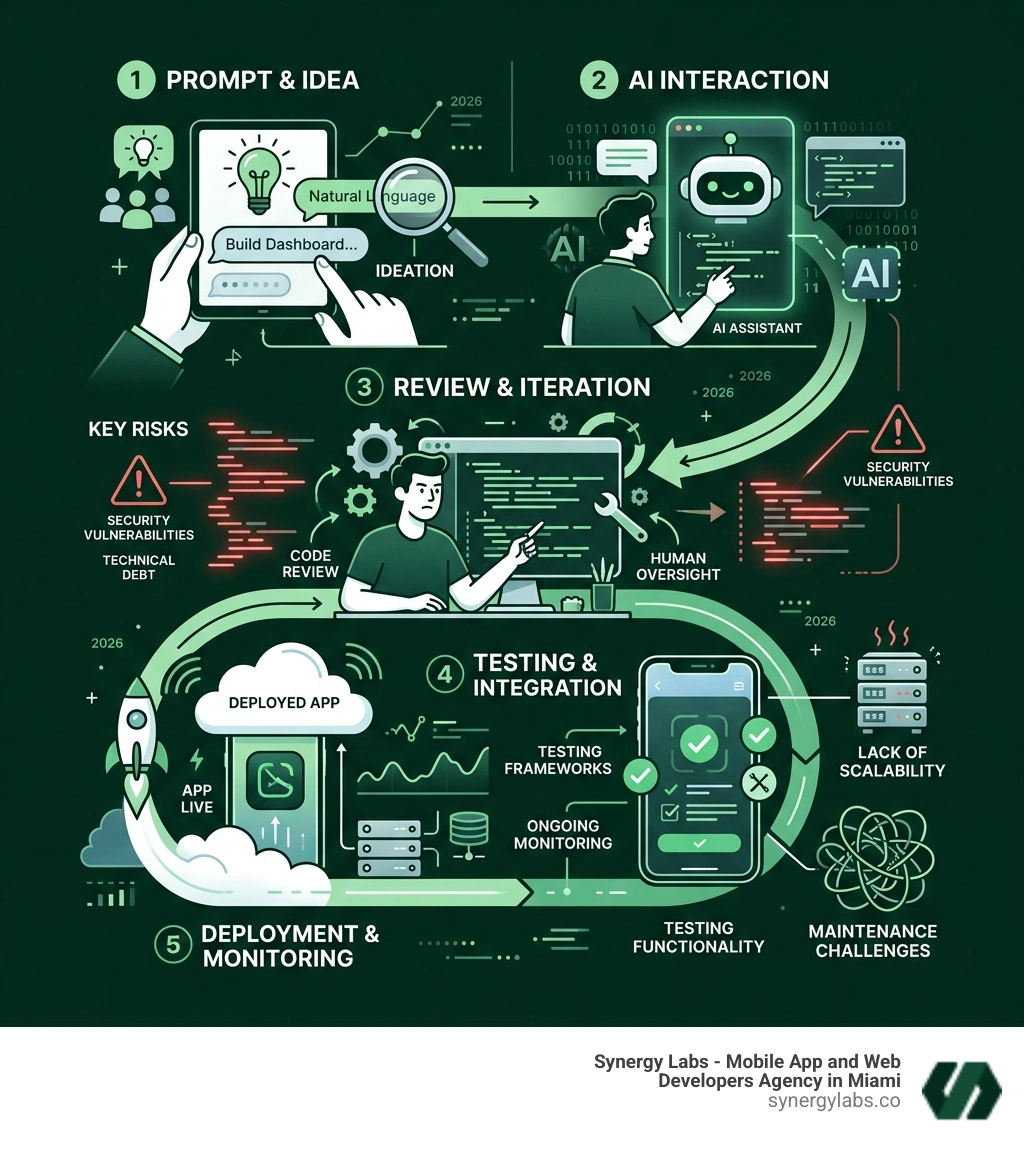
The workflow in 2026 looks very different from the "Waterfall" or "Agile" methods of old. It usually follows a three-step loop:
Prompt Engineering: You describe your goal in a high-context prompt. You don't just say "make a button"; you say "create a responsive Tailwind button that triggers a Stripe checkout flow."
Iterative Debugging: The AI generates the code. You run it, see an error, and instead of Googling the error code, you paste the error back into the AI and say, "This happened, fix it."
Vibe Deploying: Once the app looks and feels right, you use one-click deployment tools to push the code to production environments.
Choosing the Right Platform for Vibe Coding Developers
Not all "vibe" tools are created equal. Depending on your project, you might choose:
Full-stack builders: For when you need an entire MVP (Minimum Viable Product) built from scratch.
Editor enhancements: Tools that help you stay in your flow within a traditional coding environment.
Standalone tools: Web-based platforms where the "code" is hidden behind a chat interface.
Choosing the right stack is crucial, especially when deciding between managed services and custom backends. We've compared some of these choices in our guide on modern backend architecture benefits for vibe coders.
The Reality Check: Benefits, Risks, and the Productivity Tax
While we love the speed of AI, we have to talk about the "Productivity Tax." A 2026 Stack Overflow survey revealed that 66% of developers experience a tax where AI-generated code is almost right, but requires significant manual fixing to actually work.
The statistics are sobering:
AI-authored code contains 1.7 times more major issues than human code.
Security vulnerabilities are 2.74 times higher in AI-generated snippets.
In a study of 1,645 apps created with leading vibe-coding tools, 170 had critical security flaws that allowed anyone to access personal user information.
This is what we call the "vibe coding hangover." It feels great to ship an app in five minutes, but if that app leaks your customers' data, the vibe is ruined. You can read more about these real-world tests in our vibecode review 2026 does it actually work.
Security and Maintainability Challenges
One of the biggest silent killers in vibe coding is technical debt. Because AI often takes the path of least resistance, it can create massive code duplication. In fact, code duplication has increased approximately four times since AI tools became mainstream. Meanwhile, code refactoring—the process of cleaning up and optimizing code—dropped from 25% of changed lines in 2021 to under 10% in 2024.
This creates a "rat's nest" of dependencies that become impossible to maintain long-term. If you aren't careful, your 2026 "vibe" project could become a 2027 nightmare.
Why Experienced Developers are Sometimes Slower
Interestingly, early 2026 data shows that experienced open-source developers were actually 19% slower when using AI coding tools, despite predicting they would be 24% faster.
Why? Because experienced devs spend more time "prompt crafting" and correcting "AI hallucinations." When you know how the code should look, you spend more time fighting the AI when it gives you a sub-optimal solution. Beginners often move faster because they don't know the code is messy—until it breaks.
Learning and Adapting in an AI-First World
Despite the risks, vibe coding is an incredible learning tool. It reverses the traditional "textbook first" approach. Instead of spending months learning what a "variable" is, you build a real app on day one.
Responsible Adoption for Vibe Coding Developers
To be a successful vibe coder, you must adopt a "trust but verify" mindset. We recommend:
Human Review: Never push AI code to production without reading it line-by-line.
Expert Validation: If you are a non-coder, hire a senior developer to perform a security audit.
Breaking and Fixing: Intentionally break the AI's code to see how it works. This "generate-study-break-repair" cycle is the fastest way to learn programming in 2026.
The Future Outlook for Vibe Coding Developers
By 2030, experts predict that natural language will be the standard layer for most software applications. We are moving toward a hybrid workflow where humans own the vision and validation, while AI owns the implementation.
The "vibe" isn't going away. It’s becoming the foundation of how we interact with machines. The developers who thrive will be those who can bridge the gap between human creativity and machine execution.
Frequently Asked Questions about Vibe Coding
What is vibe coding and who coined the term?
Vibe coding is a software development practice where users guide AI assistants conversationally to generate and debug code. The term was coined by Andrej Karpathy in February 2026 to describe the shift from syntax-heavy programming to intent-based creation.
Is vibe coding replacing professional developers?
No. It is a force multiplier. While it allows non-coders to build prototypes, professional developers are needed more than ever to architect complex systems, ensure security, and clean up the technical debt that AI often leaves behind. Companies are now rejecting candidates who don't know how to use AI to be 10x more productive.
What are the primary risks of vibe coding?
The main risks include security vulnerabilities (which are 2.74x higher in AI code), lack of maintainability, and "code churn." AI-generated apps often lack proper data protection and can lead to a "productivity tax" where fixing the AI's mistakes takes longer than writing the code from scratch.
Mastering the Vibe Without the Hangover
At Synergy Labs, we understand that you want to move at the speed of light, but you also need your software to work when thousands of users hit your servers. We specialize in helping visionaries in Miami, Dubai, and beyond turn their "vibes" into robust, scalable, and secure realities.
Our unique model is designed for the modern era of development. We provide an in-shore CTO based in your region—whether that's New York City or Doha—who works directly with our elite offshore development team. This ensures you get high-level strategic oversight and direct communication without the massive overhead of a traditional agency.
We operate on a fixed-budget model with milestone-based payments, meaning you only pay when we deliver. Whether you need a rapid app launch or a complex cross-platform solution, we focus on user-centered design and ironclad security to ensure your project doesn't just look good—it lasts.
Ready to build your vision with a team that understands the future of coding? Contact Synergy Labs today to see how we can turn your idea into a production-ready masterpiece.




.avif)

.avif)


