HTML5 lets you write once and deploy everywhere — iOS, Android, Windows, macOS, and Linux. Here's how modern frameworks like Electron, Ionic, and Capacitor make it production-ready in 2026.
Remember when "going to work" meant physically being at your desk? Those days are rapidly fading into history. Today's workplace extends far beyond office walls, and Enterprise mobility solutions are making this change possible.
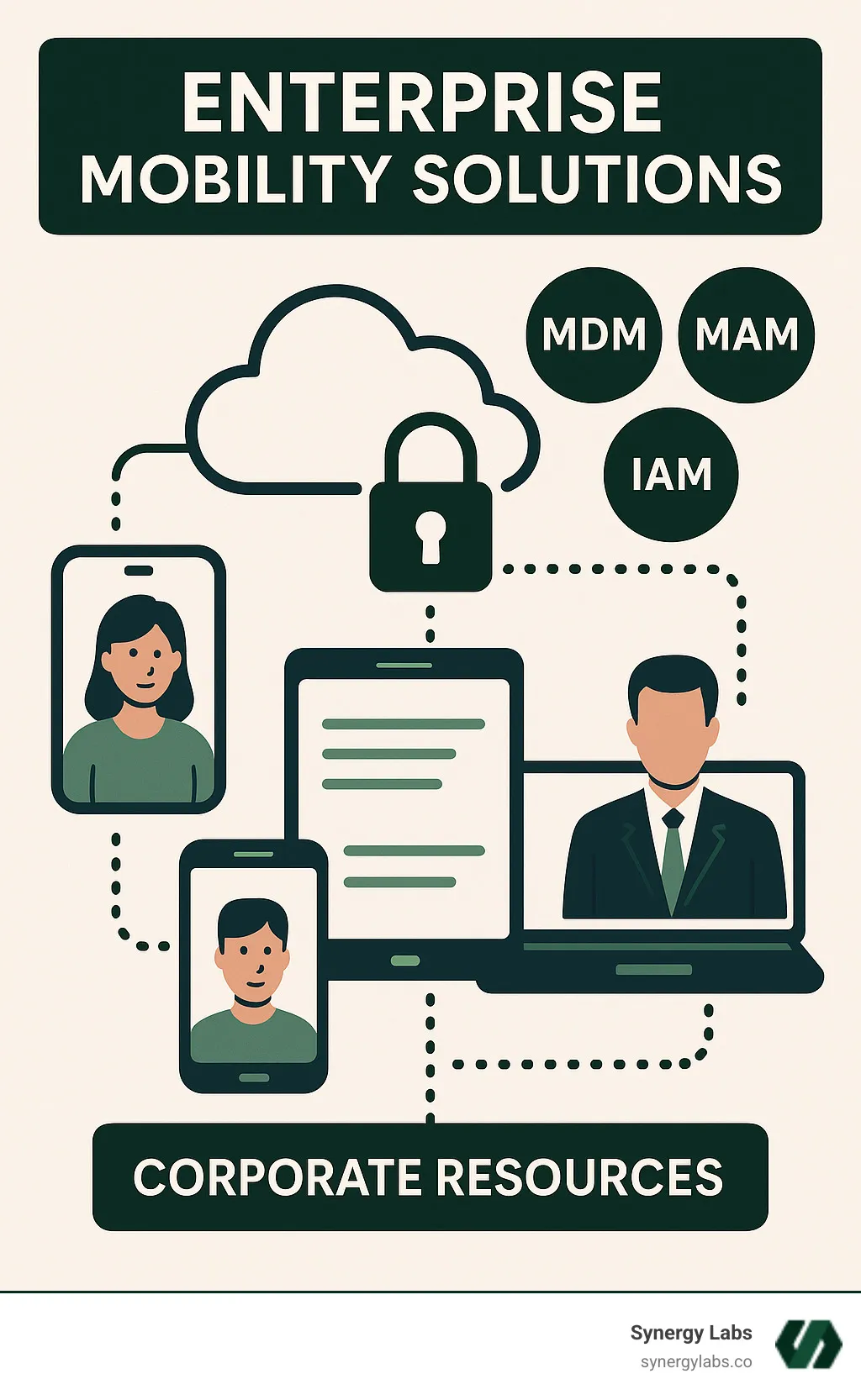
At their core, Enterprise mobility solutions are comprehensive systems that empower your team to work securely from anywhere. They're the invisible bridge connecting your employees to critical business resources, regardless of location or device. Think of them as the digital backbone supporting today's flexible work environments.
What exactly do these solutions include? Let's break it down:
What Are Enterprise Mobility Solutions?Key ComponentsSoftware and services that secure corporate data on mobile devices• Mobile Device Management (MDM)Enable workforce productivity across locations• Mobile Application Management (MAM)Support BYOD (Bring Your Own Device) policies• Identity and Access Management (IAM)Provide secure access to company resources• Information Management (MIM)Streamline operations through mobile workflows• Content Management (MCM)• Mobile Expense Management (MEM)
The numbers tell a compelling story about where we're headed. The global enterprise mobility market is on track to reach a staggering $69 billion by 2030, growing at a remarkable 24% annual rate. This explosive growth isn't just a trend—it reflects how essential mobility has become in our rapidly evolving business landscape.
As one recent industry report put it: "If the global pandemic has taught us one thing about work, it's that the flexibility to work from anywhere isn't a luxury but a necessity."
What's driving companies to accept these solutions? The benefits are substantial and measurable. Organizations implementing Enterprise mobility solutions typically see productivity increases of up to 30%. They also enjoy improved security through robust encryption and remote management capabilities, significant cost reductions from streamlined processes, improved team collaboration across distributed workforces, and more responsive customer engagement.
At Synergy Labs, we've witnessed how these solutions transform businesses—from field service teams accessing critical information on-site to executives making data-driven decisions through mobile dashboards while traveling.
Whether you're managing company-owned devices or navigating the complexities of BYOD policies, the right mobility approach doesn't just keep your business running—it gives you a competitive edge in today's digital-first economy.
The Rise of Enterprise Mobility
The world of work has changed forever, and enterprise mobility is leading the charge. By 2025, an estimated 1.87 billion people—over 57% of the global workforce—will be mobile workers, untethered from traditional office spaces.
Remember when working remotely was the exception, not the rule? The COVID-19 pandemic changed all that, compressing years of digital change into mere months. Companies that had been cautiously exploring remote work suddenly found themselves racing to provide secure access to critical systems from anywhere. This wasn't just an adjustment—it was a complete reimagining of workplace connectivity.
"A driving force of our success has always been to take care of customers and employees first, and everything else will follow," explains Chrissy Taylor, President and CEO of Enterprise Mobility. Her insight captures why enterprise mobility solutions have become the backbone of modern business continuity strategies.
This shift brings impressive benefits beyond just operational flexibility. Take sustainability, for instance. Enterprise-grade commuter vanpooling services have already eliminated over one billion commuter miles and prevented more than 400,000 metric tons of CO₂e emissions. As environmental targets become business imperatives, mobility solutions are proving to be powerful allies in meeting sustainability goals.
Security approaches are evolving too. The traditional network perimeter has essentially dissolved, replaced by zero-trust architectures that verify every access request regardless of where it originates. This approach is particularly vital for enterprise mobility solutions, where devices routinely connect from networks of varying security levels.
From Devices to Strategy: How Enterprise Mobility Has Evolved
Remember when "enterprise mobility" simply meant managing a handful of company BlackBerrys? Those days feel like ancient history.
What began as basic device management has blossomed into a comprehensive business strategy. Early mobility efforts focused primarily on provisioning corporate smartphones and providing basic security. Today, the landscape is dramatically richer, with sophisticated app-driven workflows changing entire industries.
Modern enterprise mobility solutions now accept:
Cross-platform application ecosystems that work seamlessly across devices
Edge computing capabilities that ensure productivity even offline
Integrated AI assistants that boost employee effectiveness
Electrification strategies for vehicle fleets to reduce carbon footprints
Comprehensive data analytics that support faster, better decisions
"It's an evolution, not a revolution," notes industry expert Chrissy Taylor. Her observation highlights how successful organizations approach mobility—through thoughtful progression rather than disruptive overhauls that risk overwhelming teams.
The smartphone's ubiquity has fundamentally altered employee expectations. Today's workers expect business applications to be as intuitive and responsive as their favorite consumer apps. This shift has sparked significant investment in user experience design, as organizations recognize that adoption rates directly correlate with how enjoyable an app is to use.
At Synergy Labs, we've witnessed this evolution firsthand. We've moved from simply creating mobile versions of desktop applications to designing comprehensive mobility ecosystems that transform business processes from the ground up. The smartphone isn't just another device anymore—it's often the primary interface between your business and both employees and customers.
What Are Enterprise Mobility Solutions?
Enterprise mobility solutions encompass the technologies, policies, and services that enable and manage the use of mobile devices and applications within an organization. These solutions do much more than just manage devices—they create secure, productive mobile workflows that transform how businesses operate in today's mobile-first world.
When discussing mobility solutions, it's important to distinguish between Enterprise Mobility Solutions (EMS) and Enterprise Mobility Management (EMM). Though often used interchangeably, EMM is actually a subset of EMS that focuses specifically on the management layer. A truly comprehensive EMS strategy includes EMM alongside application development, infrastructure planning, security architecture, and business process redesign.
The ecosystem of mobility solutions has evolved into a sophisticated framework with distinct components, each serving unique functions:
Solution TypePrimary FunctionKey FeaturesCommon Use CasesMobile Device Management (MDM)Secure, monitor and manage mobile devicesDevice enrollment, configuration, security policy enforcement, remote wipeCorporate-owned device fleets, BYOD enrollmentMobile Application Management (MAM)Control and secure enterprise appsApp whitelisting/blacklisting, app wrapping, secure distributionDeploying internal apps, preventing data leakageIdentity & Access Management (IAM)Control who accesses what resourcesSingle sign-on, multi-factor authentication, role-based accessSecure access to corporate resourcesMobile Information Management (MIM)Secure document access and sharingDocument encryption, access controls, DLPSecure document sharing, complianceMobile Content Management (MCM)Manage content across mobile devicesContent synchronization, version control, secure sharingField documentation, sales materialsMobile Expense Management (MEM)Track and optimize mobile spendingUsage monitoring, cost allocation, policy enforcementTelecom expense management, data usage optimization
As Chrissy Taylor aptly puts it, "We've set an ambitious vision to be recognized as the world's best and most trusted mobility company," highlighting how forward-thinking organizations now view mobility as a strategic advantage rather than just an IT concern.
Key Components of Enterprise Mobility Solutions (MDM, MAM, IAM)
At the heart of effective enterprise mobility solutions are several critical components that work together to create a secure, productive mobile ecosystem for today's workforce.
Mobile Device Management (MDM) serves as the foundation for most enterprise mobility implementations. Think of it as the command center that gives IT teams the power to enroll, configure, secure, and manage mobile devices across the organization. With MDM, administrators can remotely push security policies, distribute software updates, maintain device inventory, and—when necessary—lock or wipe devices that have been lost or compromised.
When it comes to applications, Mobile Application Management (MAM) takes center stage. This approach is particularly valuable in BYOD (Bring Your Own Device) scenarios, where organizations need to manage corporate apps without controlling personal ones. MAM creates a clear boundary between work and personal life on the same device. It allows IT teams to distribute approved apps through private app stores, "wrap" applications with additional security layers, and even selectively wipe business data while leaving personal content untouched.
Controlling who can access what is the domain of Identity and Access Management (IAM). Modern IAM solutions make life easier for employees with single sign-on capabilities, while keeping resources secure through multi-factor authentication. They can also adapt security requirements based on risk factors—for example, requiring additional verification when someone tries to access sensitive data from an unusual location.
Containerization represents another powerful concept in the mobility toolkit. This approach creates a secure, isolated environment on the device specifically for corporate data and applications. It's like having a secure office space on your personal device—what happens in the container stays in the container, protecting company information while respecting user privacy.
At Synergy Labs, our cross-platform expertise ensures that these components work harmoniously across iOS, Android, and other platforms. We believe effective mobility solutions should feel seamless to users while maintaining robust security behind the scenes. Learn more about our Cross-Platform App Development Service to see how we approach these challenges.
Enterprise Mobility Solutions and Remote/Hybrid Workforces
Enterprise mobility solutions have become the backbone of successful remote and hybrid work models. As organizations permanently accept flexible work arrangements, these solutions provide the essential infrastructure needed to maintain productivity, security, and collaboration—no matter where employees are located.
The traditional VPN connection is increasingly giving way to more modern approaches. Many organizations now implement VPN-less access through zero-trust network access (ZTNA) solutions, offering more precise control and smoother user experiences. Rather than granting access to the entire network, these systems verify both identity and device health before allowing access to specific applications—creating a more secure and streamlined experience.
True mobility means being productive even without an internet connection. Field workers, sales representatives, and traveling executives all encounter dead zones or connectivity challenges. Modern enterprise mobility solutions address this reality through intelligent data synchronization that works behind the scenes—storing changes locally, resolving conflicts intelligently, and prioritizing critical data when connectivity returns.
Today's collaboration platforms have evolved dramatically to support teams spread across different locations. These tools now seamlessly integrate messaging, video conferencing, document collaboration, and workflow management in unified mobile experiences. The best implementations allow work to flow naturally between desktop and mobile contexts, letting employees stay productive regardless of which device they happen to be using.
Organizations are increasingly focusing on digital employee experience (DEX) as a critical success factor. The quality of mobile tools directly impacts employee satisfaction, retention, and productivity. Forward-thinking companies now measure and continuously improve this experience through analytics and regular feedback loops.
As Chrissy Taylor thoughtfully notes, "Our aim is to create better experiences for how the world moves," highlighting how effective mobility solutions must prioritize user experience alongside security and functionality.
At Synergy Labs, we understand the nuances of designing for today's diverse work environments. Our collaborative approach ensures that mobile solutions meet the needs of different work styles and situations. Learn more about our App Development Team Collaboration to see how we bring these principles to life in real-world applications.
Business Benefits of Implementing Enterprise Mobility
When companies accept enterprise mobility solutions, they don't just get new technology—they open up remarkable business improvements across the board. Industry studies show that well-implemented mobility strategies can boost productivity by up to 30%. This isn't surprising when you consider how these solutions eliminate location constraints, slash downtime, and put critical information at employees' fingertips wherever they happen to be working.
The benefits extend to your IT department too. Organizations typically see support tickets drop by around 40% after deploying unified mobility platforms. This welcome relief comes from having standardized setups, empowering users with self-service options, and implementing smart monitoring systems that catch and fix problems before they disrupt your team's workflow.
The financial advantages go far beyond IT savings. Companies implementing enterprise mobility solutions typically enjoy:
Reduced real estate costs by enabling flexible work arrangements that require less office space. Lower travel expenses thanks to robust mobile collaboration tools that make many trips unnecessary. Decreased document costs as digital workflows replace printing and physical storage needs. Optimized mobile service plans through better visibility and management of usage. And improved asset utilization with improved tracking capabilities that maximize the value of your technology investments.
Perhaps the most valuable benefit in today's rapidly changing business landscape is flexibility. With enterprise mobility, your organization can pivot quickly when market conditions shift, whether you're scaling operations, entering new territories, or responding to unexpected disruptions. This adaptability proved invaluable during recent global challenges when mobile-ready companies adjusted far more smoothly than their less prepared competitors.
Your customers will notice the difference too. When your team has mobile access to complete information and systems, customer satisfaction metrics typically climb. Field technicians resolve issues faster with complete history at their fingertips. Sales representatives answer questions and process orders on the spot rather than promising to "get back to you." Support staff access knowledge bases from anywhere, providing faster, more accurate assistance.
"Real-time insights change how we make decisions," a client recently told us. Leaders no longer wait for weekly reports or rush back to the office to check dashboards. This immediacy accelerates your business rhythm and helps you respond to market shifts before competitors even notice them.
In today's sustainability-conscious environment, the environmental benefits of mobility solutions are increasingly important. Reduced commuting, lower paper usage, and optimized resource utilization all contribute to a smaller carbon footprint. The Commute with Enterprise program offers an impressive example, eliminating over one billion commuter miles and reducing carbon emissions by more than 400,000 metric tons.
Perhaps most exciting is how enterprise mobility solutions nurture a culture of innovation. When people can work flexibly and access systems from anywhere, they're more likely to experiment, collaborate across traditional boundaries, and develop fresh ideas. This cultural change often creates long-term competitive advantages that far outweigh the immediate operational benefits.
ROI Drivers & KPIs
Measuring the return on your mobility investment requires thoughtful planning. Start by developing a comprehensive Total Cost of Ownership (TCO) model that captures all aspects of implementation and operation.
On the cost side, be sure to account for hardware (devices and infrastructure), software (licenses and subscriptions), implementation services, ongoing operations, training, and security measures. Against these expenses, you'll want to track benefits across several key dimensions.
Your adoption metrics should include active users as a percentage of eligible staff, how frequently people use your mobile apps, which features get the most traction, user satisfaction scores, and time spent in mobile applications. These indicators help you understand if your solutions are actually being acceptd or just sitting unused.
For operational efficiency, track metrics like mean time to repair issues, first-call resolution rates, self-service utilization, process completion times, and automation rates. These measurements reveal how mobility is streamlining your day-to-day operations.
Business impact metrics connect mobility to your bottom line through revenue influenced by mobile tools, cost reductions from streamlined workflows, productivity gains, customer satisfaction improvements, and innovation metrics like ideas generated and implemented.
Don't overlook security and compliance measurements, including incident frequency, compliance scorecard metrics, risk assessment improvements, data protection effectiveness, and audit findings. These indicators help ensure your mobility program improves security rather than compromising it.
"A study conducted by Microsoft reveals that every one in three employees of companies uses enterprise mobility management platforms to get critical business tasks done," highlighting how central these solutions have become to core business functions.
At Synergy Labs, we believe effective ROI tracking should begin before implementation and continue throughout the solution lifecycle. This approach enables continuous optimization and helps you clearly demonstrate value to stakeholders across your organization.
Success Stories & Case Studies
Real-world examples best illustrate how enterprise mobility solutions transform businesses across industries and use cases.
A leading utilities provider revolutionized their field service operations with offline-capable mobile apps. Their technicians now access work orders, equipment histories, and troubleshooting guides regardless of connectivity. The impact was dramatic: first-time fix rates increased 27%, average repair time dropped by 35%, customer satisfaction jumped 42%, and they saved $3.2 million annually in operational costs. The ability to capture data in remote locations and synchronize it when connectivity returns proved especially valuable for crews working in rural areas.
In manufacturing, a company equipped their sales team with tablets featuring custom mobile apps that provided instant access to product catalogs, inventory status, and order submission capabilities. The results speak for themselves: average order value increased 22%, sales cycle length shortened by 18%, quote accuracy improved 31%, and they generated $4.7 million in additional annual revenue. Sales representatives particularly valued showing interactive product demonstrations and configuring complex orders while sitting with customers.
A financial services firm implemented secure mobile dashboards delivering real-time KPIs to their executive team. This solution enabled leaders to monitor performance metrics and respond to market changes from anywhere. The benefits were substantial: 40% faster response to market events, 25% shorter decision cycles, 30% more data-driven decisions, and $2.1 million in additional opportunity capture through faster responses. The ability to receive alerts and approve actions via mobile devices proved especially valuable during volatile market periods.
Enterprise Mobility's commuter vanpooling service demonstrates how mobility solutions deliver environmental benefits alongside business value. The program served more than 50,000 riders with over 10,000 vehicles, eliminating more than 1 billion commuter miles and reducing carbon emissions by over 400,000 metric tons. Beyond the environmental impact, the program significantly decreased employee commuting costs while improving satisfaction and retention.
These success stories represent just a fraction of the potential value. For more insights into the evolving enterprise mobility market, explore the latest research on enterprise mobility market.
Challenges and Best Practices for Deployment
Let's be honest – implementing enterprise mobility solutions isn't always smooth sailing. Even with their impressive benefits, organizations often encounter several roadblocks along the way. The good news? With the right approach, these challenges become manageable stepping stones rather than impossible barriers.
Device sprawl has become a genuine headache for IT departments everywhere. As employees use an ever-expanding collection of smartphones, tablets, laptops, wearables, and IoT devices, management complexity increases exponentially. At Synergy Labs, we've seen organizations successfully tackle this challenge by establishing clear device eligibility guidelines and implementing unified endpoint management solutions. Creating structured device lifecycle processes also prevents the accumulation of outdated, unsecured hardware floating around your organization.
Data governance takes on new dimensions in mobile environments. When your company information flows freely across devices, networks, and storage locations, maintaining control becomes tricky. Smart organizations address this by developing comprehensive frameworks that classify data, establish retention policies, and implement appropriate security controls. The key is finding that sweet spot between protection and accessibility – too restrictive, and employees will find workarounds; too open, and you risk exposure.
"The best security system in the world is useless if your employees hate using it," as one of our clients aptly put it. User experience often gets sacrificed at the altar of security and functionality, leading to poor adoption rates. Successful mobility initiatives prioritize UX through thoughtful research, iterative design, and continuous performance optimization. Your mobile solutions compete with consumer apps for your employees' attention – they expect the same level of polish and intuitive design.
Change management might not sound exciting, but it can make or break your mobility initiative. We've seen technically brilliant solutions fail simply because organizations didn't prepare their people for the change. Effective communication, comprehensive training, and visible executive sponsorship create the foundation for successful adoption. As one project leader told us, "We spent as much time planning how to introduce the solution as we did building it – and it was worth every minute."
Talent gaps present another significant challenge, particularly in specialized areas like mobile development and security. Not every organization can maintain a full roster of mobile experts, which is why many choose to partner with specialized providers (like Synergy Labs) while building internal capabilities through training and knowledge sharing. Creating centers of excellence can help distribute specialized knowledge throughout your organization.
Integration challenges are practically inevitable when connecting mobile solutions with legacy systems. The most successful organizations adopt API-first architecture approaches and implement robust middleware solutions where needed. Comprehensive testing across integration points helps identify issues before they impact users. And always have fallback plans – even the best integrations occasionally fail, and graceful degradation keeps your mobile solutions functioning when they do.
"If you believe your website is too small to be attacked, think again!" This warning applies equally to mobile solutions – security can never be an afterthought in your mobility strategy.
Overcoming Security & Compliance Problems
Security and compliance concerns keep many IT leaders awake at night when implementing enterprise mobility solutions. The distributed nature of mobile workforces creates inherent vulnerabilities that demand systematic attention.
Encryption forms the bedrock of mobile security, protecting your valuable data whether it's sitting on a device or zooming across networks. Strong implementations include full-device encryption for corporate assets, app-level encryption for sensitive information, and secure transport protocols for all communications. One often overlooked aspect is key management – even the strongest encryption becomes vulnerable with poor key handling practices.
Multi-factor authentication has evolved from a nice-to-have to an absolute necessity. The days of relying solely on passwords are long behind us, especially in mobile environments. Modern MFA approaches blend convenience with security through biometric factors, push notifications, and contextual authentication that considers the user's location, device, and behavior patterns. As one security expert colorfully put it, "Passwords are like underwear – don't share them, change them regularly, and don't leave them lying around."
Regulatory compliance adds another layer of complexity to mobile deployments. Whether you're dealing with GDPR, HIPAA, or industry-specific regulations, you need structured approaches to maintain compliance. This includes comprehensive data mapping, privacy impact assessments, and region-specific controls to address data residency requirements. Automated compliance monitoring helps identify potential issues before they become regulatory violations.
Zero-trust security models have emerged as the gold standard for mobile environments. Rather than assuming anything inside your network is safe, zero-trust follows the "never trust, always verify" principle. Every access request is thoroughly validated regardless of source. This approach includes continuous verification of identity and device health, least-privilege access controls, and comprehensive monitoring to detect suspicious activities.
Remote wipe capabilities provide essential protection when devices go missing. Modern implementations offer nuanced options beyond the all-or-nothing approach of the past. Organizations can selectively remove corporate data while leaving personal information intact on BYOD devices, or trigger automatic wipes based on specific conditions like failed authentication attempts or geographic boundaries.
At Synergy Labs, we understand that security must be invisible to be effective. As one industry study noted, "Only a 'one-second delay' in website loading time can drop conversion rates by 7%." The same principle applies to mobile security – if it significantly degrades performance or user experience, people will find ways around it.
Successfully deploying enterprise mobility solutions is more marathon than sprint. A thoughtfully phased approach helps organizations deliver early wins while building toward comprehensive coverage.
Start with a thorough needs assessment and strategy development. This foundational phase involves speaking with stakeholders across your organization to understand their mobility challenges and opportunities. Document the current technology landscape, identify integration points, and develop clear KPIs tied to business objectives. This groundwork might seem time-consuming, but it prevents costly redirections later.
Securing stakeholder buy-in comes next, and it's more art than science. Present compelling business cases with realistic ROI projections. Identify and engage executive sponsors who can champion your initiative. Establish a cross-functional steering committee to ensure diverse perspectives inform your decisions. As one successful project leader told us, "The time spent building consensus early saved us months of resistance later."
The pilot launch phase provides a controlled environment to validate your approach. Select representative user groups who can provide meaningful feedback. Implement core functionality and collect detailed input through surveys, interviews, and usage analytics. Measure performance against your established KPIs and refine the solution based on real-world experience. One client described this phase as "our safety net – we learned more in two weeks of pilot testing than in months of planning."
Scaled deployment requires careful orchestration. Develop a phased rollout plan that considers business priorities and technical dependencies. Implement comprehensive training programs that address different learning styles and technical comfort levels. Establish operational processes for ongoing management and support. Throughout this phase, proactive communication about successes and transparent addressing of concerns helps maintain momentum.
Continuous optimization is where many organizations falter, but it's where the greatest long-term value emerges. Implement automated testing for new releases and updates. Analyze usage data to identify improvement opportunities. Establish regular review cycles with stakeholders to ensure alignment with evolving business needs. Continuously improve security postures based on emerging threats. As one client aptly put it, "The day we launched wasn't the finish line – it was just the starting gun."
Throughout this journey, balancing technical excellence with user adoption remains crucial. At Synergy Labs, we've learned that successful implementations require both solid architecture and human-centered design. Even the most technically perfect solution fails if users don't accept it.
The world of enterprise mobility solutions is constantly evolving, with exciting new technologies reshaping how businesses approach mobile work. Let's explore what's on the horizon for organizations embracing mobility.
AI co-pilots are perhaps the most transformative development we're seeing today. These aren't just simple chatbots – they're sophisticated digital assistants that work alongside employees to boost productivity in remarkable ways. They can draft emails based on your previous communications, automate those tedious repetitive tasks, proactively bring important information to your attention, provide on-the-spot guidance, and continuously learn from how you work to get better over time.
"AI-enabled app generation automatically converts existing business processes into digital apps, accelerating deployment by up to 100×," notes one industry observer, highlighting just how dramatically these technologies are changing the development landscape.
The combination of 5G and edge computing is opening doors to experiences that simply weren't possible before. With virtually no latency, massive bandwidth, and processing power pushed to the network edge, organizations can now implement advanced augmented reality for field technicians, analyze data in real-time where it's collected, connect thousands of IoT devices with minimal infrastructure, and enable crystal-clear video collaboration for remote teams.
Low-code and no-code platforms are democratizing app creation in fascinating ways. Business users who understand their processes intimately can now build their own mobile solutions without waiting for IT or development resources. This shift is accelerating innovation across organizations and helping clear those perpetual development backlogs that have frustrated business units for years.
Wearable technology and extended reality (XR) are moving beyond consumer gadgets into serious business tools. Smart glasses allow warehouse workers to process orders hands-free. VR headsets create immersive training environments for everything from surgery to equipment repair. Smartwatches monitor health metrics for employees in dangerous environments. These technologies aren't just cool – they're solving real business problems in innovative ways.
For organizations with vehicle fleets, electrification represents a major trend with both operational and sustainability implications. Enterprise Mobility achieved record revenue exceeding $38 billion in fiscal year 2024, with significant investments flowing into electric vehicle infrastructure and management solutions.
The market numbers tell a compelling story about the future of mobility. Projected to reach a staggering $69 billion by 2030 with a compound annual growth rate of nearly 24%, enterprise mobility solutions are clearly becoming essential rather than optional for forward-thinking organizations.
Sustainability requirements are increasingly shaping mobility strategies as well. As organizations face mounting pressure to reduce their environmental impact, mobility solutions provide powerful tools to help meet these goals. Remote work capabilities reduce commuting emissions. Digital workflows eliminate paper waste. Better coordination tools optimize travel. Energy-efficient mobile architectures minimize power consumption. And new carbon tracking features help organizations measure and report their progress.
At Synergy Labs, we keep a close eye on these emerging trends to ensure our clients stay ahead of the curve. We believe the best approach isn't just responding to today's needs but anticipating tomorrow's opportunities.
Choosing the Right Partner for Your Enterprise Mobility Solutions
Finding the perfect partner for your enterprise mobility solutions is one of the most important decisions you'll make on your digital change journey. The right partner brings more than just technical know-how – they bring strategic vision and real-world experience that dramatically increases your chances of success.
When evaluating potential mobility partners, consider these key factors:
First, look closely at their technical capabilities. Do they have experience developing across multiple platforms like iOS, Android and web? Have they successfully integrated with systems similar to yours? Do they have deep expertise in security and compliance? Can they demonstrate strong user experience design skills? And have they acceptd modern DevOps practices for smooth delivery?
Next, assess their strategic approach. How do they gather and analyze business requirements? Do they understand the specific challenges of your industry? Can they help with change management to ensure adoption? How do they measure and optimize performance? And importantly, how do they approach innovation to future-proof your investment?
Support and maintenance considerations are equally crucial. What service level agreements do they offer for critical issues? How do they handle ongoing improvements? What's their approach to security updates and vulnerability management? Do they proactively monitor performance? And will they provide thorough documentation and knowledge transfer?
Perhaps most overlooked but vitally important is cultural alignment. Does their communication style match yours? How do they approach problem-solving? Do their values align with your organization? Is their team stable, ensuring knowledge continuity? And do they approach the relationship as a true partnership rather than just a transaction?
"A driving force of our success has always been to take care of customers and employees first, and everything else will follow," reflects an important principle when selecting a partner. The best relationships combine technical excellence with genuine care for your business outcomes.
At Synergy Labs, we take pride in our personalized approach, giving clients direct access to senior talent throughout the engagement. Our cross-platform expertise ensures your mobility solutions work flawlessly across all environments, while our security focus protects your most valuable assets.
We're passionate about helping organizations steer the complexities of enterprise mobility implementation. To learn more about how we can support your mobility journey, explore our services.
Frequently Asked Questions about Enterprise Mobility Solutions
What industries benefit most from enterprise mobility solutions?
While enterprise mobility solutions deliver value across virtually all sectors, certain industries are experiencing particularly dramatic changes.
Healthcare providers have acceptd mobility in ways that directly improve patient outcomes. Clinicians now access complete patient records right at the bedside, making more informed decisions in the moment. Remote monitoring applications have extended care beyond hospital walls, allowing patients to recover at home while staying connected to their care teams. A doctor at a leading hospital recently shared, "Having complete medical histories in my pocket has changed how I practice medicine—I can make better decisions faster."
Manufacturing has seen a revolution on the factory floor. Workers use tablets and ruggedized devices to monitor production in real-time, conduct quality checks, and manage maintenance schedules without leaving their stations. Some facilities have implemented augmented reality solutions that overlay visual instructions for complex assembly tasks, reducing errors by up to 40% in some cases.
Field service operations might be the perfect showcase for mobility's potential. Technicians arrive at customer locations with complete work histories, technical documentation, and inventory information at their fingertips. GPS integration optimizes routing between jobs, while mobile payment processing means no more paper invoices or delayed billing cycles. One HVAC company reported a 27% increase in jobs completed per day after deploying their mobile solution.
Retailers have finded that freeing associates from fixed checkout stations creates entirely new customer experiences. Mobile point-of-sale systems allow transactions anywhere in the store, reducing abandoned purchases due to long lines. Store associates with inventory apps can instantly check stock levels across locations, while clienteling applications help them remember customer preferences and purchase history.
Financial services firms have transformed client meetings with mobile portfolio access and real-time market data. Mobile onboarding has slashed paperwork and accelerated account opening from days to minutes. Secure messaging platforms facilitate compliant client communications, even for highly regulated interactions.
The common thread? Enterprise mobility solutions bring critical information and capabilities directly to the point of need—whether that's a hospital room, factory floor, customer's home, retail aisle, or client meeting.
How do enterprise mobility solutions protect corporate data on BYOD devices?
The challenge of securing company information on personal devices represents one of the trickiest balancing acts in the mobility world. Today's enterprise mobility solutions employ sophisticated approaches that protect corporate assets while respecting personal privacy.
Application containerization creates what's essentially a secure corporate "bubble" on personal devices. This encrypted environment keeps work apps and data completely separate from personal content. As one IT director put it, "It's like having two phones in one—employees can keep their personal lives private while we maintain security over company information."
Behind the scenes, conditional access policies work like digital bouncers, evaluating multiple risk factors before granting access to corporate resources. These systems consider the device's security status, location, network connection, and even unusual user behavior patterns. An employee trying to access sensitive financial data at 3 AM from an unfamiliar location might trigger additional verification steps or be denied access entirely.
Mobile Application Management (MAM) provides granular control over how corporate apps behave on personal devices. IT teams can prevent copying and pasting between work and personal apps, block screenshots of sensitive information, control document sharing permissions, and enforce encryption for stored data. Perhaps most importantly for BYOD scenarios, MAM enables selective remote wiping of only corporate data if a device is lost or an employee leaves—leaving personal photos and messages untouched.
Data Loss Prevention technologies act as vigilant guardians, monitoring data movements and preventing unauthorized sharing. These tools can spot when someone tries to forward a confidential email to a personal account or save protected documents to personal cloud storage.
Identity and Access Management systems serve as the foundation of this security ecosystem, ensuring that only the right people access corporate resources. Multi-factor authentication adds essential security layers, while single sign-on capabilities prevent the frustration of managing multiple passwords.
"If there's anything that's 'super non-negotiable' in custom enterprise software development, that's none other than compromising the user's security and privacy," notes a security expert, highlighting the critical importance of balancing protection with usability.
At Synergy Labs, we design BYOD security that protects what matters while respecting personal boundaries. This balanced approach leads to higher adoption rates and better overall security posture.
What is the typical timeline and cost to deploy an enterprise mobility solution?
When clients ask about timelines and budgets for enterprise mobility solutions, I always start with, "Well, that depends on what we're building." While there's no one-size-fits-all answer, I can share some general guidelines based on our experience.
For basic Mobile Device Management implementation, most organizations can be up and running in 1-3 months. This typically includes device enrollment, basic security policies, and simple inventory management. It's like setting up the foundation of your mobility house—not particularly exciting, but essential for everything that follows.
More comprehensive Enterprise Mobility Management deployments usually take 3-6 months. These projects integrate device management with application controls and identity systems, creating a more complete security framework. The timeline extends because proper security policy development requires thoughtful consideration of business needs and risk tolerance.
Custom mobile application development varies widely, typically ranging from 4-12 months depending on complexity. A simple field data collection app might take just a few months, while a comprehensive customer-facing platform integrated with multiple backend systems could require a year or more. At Synergy Labs, we often break larger projects into phases to deliver value sooner while continuing to build toward the complete vision.
Enterprise-wide mobility changes often span 12-24 months. These comprehensive programs include strategy development, multiple application deployments, integration with core business systems, and robust security frameworks. The timeline reflects not just technical work but the organizational change management required for successful adoption.
Cost factors fall into several categories. Licensing and infrastructure typically run $20-200 per device annually, depending on the sophistication of your management platform and security tools. Custom application development ranges from $50,000 for simpler apps to $500,000+ for complex, mission-critical solutions with extensive integration requirements.
Implementation services—including strategy, technical work, integration, testing, and training—can range from $75,000 for targeted solutions to well over $1,000,000 for enterprise-wide programs. Ongoing operations generally require 15-25% of implementation costs annually to maintain platforms, improve applications, monitor security, and support users.
"Average custom enterprise solution development cost ranges from $100,000 to $1,000,000," which aligns with what we typically see at Synergy Labs. We work with clients to develop right-sized approaches that deliver maximum value while respecting budget constraints.
Many organizations find success with phased implementations, starting with high-value use cases that generate quick wins. This approach allows for value realization that helps fund subsequent phases while reducing implementation risks. A telecommunications client recently told me, "Breaking our mobility project into three phases not only made it more manageable—it actually built momentum as early successes created advocates for later phases."
Conclusion
As we've explored throughout this guide, enterprise mobility solutions have become so much more than simple device management tools. They've evolved into strategic enablers that fundamentally transform how organizations operate. Today's workforce expects seamless, secure access to business resources from anywhere, at any time, on any device – and meeting these expectations is no longer optional.
The business benefits we've seen are compelling and tangible. Organizations implementing robust mobility strategies enjoy increased productivity, with some seeing efficiency gains of up to 30%. They also benefit from improved security through modern approaches like zero-trust architectures. Operational costs typically decrease, while collaboration flourishes across distributed teams. Perhaps most importantly, customer engagement improves as employees gain the tools to respond more quickly and effectively to needs.
Success doesn't come automatically, though. Organizations must steer significant challenges around security, integration, user experience, and change management. We've found that a structured, phased approach works best – one that balances technical excellence with thoughtful user adoption strategies. Having an experienced partner by your side can make all the difference in this journey.
Looking ahead, the future of enterprise mobility solutions looks incredibly promising. AI co-pilots will soon transform how we work with mobile apps, making them more intuitive and proactive. The combination of 5G and edge computing will enable entirely new classes of mobile experiences. Extended reality technologies will blur the line between physical and digital workspaces. Organizations that build strong mobility foundations today will be perfectly positioned to leverage these innovations as they mature.
At Synergy Labs, we're passionate about helping organizations steer this complex landscape. Our approach combines deep technical expertise with strategic insight, ensuring that your mobility solutions deliver real business value. We provide:
Personalized service where you work directly with senior talent, not junior associates
Secure, scalable cross-platform applications that work beautifully across all devices
Rapid launches that get you to market quickly, with ongoing support as you grow
User-centered design that drives adoption and satisfaction among your team
Robust security engineering that protects your most valuable assets without compromising usability
Whether you're just starting your mobility journey or looking to improve existing capabilities, we'd love to help. We invite you to explore our services and find how Synergy Labs can help you achieve your mobility objectives.
The future of work is undeniably mobile, and the time to act is now. With the right strategy, technology, and partners, your organization can harness the transformative power of enterprise mobility solutions to drive growth, innovation, and competitive advantage in today's digital economy.








.avif)

.avif)


