Why App Maintenance Costs Catch Most Founders Off Guard

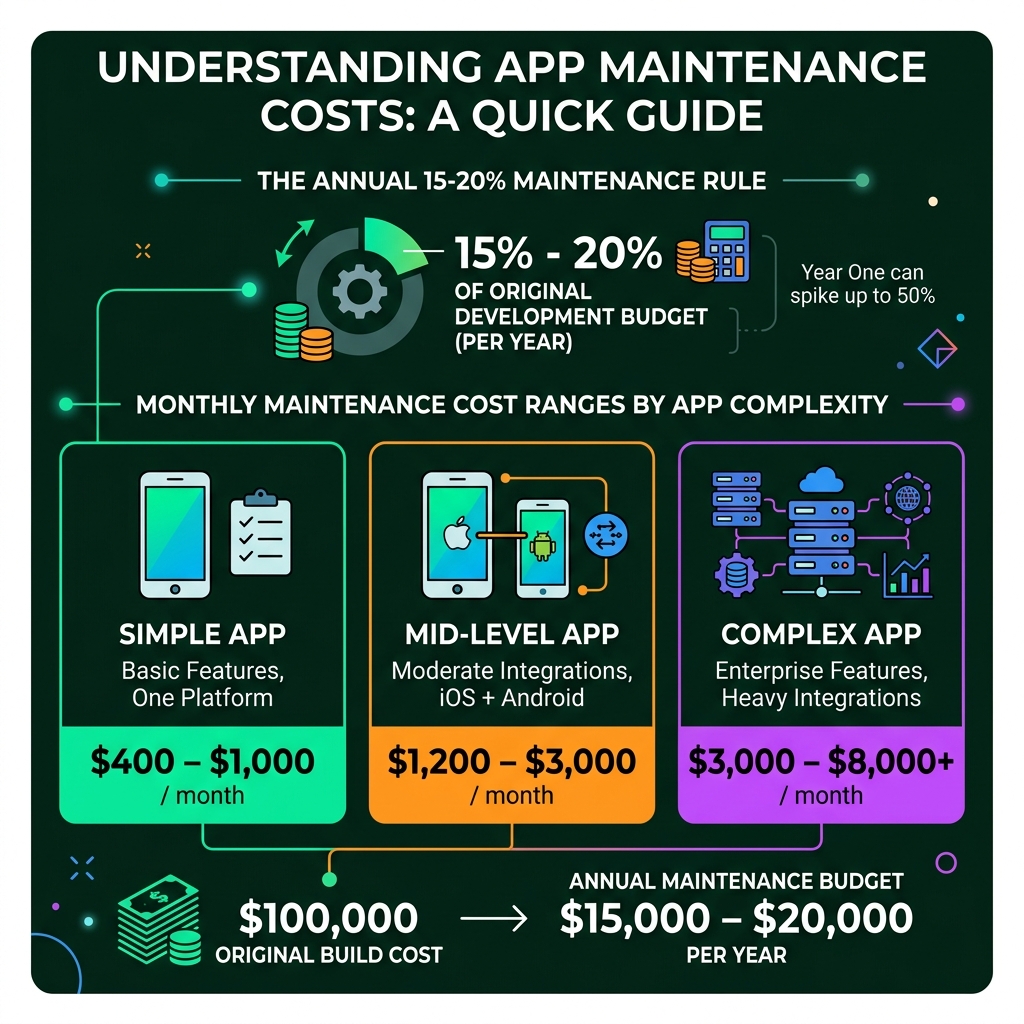
App maintenance costs typically run between 15% and 20% of your original development budget every single year — and in year one, that figure can spike to 50%.
Here's a quick breakdown of what to expect:
- Simple app (basic features, one platform): $400–$1,000/month
- Mid-level app (moderate integrations, iOS + Android): $1,200–$3,000/month
- Complex app (enterprise features, heavy integrations): $3,000–$8,000+/month
- Annual rule of thumb: Multiply your original build cost by 0.15–0.20
So if you spent $100,000 building your app, budget at least $15,000–$20,000 per year just to keep it alive and healthy.
You planned for design. You planned for development. You even planned for launch day. But the bill that arrives in month two? That one catches most founders completely off guard.
The reality is that launching an app is the starting line, not the finish line. Every major iOS and Android release, every new device, every security vulnerability, every user expectation shift — all of it demands ongoing attention. And ongoing attention costs money.
In 2024 alone, over 2.6 million apps were removed from major app stores. Many weren't pulled because they were bad ideas. They were pulled because they were neglected.
At Synergy Labs, we've guided startups through the full lifecycle of app development — including the part nobody budgets for — and understanding app maintenance costs upfront is one of the most important things we help our clients do. In the sections below, we'll break down exactly where your money goes, what drives costs up, and how to keep your budget from ballooning.
The Post-Launch Reality: What App Maintenance Actually Entails

When we talk about maintenance, many founders imagine a "set it and forget it" machine that only needs a quick oil change once a year. In the software world, it’s more like tending to a living garden. If you stop watering it, the weeds (bugs) take over, and the fruit (user experience) withers.
To understand your app maintenance costs, we first have to categorize the work. Professional maintenance isn't just one task; it's a multi-layered strategy:
- Corrective Maintenance: This is the classic "bug fixing." No matter how much you test before launch, real-world users will find edge cases. A button might not work on a specific Samsung model, or a payment might hang if the user's Wi-Fi drops at the exact wrong second.
- Adaptive Maintenance: The digital environment changes constantly. When Apple releases iOS 19 or Google updates Android’s privacy permissions, your app must adapt or it will literally stop functioning.
- Perfective Maintenance: This is about listening to your users. If 70% of your users are accessing the app late at night, adding a "Dark Mode" is perfective maintenance. It improves the experience based on real data.
- Preventive Maintenance: We call this "reducing technical debt." It involves cleaning up code, updating documentation, and ensuring the backend can handle 10,000 users as easily as it handled 100.
- Emergency Maintenance: These are the "all hands on deck" moments. If your server goes down during a holiday sale or a critical security vulnerability is discovered, emergency fixes are required immediately. These often cost 3x to 5x more than planned updates due to the urgency involved.
Maintaining high stability is a massive competitive advantage. Research shows that apps maintaining a 99% crash-free rate retain 42% more monthly active users than those that let stability slip. For more details on how we structure these phases, check out our app development services.
The High Stakes of Neglecting Your App
What happens if you decide to skip the maintenance bill? In 2026, the consequences are swifter than ever.
App stores have become aggressive about "purging" abandoned software. In late 2024 and early 2026, Google Play removed nearly 47% of its total apps—dropping from 3.4 million to roughly 1.8 million. If your app hasn't been updated in two years, it’s a prime candidate for delisting.
Beyond store removal, there's the risk of user churn. 71% of users will uninstall an app immediately if it crashes or performs poorly. Then there’s the legal side: GDPR and HIPAA fines for non-compliant, unpatched apps can reach staggering heights, with some HIPAA violations resulting in fines up to $1.5 million annually.
Essential Activities for Long-Term Success
To keep your app in the "success" column, your maintenance team should be performing these activities regularly:
- Security Patches: New vulnerabilities are discovered daily. Regular audits (costing $1,000–$10,000 annually) are non-negotiable.
- API Management: Your app likely talks to other services (Stripe, Google Maps, etc.). When those services update their code, your app needs to be updated too.
- Performance Monitoring: Using tools like Firebase or Sentry to watch for lags or crashes in real-time.
- UI/UX Refreshes: Keeping the design looking modern so users don't feel like they're using a digital relic from 2022.
Breaking Down the Real app maintenance costs in 2026
Budgeting for app maintenance costs requires looking at both fixed and variable expenses. While the 15–20% rule is a battle-tested benchmark, 2026 has introduced new variables, especially regarding AI integration and cloud infrastructure.
For a deep dive into how these costs scale for larger organizations, see our guide on enterprise-grade app development.
Infrastructure and Hosting Fees
Your app needs a home. Hosting fees are the "rent" you pay to keep your backend running.
- Small Apps: $70–$320 per month.
- Mid-Scale: $500–$2,000 per month.
- Enterprise: $3,000–$10,000+ per month.
One major drain on budgets is the hidden cost of idle virtual machines (VMs). If your servers are running at full capacity at 3:00 AM when no one is using the app, you are throwing money away. Modern DevOps practices and auto-scaling can save thousands of dollars a year by adjusting resources based on actual traffic.
Third-Party Integrations and Licenses
Most modern apps are "mashups" of various services. Each of these carries its own recurring cost:
- Payment Processors: Stripe and similar gateways typically charge 2.9% + $0.30 per transaction, but there are often monthly "pro" fees for advanced reporting.
- Mapping Services: The Google Maps API is free up to a point, but high-traffic apps can see bills of $5,000+ annually just for map credits.
- Push Notifications: Services like OneSignal or Firebase Cloud Messaging often have free tiers, but enterprise features (like advanced segmentation) require paid subscriptions.
- App Store Fees: Don't forget the basics. Apple charges $99/year, while Google Play has a one-time $25 fee. Both platforms generally take a 15% to 30% cut of in-app purchases.
The Hidden Drivers: Why Some Apps Cost More to Keep Alive
Not all apps are created equal. A simple internal tool for a small team in Miami will have vastly different app maintenance costs than a social media platform used in Dubai and Riyadh.
The architecture you choose today dictates your bills tomorrow. For example, scalable app architecture might cost more upfront but prevents the "rebuild from scratch" nightmare two years down the road.
How Complexity Drives Your app maintenance costs
Complexity isn't just about how many buttons your app has; it's about what happens behind the scenes.
- AI-Native Features: If your app uses LLMs (Large Language Models), you have "Token Management" costs. Maintaining AI prompts and ensuring the AI doesn't start hallucinating after a model update is a new, specialized maintenance task for 2026.
- Data Flow: Apps that handle real-time data (like a ride-sharing app or a stock trading platform) require much more intensive server monitoring than a standard e-commerce store.
- Regulatory Compliance: If you operate in London or Chicago, you deal with different privacy laws (GDPR vs. US state laws). Keeping your data encryption up to date to avoid fines is a major cost driver.
If you build "Native" apps (one separate app for iOS and one for Android), you are essentially doubling your app maintenance costs. Every time a bug is found, it has to be fixed twice. Every time a feature is added, it has to be developed twice.
This is why we often recommend cross-platform frameworks like Flutter or React Native. By maintaining a single codebase, you can reduce your long-term maintenance workload by nearly 50%. However, Android fragmentation remains a challenge; your app needs to work on everything from a high-end Pixel to a budget device used in Doha, which requires an extensive QA device matrix.
Global Benchmarks: Regional Rates and Developer Labor
Where your developers sit has the single biggest impact on your monthly maintenance bill. While we are headquartered in Miami, we utilize a global talent model to balance quality and cost.
The decision between in-house vs. outsourcing is often a matter of scale. An in-house developer in San Francisco might cost $150,000/year plus benefits, whereas a managed maintenance retainer with an agency can provide a full team (QA, DevOps, and Developer) for a fraction of that cost.
Comparing Hourly Rates by Region
Here is how the hourly rates for maintenance talent break down globally in 2026:
- North America (Miami, NYC, SF): $100–$200/hour. High quality, same time zone, but the most expensive.
- Western Europe (London): $70–$150/hour. Excellent standards and strong compliance knowledge.
- Eastern Europe: $30–$70/hour. A "sweet spot" for many startups, offering high technical skill at a moderate price.
- South Asia (India): $20–$50/hour. The most cost-effective for routine bug fixes and 24/7 support.
- South America: $40–$70/hour. Growing in popularity for US-based companies due to time zone alignment.
The Cost of Specialized Talent
Maintenance isn't just "coding." A healthy app ecosystem requires:
- QA Engineers: To run regression tests every time a change is made.
- DevOps Specialists: To manage those servers and "idle VM" costs we mentioned.
- Security Auditors: To perform penetration testing and ensure you aren't the next headline-grabbing data breach.
- Customer Support Reps: Charging $15–$25/hour to handle user tickets and feedback, which then feeds into your maintenance roadmap.
Future-Proofing Your Budget: How to Optimize app maintenance costs
You can't eliminate app maintenance costs, but you can certainly optimize them. Smart founders treat maintenance as a strategic lever, not a tax. To get a head start on your numbers, you can use a mobile app cost calculator to model different scenarios.
Smart Strategies to Lower Your app maintenance costs
- The MVP Approach: Don't build 50 features if your users only need 5. Every line of code you don't write is a line of code you don't have to maintain.
- Modular Architecture: Build your app like LEGO bricks. If the payment module needs an update, you should be able to swap it out without breaking the login screen.
- Automated Testing: Investing in automated scripts during development might seem expensive, but it saves hundreds of manual QA hours during every future update.
- CI/CD Pipelines: Implementing Continuous Integration and Continuous Deployment allows for smaller, more frequent updates. Small updates are easier to fix than giant, once-a-year overhauls.
When to Rebuild Instead of Maintain
Sometimes, maintenance becomes "rework." If you find that you are spending more on "fixing" old bugs than you would on building a fresh version, it might be time to move on.
Signals that you should consider a rebuild include:
- Your app takes more than 3 seconds to load despite optimization.
- You can't find developers who know your "legacy" tech stack.
- Your monthly maintenance bill has surpassed 30% of your original build cost.
In these cases, legacy system modernization is actually the more cost-effective path forward.
Frequently Asked Questions about app maintenance costs
Is app maintenance a one-time or recurring cost?
It is strictly a recurring cost. Think of it like a utility bill for your business. While some months might be "heavier" (like during a major iOS launch), you should have a baseline monthly retainer to ensure your app stays secure and functional.
How often should I update my mobile app in 2026?
We recommend pushing small updates (bug fixes, performance tweaks) every 2 to 4 weeks. Major feature updates or compatibility overhauls usually happen quarterly or annually following major OS releases.
Can I handle app maintenance myself to save money?
You can certainly handle "content" updates (changing prices or text) through a CMS. However, technical maintenance—server management, security patching, and OS debugging—requires professional expertise. DIY maintenance on a complex app often leads to "emergency" bills that are significantly higher than a standard retainer.
Beyond the Bill: Partnering with Synergy Labs for Sustainable Growth
Navigating app maintenance costs doesn't have to be a series of unpleasant surprises. At Synergy Labs, we believe that transparency is the foundation of a great partnership. Whether you are based in Miami, Dubai, or London, our goal is to provide you with a predictable, high-value roadmap for your app’s entire lifecycle.
We pride ourselves on our personalized service. When you work with us, you aren't just a ticket number in a system; you have direct access to senior talent who understand your business goals. We specialize in creating high-quality, scalable, cross-platform apps that are "maintainable by design."
Our unique model is built for your peace of mind:
- Fixed-Budget Model: We hate "hidden fees" as much as you do. We work with you to establish clear, predictable costs from day one.
- In-Shore CTO, Offshore Dev Team: You get the strategic leadership of a US-based CTO with the cost-efficiency of a world-class offshore development team.
- Milestone-Based Payments: You only pay when real, verifiable progress is made. This ensures your project stays on track and within budget.
Don't let your app become one of the millions delisted due to neglect. Let's build something that lasts.
Contact Synergy Labs today to schedule a free app health check


.avif)

.avif)


