

Why Comparing Staff Augmentation Services Is the Smartest Move You Can Make in 2026

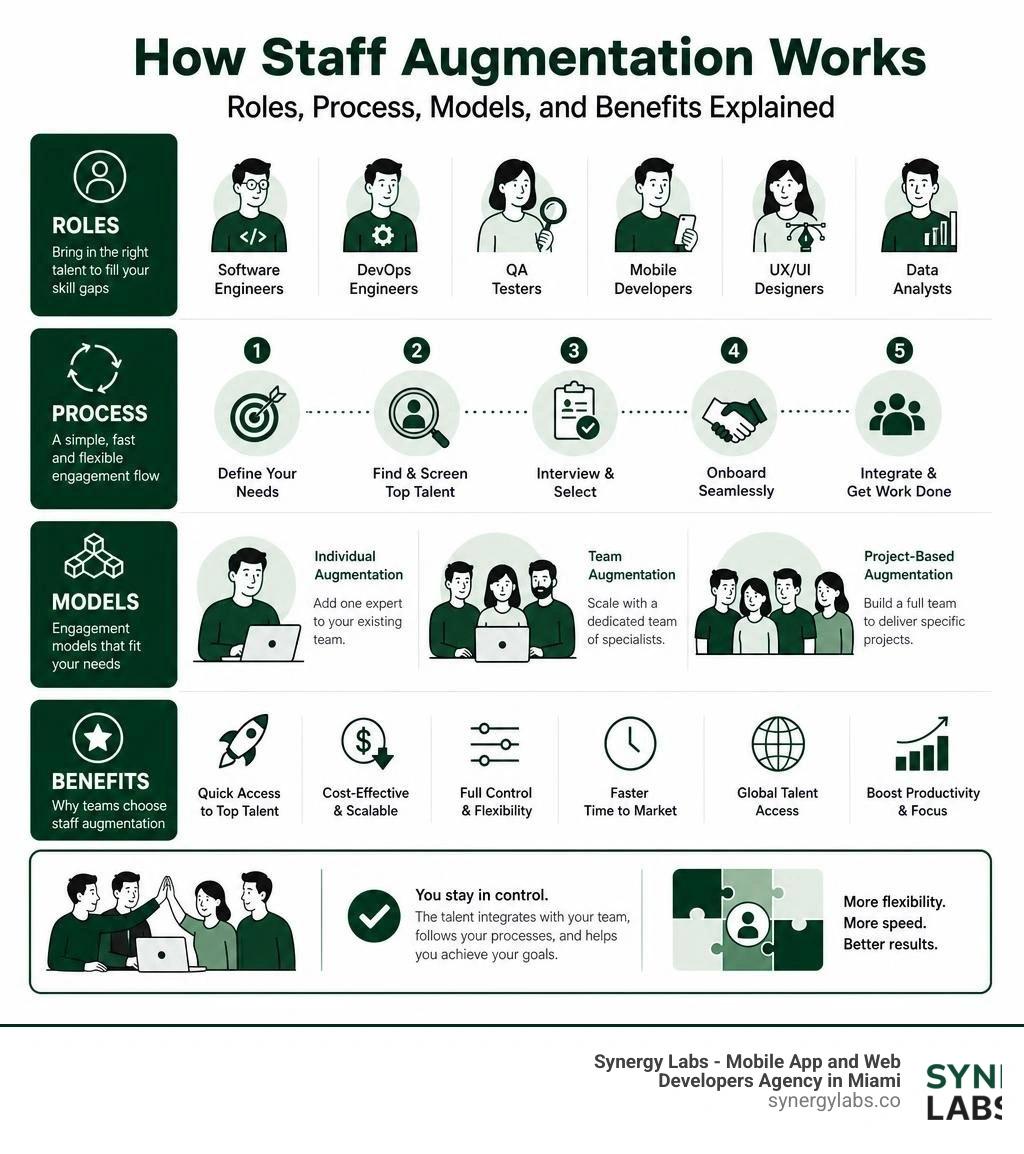
Staff augmentation services let you add skilled external professionals directly to your team — without the cost, delay, or commitment of full-time hiring.
Here's a quick snapshot of what they cover:
- What it is: Temporarily embedding external talent into your existing team, under your management
- Best for: Skill gaps, product launches, scaling sprints, and global expansion
- Time-to-hire: 7–21 days on average, vs. 60–90 days for traditional hiring
- Cost savings: 30–40% lower than equivalent in-house hiring
- Key difference from outsourcing: You keep full control — the work stays in-house
- Common roles: Software engineers, DevOps, QA testers, mobile developers, UX/UI designers, data analysts
The challenge most founders face isn't finding staff augmentation options — it's knowing which model actually fits their situation. Short-term or long-term? Onshore or offshore? One contractor or a full pod? The wrong choice can cost you months and burn through your budget.
That's exactly what this guide is here to solve.
At Synergy Labs, our team works hands-on with staff augmentation services as part of how we help startups scale their mobile and web development teams without the overhead of permanent hires. We've seen what works — and what quietly derails projects six months in.
Key staff augmentation services vocabulary:
What is Staff Augmentation and How Does It Differ From Other Models?

To make an informed decision, we must first understand exactly what staff augmentation is and how it functions. At its core, staff augmentation is a flexible outsourcing strategy where we bring in external, highly skilled professionals on a temporary or long-term basis to fill specific roles within our organization. These professionals do not operate in a vacuum; instead, they integrate directly into our daily operations, attend our team meetings, use our tools, and report directly to our internal project managers.
The defining characteristic of staff augmentation is operational control. You retain complete ownership of the project, the workflow, and the ultimate code or product. The augmented resources act as an extension of your existing staff, filling capacity or skill gaps seamlessly.
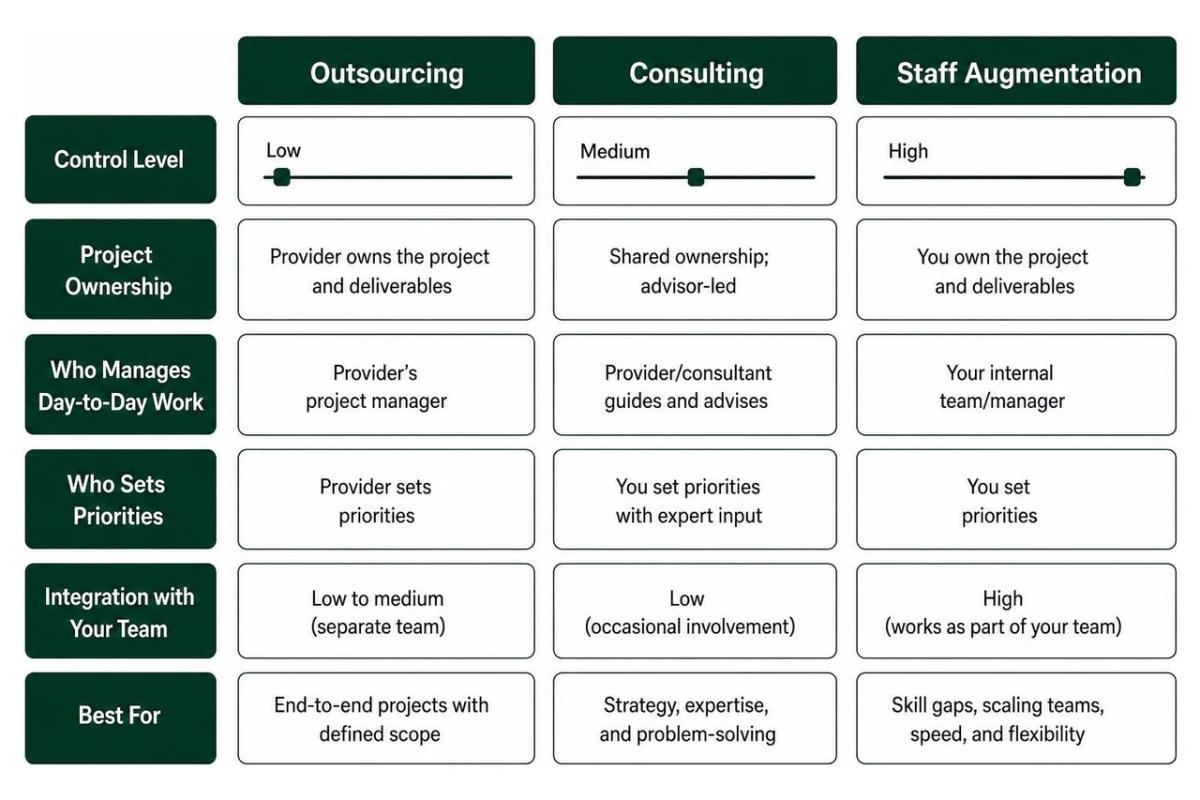
To see how this model compares to other common talent acquisition strategies, let us look at how control and management are distributed across different engagement types.
Staff Augmentation vs. Outsourcing
The line between staff augmentation and project outsourcing is frequently blurred in industry discussions, yet they represent fundamentally different operational philosophies.
With staff augmentation, we retain day-to-day management and direct oversight of the developers. They work alongside our internal team, following our development cycles, utilizing our communication channels (like Slack or Teams), and committing code directly to our repositories. We are responsible for the outcome, while the provider is responsible for delivering qualified talent. This is highly beneficial when we want to maintain strict control over our product roadmap and development quality.
In contrast, traditional project outsourcing involves handing over an entire project or defined business function to an external vendor. The vendor manages the team, defines the workflows, and is responsible for delivering a finished product based on a pre-determined Statement of Work (SOW). While outsourcing reduces our management burden, it also limits our visibility and direct control over the day-to-day development process.
Deciding which route to take depends heavily on your team's internal technical leadership. For a deeper look at how to weigh these two approaches, read our guide on Building Your App In-House vs Outsourcing.
Staff Augmentation vs. Consulting and Managed Services
Understanding how staff augmentation differs from consulting and managed services is essential for procurement and engineering teams alike, as it directly impacts contract structures, compliance, and worker classification.
Consulting is primarily advisory. When we hire consultants, we are paying for their specialized expertise, strategic recommendations, and high-level problem-solving capabilities. Consultants analyze our existing processes, point out inefficiencies, and provide a roadmap for improvement. However, they rarely embed themselves within our daily team structure to execute the actual coding or design work. They advise; our team executes.
Managed services, on the other hand, represent an ongoing, SLA-driven engagement where an external provider takes full, end-to-end responsibility for a specific business function—such as cloud infrastructure management, security monitoring, or helpdesk support. Managed service providers operate independently under strict Service Level Agreements (SLAs), managing their own staff and methodologies to deliver a consistent outcome.
Staff augmentation bypasses both of these structures. It is a capacity-building model. We are not paying for strategic advice or a hands-off managed service; we are securing vetted, ready-to-code professionals to execute our vision under our direct supervision.
Key Benefits of Integrating Staff Augmentation Services
The rapid pace of technological change in 2026 means that waiting months to hire full-time employees can cause us to miss critical market windows. By integrating staff augmentation services into our workforce strategy, we unlock several operational and financial advantages that help us maintain momentum.
Cost Efficiency and Scalability
One of the most immediate benefits of staff augmentation is the massive reduction in hiring and operational overhead. Traditional full-time hiring is an expensive and time-consuming process. Between recruitment fees, background checks, onboarding costs, and employee benefits, bringing on a permanent engineer can quickly drain resources.
With staff augmentation, we convert these fixed payroll costs into variable, project-based expenses. We pay only for the productive hours worked, while the staffing agency handles background checks, payroll taxes, benefits, and administrative HR overhead. Research shows that utilizing augmented staff can reduce hiring costs by 30% to 40% compared to equivalent in-house hiring.
Furthermore, this model provides unparalleled scalability. If we experience a seasonal surge, a major product launch, or need to accelerate a sprint, we can scale our team up in a matter of days. Once the peak period ends or the project is delivered, we can scale back down without the legal and moral complexities of employee layoffs. This flexibility is a vital tool for managing risk, especially during periods of economic fluctuation. For a balanced view of how this impacts mobile-focused projects, check out our analysis of The Pros and Cons of Staff Augmentation for Mobile App Development Projects.
For businesses operating in highly competitive tech hubs, local talent costs can be exceptionally high. Leveraging regional rankings and localized networks can help optimize these costs. For instance, teams looking for specialized regional talent often consult resource rankings like the Top Staff Augmentation Services in Texas - Jul 2026 Rankings or explore international markets through resources such as the Top Staff Augmentation Services in Saudi Arabia - Jul 2026 Rankings to benchmark rates and find vetted partners.
Access to Specialized Global Talent
The global tech talent shortage is a persistent challenge. Finding a local developer with deep expertise in emerging fields—like artificial intelligence, Web3, or cross-platform mobile frameworks—can feel like searching for a needle in a haystack.
Staff augmentation breaks down geographical barriers, giving us direct access to a global pool of pre-vetted specialists. Instead of settling for local candidates who may require weeks of training, we can onboard senior engineers who have already shipped production code in our exact technology stack.
This model is built for speed. While the traditional corporate recruiting cycle for specialized roles typically takes 60 to 90 days, staff augmentation services can typically source and deploy qualified professionals within 7 to 21 working days. This rapid deployment ensures that critical project deadlines are met without burning out our core internal staff.
Step-by-Step Guide to Compare Staff Augmentation Options

Choosing the right staff augmentation model requires a structured evaluation of your project's technical needs, budget constraints, and management capacity. Let us break down the key comparisons you must make to select the optimal path.
Short-Term vs. Long-Term Staff Augmentation Services
The duration of your project and the stage of your product lifecycle are the primary factors in determining whether to choose a short-term or long-term engagement model.
Short-term staff augmentation is ideal for:
- Covering temporary skill gaps during a specific project phase (e.g., bringing in a cybersecurity expert for a pre-launch audit)
- Handling seasonal hiring surges or sudden workload spikes
- Keeping development on track when a key team member takes unexpected leave
- Executing rapid, time-limited development sprints to meet a critical client deadline
While short-term staffing is highly flexible, it requires a fast onboarding process to ensure the temporary developer can contribute immediately.
Long-term staff augmentation, on the other hand, is designed for ongoing, large-scale initiatives. In this model, augmented developers are integrated deeply into our team for 6, 12, or even 18+ months. This is highly effective for:
- Supporting the continuous development and maintenance of a core product
- Navigating hiring freezes while still scaling engineering capacity
- Building a stable, dedicated extension of your in-house engineering team
Long-term engagements allow developers to build deep product knowledge, align with company culture, and establish strong relationships with internal team members, reducing knowledge-transfer friction over time. To see how long-term talent integration supports product growth from early stages, read our guide on From MVP to Market Leader: Scaling an App Without Rewriting Everything.
Onshore vs. Offshore Staff Augmentation Services
When evaluating geographical options for staff augmentation, we must balance cost savings against communication efficiency and cultural alignment.
Onshore staff augmentation involves hiring talent within our same country or immediate geographic region. For example, a business based in New York City or Chicago hiring developers located in Austin, Phoenix, or San Francisco.
- Pros: Perfect timezone alignment, zero language barriers, shared cultural and business norms, and ease of face-to-face collaboration if needed.
- Cons: Highest hourly rates and intense competition for local talent.
Offshore staff augmentation involves sourcing talent from international tech hubs, such as Eastern Europe, Latin America, or Southern Asia.
- Pros: Significant cost savings (often 40% to 50% lower than onshore rates) and access to massive, highly educated talent pools.
- Cons: Significant timezone differences, potential communication barriers, and complex cross-border compliance rules.
To mitigate timezone challenges, many forward-thinking teams utilize a nearshore or hybrid model, ensuring that remote developers maintain a strict 3 to 5-hour daily overlap with the core team for collaborative ceremonies (such as daily standups and sprint reviews), leaving the remaining hours for uninterrupted deep development work.
How to Implement and Manage the Staff Augmentation Process
Successfully scaling your team with augmented staff requires a structured, step-by-step implementation process. Treating staff augmentation as a strategic partnership rather than a transactional transaction is what separates successful integrations from failed projects.
Needs Assessment and Talent Sourcing
Before contacting a staff augmentation provider, we must conduct a thorough internal needs assessment. This involves mapping out the exact technical requirements, required seniority levels, and expected duration of the engagement. Creating a detailed skills matrix helps ensure we do not waste time reviewing mismatched profiles.
Once our requirements are defined, we partner with a reputable staffing provider to source candidates. Rather than relying on simple keyword matching on resumes, leading providers use scenario-based technical evaluations and cultural vetting to curate a shortlist of top candidates.
As the client, you should always participate directly in the final interviews. This allows your technical leadership to evaluate the candidate's problem-solving methodology, communication style, and alignment with your team's agile development workflows. To understand how to scale these sourcing strategies for larger organizations, read our article on Enterprise Mobile App Development: Scaling Solutions for Large Organizations. For an example of how public and enterprise entities structure their formal talent requests, you can review the Information Technology Staff Augmentation Services Request for ... documentation.
Onboarding, Integration, and Contract Essentials
Onboarding augmented staff should be treated with the same level of care as onboarding permanent employees. A structured onboarding plan is critical to help remote developers reach full productivity quickly.
Key elements of a successful onboarding and integration strategy include:
- Immediate Tool Access: Ensure all communication channels (Slack, Teams), project management boards (Jira, Asana), and code repositories (GitHub, GitLab) are configured and accessible on day one.
- A 30/60/90 Day Plan: Establish clear, measurable performance milestones and knowledge-transfer targets to track the developer's integration progress.
- Pair Programming: Pair the new augmented developer with an internal team member for the first two weeks to help them navigate the codebase and understand internal coding standards.
- A Single Definition of "Done": Ensure both internal and augmented developers follow the exact same testing, code review, and deployment protocols.
From a contractual perspective, working with external talent requires robust legal protections. Your staff augmentation contract must explicitly address:
- Intellectual Property (IP) Ownership: Clear, non-negotiable clauses stating that all code, designs, and documentation created during the engagement belong entirely to your company.
- Non-Disclosure Agreements (NDAs): Strict confidentiality terms to protect proprietary data, trade secrets, and user information.
- Compliance and Classification: Clear definitions of the relationship to mitigate co-employment and worker misclassification risks across different jurisdictions.
For a detailed breakdown of what to expect as you transition from early discovery to active development, read our guide on Mobile App Development Agency: What to Expect from Discovery to Launch.
Frequently Asked Questions about Staff Augmentation
To help you navigate your scaling journey, we have compiled answers to the most common questions businesses ask when exploring staff augmentation.
What is the difference between staff augmentation and outsourcing?
With staff augmentation, you retain direct, day-to-day management control over the external professionals embedded in your team. They follow your internal workflows, tools, and processes. With project outsourcing, you contract an external vendor to deliver a specific outcome or finished product, and the vendor manages the team and execution processes independently.
How quickly can an augmented developer be onboarded?
While traditional in-house hiring typically takes 60 to 90 days, staff augmentation services leverage pre-vetted talent networks to significantly accelerate the process. On average, a qualified augmented developer can be sourced, interviewed, contracted, and onboarded within 7 to 21 working days.
How do we protect our intellectual property (IP) with augmented staff?
IP protection is handled before day one of the engagement through legally binding Master Services Agreements (MSAs) and individual Non-Disclosure Agreements (NDAs). These contracts must explicitly state that all work product, source code, and intellectual property developed during the contract period belong solely to the client. Reputable staffing agencies also manage background checks and compliance reviews to minimize security risks.
Build Smarter, Scale Faster: Your Next Step with Synergy Labs
Scaling your technical capacity in 2026 does not have to mean taking on the financial risk, administrative burden, and long-term commitments of traditional hiring. Whether you are launching a new product, expanding into global markets, or tackling a complex development sprint, staff augmentation provides the flexibility and specialized skills you need to succeed.
At Synergy Labs, we do things differently. We do not just hand over a database of resumes and wish you luck. We offer a highly personalized, premium approach to scaling your team:
- Personalized Access to Senior Talent: Our clients work directly with senior engineering talent and an in-shore CTO, ensuring that your technical architecture is robust, secure, and built to scale.
- A Seamless Hybrid Model: We combine the strategic oversight of our local technical leadership with the cost efficiency of our highly skilled offshore development teams.
- A Fixed-Budget, Milestone-Based Approach: We eliminate pricing uncertainty. Our engagements are structured around clear, milestone-based payments, meaning you only pay when real, verified progress is delivered.
- Rapid App Launches and Ongoing Support: We focus on user-centered design, robust security compliance, and rapid time-to-market, followed by the long-term support your product needs to thrive.
Ready to close your talent gaps and accelerate your product roadmap? Explore Our Staff Augmentation Service or check out our full suite of digital product solutions on Our Services page. Let us build something incredible together.