"The process of designing, building, and deploying secure, high-performance mobile applications that serve thousands of users, integrate with complex backend systems, and meet strict compliance standards."
The Enterprise App Revolution: More Than Just Code
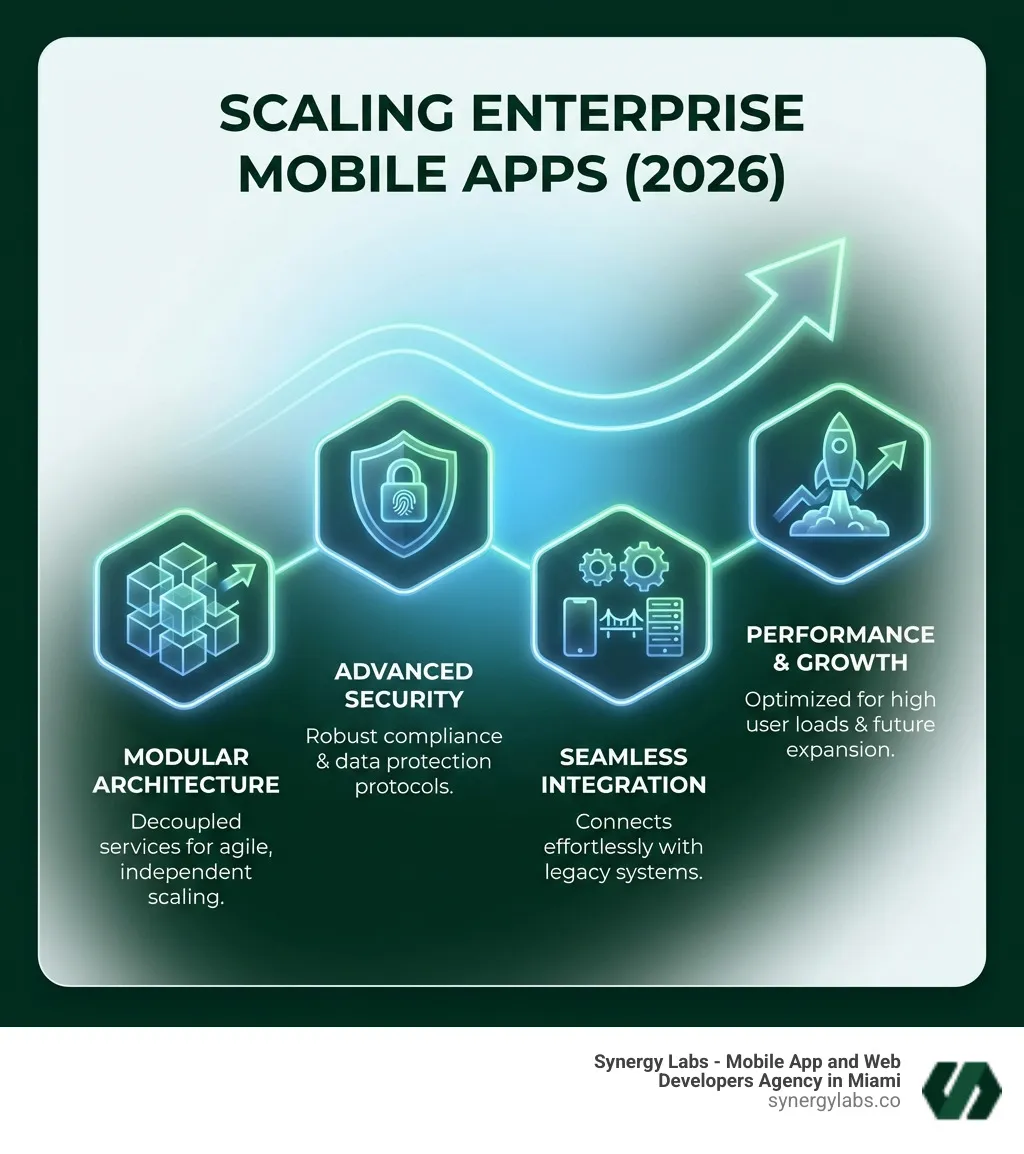
Enterprise Mobile App Development: Scaling Solutions for Large Organizations is the process of designing, building, and deploying secure, high-performance mobile applications that serve thousands of users, integrate with complex backend systems, and meet strict compliance standards. Here's what sets it apart:
Security-first architecture with end-to-end encryption, role-based access control, and compliance with GDPR, HIPAA, or PCI DSS
Seamless integration with existing ERP, CRM, and legacy systems through robust APIs and middleware
Cloud-native design using containerization (Docker, Kubernetes) and microservices for independent scaling
Real-time data synchronization and offline functionality to support distributed workforces
Advanced analytics and monitoring to track performance, predict issues, and optimize user experience
Unlike consumer apps that prioritize speed-to-market and viral growth, enterprise apps are built for reliability, scalability, and long-term value. They must handle sensitive data, support complex workflows, and evolve alongside your organization's changing needs.
The enterprise application market exceeded USD 295 billion in 2024 and is forecast to reach USD 521 billion by 2032, driven by digital change and the urgent need for mobile-first operations. Nearly 94% of enterprises now use cloud services, and about 85% of large organizations have adopted microservices to improve scalability. Yet 45% of organizations report limited progress in modernizing legacy systems due to their complexity, and 82% struggle to hire the software engineers they need to achieve their digital change goals.
This isn't just about building an app—it's about architecting a scalable, secure foundation that empowers your workforce, delights your customers, and gives you a competitive edge in a mobile-first world.
I'm a senior writer at Synergy Labs, where we've helped startups and enterprises alike steer the complexities of Enterprise Mobile App Development: Scaling Solutions for Large Organizations, from initial strategy through post-launch iteration. We've seen how the right architecture, security measures, and development practices can transform business operations and drive measurable ROI.
Basic Enterprise Mobile App Development: Scaling Solutions for Large Organizations vocab:
Why Your Organization Needs a Scalable Mobile Strategy
In today's digital landscape, the question isn't if your organization needs a mobile strategy, but how to implement a scalable one. Mobile applications are no longer just a nice-to-have; they are the backbone of modern enterprises, driving productivity, streamlining operations, and connecting businesses with their employees and customers in unprecedented ways. For large organizations, investing in Enterprise Mobile App Development: Scaling Solutions for Large Organizations means open uping significant competitive advantages.
Consider a warehouse worker in Miami, using a rugged tablet app for real-time inventory management. Or a sales team in Dubai accessing CRM data on the go. These aren't just conveniences; they represent improved productivity, streamlined operations, and access to real-time data that enables better, faster decision-making. We've seen how a well-executed mobile strategy can significantly improve customer engagement and provide a distinct competitive edge. For more on how mobile drives change, explore our insights on digital transformation services.
Types of Enterprise Mobile Apps and Their Use Cases
Enterprise Mobile App Development: Scaling Solutions for Large Organizations encompasses a broad spectrum of applications, each designed to address specific business needs and optimize workflows. Here are some common types:
Employee Productivity Apps: These are designed to boost internal efficiency. Think task management, time tracking, attendance marking, employee training and learning apps, remote work management, and shift scheduling apps. They empower your workforce, whether they are in London, New York City, or Phoenix.
Customer Relationship Management (CRM) Apps: Essential for sales and customer service teams, these apps provide on-the-go access to customer data, interaction history, and sales pipelines, enhancing customer engagement and service delivery.
Supply Chain Management (SCM) Apps: From tracking inventory in a Riyadh distribution center to managing logistics across different continents, SCM apps streamline operations, reduce waste, and improve efficiency.
Human Resources (HR) Apps: These can range from employee self-service portals for payroll and benefits to performance management and internal communication tools, fostering a better employee experience.
Business Intelligence (BI) Apps: Providing real-time dashboards and reports, BI apps enable executives and managers in Hartford or Austin to make data-driven decisions quickly.
Field Service Apps: Empowering technicians and field agents with crucial information, scheduling, and reporting capabilities while on-site, improving response times and customer satisfaction.
At Synergy Labs, we're proud to have developed a diverse range of custom solutions custom to these and many other use cases. You can explore our portfolio of custom solutions to see the breadth of our work.
The Tangible Benefits of Going Mobile-First
The push for Enterprise Mobile App Development: Scaling Solutions for Large Organizations isn't just about keeping up with trends; it's about realizing concrete benefits that impact the bottom line:
Cost Savings: By automating repetitive tasks, reducing paperwork, and optimizing workflows, mobile apps can significantly lower operational costs. An IDC study, for instance, found that a process automation platform helped teams save an incredible 62,800 work hours per year.
Increased Revenue: Improved customer engagement, faster sales cycles, and personalized experiences can directly lead to higher conversion rates and increased revenue.
Higher Employee Retention: Providing employees with intuitive, efficient tools that simplify their work can lead to greater job satisfaction and, consequently, improved retention rates. Apps with strong Day 1 retention, above 25%, are significantly more likely to succeed in the long term.
Improved Data Accuracy: Real-time data entry and synchronization reduce errors, providing a more accurate and reliable foundation for business decisions.
Empowering a Remote Workforce: With hybrid and remote work becoming the norm, mobile apps are crucial for maintaining connectivity, collaboration, and productivity, regardless of geographical location.
Understanding the financial impact is key. We often help our clients in San Francisco, Doha, and other global locations with calculating the ROI of enterprise app development to ensure their investment yields significant returns.
Architecting for Infinity: The Technical Blueprint for Scalable Enterprise Apps
When it comes to Enterprise Mobile App Development: Scaling Solutions for Large Organizations, the architecture is everything. It's the blueprint that determines how your application will grow, adapt, and perform under pressure. Without a solid foundation, even the most innovative app can crumble. We believe that scalability isn't just a feature to add later; it's a set of early choices that prevent costly rewrites and ensure future-proofing. As one expert put it, "If microservices do not make sense for you, do not force it." Instead, start with a modular architecture and transition only when the pain becomes real. This early planning is crucial for long-term success. For a deeper dive into making your app ready for growth, take a look at a technical guide to app scalability.
Key Architectural Choices for Growth
The choice of architecture is foundational for any scalable enterprise app:
Monolithic Architecture: Often suitable for initial development, a monolithic app is built as a single, indivisible unit. It's simpler to develop and deploy early on but can become a bottleneck as the organization grows.
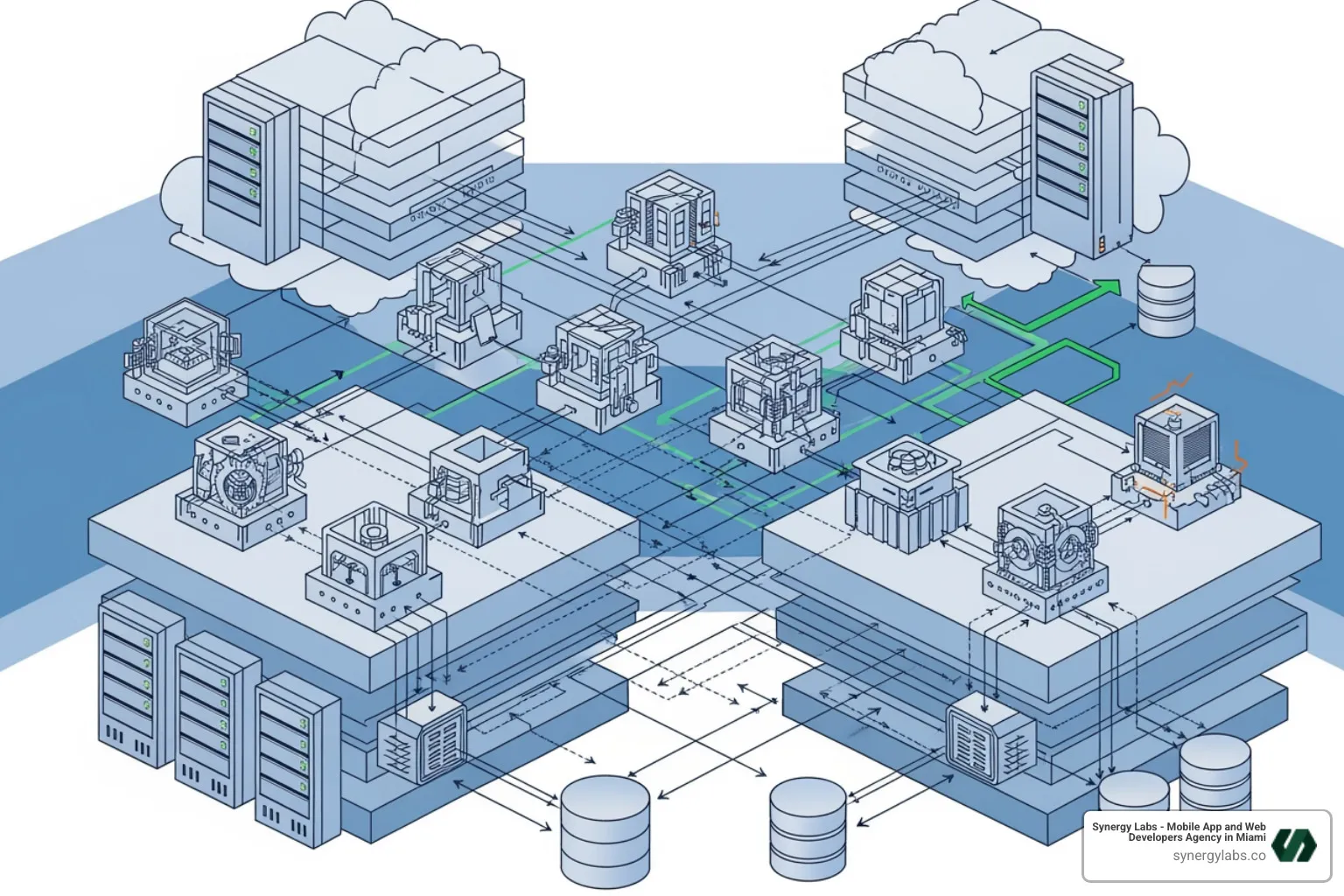
Microservices Architecture: This approach breaks down an application into smaller, independent services that communicate via APIs. This allows individual services to be developed, deployed, and scaled independently, making it ideal for large, complex organizations with diverse teams. About 85% of large organizations now use microservices to improve scalability.
Modular Monoliths: A hybrid approach that structures a monolith internally into well-defined modules. This offers the simplicity of a monolith with the organizational benefits and potential for future microservices extraction. This can be a smart starting point, allowing for modularity without the full overhead of microservices from day one.
The key is to choose an architecture that aligns with your current business needs while providing a clear path for future growth. We guide our clients in Chicago, London, and other major hubs through this critical decision.
The Power of Cloud-Native and API-First Design
To truly achieve scalable enterprise mobile applications, two concepts stand out:
Cloud-Native Principles: This involves building and running applications that take full advantage of the cloud computing delivery model. Key components include containerization (using technologies like Docker and Kubernetes), microservices, and continuous delivery. Containerization allows for consistent deployment across various environments, from development to production, and enables services to scale independently. For example, a large booking platform relies on containerization to deploy services consistently across teams and geographies, scaling independently during peak seasons. Similarly, a music streaming service operates hundreds of microservices managed by Kubernetes to recommend music and create playlists, allowing for seamless upgrades.
Multi-cloud Strategy: A remarkable 83% of enterprise CIOs maintained a multi-cloud environment in 2024. This strategy leverages services from multiple cloud providers (e.g., AWS, Azure, Google Cloud) to improve resilience, optimize costs, and avoid vendor lock-in.
API-First Design: This approach emphasizes designing and building APIs (Application Programming Interfaces) before developing the application's user interface. By defining clear API contracts early, different teams can work in parallel, and integrations with other systems become much smoother and more stable. As one Reddit user shared, "API first is more upfront work because it solves a bunch of collaboration and architecture problems. Therefore, it should be considered a tool for scaling a project/product/team up." This composable architecture allows for greater flexibility and easier integration with existing enterprise systems. See how leading companies use Kubernetes for scalability.
From Blueprint to Launch: A Step-by-Step Development Guide
Developing an enterprise mobile app is a significant undertaking, akin to directing a blockbuster film. It demands a detailed script, a talented team, and impeccable performance in every frame. Our process at Synergy Labs ensures that your vision, from Miami to Riyadh, is transformed into a market-ready mobile solution. It typically moves through distinct phases: Findy, Design, Development, Testing, Deployment, and ongoing Maintenance. To understand the full journey, explore what to expect from a mobile app development agency.
Critical Planning and Strategy Considerations
Before a single line of code is written, thorough planning is paramount. We help large organizations address these critical considerations:
Defining Business Objectives: What specific problems will the app solve? How will success be measured? This alignment with business goals is the absolute first step.
Identifying User Roles: Enterprise apps often have diverse user groups (employees, managers, partners) with different needs and access levels.
Compliance and Regulatory Needs: For industries in Doha, San Francisco, or London, adherence to regulations like GDPR, HIPAA, or PCI DSS is non-negotiable and must be baked into the design from day one.
Platform Choice (Native vs. Hybrid): Deciding between native development (for specific iOS or Android performance) or cross-platform solutions (for broader reach and faster development) is a strategic trade-off. Learn more about cross-platform development.
Integration Planning: How will the new app connect with existing ERP, CRM, HR, or other legacy systems? This requires detailed API mapping and data consistency strategies.
Defining KPIs: Establishing clear Key Performance Indicators (KPIs) like user retention, engagement, session frequency, and crash rate is essential to track value and success. Apps with strong Day 1 retention, above 25%, are significantly more likely to succeed in the long term.
The Step-by-Step Process for Enterprise Mobile App Development: Scaling Solutions for Large Organizations
Our structured approach ensures transparency and efficiency throughout the development lifecycle:
Findy & Strategy: We start by deeply understanding your business needs, target users, and technical landscape. This phase involves stakeholder interviews, process mapping, and defining a clear roadmap.
UX/UI Design: Our designers create intuitive, user-friendly interfaces custom to your enterprise users. This includes wireframing, prototyping, and visual design, ensuring a consumer-grade experience.
MVP Development: We build a Minimum Viable Product (MVP) first, focusing on core features to validate the concept, gather early feedback, and deliver value quickly. This minimizes risk and accelerates time-to-market. Find the benefits of building an MVP first.
Full-Scale Development & Integration: Based on MVP feedback, we proceed with full feature development, robust backend engineering, and seamless integration with your existing enterprise systems.
Rigorous QA & Security Testing: Our dedicated QA team conducts extensive functional, performance, security, and usability testing to ensure the app is robust, secure, and bug-free. This includes penetration testing and code reviews.
Deployment & Change Management: We manage the deployment process, whether through internal enterprise app stores, MDM solutions, or public app stores. Crucially, we work with you on change management strategies and user training programs to ensure smooth adoption.
Post-Launch Support & Iteration: An app is never truly "done." We provide ongoing maintenance, monitoring, and updates, continuously iterating based on user feedback and evolving business needs.
Essential Features and UX for Enterprise Users
Enterprise users, whether they're executives in New York City or field technicians in Austin, expect apps that are not only powerful but also a joy to use. Just because an app is for enterprise use doesn’t mean it should be clunky or confusing. A great user experience (UX) is critical for adoption.
Key features and UX expectations include:
Role-Based Access Control (RBAC): Ensures that users only see and interact with the data and functions relevant to their role, enhancing security and simplifying the interface.
Offline Functionality and Data Sync: Critical for users in areas with limited or no connectivity. The app should cache data locally and synchronize seamlessly when online.
Real-Time Notifications: Keeping users informed about critical updates, approvals, or system alerts.
Advanced Analytics Dashboards: Providing personalized, actionable insights directly within the app, allowing decision-makers to monitor KPIs and performance.
Intuitive, Consumer-Grade UX: Enterprise apps should offer the same polished, efficient, and intuitive experience that users expect from their favorite consumer apps. This includes clear navigation, simplified workflows, and consistent branding.
We believe that founders should treat UX as a growth lever because a well-designed app drives adoption and productivity.
Navigating the Gauntlet: Security, Compliance, and Modernization
For large organizations, Enterprise Mobile App Development: Scaling Solutions for Large Organizations isn't just about functionality; it's about navigating a complex landscape of security threats, regulatory compliance, and the often-daunting task of integrating with legacy systems. A security breach in an enterprise app can be devastating, with the average cost of a data breach estimated at $4.45 million in 2023. This highlights why security must be a foundational design principle, not an afterthought.
Essential Security and Compliance Strategies
Security and compliance are non-negotiable pillars of enterprise mobile app development. We integrate these strategies from the very beginning:
End-to-End Encryption: Protecting sensitive data both in transit and at rest, ensuring that information is unreadable to unauthorized parties.
Multi-Factor Authentication (MFA): Implementing strong user authentication mechanisms like biometrics, one-time passwords, or single sign-on (SSO) to prevent unauthorized access.
Secure Coding Practices: Adhering to industry best practices to prevent common vulnerabilities, including input validation, avoiding hardcoded credentials (over half of mobile apps contain hardcoded credentials or shared tokens, an unacceptable risk), and using vetted libraries.
Regular Security Audits: Conducting frequent vulnerability assessments, penetration testing, and code reviews to identify and remediate potential weaknesses. It's concerning that 43% of top enterprise apps have cryptographic weaknesses, making regular audits critical.
Compliance with Regulations: Ensuring the app adheres to relevant industry-specific regulations like GDPR (for data privacy in Europe), HIPAA (for healthcare data in the US), or PCI DSS (for payment card information).
Data Governance Policies: Establishing clear frameworks for data collection, storage, access, and retention, along with robust audit logs for accountability.
Overcoming Legacy System Integration and Driving User Adoption
One of the most significant problems in Enterprise Mobile App Development: Scaling Solutions for Large Organizations is integrating with existing legacy systems. Many large organizations in places like Hartford and Doha rely on older backend systems (ERP, CRM, mainframes) that lack modern mobile interfaces. About 45% of organizations reported limited progress in modernizing these complex systems.
Our strategies for overcoming these challenges include:
Middleware and API Layers: Building robust APIs and middleware that act as a bridge between the mobile app and legacy systems, standardizing data exchange and abstracting complexity. An Integration Platform as a Service (iPaaS) can also be instrumental here.
The "Strangler Fig" Pattern for Modernization: This approach involves gradually replacing parts of a legacy system with new services, rather than attempting a risky "big bang" rewrite. The new mobile app can be one of the first "strangler" components, taking over specific functionalities.
Change Management Strategies: Introducing a new enterprise app requires careful planning to manage the transition for employees. This involves clear communication, addressing concerns, and highlighting the benefits.
User Training Programs: Providing comprehensive training and support ensures employees are comfortable and proficient with the new app, driving adoption.
Feedback Loops: Establishing channels for continuous user feedback helps refine the app, address pain points, and ensure it truly meets their needs.
Future-Proofing Your Enterprise: Trends and Best Practices for Enterprise Mobile App Development: Scaling Solutions for Large Organizations
To remain competitive, large organizations must not only build scalable mobile apps but also ensure they are future-proof. This involves embracing modern development cultures like DevOps, prioritizing quality and observability, and staying ahead of emerging trends. Research predicts that organizations that implement observability well will achieve shorter decision-making times by 2026. This means leveraging real-time monitoring and analytics to quickly identify and resolve issues, allowing for rapid iteration and continuous improvement.
The Role of DevOps, Observability, and Quality Engineering
These practices are crucial for efficient and effective Enterprise Mobile App Development: Scaling Solutions for Large Organizations:
DevOps Culture: Fostering collaboration between development and operations teams to automate and streamline the entire software delivery pipeline. Organizations that accept DevOps can deliver software updates more frequently and recover from failures 24 times faster than traditional teams. About 94% of organizations now use Agile, which pairs well with DevOps.
CI/CD Pipelines: Implementing Continuous Integration and Continuous Delivery automates the building, testing, and deployment of code changes, ensuring faster, more reliable releases.
Automated Testing: Integrating automated test suites (unit, integration, UI, performance) into the CI/CD pipeline significantly improves code quality and reduces manual effort.
Real-Time Monitoring and Logging: Setting up comprehensive monitoring tools to track app performance, server health, and user activity, providing immediate alerts for anomalies.
Crash Reporting: Automatically capturing and analyzing app crashes to quickly diagnose and fix issues, improving user experience.
Performance Metrics: Continuously tracking key performance indicators such as load times, API response times, and resource utilization to ensure optimal app performance.
The cost of Enterprise Mobile App Development: Scaling Solutions for Large Organizations can vary significantly. The cost of an enterprise application development is typically between $50,000 to $250,000+, depending on its characteristics, difficulty, and size. For complex, custom solutions with extensive integrations, this cost can be even higher. Measuring ROI is crucial and involves tracking productivity gains, cost savings, increased revenue, and improved employee/customer satisfaction. For more details on budgeting, check out how enterprise app costs range from $50,000 to $250,000+.
The landscape is also being reshaped by the rise of low-code/no-code platforms. Industry projections suggest that 70% of new enterprise applications will be built using low code or no code technologies in 2026. These platforms allow organizations to build applications with minimal or no coding, accelerating development and empowering citizen developers. While they offer speed and cost efficiency for simpler applications or specific use cases, we often find that large organizations still require custom development for complex, highly specialized, or deeply integrated solutions that demand unique functionality, ironclad security, or specific performance optimizations.
Key Trends Shaping the Future of Enterprise Mobility
The future of Enterprise Mobile App Development: Scaling Solutions for Large Organizations is dynamic and exciting, driven by several key trends:
AI-Driven Personalization: AI is moving from a novelty to a core requirement. Forecasts predict that by 2026, over 20% of enterprise apps will use AI-driven personalization algorithms. This means apps will adapt to user behavior, preferences, and context, offering highly personalized experiences, recommendations, and workflows.
Predictive Analytics: Leveraging AI and machine learning to analyze vast datasets and predict future outcomes, allowing enterprises to proactively address issues, optimize operations, and identify new opportunities.
Augmented Reality (AR) for Training and Field Service: AR can overlay digital information onto the real world, revolutionizing training, maintenance, and field service operations for industries in San Francisco, Phoenix, and other locations.
Internet of Things (IoT) Integration: Connecting mobile apps with IoT devices to collect real-time data, monitor assets, and enable remote control, particularly relevant for supply chain, manufacturing, and smart city initiatives.
Voice-Enabled Interfaces: Integrating natural language processing and voice commands for hands-free interaction, enhancing accessibility and efficiency in various work environments.
These trends signify a shift towards more intelligent, adaptive, and intuitive enterprise mobile solutions. To stay ahead, organizations should actively explore AI-first app development.
Building Your Digital Empire: Partner with Synergy Labs
Enterprise Mobile App Development: Scaling Solutions for Large Organizations is a strategic journey, not just a project. It requires a partner who understands the complexities of security, scalability, and user-centric design. At Synergy Labs, we specialize in changing your vision into a robust, scalable mobile solution that drives real business value. With our fixed-budget model, in-shore CTO leadership, and milestone-based payments, we eliminate financial surprises and ensure your project is delivered on time and to your exact specifications. Ready to build an enterprise app that scales with your ambition? Explore our services and let's start the conversation.




.avif)

.avif)


