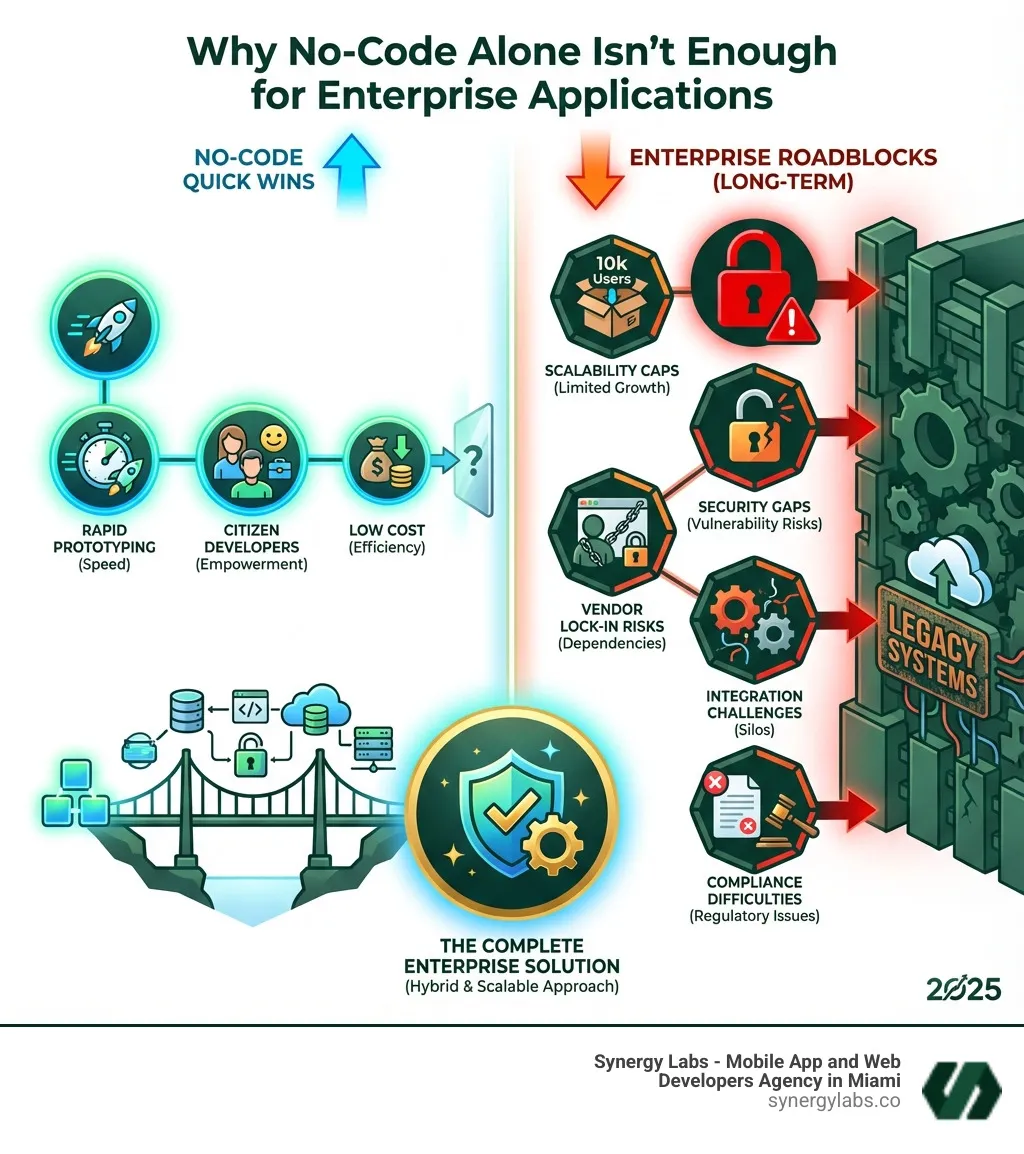
Security Vulnerabilities - Platform-level security risks affect all apps built on them, with limited control over protocols and compliance
Customization Dead Ends - Rigid templates and inability to access backend code block unique business logic and integrations
Vendor Lock-In - Proprietary ecosystems trap your data and workflows, making migration nearly impossible
Integration Barriers - Connecting to legacy systems and complex enterprise infrastructure hits hard limits
The numbers tell a compelling story. 84 percent of enterprises have turned to no-code for agility and innovation, and platforms can reduce development time by 90 percent. By 2025, 70% of new enterprise applications will use low-code or no-code tools.
But here's the reality check: speed isn't everything.
When your application needs to handle millions of transactions, integrate with decades-old ERP systems, or comply with HIPAA regulations, those drag-and-drop builders hit a wall. As one CTO warns, the real risk isn't just a vulnerability in your app—it's a flaw in the platform itself that impacts everyone using it.
At Synergy Labs, we've helped dozens of startups and enterprises steer this exact challenge—building scalable, secure applications that start fast but don't trap you in a platform's limitations. Understanding Why No-Code Alone Isn't Enough for Enterprise Applications has shaped how we guide clients toward hybrid strategies that balance speed with long-term flexibility. Let's break down exactly where no-code shines, where it fails, and how to build your enterprise future without hitting a dead end.
Basic Why No-Code Alone Isn’t Enough for Enterprise Applications glossary:
The Allure of No-Code: Why 84% of Enterprises Are on Board
The rise of no-code platforms is undeniably compelling. The promise of rapid application development, reduced costs, and empowering non-technical users to build solutions is a powerful draw for businesses struggling with IT backlogs and developer shortages. We've seen how tempting it is to jump on the no-code bandwagon, and for good reason.
Statistics highlight this widespread appeal: a staggering 84 percent of enterprises have turned to no-code for agility and innovation. This isn't just experimental adoption; these are production deployments aimed at solving real business problems. The speed advantage is significant, with no-code platforms capable of reducing development time by an impressive 90 percent. This speed is particularly pronounced for applications focused on business process support rather than complex algorithms.
Consider the sheer pressure on IT departments. Many enterprises, including those in the US where federal agencies spend 70-80 percent of IT budgets on legacy maintenance, face similar constraints. No-code offers a clear path to modernization without completely abandoning working systems. It allows organizations to tackle the backlog of smaller, yet critical, applications that often languish due to limited developer resources.
Indeed, 65 percent of companies are using no-code platforms to overcome developer shortages. This shortage makes rapid iteration even more important, as you can't afford to spend months on projects that could be built in weeks. Furthermore, 46 percent of organizations use no-code platforms for business process automation. This includes everything from employee onboarding workflows to customer service ticket management, areas where well-defined processes need to adapt quickly to local circumstances or changing business needs.
The ability to launch Minimum Viable Products (MVPs) quickly, iterate based on feedback, and respond to market changes with unprecedented agility has made no-code a game-changer for many. More info about the benefits of MVPs and more info about agile methodologies dig deeper into these advantages.
Empowering the "Citizen Developer"
One of the most transformative aspects of no-code is its empowerment of the "citizen developer." This term refers to business professionals with minimal coding background who can now build fully functioning applications. Imagine your marketing manager creating a lead tracking tool, or your HR specialist designing an automated onboarding portal, all without writing a single line of code.
This movement is not just a passing trend; it's a strategic shift. Experts predict that citizen developers will soon outnumber professional developers four to one. This direct involvement ensures that solutions actually address real business problems, building a sense of ownership that drives adoption. No-code democratizes development, removing technical barriers that once confined application creation to specialized IT teams. This decentralization of innovation can significantly reduce IT backlogs, allowing IT to focus on more complex, mission-critical projects. Industry experts have even recognized citizen development as a fundamental pillar of broader digital change, emphasizing how it broadens a company’s development base and shortens development cycles.
Unprecedented Speed and Agility
The allure of no-code is often encapsulated in two words: speed and agility. In today's business environment, the ability to launch applications quickly and iterate rapidly is a significant competitive advantage. No-code platforms deliver on this promise, allowing businesses to respond to market changes and customer demands with unprecedented speed.
These platforms can reduce the time needed to build custom applications by between 50% -90% compared to traditional development methods. This rapid turnaround means that ideas can go from concept to deployment in a fraction of the time, enabling businesses to experiment more, fail faster (and cheaper!), and ultimately succeed sooner. This quick iteration is crucial for gaining a competitive edge, allowing companies to test new services, optimize internal processes, and adapt their offerings without the lengthy development cycles associated with traditional coding. The ability to quickly spin up an application for a specific need, gather feedback, and make immediate adjustments is invaluable in dynamic markets, whether you're in Miami, Dubai, or London.
Why No-Code Alone Isn’t Enough for Enterprise Applications
While no-code offers undeniable benefits for rapid prototyping and departmental solutions, relying on it solely for enterprise-level applications can lead to significant challenges. The very simplicity that makes no-code appealing can become its biggest limitation when dealing with the complexity, scale, and security demands of a large organization. This is where the rubber meets the road, and the initial speed can turn into a long-term headache.
As we often say at Synergy Labs, speed is great, but not if it drives you off a cliff. More info on enterprise app development costs highlights the importance of making informed decisions for long-term success.
The Scalability Ceiling: A Key Reason Why No-Code Alone Isn’t Enough for Enterprise Applications
One of the most critical limitations of no-code platforms for enterprise use is their inherent scalability ceiling. While they excel at handling small to medium-scale workloads, they often struggle when confronted with the immense demands of large-scale enterprise applications. Our research indicates that some no-code solutions have an observed inability to support more than 10,000 concurrent sessions without significant performance degradation.
This is largely due to the underlying architecture of many no-code platforms. Their reliance on abstraction layers and auto-generated code, while simplifying development, introduces runtime overhead. This can lead to inefficient database schemas, which directly impacts performance under heavy loads. Imagine a customer-facing application in New York City or a supply chain management system in Dubai handling thousands of transactions per minute – a no-code platform might buckle under the pressure.
Furthermore, no-code platforms typically offer limited control over database queries, indexing, and custom schema modifications. This means that when an application needs to scale, fine-tuning the infrastructure for optimal performance becomes incredibly challenging, if not impossible. The "black box" nature of many no-code solutions prevents developers from getting "down in the guts" of the system, as one principal analyst puts it, to optimize for specific high-volume enterprise transactions. More info on what makes an app scalable digs into the complexities of building truly scalable solutions.
The Security and Compliance Gauntlet
For any enterprise, security and compliance are non-negotiable. This is another area where Why No-Code Alone Isn’t Enough for Enterprise Applications becomes starkly clear. While no-code platforms often boast built-in security features, the level of control and customization required by large organizations in heavily regulated industries (such as finance in London or healthcare in Miami) often exceeds what these platforms can offer.
The risks associated with shadow IT, where applications are built without IT oversight, are particularly relevant here. A single vulnerability in a no-code platform's core code can affect all products built on it, creating a significant and often unknown attack surface. As one CTO highlights, the bigger risk is where a bad actor finds a problem in the platform itself. The average total cost of a data breach is a staggering $4.35 million, and fines for non-compliance with regulations like GDPR (relevant to our operations in London and Dubai) can be up to €20 million or 4 percent of a company’s revenue.
Highly regulated industries, such as healthcare (with HIPAA compliance in our US locations) or financial services, require specific permissions, audit logging, and data encryption protocols that many no-code tools don't natively support. Granular control over security protocols, user authentication, and access frameworks is paramount. When non-technical users are building applications, they are often not equipped to recognize or fix security flaws, leaving enterprises vulnerable. Effective IT governance and oversight are crucial to mitigate these risks.
The Customization and Integration Dead End
No-code platforms, by design, prioritize ease of use over limitless flexibility. This means they often come with rigid UI/UX templates and limited options for truly custom code. While this speeds up initial development, it quickly becomes a dead end for enterprise applications that require unique branding, complex user experiences, or proprietary business logic.
The inability to write custom code or directly access the backend severely restricts innovation. If your business relies on a unique algorithm, a specialized data processing workflow, or a deeply integrated third-party service, no-code platforms will likely fall short. They often rely on pre-configured database solutions with limited direct access to SQL queries or custom schema modifications, hindering advanced data modeling and optimization.
Integration with existing IT infrastructure is another major hurdle. Enterprises typically operate with a heterogeneous IT environment, including numerous legacy systems. While some no-code platforms offer basic API integrations, they may struggle with complex, multi-layered integrations, high-volume data transfers, or connections to older, bespoke systems. This can lead to "phantom couplings"—unintended or undocumented dependencies that create significant technical debt. Best practices for legacy system modernization in 2025 emphasizes the need for thoughtful integration strategies. Vendor lock-in also becomes a concern, as proprietary data formats and closed ecosystems make it difficult to migrate applications or integrate with other tools if a platform no longer meets evolving business needs.
Low-Code to the Rescue: Bridging the Gap Between Simplicity and Power
If no-code hits a wall for enterprise applications, where do we turn for the speed and agility businesses crave, coupled with the power and flexibility they demand? The answer often lies in low-code platforms. Low-code represents a crucial middle ground, offering the visual development benefits of no-code while providing professional developers with the tools and access they need for complex enterprise solutions.
As one industry expert wisely differentiates, "No-code is for businesspeople… and is really all about telling the system the functions you want. Low-code is for developers… and is about giving them the tools to go fast." This distinction is key. Low-code platforms empower developers and power users to build applications visually, using pre-built components, but they also provide command-line options, direct code access, and the ability to inject custom code (like JavaScript, Python, or API integrations) when needed.
At Synergy Labs, we see low-code as a powerful enabler. It allows us to leverage rapid development techniques for common functionalities while retaining the ability to craft unique, highly customized, and deeply integrated solutions that meet the stringent requirements of enterprise clients in places like Chicago, Phoenix, or Austin.
Opening up True Customization and Extensibility
This is where low-code truly shines compared to its no-code sibling. Low-code platforms are designed to be extensible, providing the flexibility that enterprise applications demand. This means we can:
Override defaults with JavaScript/CSS: Achieve pixel-perfect UI/UX that aligns precisely with brand guidelines and complex user experience requirements. This is crucial for applications that need to feel native and intuitive, whether it's a customer portal or an internal dashboard.
Integrate custom components: Build unique functionalities as reusable components that can be seamlessly incorporated into low-code applications, extending the platform's capabilities far beyond its out-of-the-box offerings.
Perform direct database queries (SQL/NoSQL): Gain granular control over data management, allowing for advanced data modeling, complex queries, and performance optimization that is simply not possible with no-code's pre-configured solutions.
Build proprietary algorithms: Incorporate unique business logic and competitive advantages directly into the application, rather than being limited to generic functionalities.
Leverage full API control: Connect to virtually any external system, whether it's a legacy ERP, a modern microservice, or a specialized AI model. This enables seamless data flow and integration across the entire enterprise ecosystem. More info on AI infusion services can illustrate how this is vital for advanced capabilities.
Low-code platforms typically integrate with standard Integrated Development Environments (IDEs), offering developers the flexibility to see and modify the actual code. This transparency and control are essential for debugging, performance tuning, and ensuring the long-term maintainability of complex applications.
Why Low-Code is a Better Fit for Complex Enterprise Needs
When it comes to complex, mission-critical enterprise applications, low-code is often a far more suitable option than no-code. The reasons are rooted in the fundamental capabilities and control that low-code offers:
Mission-critical workflows: Low-code platforms provide the robustness and extensibility needed for applications that are central to business operations. They allow for the implementation of complex business logic, multi-step workflows, and intricate data changes that no-code platforms often cannot handle.
Enterprise-grade security controls: While no-code platforms offer basic security, low-code enables the implementation of advanced security features, including granular role-based access control (RBAC), OAuth 2.0, and deep integration with Identity and Access Management (IAM) systems. This ensures that applications meet stringent enterprise security policies and compliance requirements.
CI/CD pipeline integration: Low-code platforms integrate seamlessly with DevOps pipelines, supporting Continuous Integration and Continuous Deployment (CI/CD). This means automated testing, version control (like Git), and automated deployments (via standard deployment tools), ensuring consistent quality and rapid, reliable releases—a must for any large organization.
Performance tuning: With access to the underlying code and infrastructure settings, developers can perform fine-grained performance tuning, optimizing database queries, caching strategies, and server configurations to handle high volumes of users and data without sacrificing speed.
Full control over the application lifecycle: From development and testing to deployment, maintenance, and future improvements, low-code provides comprehensive control. Projects built with low-code can be handed off to professional developers for further improvements as the application grows, ensuring that the solution can evolve with the business. More info on enterprise solutions emphasizes this full lifecycle management.
Low-code empowers enterprises to achieve both speed and sophistication, striking a balance that pure no-code solutions cannot. It allows for the rapid creation of core functionalities while providing the necessary hooks for professional developers to add the custom logic, integrations, and performance optimizations that transform a simple app into a resilient enterprise solution.
Building a Hybrid Strategy: Governance, Oversight, and Making the Right Choice
The takeaway isn't that no-code is bad, or that low-code is a magic bullet. Instead, for enterprise applications, the most effective approach is often a hybrid strategy that leverages the strengths of both, underpinned by robust IT governance and oversight. This ensures that while innovation is democratized and accelerated, core enterprise requirements for security, scalability, and integration are never compromised.
At Synergy Labs, we guide our clients in Miami, San Francisco, and beyond to think strategically about their development ecosystem. Choosing the right platform is not just a technical decision; it's a business decision that impacts long-term growth and competitiveness. More info on choosing a development agency can help you steer these complex choices.
Establishing Robust IT Governance and Oversight
The rise of citizen developers and the proliferation of low-code/no-code tools necessitate a proactive approach to IT governance. Without proper guardrails, the very agility these platforms promise can lead to a new form of "shadow IT"—applications built without IT's knowledge, introducing security risks, compliance issues, and technical debt.
Leading consulting firms highlight that "low-code/no-code: A way to transform shadow IT into a next-gen technology asset." The key is collaboration between business and IT. IT departments should accept business developers by providing professional low-code/no-code platforms and extending their software development know-how. This involves:
Creating guardrails for citizen developers: Establishing clear policies, templates, and best practices for application development, data access, and integration. This ensures that citizen developers build within a secure and compliant framework.
Security reviews and data access policies: Implementing mandatory security reviews for all applications, regardless of how they are built, and defining strict data access policies to protect sensitive enterprise information. The average total cost of a data breach is $4.35 million.
Application lifecycle management: Ensuring that applications built with low-code/no-code tools are properly managed throughout their lifecycle, from development and deployment to maintenance and eventual retirement.
Ensuring seamless integration: Developing standards and APIs that allow low-code/no-code solutions to integrate smoothly with existing IT infrastructure and systems, preventing data silos and maintaining a cohesive enterprise architecture.
This structured approach transforms shadow IT from a risk into a valuable source of innovation, allowing business units to move fast while IT maintains control over the broader technology landscape.
Choosing the Right Tool: Why No-Code Alone Isn’t Enough for Enterprise Applications with Complex Needs
Making the right choice between no-code, low-code, or traditional custom development requires a clear understanding of your specific needs and long-term vision. For simple, departmental applications, no-code can be a fantastic accelerator. But for complex enterprise applications, the limitations of no-code become too significant to ignore. Here are key considerations:
Scalability requirements: If your application needs to support thousands or millions of users, handle massive data volumes, or process high-frequency transactions (e.g., a financial trading app in London or a logistics platform in Dubai), low-code or custom code will be necessary. No-code platforms often have inherent performance bottlenecks and limited infrastructure control.
Integration needs: How deeply does your application need to integrate with existing legacy systems, CRMs, ERPs, or external APIs? If complex, real-time, or mission-critical integrations are required, low-code's extensibility and API control, or custom code, will be essential.
Security and compliance standards: For highly regulated industries (e.g., HIPAA in US locations like Hartford or Phoenix, GDPR in London) or applications handling sensitive data, the granular security controls, audit trails, and compliance features offered by low-code or custom development are non-negotiable.
Customization flexibility: Does your application require a unique user experience, proprietary business logic, or highly specialized functionalities that differentiate your business? If so, no-code's rigid templates and lack of code access will be a significant roadblock. Low-code or custom code provides the necessary freedom.
Total cost of ownership and vendor lock-in risk: While no-code offers low upfront costs, consider the long-term implications. Proprietary no-code ecosystems can lead to vendor lock-in, making migration difficult and costly if your needs evolve or the vendor's pricing changes. Low-code often offers more portability and control over the underlying code, mitigating this risk.
We encourage our clients to ask critical questions: Will this platform support where our business model is headed? Can it scale with our growth? Does it meet our security and compliance needs? For enterprise applications, the answer to these questions often points away from a pure no-code strategy.
Beyond Drag-and-Drop: Building Your Enterprise Future
The no-code revolution has undeniably changed the landscape of software development, offering incredible speed and accessibility for certain use cases. It empowers citizen developers and rapidly prototypes ideas, delivering agility that traditional coding often struggles to match. Yet, as we've explored, for the intricate, mission-critical, and highly scalable demands of enterprise applications, Why No-Code Alone Isn’t Enough for Enterprise Applications becomes a central question.
The truth is, enterprises need to move beyond the simplicity of drag-and-drop interfaces when their applications are tasked with handling millions of transactions, safeguarding sensitive data under stringent regulations, or integrating seamlessly with a complex mix of existing systems. In these scenarios, the limitations of a pure no-code strategy — its scalability ceiling, security vulnerabilities, customization dead ends, and integration barriers — transform into significant business risks.
This is why a balanced, hybrid approach, often incorporating low-code and traditional custom development, is not just an option but a necessity. Low-code bridges the gap, providing the speed of visual development with the power of code for deep customization, robust security, and seamless integration. It allows professional developers to maintain control, optimize performance, and build truly enterprise-grade solutions that are both agile and resilient.
At Synergy Labs, we believe in building for the future, not just for today. We work with enterprises in cities like Miami, New York City, London, and Dubai to craft digital solutions that are not only innovative but also scalable, secure, and perfectly aligned with their strategic objectives. When you need to go beyond the template and build a truly custom, enterprise-grade solution that stands the test of time, partnering with experts is key. We help you steer the complexities, ensuring your applications are built right from the start, with the flexibility to evolve as your business grows.
Explore how to build your next enterprise application with Synergy Builder.




.avif)

.avif)


