

Cross-Platform Mobile Development Frameworks Comparison for 2026

The best framework depends on what your team already knows and what your app must do. In this comparison of cross-platform mobile development frameworks, Flutter is a strong fit for highly custom visuals, while React Native suits teams that know JavaScript or TypeScript. Kotlin Multiplatform lets teams share app logic while keeping native screens. .NET MAUI fits C# teams building mobile and desktop apps, and Uno Platform is worth a look when web and Linux support matter too.
A shared codebase can speed up a launch, but it will not erase every platform-specific task. Before choosing, test your hardest device feature, check how the app runs on everyday phones, and budget for updates after launch.
As director of product at Synergy Labs, I would start with those real-world needs, not a popularity chart.
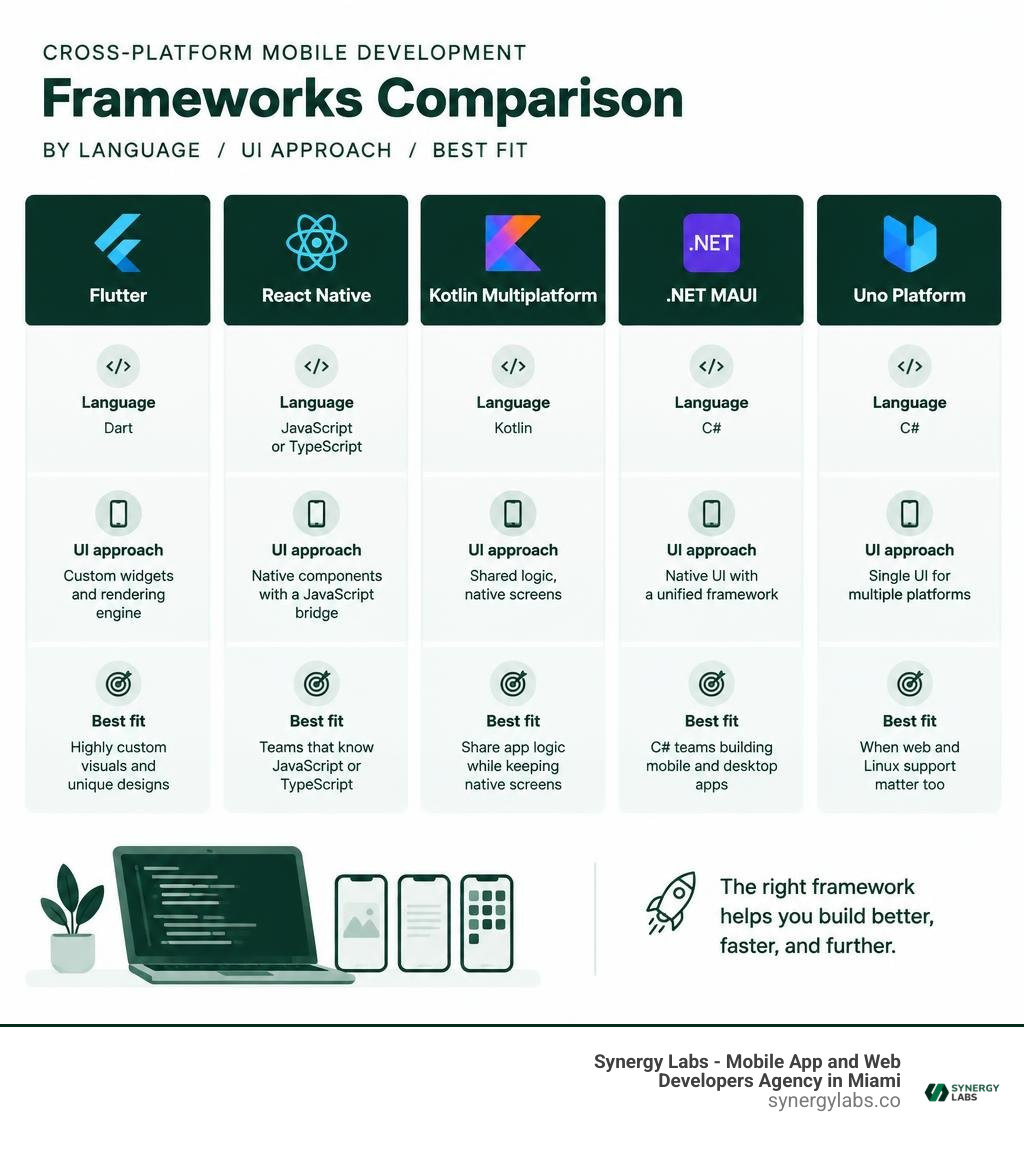
Cross platform mobile development frameworks comparison basics:
- Cross-platform app development
- Develop iOS Android cross platform
- Xamarin mobile application development
Core Architectural Paradigms Shaping Modern App Development
Mobile engineering has changed dramatically over the last few years. The cross-platform app development framework market is projected to exceed $546.7 billion by 2033, driven by businesses wanting to build for iOS and Android without building two identical apps from scratch. The mobile app market as a whole is projected to grow by USD 2.63 trillion from 2026 to 2029, with a compound annual growth rate of 31.1%.
Android holds roughly 72.04% of the global market, while iOS claims 27.49%. Together, they represent over 99.5% of mobile operating system activity. Maintaining two separate native teams means duplicating business logic, writing tests twice, and constantly managing feature drift. Switching to unified development unlocks the 4 key benefits of cross-platform development, allowing teams to achieve 30% to 50% productivity gains and share 80% or more of their codebase across platforms.
As highlighted in the industry whitepaper Expanding the Vision for the Mobile Industry, modern software engineering extends beyond Apple and Google store ecosystems. More than 2 billion mobile devices operate outside standard Google Mobile Services, including HarmonyOS and customized Android Open Source Project forks. To build resilient digital products, we need architectures that share core business logic while adapting to varied hardware.
Native Bridge and Direct Execution Engines
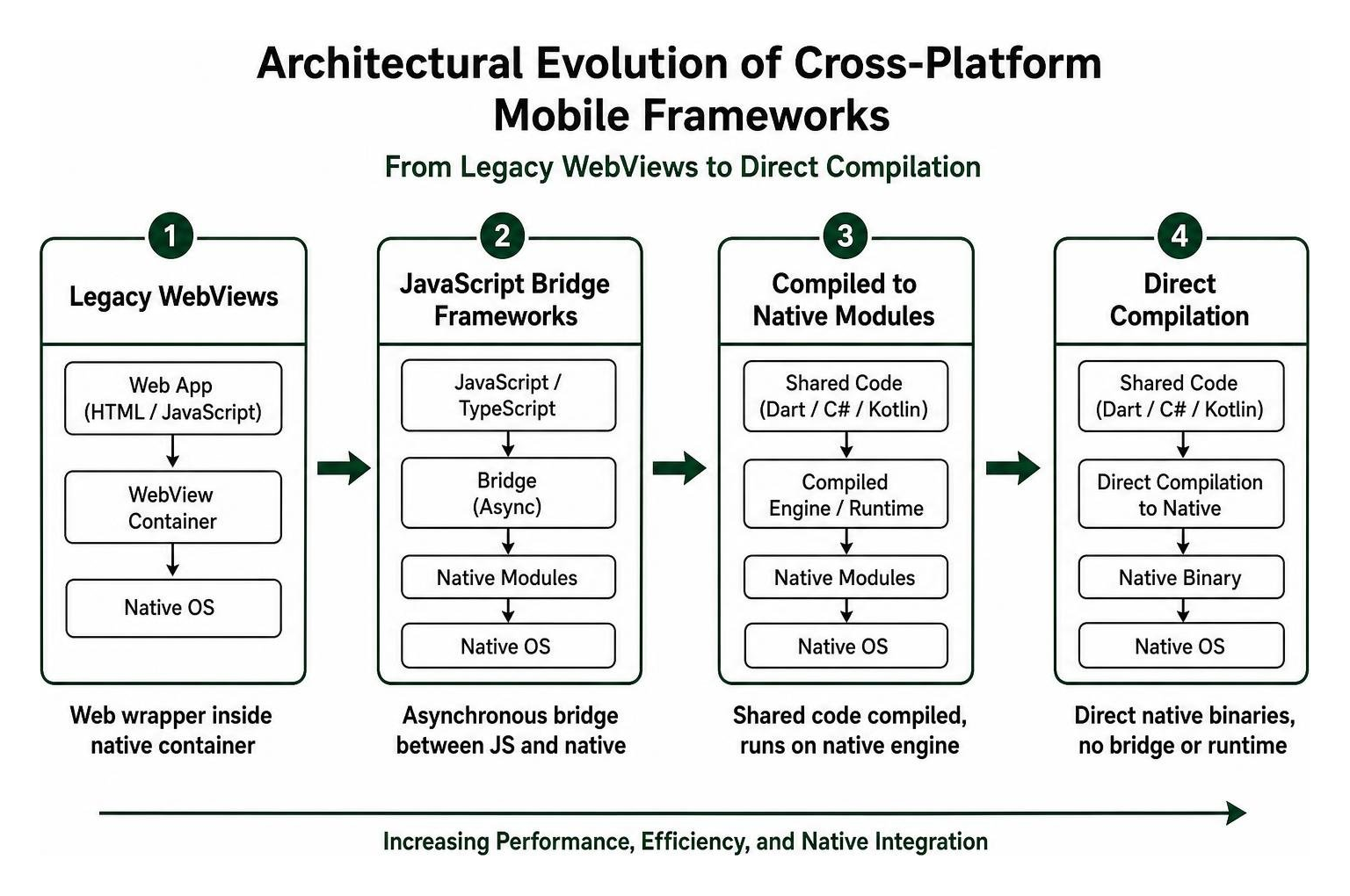
Early multi-platform tools relied on web wrappers and asynchronous JavaScript-to-native bridges. Those bridges functioned like translators passing notes across a crowded room: workable for basic forms, but prone to frame drops when handling heavy gesture animations or rapid data streams.
Modern architectures have removed that bottleneck. React Native replaced its legacy bridge with the JavaScript Interface (JSI) and TurboModules, allowing JavaScript to hold direct C++ references to host platform objects. If you are weighing a hybrid app or native app for your business, this shift means modern multi-platform runtimes execute synchronously, providing performance virtually indistinguishable from purely native Swift or Kotlin code.
Custom Engine Rendering vs Logic-Only Sharing
Today's mobile frameworks follow two primary design philosophies:
- Custom Canvas Rendering: Engines like Flutter render their own user interface from scratch onto an OpenGL, Metal, or Vulkan canvas using graphics engines like Impeller or Skia. Every button, shadow, and text field looks and animates identically across operating systems.
- Selective Logic Sharing: Frameworks like Kotlin Multiplatform share the data layer, networking, local caching, and business rules across platforms while allowing teams to build fully native user interfaces in SwiftUI for iOS and Jetpack Compose for Android. Compose Multiplatform expands this option by enabling teams to share up to 100% of their UI components across targets when desired.
2026 Cross Platform Mobile Development Frameworks Comparison: The Top 5 Contenders
Choosing the right development stack requires balancing rendering mechanics, developer availability, and platform targets. Academic research in the Comparative analysis of mobile application Frameworks: A developer's guide for choosing the right tool highlights that no single framework solves every technical requirement.
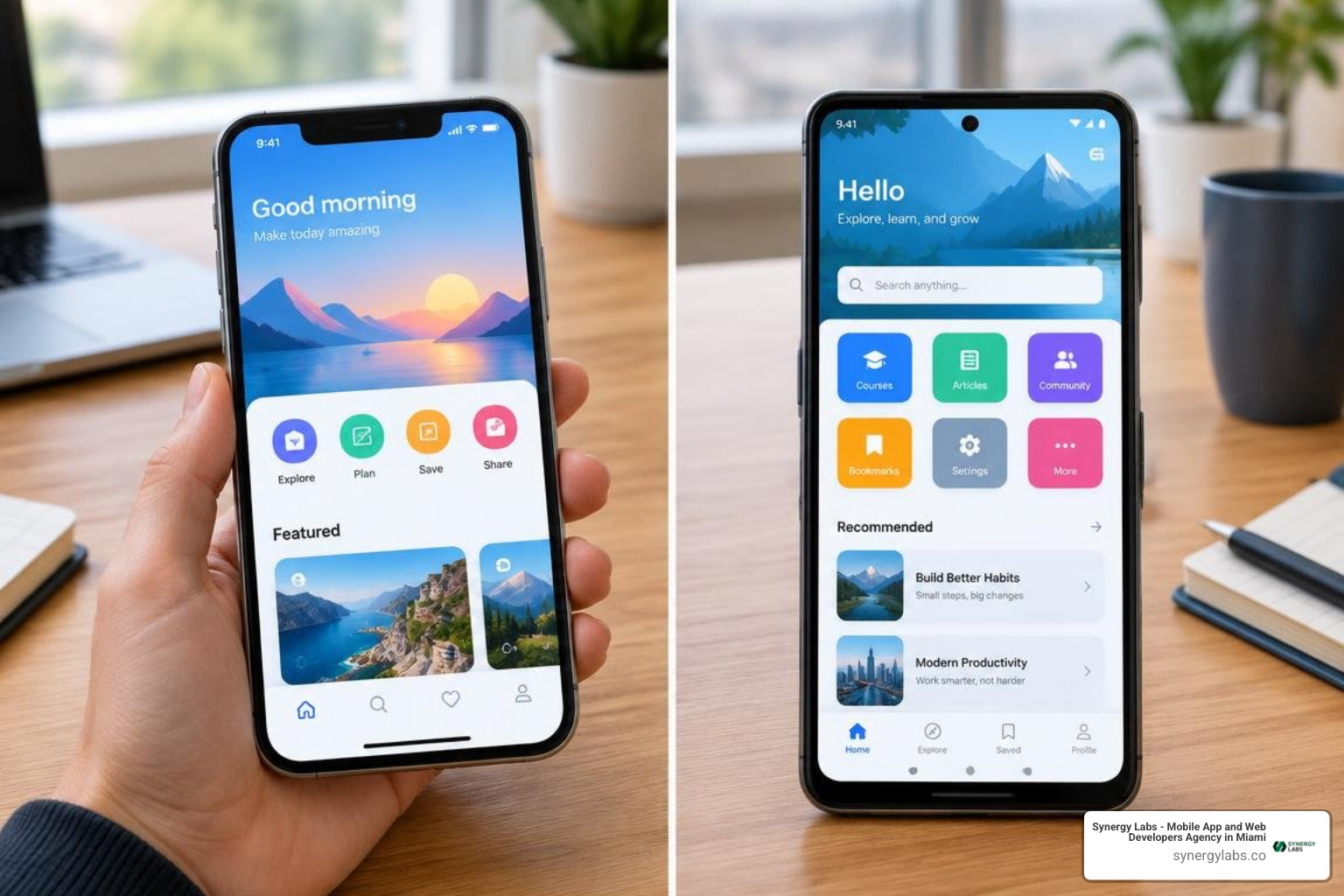
Here is how the top five frameworks compare in 2026:
Flutter: High-Velocity Canvas-Rendered UI
Backed by Google, Flutter commands approximately 46% market share among cross-platform mobile developers. It uses Dart, an object-oriented language optimized for client interfaces with rapid execution and fast build times.
- Platform Support: iOS, Android, Web, macOS, Windows, Linux, and embedded systems.
- Key Strengths: Flutter's Impeller graphics engine eliminates runtime shader compilation stutter, delivering smooth 60fps and 120fps animations. With a comprehensive collection of built-in Material 3 and Cupertino widgets, teams can easily create consistent cross-platform designs. When comparing Flutter vs React Native for your project, Flutter is often the top choice for apps requiring rich, custom animations or unified branding. Developers can also take advantage of the best Flutter plugins for app development in 2026 to streamline device integrations.
- Honest Limitations: Flutter's WebAssembly support works smoothly in Chromium-based browsers (Chrome and Edge), but Safari and Firefox fallback to standard JavaScript rendering pipelines. App bundle sizes are also larger out-of-the-box compared to pure native binaries.
React Native: The Web-Integrated Native Primitive Champion
Maintained by Meta and an extensive open-source community, React Native powers roughly 42% of cross-platform apps worldwide. It lets developers write user interfaces in JavaScript and TypeScript while rendering authentic native UI components.
- Platform Support: iOS and Android officially, with community and partner-supported implementations for macOS, Windows, and Web.
- Key Strengths: Web frontend engineers familiar with React can transition to mobile development quickly. React Native maps declarative JSX markup directly to native iOS and Android interface components. When paired with the modern Expo ecosystem, teams benefit from simplified native project management, streamlined over-the-air updates, and rapid onboarding. In addition, apps built with React Native generate significant store revenue due to widespread adoption across top-tier enterprise, fintech, and e-commerce companies.
- Honest Limitations: Desktop and web targets are maintained outside Meta's core repository, requiring additional third-party dependencies for broad multi-platform deployments. Framework upgrades and native debugging can also require deeper native platform expertise than pure canvas-rendered solutions.
Kotlin Multiplatform: Flexible Native Logic Sharing
Created by JetBrains and officially supported by Google for sharing business logic between Android and iOS, Kotlin Multiplatform (KMP) has quickly become a favorite among mobile engineers.
- Platform Support: Android, iOS, Desktop (JVM), Web (Wasm), and Server.
- Key Strengths: KMP lets you share as much or as little code as you want. Teams can share networking, data storage, and domain logic while retaining native SwiftUI and Jetpack Compose user interfaces. Major companies like Netflix, McDonald's, Cash App, Forbes, and Duolingo use KMP in production to avoid duplicated business logic while preserving authentic platform-native styling.
- Honest Limitations: While Compose Multiplatform now offers stable multi-platform UI sharing, managing iOS build tooling and bidirectional Swift-to-Kotlin interoperability can introduce a steeper learning curve for teams without prior native mobile experience.
.NET MAUI: Microsoft’s Unified Enterprise Solution
As the evolution of Xamarin.Forms, .NET MAUI (Multi-platform App UI) unites mobile and desktop development within Microsoft's .NET ecosystem.
- Platform Support: Android, iOS, Windows, and macOS (via Mac Catalyst).
- Key Strengths: .NET MAUI is an excellent choice for enterprise teams with established C# and .NET codebases. It provides tight integration with Visual Studio, shared resource management in a single project structure, and direct access to enterprise tools and cloud services.
- Honest Limitations: Out-of-the-box support for Linux desktop is absent, and native WebAssembly deployments require hybrid WebView patterns or third-party extensions.
Uno Platform: Comprehensive 6-Platform Architecture
Uno Platform enables .NET developers to build applications across six platforms from a single codebase using WinUI and Windows App SDK APIs.
- Platform Support: iOS, Android, Windows, macOS, Linux, and WebAssembly (WASM).
- Key Strengths: Uno Platform offers true single-project configurations, a runtime visual designer (Hot Design), and first-class WebAssembly support powered by Skia rendering. It even supports embedding third-party .NET MAUI controls, making it a versatile option for line-of-business applications requiring web and desktop coverage alongside mobile.
- Honest Limitations: The platform requires familiarity with XAML markup and WinUI concepts, and its community ecosystem is smaller than those of Flutter and React Native.
Critical Technical Trade-Offs Across Modern Frameworks
Selecting a mobile tech stack involves real-world trade-offs between performance, long-term maintenance costs, and team velocity. Detailed research in the State-of-the-Art Cross-Platform Mobile Application Development Frameworks: A Comparative Study of Market and Developer Trends highlights the importance of evaluating technical architecture alongside community support and hiring demand.

Evaluating Rendering Engines in Our Cross Platform Mobile Development Frameworks Comparison
A framework's rendering model plays a major role in overall app performance, battery usage, and interface consistency:
- Canvas Rendering (Flutter, Uno Platform): Renders every pixel through a custom graphics engine. This guarantees visual consistency across OS versions and eliminates device-specific layout quirks, though it carries a slight initial startup memory footprint.
- Native Component Mapping (React Native, .NET MAUI): Maps framework abstractions directly to platform UI controls (such as
UIViewon iOS andandroid.view.Viewon Android). This approach gives apps an authentic native feel and adapts automatically to system-level accessibility updates, though minor layout adjustments may be needed across platforms. - Native UI with Shared Logic (Kotlin Multiplatform): Leaves UI rendering entirely to the host OS using SwiftUI and Jetpack Compose, delivering authentic native styling with zero rendering overhead while sharing complex backend logic.
Cross Platform Mobile Development Frameworks Comparison: Community, Tooling, and Longevity
Long-term project costs depend heavily on the strength of a framework's ecosystem. A framework might excel in initial proof-of-concept tests, but if third-party packages become obsolete or break after a major OS release, maintenance costs quickly rise.
When choosing a mobile app tech stack, evaluate:
- Package Registry Vitality: Check how quickly community packages update when Apple and Google release new software development kits.
- Developer Availability: React Native and Flutter benefit from large global talent pools across JavaScript, TypeScript, and Dart. Kotlin Multiplatform is supported by a growing base of Android engineers, while .NET MAUI and Uno Platform draw from the enterprise C# developer community.
- Tooling and Debugging: Evaluate IDE integrations across VS Code, Android Studio, and Visual Studio, alongside hot reload stability to maintain fast development cycles.
Strategic Framework Selection: Aligning Tech Stacks with Business Goals
The best technology choice depends on your team's background, application requirements, and target platforms.
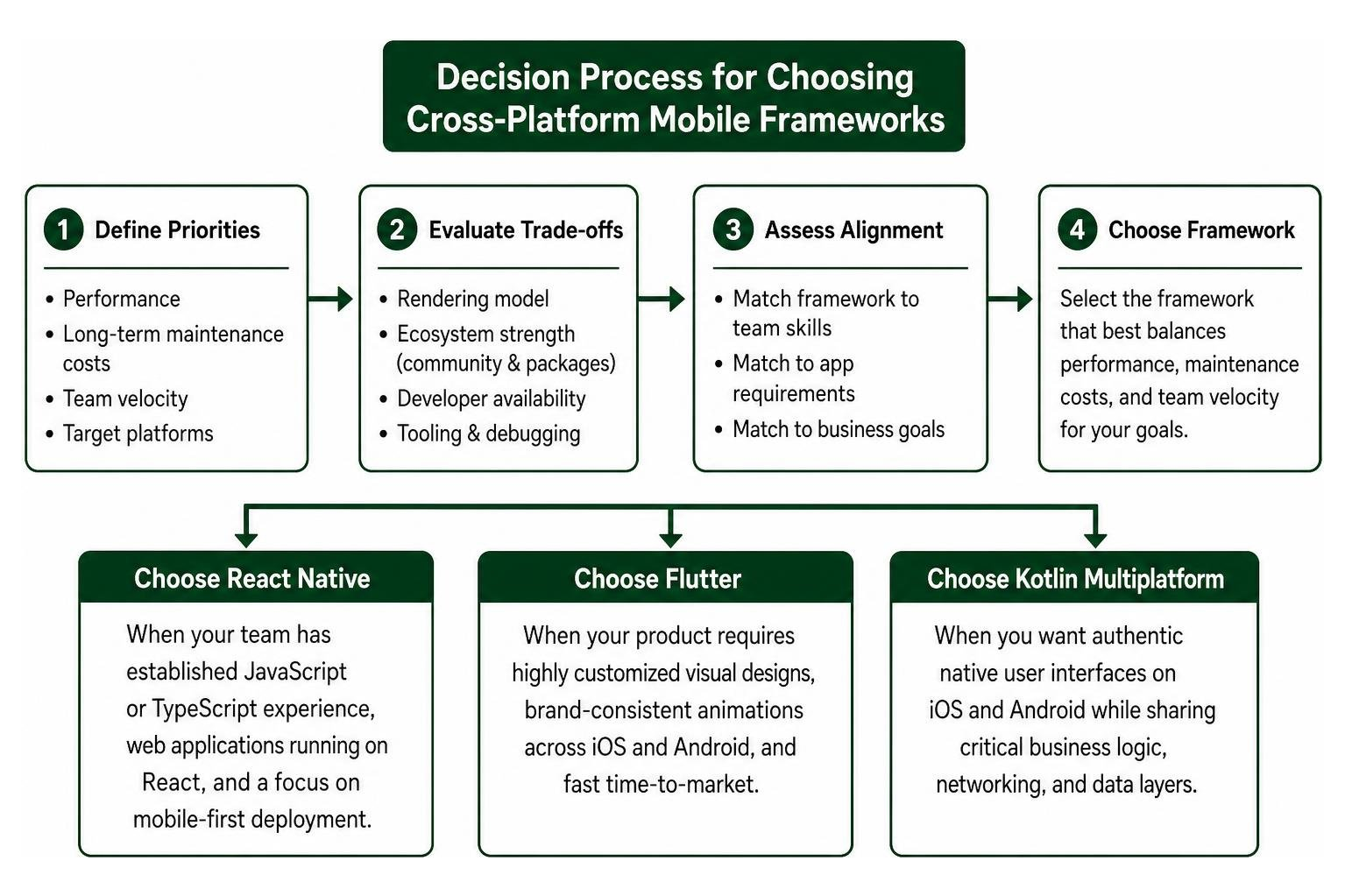
Key evaluation factors to keep in mind:
- Choose React Native when your team has established JavaScript or TypeScript experience, web applications running on React, and a focus on mobile-first deployment.
- Choose Flutter when your product requires highly customized visual designs, brand-consistent animations across iOS and Android, and fast time-to-market.
- Choose Kotlin Multiplatform when you want authentic native user interfaces on iOS and Android while sharing critical business logic, networking, and data layers.
- Choose .NET MAUI when building enterprise tools inside a Microsoft-centric environment with existing C# libraries and Windows desktop needs.
- Choose Uno Platform when you need single-codebase coverage across six platforms, including Linux desktops and production-ready WebAssembly.
Choosing Based on Internal Engineering Expertise
Hiring or retraining engineers represents a real operational cost. If your team consists of skilled React developers, moving to React Native offers an intuitive learning curve. Similarly, if your engineering team has extensive native Android experience, Kotlin Multiplatform provides a smooth adoption path with minimal disruption.
Introducing Dart for Flutter or C# for .NET MAUI is straightforward for experienced object-oriented developers, but teams should still account for a short ramp-up period when learning framework-specific state management and layout conventions.
Enterprise Readiness, Security, and Hardware Integration
For enterprise and financial applications, security cannot be an afterthought. Regardless of the framework you choose, your architecture should comply with OWASP Mobile Top 10 standards:
- Implement secure key storage using iOS Keychain and Android KeyStore rather than plain local storage.
- Apply certificate pinning and end-to-end payload encryption for network communications.
- Isolate CPU-heavy tasks on background threads to ensure UI animations remain smooth and responsive.
- Test performance across mid-range and entry-level mobile devices to confirm acceptable memory footprints, fast startup times, and smooth battery consumption.
Frequently Asked Questions about Cross-Platform Frameworks
Which cross-platform framework delivers the highest runtime performance?
All modern cross-platform frameworks offer near-native runtime performance for everyday business, media, and e-commerce applications. Flutter's Impeller engine ensures steady 60fps and 120fps graphics rendering, React Native's JSI provides direct C++ component invocation without legacy serialization delays, and Kotlin Multiplatform compiles shared business logic directly into native binaries. For most applications, differences in runtime speed come down to clean state management and efficient asset loading rather than framework limitations.
Can Kotlin Multiplatform and React Native coexist within existing native apps?
Yes. Both frameworks support brownfield integration, allowing you to embed them into existing native iOS and Android projects. With Kotlin Multiplatform, you can introduce shared networking or database modules while leaving your existing native UI intact. With React Native, you can embed specific cross-platform screens or feature flows into an existing application without rewriting your entire codebase.
What are the main limitations of cross-platform frameworks compared to pure native development?
While cross-platform frameworks handle the vast majority of mobile use cases effectively, pure native development (Swift/SwiftUI for iOS and Kotlin/Jetpack Compose for Android) still offers advantages when apps require immediate zero-day access to newly released platform APIs, deep low-level Bluetooth and peripheral hardware tuning, or specialized system extensions like live audio processing pipelines and augmented reality engines.
Build Your Next Cross-Platform App with Synergy Labs
Selecting the right development framework is one of the most critical technical decisions your team will make. A well-matched framework accelerates launch timelines, keeps engineering budgets predictable, and ensures your digital products scale smoothly as your user base grows.
At Synergy Labs, we help startups and established enterprises turn product concepts into market-ready applications. Our engagement model pairs clients with an experienced in-shore CTO with an offshore dev team, providing senior-level technical leadership and dedicated development support from day one. With our fixed-budget model and milestone-based payments that ensure projects are completed efficiently, you retain full clarity and control over your roadmap and delivery timeline.
Explore our custom cross-platform app solutions or get in touch with our engineering team today to design, build, and launch your next high-performance mobile application.