

How to Choose Android Antivirus for Automotive Infotainment

Choose a security tool built for the vehicle's head unit, not a phone antivirus app. Look for malware detection that runs quietly in the background, checks installed apps and update activity, and alerts your team to unusual network traffic. For fleets, remote alerts and a clear way to contain an infected unit matter just as much as scanning.
The risk is real. In 2026, researchers documented malware spread through built-in head-unit updaters. It ran without a visible app and could commit ad fraud or download more code. Antivirus can help spot that behavior, but it cannot replace secure updates and strong access controls.
As director of product at Synergy Labs, I'll use those limits to guide what we look for in the options ahead.
Simple guide to android antivirus for automotive terms:
- Android Antivirus
- android antivirus licensing model
Anatomy of Car Head Unit Attacks: The MoYu and BADBOX Botnet Threat
The automotive landscape has changed dramatically. Connected vehicles are essentially massive data centers on wheels, running sophisticated infotainment systems that manage navigation, media streaming, climate settings, and telematics. However, as the Android Open Source Project (AOSP) and Android Automotive OS (AAOS) become the industry standard for in-vehicle infotainment (IVI), they also inherit the broader threat vectors targeting Android ecosystems.
The most concerning milestone occurred when cybersecurity researchers uncovered the first documented case of malware purpose-built to exploit Android-based automotive head units. Operating through compromised firmware pipelines provided by suppliers like DoFun, this campaign demonstrated that vehicles are no longer theoretical targets—they are active endpoints in global cybercrime operations.
The campaign has been attributed with high confidence to the MoYu Group, an advanced threat actor closely tied to the infamous BADBOX botnet previously exposed by cybersecurity researchers. Rather than relying on physical access or tricking a driver into plugging in a malicious USB drive, these attackers compromised upstream supply chains. By embedding backdoor mechanisms into the base firmware before consumer delivery or weaponizing remote maintenance utilities, they established covert persistence across thousands of connected vehicles.
Hijacking Legitimate OTA Channels and System Apps
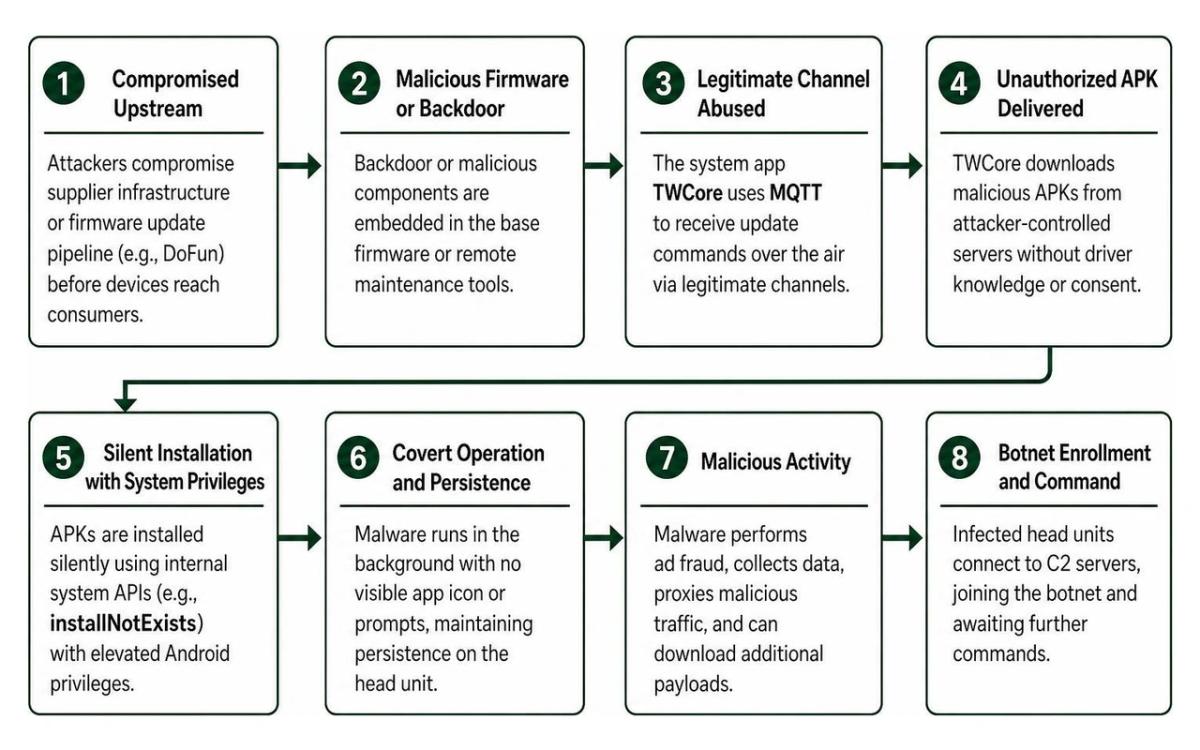
The primary entry vector in this campaign exploited legitimate update mechanisms built directly into the head unit firmware. Central to the compromise was a privileged system application known as TWCore. Because system apps execute with elevated Android operating system privileges (often running under shared system UIDs), they can install or update software packages without requiring explicit driver consent or triggering graphical confirmation dialogs.
The attackers weaponized this setup by abusing MQTT (Message Queuing Telemetry Transport) protocols. The TWCore service constantly listened for update notifications via MQTT. When the threat actors dispatched an update command, TWCore fetched unauthorized Android application packages (APKs) over the air and installed them silently using internal system API flags like installNotExists. The malware operated entirely headlessly:
- It registered no user-accessible launcher activity.
- It created no visible dashboard icons.
- It generated zero notifications to alert the driver.
- It maintained uninterrupted execution across vehicle power cycles.
This demonstrates why standard consumer endpoint defenses fall short. When a pre-installed system utility is hijacked, standard user permission prompts are bypassed entirely.
Multi-Stage Payloads, Ad Fraud, and Reverse Proxies
Once the initial vector was triggered, the attack executed a multi-stage infection chain designed to evade detection and monetize vehicle compute resources:
- Stage 1 (Dropper): The system app drops an initial payload named
JarService. This component establishes local persistence and prepares the environment for dynamic code loading. - Stage 2 (Loader):
JarServiceunpacks an obfuscated secondary loader. This module initializes encrypted command-and-control (C2) communication. - Stage 3 (Execution Engine): The loader fetches active payload modules capable of interpreting at least nine distinct remote commands (including
return,copy,http,web,loadlib2,deeplink, andtraceroute).
By default, the compromised head unit transmitted an HTTP POST beacon to its C2 endpoint every 90 minutes. These payloads turned in-car infotainment units into covert nodes for click fraud and distributed ad viewing. The malware could open hidden browser windows to simulate user engagement on advertising networks.
Even more alarming was the integration of modules like zhima, a reverse-proxy tool. By routing unauthorized internet traffic through the vehicle’s cellular data connection (via onboard 4G/5G SIM cards), attackers monetized the vehicle as a residential proxy node within the BADBOX infrastructure. For drivers and fleet operators, this resulted in unexplainable cellular data overages, degraded infotainment performance, and critical background vulnerabilities that required rapid adware removal for Android alongside comprehensive firmware remediation.
Evaluating the Need for Android Antivirus for Automotive Systems
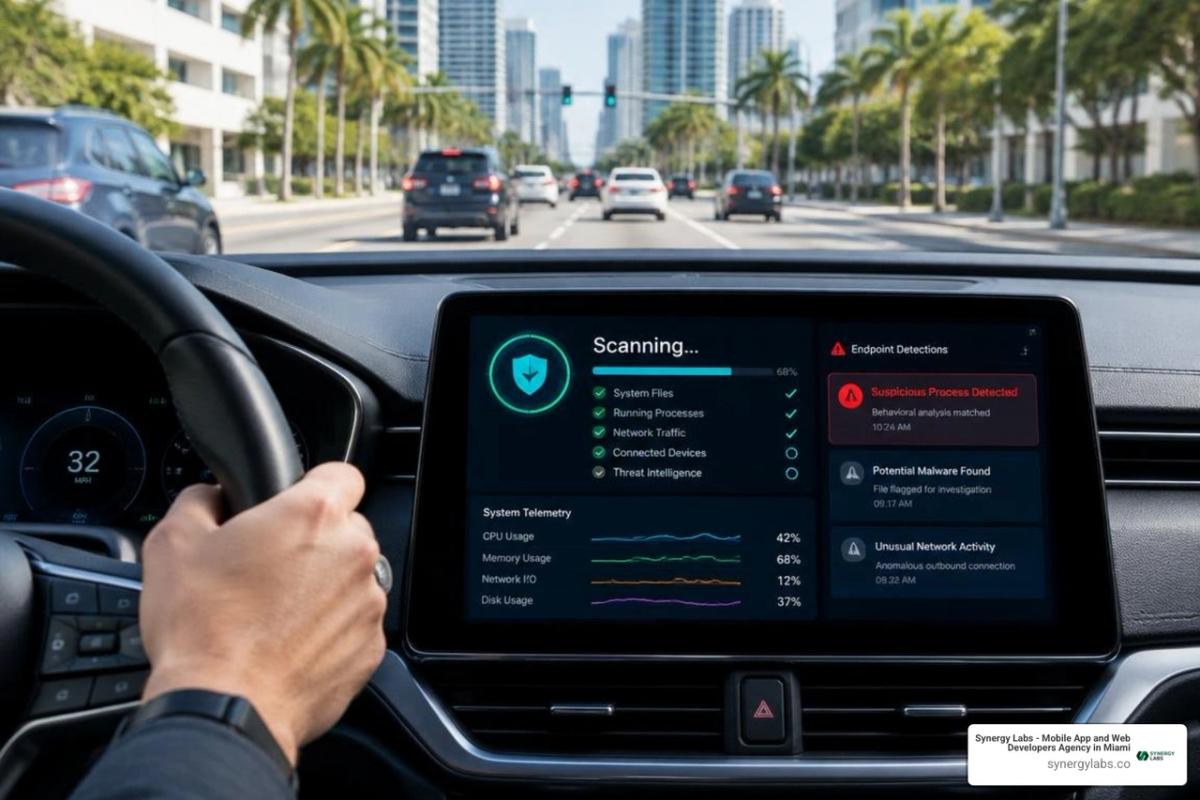
The emergence of vehicle-targeted botnets answers a critical industry question: Do connected cars actually need automotive-specific antivirus software? The short answer is yes—but the definition of "antivirus" in an automotive context differs fundamentally from traditional desktop or mobile virus scanners.
In standard consumer environments, an antivirus app periodically scans stored files and alerts the user when a known malware signature appears. In an automotive software-defined vehicle (SDV), traditional file scanners are impractical. Infotainment processors must prioritize safety-critical UI elements, rear-view camera feeds, and real-time audio alerts. A heavy scanner consuming 100% CPU to check file hashes could cause unacceptable dashboard lag. Furthermore, because head units run headless background tasks without constant user interaction, automotive security must center on proactive mobile app security, behavioral heuristics, and kernel-level anomaly detection.
Core Capabilities of an Android Antivirus for Automotive Infotainment
An effective automotive endpoint security engine must be engineered specifically for embedded vehicle environments:
- Signature-Less Behavioral Monitoring: Rather than solely checking known file hashes, the engine analyzes process behavior—such as unexpected dynamic DEX class loading (
loadlib2), hidden WebView creation, or abnormal MQTT subscriptions. - System App Integrity Verification: Continuous monitoring of system-level daemons and system-partition apps ensures that legitimate services like
TWCorehave not been altered or coerced into downloading arbitrary code. - Telemetry Data Logging and SIEM Reporting: Because drivers cannot triage security alerts while driving on the highway, threat logs must stream securely to an automotive Security Operations Center (SOC) or Fleet Management SIEM via standardized protocols.
- Ultra-Low Latency & Minimal Footprint: Security agents must adhere to strict compute budgets, ensuring memory and CPU utilization do not impact critical vehicle Human-Machine Interface (HMI) operations.
- Native Network Packet Filtering: Real-time inspection of inbound and outbound socket connections detects periodic beaconing (such as 90-minute HTTP POST intervals) and blocks unauthorized reverse proxies from abusing onboard telematics.
Fleet managers evaluating specialized protection often pair embedded agents with best free security apps for android concepts tailored to embedded ecosystems to keep head units isolated and secure.
Built-In AAOS Protections: SELinux, dm-verity, and Verified Boot
To evaluate third-party security engines effectively, we must first understand the baseline defense-in-depth architecture provided by Android Automotive OS (AAOS):
- Android Verified Boot (AVB) and dm-verity: AVB establishes a cryptographic chain of trust from the hardware bootloader up to the Android system partition. Using
dm-verity, the Linux kernel verifies the cryptographic hash of every single 4 KB storage block on the fly. If an attacker attempts to modify a read-only system file, the block verification fails, preventing the corrupted code from executing. - SELinux (Security-Enhanced Linux): SELinux enforces Mandatory Access Control (MAC) policies across all processes. Even if a malicious app gains root privileges inside a container, SELinux policies restrict its ability to access raw block devices, modify system properties, or interact with unapproved hardware drivers.
- UID Sandboxing: Every installed Android package runs in an isolated process sandbox mapped to a unique Linux User ID (UID), preventing unauthorized inter-process data access.
- APEX Container Packaging: Under modern AAOS SDV secure by design principles, modular system components are packaged inside APEX containers. These use immutable storage, active/backup partitions for double-buffered atomic rollbacks, and cryptographic verification to prevent pipeline corruption.
While these built-in controls provide a formidable security posture, the MoYu Group attack succeeded because the compromise lived within the trust boundary—exploiting a vendor-signed system app authorized to install user-space packages. Dedicated automotive antivirus fills this exact gap by inspecting runtime behavior within legitimate execution contexts.
Hardware-Backed Isolation and Memory-Safe Architecture
A fundamental rule of modern automotive engineering is that an infotainment compromise must never compromise vehicle dynamics. If an attacker gains full control over the Android media player, they must remain completely isolated from safety-critical Electronic Control Units (ECUs) controlling steering, braking, powertrain, and advanced driver assistance systems (ADAS).
Achieving this separation requires hardware-enforced isolation, microkernel virtualization, and memory-safe programming paradigms at the silicon level.
Hypervisor Virtualization and Trusty OS Integration
Leading automotive System-on-Chips (SoCs), such as the NXP i.MX applications processors, utilize Type-1 hardware hypervisors to consolidate multiple distinct operating environments onto a single physical chip:
- Domain Isolation: The Android Automotive infotainment stack runs inside an isolated Virtual Machine (VM). Safety-critical RTOS instances (such as AUTOSAR or FreeRTOS) execute in parallel VMs with hardware-guaranteed memory segregation and CPU scheduling priority.
- Trusty OS and TEE: Sensitive cryptographic operations, digital keys, and biometric credentials are handled inside a Trusted Execution Environment (TEE) powered by Trusty OS. Even a full kernel panic or root exploit inside the Android VM cannot access private keys held within Trusty's secure world.
- Vehicle HAL (VHAL) Gateway: Infotainment apps never talk directly to the Controller Area Network (CAN) bus or Automotive Ethernet backbones. Instead, all vehicle data requests must route through a strictly mediated Vehicle Hardware Abstraction Layer (VHAL) protected by Android permissions and SELinux constraints.
By enforcing virtualization, vehicle manufacturers ensure that ad-fraud botnets or proxy malware on the infotainment screen remain sandboxed from critical vehicle controllers.
Memory Safety with Rust in Software-Defined Vehicles
Historically, low-level Android native daemons and HAL implementations were written in C and C++, languages susceptible to memory corruption vulnerabilities (such as buffer overflows, use-after-free, and race conditions). Attackers frequently exploit these memory flaws to escalate privileges from a sandboxed app to native root.
To eliminate entire classes of vulnerabilities, Android Automotive has adopted Rust as the primary language for new native platform components:
By enforcing strict compile-time ownership, lifetime checks, and thread-safety invariants, Rust eliminates memory safety bugs without runtime garbage collection overhead. Utilizing Rust across Android Interface Definition Language (AIDL) HAL backends ensures that untrusted data inputs from Bluetooth, Wi-Fi, or cellular modems cannot trigger buffer overflow exploits in core system daemons.
Securing Vehicle Networks and the Automotive Software Supply Chain
Modern Software-Defined Vehicles rely heavily on high-speed Automotive Ethernet to connect domain controllers, radar/camera sensors, and infotainment gateways. Protecting these communication channels from packet sniffing, spoofing, and man-in-the-middle (MitM) injection is critical to overall vehicle security.
When evaluating endpoint defenses, security architectures must extend beyond the head unit to secure inter-ECU data links and the remote software delivery pipeline through continuous app security patch maintenance.
In-Vehicle Ethernet Defense with MACsec and DICE-Based TLS
Securing internal vehicle networks requires end-to-end cryptographic protection:
- IEEE 802.1AE MACsec: Automotive Ethernet links can be secured using MACsec, which encrypts and authenticates Layer-2 network frames at wire speed. By enabling MACsec for Android Automotive Ethernet, OEMs ensure that rogue devices attached to the vehicle wiring harness cannot inject malicious packets or eavesdrop on internal communications.
- Hardware-Backed CAK Storage: MACsec Connectivity Association Keys (CAK) are securely stored in tamper-resistant hardware modules managed by vendor-specific Hardware Abstraction Layers.
- DICE-Based Mutual TLS: Device Identifier Composition Engine (DICE) standards provide hardware-rooted cryptographic identities. Using DICE-derived keys, VM-to-VM and ECU-to-head-unit sessions establish mutual Transport Layer Security (mTLS), verifying that every communicating service is authenticated and running an uncompromised software build.
These network controls ensure that even if an attacker attempts lateral movement from an infected media app, the underlying network interfaces reject unauthenticated traffic.
Deploying Android Antivirus for Automotive Fleets and Connected Vehicles
Managing security across thousands of commercial connected vehicles requires an enterprise-grade operational approach. Fleet operators cannot rely on manual device inspections; they require automated fleet telemetry, continuous scanning, and over-the-air response capabilities.
Implementing a fleet-wide automotive endpoint protection strategy involves:
- Zero-Touch Provisioning: Embedding lightweight monitoring agents directly into the base BSP during manufacturing or via signed, atomic OTA updates.
- Centralized Telemetry Ingestion: Aggregating behavioral logs into cloud-hosted SIEM platforms to correlate anomalies across entire vehicle fleets in real time.
- Automated Incident Containment: Utilizing remote policy enforcement to quarantine compromised apps, revoke cellular data privileges, or roll back firmware images without taking the vehicle off the road.
Fleet architects and technical leads can explore our best mobile security software guide 2026 for deeper architectural strategies on deploying scalable mobile and embedded endpoint defenses.
Regulatory Compliance: ISO/SAE 21434 and Continuous Vulnerability Audits
Automotive cybersecurity is heavily governed by stringent international regulations. Manufacturers, tier-1 suppliers, and software vendors must align their engineering pipelines with global frameworks:
- ISO/SAE 21434: This standard defines cybersecurity engineering throughout the complete vehicle lifecycle—from design and development to production, operation, and decommissioning. It mandates structured Threat Analysis and Risk Assessment (TARA) for all software components.
- UNECE WP.29 Regulation R155/R156: Mandates that OEMs maintain a certified Cybersecurity Management System (CSMS) and a secure Software Update Management System (SUMS) to legally sell vehicles across major global markets.
Meeting these rigorous standards requires regular penetration testing, automated static/dynamic code analysis (SAST/DAST), and strict vulnerability disclosure programs to eliminate supply chain risks before firmware images are flashed onto physical head units.
Frequently Asked Questions About Automotive Android Security
How does malware infect Android automotive head units without user interaction?
Malware infects automotive head units without user interaction primarily by targeting vulnerabilities in pre-installed, privileged system apps or supply-chain update channels. In the documented MoYu Group attack, attackers abused the TWCore system updater via MQTT commands, leveraging system-level permissions to download and install unauthorized APK packages silently in the background.
Can traditional smartphone antivirus apps protect Android Automotive OS?
No, traditional consumer smartphone antivirus apps are ineffective for Android Automotive OS. Phone antivirus tools rely on interactive graphical interfaces, broad user scanning permissions, and cloud-heavy engines that cause latency and UI stuttering on vehicle dashboards. Automotive environments require lightweight, headless, behavioral detection engines integrated into the vehicle's HAL architecture and connected to enterprise fleet management SIEMs.
What standards govern cybersecurity in Android-powered connected vehicles?
Cybersecurity in connected vehicles is primarily governed by ISO/SAE 21434 (Road vehicles — Cybersecurity engineering) and UNECE WP.29 Regulations R155 and R156. These frameworks require manufacturers to maintain verified cybersecurity management systems, perform rigorous risk assessments, maintain supply chain security, and ensure tamper-proof over-the-air software updates throughout the vehicle's operational lifecycle.
Driving Forward: Engineering Secure Connected Vehicle Solutions
Securing modern automotive infotainment systems requires a layered defense-in-depth architecture. As head units evolve into full-featured computing hubs, threats like the MoYu Group campaign highlight the critical need for signed OTA pipelines, SELinux enforcement, hardware-backed isolation, and purpose-built automotive endpoint detection.
At Synergy Labs, we specialize in building high-performance, secure digital platforms and embedded software solutions. Whether you are architecting a custom Android Automotive application, hardening an embedded Linux runtime, or designing a secure telematics pipeline, our team delivers the technical expertise needed to safeguard your systems.
We operate on a transparent fixed-budget model with milestone-based payments, pairing an in-shore CTO with dedicated development teams across our offices in Miami, San Francisco, New York City, Chicago, Austin, Phoenix, Hartford, London, Dubai, Doha, and Riyadh. This structure gives you direct access to senior engineering talent while ensuring projects launch efficiently, within scope, and with uncompromising security.
Ready to engineer safe, reliable, and secure automotive software? Explore our expert connected vehicle engineering services today, and let's build the future of connected mobility together.