
Why App Development Decision-Making Determines Your Success

App Development Decision-Making is the process of making strategic choices that shape your app's success, from platform selection and technology stack to budget allocation and team structure. Key decisions include:
- Platform Choice: Native vs. cross-platform
- Development Approach: In-house vs. outsourcing
- Technology Stack: Languages, frameworks, and infrastructure
- MVP Scope: Core features for the first version
- Budget & Timeline: Costs, maintenance, and launch strategy
- Security: Data protection and user privacy
The stakes are high. Industry research shows 70% of app development failures are due to poor planning and unclear requirements. With global app spending projected to grow, competition is fierce, leaving no room for error.
Every choice impacts user experience, development costs, and time to market. Native development offers peak performance but longer timelines, while cross-platform ensures faster launches. The challenge is aligning technical choices with business goals, user needs, and market realities. Poor decisions can derail projects, waste budgets, and miss market opportunities.
As the founder of Synergy Labs, I've guided startups through these critical moments, helping clients like Clapper reach over 1 million downloads by making smart strategic choices. My experience spans fintech, social platforms, and consumer apps, each requiring a unique decision framework to succeed.
The Core Framework for App Development Decision-Making
Picture this: you're ready to transform your brilliant idea into an app. But App Development Decision-Making isn't just about technology; it's about crafting a strategic roadmap that guides your journey from concept to success.

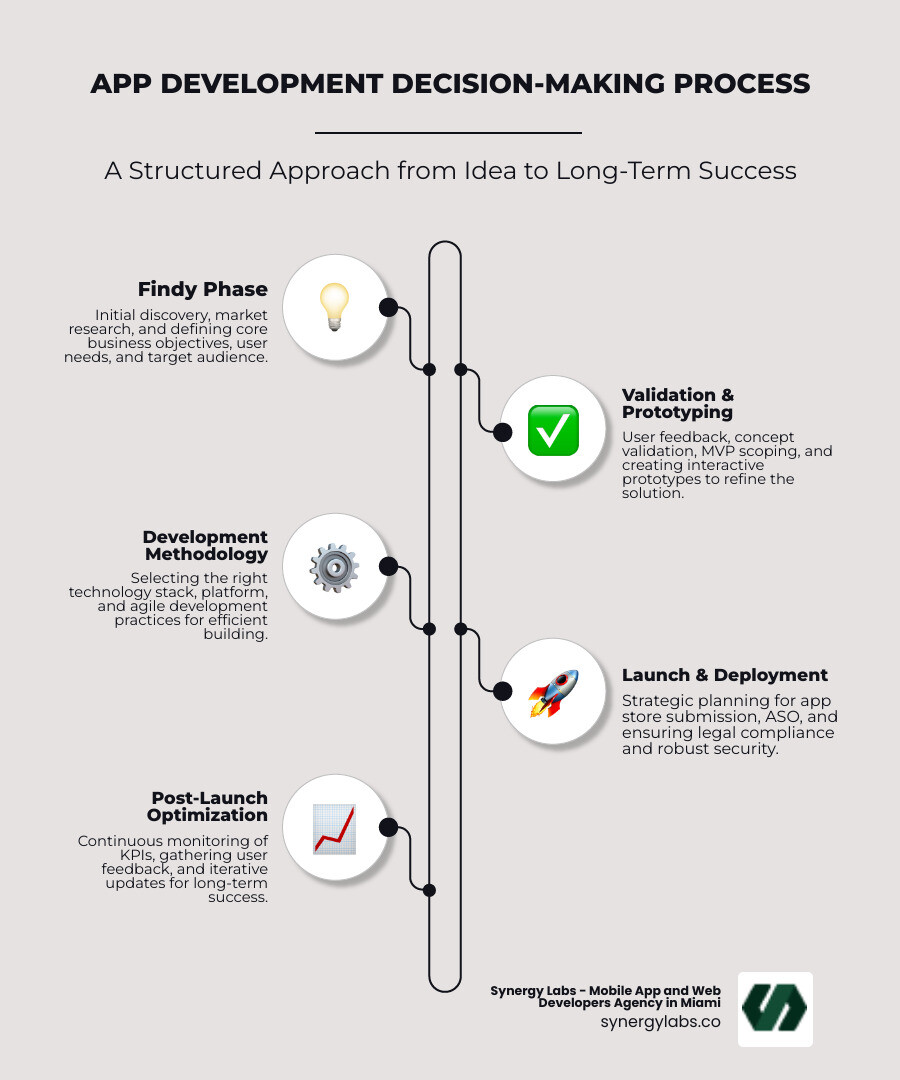
Think of it as building a house: you need blueprints. Our framework follows a proven path from concept validation and prototyping to choosing the right development methodology and post-launch optimization. This structured approach is essential to avoid the 70% failure rate caused by poor planning. Every early decision ripples through the development process, affecting user experience and your bottom line.
At Synergy Labs, we've learned that success comes from being methodical without being rigid. Our From Idea to Launch: A Step-by-Step Guide to Developing Your First Mobile App breaks down this journey, but let's explore the key decision points.
Defining Your Goals, Audience, and Competitive Edge
Before writing any code, we must answer three fundamental questions that shape every App Development Decision-Making moment.
First, what are your app's specific, measurable business objectives? Go beyond "making money" and define clear goals, like increasing customer retention by 25% or creating a new $100K revenue stream. Successful apps start with crystal-clear, SMART goals (specific, measurable, achievable, relevant, time-bound) that align with your broader business strategy.
Second, who are you building this for? Successful apps solve specific problems for specific people. Creating detailed user personas—understanding demographics, motivations, habits, and pain points—is the foundation of good design. This deep user understanding directly impacts every choice, from loading speed to button size. As over 75% of users cite user experience as a deciding factor, you can't create great UX without knowing your audience. That's why we recommend reading Why Founders Should Treat UX as an Early-Stage Growth Lever in 2025 early on.
Finally, what makes your app different? Every app category is crowded. Market analysis helps us find gaps where user needs aren't fully met. Your unique value proposition (UVP) becomes your North Star, filtering every feature and design choice. If a feature doesn't support your UVP, it shouldn't be in your first version.
Scoping the Minimum Viable Product (MVP)
Defining your MVP is one of the most critical App Development Decision-Making moments. It's not about a stripped-down app; it's about the smartest first version that delivers real value while allowing you to learn.
The MVP mindset forces you to identify what's essential. Many founders want to include every feature in version 1.0, but this adds complexity, cost, and delays. Instead, focus on solving one problem really well. Data shows 60% of users prefer simple apps with specific features.
Feature prioritization requires brutal honesty. For each feature, ask: does this support our UVP? Will users get it? Can we validate our assumptions without it? Using user stories keeps the focus on value. The goal is to get your app to users quickly to learn from real behavior, reducing risk and ensuring you're building something people want. Our podcast on Mastering Mobile App Development, Overcoming Perfectionism, AI Search & The Future of MVPs explores this philosophy in detail.
Choosing Your Monetization Strategy
Even world-changing apps need a sustainable business model. App Development Decision-Making around monetization should happen early.
- Subscription models create predictable revenue for apps with ongoing value, but you must continuously deliver to prevent churn.
- In-app purchases are perfect for open uping premium features or content. The free experience must be valuable enough to attract users, with paid features compelling enough to convert them.
- Freemium approaches give users a taste of your app's value before asking them to pay. Finding the right balance is key.
- Advertising revenue can work for apps with high engagement, but ads must feel non-intrusive.
- Paid apps with an upfront cost work best when the value is immediately clear, though this model is less common now.
The key is choosing a strategy that feels natural to your users. Our guide on App Monetization Strategies explores these approaches in detail.
Technical and Methodological Decisions
Now that we've nailed down the strategic foundation, it's time to dive into the technical "how." This is where App Development Decision-Making moves from strategy to execution.

Think of this phase as choosing the right tools and team to build your house. We're deciding on programming languages, development methodologies like Agile, and quality assurance processes. These aren't just technical choices; they're business decisions that directly impact your timeline, budget, and user experience. Getting them right builds a solid foundation for success.
Selecting the Right Technology Stack and Platform
Your technology stack—the collection of languages, frameworks, and tools—is the engine of your app. The big question is whether to build native, go cross-platform, or use a progressive web app.
- Native development (Swift/Objective-C for iOS, Kotlin/Java for Android) offers the best performance and full access to device features. The trade-off is higher cost and longer timelines, as you're essentially building two separate apps.
- Cross-platform development with modern frameworks allows you to write one codebase for both iOS and Android. This approach gets you to market faster and at a lower cost, delivering a near-native experience that's ideal for most businesses. For a deeper dive, see our guide on Hybrid App or Native App: Which One Is Right for Your Business?.
- Progressive Web Apps (PWAs) are web applications that feel like native apps. They are cost-effective and SEO-friendly but have limited access to device features.
Behind the scenes, backend technologies like Node.js or Python, databases like SQL or NoSQL, and cloud infrastructure from major providers are chosen to match your app's specific needs for performance and scalability.
In-House vs. Outsourcing: A Critical Choice for App Development Decision-Making
Who will build your app? This App Development Decision-Making moment is critical. The choice between an in-house team and a development agency like Synergy Labs can make or break your project.
Building in-house offers control, but the hidden costs are significant. You're responsible for salaries, benefits, equipment, and a lengthy hiring process. Unless tech is your core competency, you'll be managing developers instead of focusing on your business.
Outsourcing to a specialized agency provides immediate access to a team of senior developers, designers, and security experts. At Synergy Labs, our team has tackled everything from fintech to social networks, bringing hard-won experience to your project. The benefits are clear:
- Cost Savings: You pay project-based fees without the overhead of full-time employees.
- Speed to Market: Experienced teams have established processes and can start immediately.
- Talent Access: You get a full team of specialists you couldn't hire internally overnight.
- Scalability: Agencies can scale resources up or down as your project needs change.
- Risk Management: Proven processes and security protocols protect your investment.
For more on these trade-offs, explore The Pros and Cons of Staff Augmentation for Mobile App Development Projects and our guide on How to Choose the Best App Development Company for Your Business in 2024.
Optimizing for Speed and Quality with Agile & DevOps
Modern development is about building the right thing the right way. Agile methodology is the gold standard, breaking projects into short sprints (1-4 weeks) of focused work. This iterative approach allows for flexibility and continuous improvement based on real feedback. Cross-functional teams collaborate closely, catching issues early when they're easy to fix.
DevOps improves this efficiency by merging development and operations. Over 35% of teams prefer DevOps for its practical benefits. Continuous Integration/Continuous Deployment (CI/CD) means code changes are integrated, tested, and deployed frequently. This allows for faster bug fixes and quicker delivery of improvements to users.
Automated testing is the secret sauce, ensuring speed doesn't compromise quality. This results in apps that launch faster, work better, and evolve quickly based on user feedback. Learn more in our guide, Agile Methodologies: Accelerating App Development Without Compromising Quality.
Planning for Security, Budget, and Post-Launch Success
The journey of App Development Decision-Making continues long after launch. To ensure long-term success, you must plan for financial viability, robust security, and continuous improvement.

This phase is about building the foundation for your app's future. We address the practical realities that determine whether your app thrives, from budgeting and data protection to creating a roadmap for ongoing growth.
Budgeting, Timelines, and Financial Planning
Smart App Development Decision-Making requires realistic financial planning. A simple app might take 2-3 months, a moderately complex one 4-6 months, and a sophisticated build 6-12 months or more.
Initial development is just the start. You must also budget for third-party APIs, server hosting, app store fees, and future updates. We recommend setting aside at least 20% of your initial development budget for the first year's maintenance. Users expect regular updates, and staying competitive means continuous evolution. For businesses seeking financial support, our Get Financing options can help.
Security and Legal Compliance in App Development Decision-Making
Security is not optional. Every App Development Decision-Making moment must consider how to protect your users and your business. We build security into every layer, including data encryption, strong authentication, SSL certificates, and robust API security.
Our team follows secure coding practices to prevent common vulnerabilities. Legal compliance is also critical. Depending on your audience, you may need to adhere to GDPR (Europe), CCPA (California), or HIPAA (healthcare). Every app needs clear Terms of Service and a comprehensive privacy policy to build user trust. Our Privacy Policy is an example of transparent data handling.
Deployment, Maintenance, and Continuous Improvement
Launch day is just the beginning. Successful App Development Decision-Making includes a post-launch plan. For public distribution, we use App Store Optimization (ASO) to help users find your app on the Google Play Store and Apple App Store. For enterprise apps, we use secure channels like Apple's Developer Enterprise Program and Android's alternative distributions.
Post-launch maintenance includes prompt bug fixes, new features based on user feedback, continuous performance monitoring, and security updates. The most successful apps establish strong user feedback loops to capture valuable input and turn it into actionable improvements.
Measuring Success: KPIs and Data Analytics
How do you know if your app is working? The answer is in data-driven App Development Decision-Making. We focus on key performance indicators (KPIs) that tell the real story:
- User acquisition metrics (downloads, cost per install)
- Engagement rates (daily/monthly active users)
- Retention rates (7-day and 30-day)
- Conversion rates (key user actions)
- Churn rate (users who stop using the app)
Data is your superpower. If analytics show users abandoning your app during onboarding, you know where to focus improvements. When data reveals that users love certain features but ignore others, you can prioritize development accordingly. Statistics show that 53% of users will leave an app if it loads too slowly, and 25% of apps are used only once. This data underscores the importance of creating a compelling experience. AI-Powered Personalization: Enhancing User Experience in Mobile Applications can help create custom experiences that keep users coming back.
Frequently Asked Questions about App Development Decision-Making
What is the most critical phase in app development decision-making?
The most critical phase in App Development Decision-Making happens before any code is written. It's the initial strategy and planning stage. The numbers tell the story: 70% of app development failures are due to poor planning and unclear requirements. This phase is where you define your goals, identify your target audience, scope your MVP, and choose a monetization strategy. Getting this right ensures your team knows what to build, your timeline is realistic, and you create an app that solves real problems for real people.
How do I choose between native and cross-platform development?
This is a key App Development Decision-Making moment that affects your budget, timeline, and performance. Here's a simple breakdown:
- Choose native development for maximum performance and deep integration with device hardware (e.g., complex games, AR experiences). This requires separate codebases for iOS and Android, increasing time and cost, but delivers the smoothest user experience.
- Choose cross-platform development to reach both iOS and Android users quickly and cost-effectively. Modern frameworks use a single codebase, significantly cutting development time. For most business and consumer apps, the performance is excellent and users won't notice a difference.
For most projects, cross-platform is the smarter business decision. Our guide on Hybrid App or Native App: Which One Is Right for Your Business? can help you decide.
What is the biggest reason app development projects fail?
The single biggest reason is the same culprit behind the 70% failure rate: poor planning and unclear requirements. It's like building a house without blueprints. Projects start with vague ideas, requirements change constantly, and budgets spiral out of control.
Other major reasons for failure include:
- Inadequate user research: Building features nobody needs.
- Insufficient testing: Launching buggy apps that frustrate users. 25% of apps are used only once.
- Lack of ongoing maintenance: Forgetting that an app needs regular updates and bug fixes to stay relevant and secure.
Fortunately, all of these failure points are avoidable with proper App Development Decision-Making from day one. A thorough planning phase is the best investment you can make.
Conclusion
Building a successful app isn't just about a great idea—it's about making smart App Development Decision-Making choices at every step. From the initial spark of inspiration to post-launch optimization, every decision shapes your app's destiny.
We've walked through the essential decisions that separate thriving apps from the 70% that fail due to poor planning. Whether choosing between native and cross-platform, selecting a tech stack, or defining a monetization strategy, these choices have a ripple effect on your app's success.
The magic happens when strategy meets execution. Your app needs a user-centric approach, technical excellence, and unwavering alignment between your business goals and development choices. Successful apps are born from informed decisions and a deep understanding of your users and market.
At Synergy Labs, we've been in the trenches with founders, helping them steer these complex decisions with confidence. We don't just build apps—we build partnerships that transform ideas into market-leading products. Our approach combines technical expertise with the strategic guidance that makes all the difference.
When you're ready to turn your vision into reality, we're here to guide you. Check out our Portfolio to see how our strategic approach has helped other visionaries bring their ideas to life. Your app's success story starts with the right decisions—and the right partner to help you make them.