
How to Build Secure eCommerce Mobile Apps

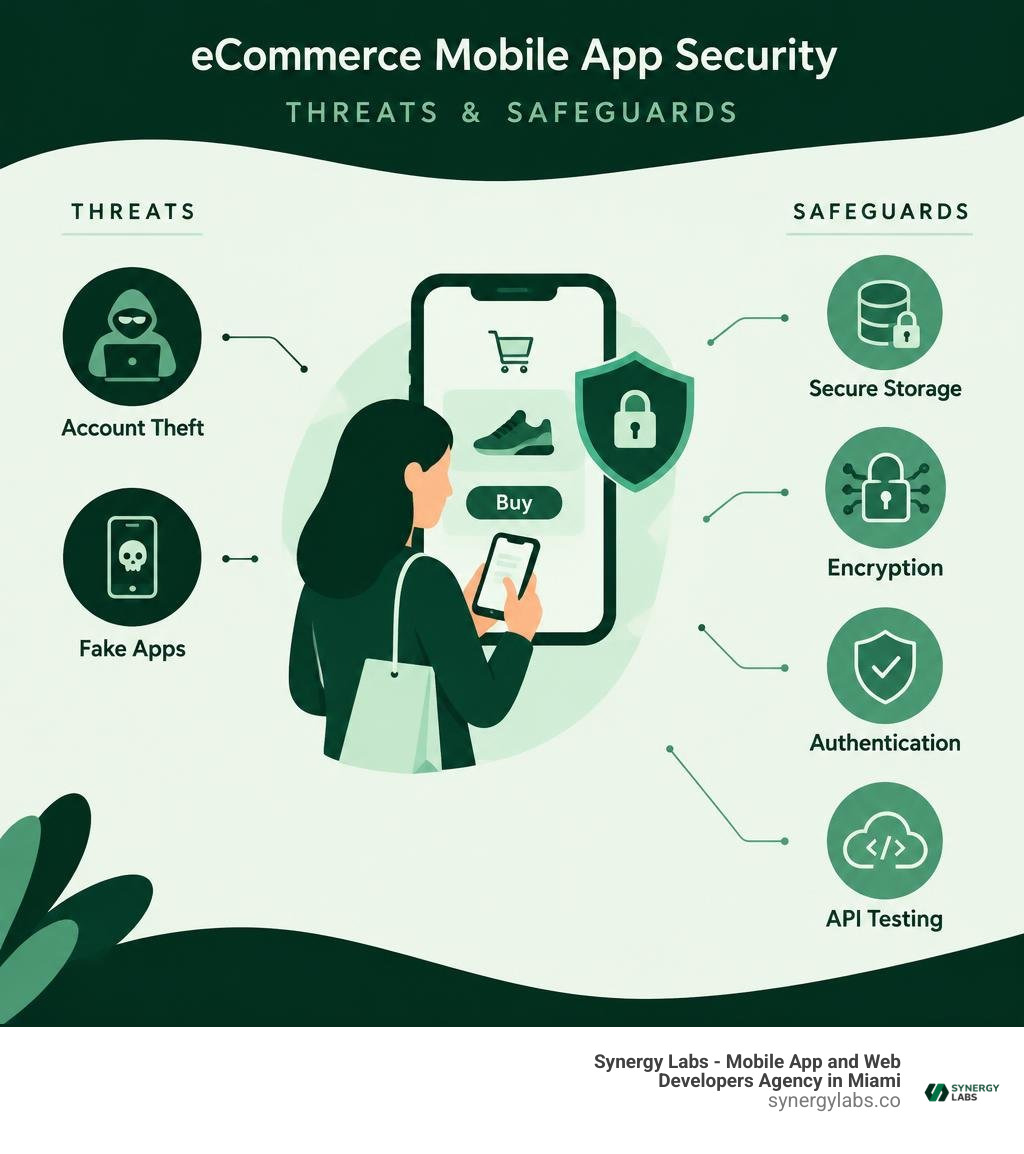
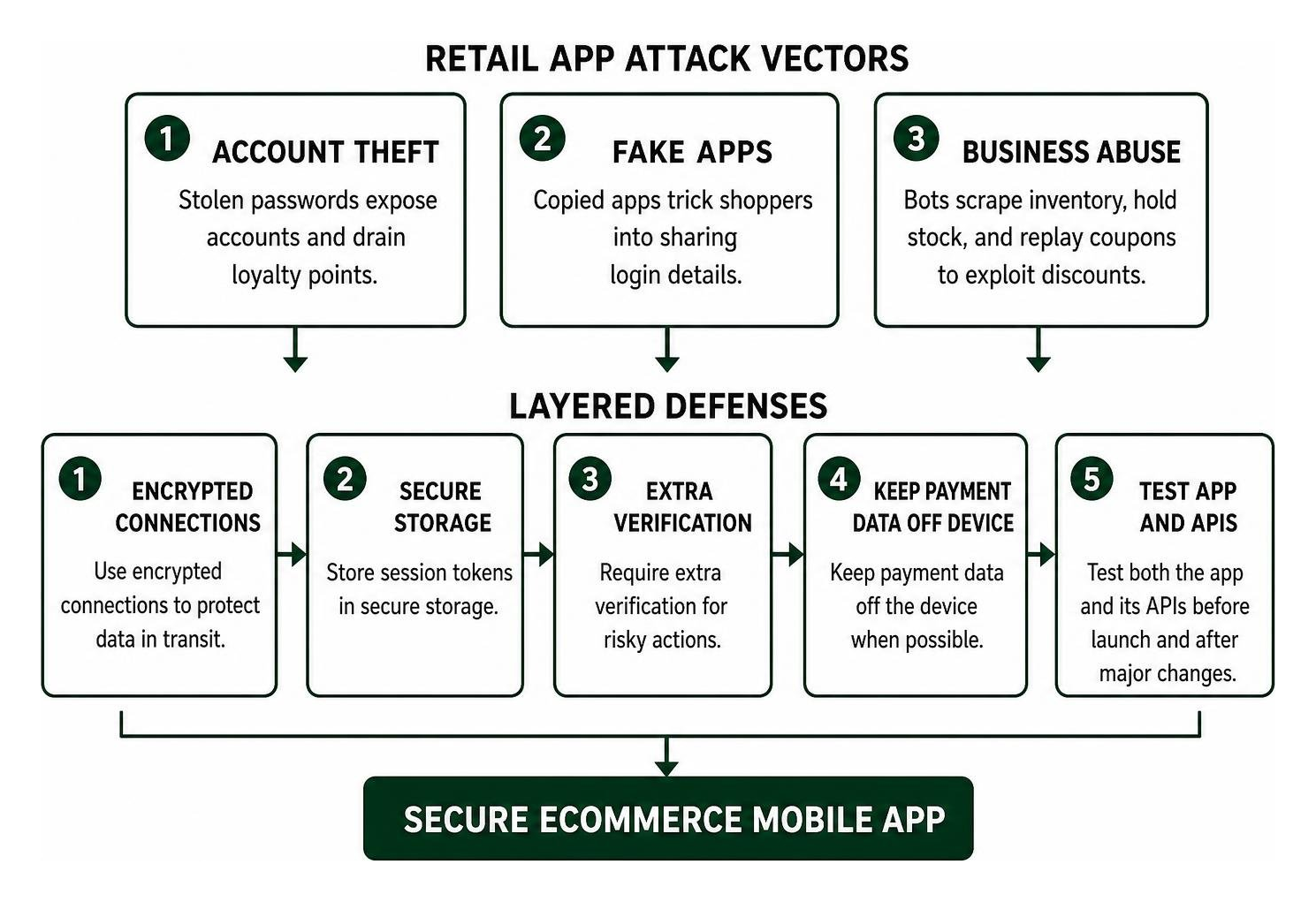
To build secure eCommerce mobile apps, protect the checkout and the account behind it. Use encrypted connections, keep payment data off the device when possible, store session tokens in secure storage, and require extra verification for risky actions. Test both the app and its APIs before launch and after major changes.
Retail apps face more than payment fraud. Stolen passwords can expose accounts, while copied apps can trick shoppers into sharing login details. Security must cover the device, the app, and the services it calls without making checkout a chore.
As director of product at Synergy Labs, I focus on building those safeguards into the shopping experience from the start.
Glossary for eCommerce secure mobile apps:
Threat Landscape and Vulnerabilities in eCommerce Secure Mobile Apps
Core Threat Vectors Facing eCommerce Secure Mobile Apps
Mobile retail platforms represent lucrative digital targets because they directly handle payment credentials, personal identity records, and accumulated reward balances. When threat actors target mobile storefronts, their attacks extend far beyond simple card-not-present fraud. Automated credential stuffing leverages vast databases of breached credentials to orchestrate mass account takeover campaigns. Once inside a consumer profile, attackers drain saved loyalty points, place fraudulent orders using pre-authorized one-click payment profiles, or harvest stored addresses for secondary phishing schemes.
Beyond account takeovers, mobile commerce platforms face sophisticated business logic abuse. Automated bots bypass standard web firewalls by communicating directly with backend endpoints, aggressively scraping live inventory levels, holding limited-edition stock in abandoned carts, or automating coupon replay attacks to exploit stacked discount codes. In high-concurrency environments, attackers execute race conditions against loyalty point balances and gift card redemption workflows to duplicate credit before backend ledgers synchronize.
Comprehensive industry evaluations, such as the mcommerce Security Report - USA, consistently show that retail applications operate with elevated risk profiles when client binaries lack rigorous validation. Defending against these multi-vector threats requires integrating comprehensive mobile app security strategies directly into the continuous integration and deployment pipelines.
Critical Client-Side and Manifest Flaws
Rigorous security assessments uncover systemic vulnerabilities across retail binaries in both major mobile ecosystems. Mobile Security Framework (MobSF) benchmarks reveal that the average security score for top-grossing Android retail applications sits at an alarming 40.92 out of 100, with approximately 84% of analyzed shopping applications harboring at least three high-severity security vulnerabilities.
A major contributor to this poor baseline is the persistence of insecure transport protocols. Roughly 92% of evaluated retail applications transmit certain tracking or asset data over clear-text HTTP connections, opening users up to local network interception. Manifest misconfigurations further expand this attack surface:
- Over-privileged permissions: Over 80% of analyzed Android commerce apps request unnecessary hardware and OS permissions, exposing background location, contacts, and external storage to third-party software development kits (SDKs).
- Unprotected components: Approximately 70% of analyzed applications expose unprotected exported activities, 63% share open background services, and 58% implement insecure broadcast receivers that malicious local apps can invoke.
- Legacy code execution flaws: About 90% of evaluated shopping apps retain unpatched implementations vulnerable to WebView Remote Code Execution (CVE-2013-4710), enabling arbitrary script execution via manipulated links.
- Task hijacking and overlay exploits: Over 50% of analyzed retail binaries lack adequate defense against Strandhogg 2.0, allowing rogue background apps to hijack the activity stack and display deceptive credential-harvesting overlays.
- Cryptographic weaknesses: Approximately 60% of applications remain susceptible to padding oracle attacks due to improper Cipher Block Chaining (CBC) implementations and weak padding schemes.
Regional comparative research indicates that while U.S.-developed applications demonstrate marginally fewer manifest, code-level, and certificate vulnerabilities than their non-U.S. counterparts—largely driven by regulatory pressures—both groups exhibit equivalent levels of network-level and transport layer misconfigurations.
Mobile vs. Web Architecture: Why Retail Apps Require Distinct Defenses
Attack Surface Disparities Across Platforms
A widespread misconception in retail software engineering is that mobile applications can rely on the same perimeter defenses as web storefronts. In standard web architectures, the execution environment resides largely on trusted servers behind enterprise firewalls, with the client running inside a standardized browser sandbox. In mobile retail, the architecture is entirely decentralized.
When an iOS or Android retail app is installed, the compiled binary executes in an untrusted, user-controlled environment. Attackers can decompile native binaries using open-source tools such as Ghidra or Jadx, inspect private business logic, analyze backend API routing, and extract hardcoded keys. Furthermore, mobile devices introduce local caching risks, fragmented operating system update cycles, and background inter-process communication channels that do not exist within desktop web sessions. Developers looking to master platform-specific hardening must consult the Mobile Application Security - OWASP Cheat Sheet Series to structure their mobile defenses systematically.
Implementing Multi-Layered Protection for eCommerce Secure Mobile Apps
To establish true defense-in-depth, mobile retail applications must employ multi-layered client protection that actively resists reverse engineering, tampering, and dynamic analysis.

- Binary Obfuscation and Code Hardening: Basic class and method renaming is insufficient. Production commerce apps require advanced control flow flattening, dummy code insertion, arithmetic transformations, and comprehensive string encryption. This ensures that decompiled source code becomes an unreadable maze for reverse engineers attempting to trace cryptographic routines or checkout logic.
- Runtime Application Self-Protection (RASP): Native RASP engines actively monitor the application's runtime memory space for hooks, code injection frameworks (such as Frida or Xposed), and active debuggers. If an attacker attaches an interactive debugger to modify shopping cart totals in memory, the RASP layer detects the anomaly and instantly terminates the process.
- Anti-Tampering and Signature Verification: Applications must compute native cryptographic checksums of their own executable code and resources. If a threat actor attempts to repackage the app with malicious tracking code and republish it as a clone, the signature verification routine halts execution and alerts the backend.
- Environment Attestation: Modern applications must detect root access on Android and jailbreaks on iOS. By querying platform integrity services, such as the Google Play Integrity API and Apple App Attest, retail backends can verify that incoming API requests originate from legitimate, unmodified binaries running on certified operating systems. Aligning these controls with enterprise mobile app security frameworks guarantees resilient commerce infrastructure across diverse device fleets.
Protecting Data in Transit, at Rest, and Across APIs
Cryptographic Standards for Stored Consumer Data
Local data persistence is unavoidable in modern retail apps, where offline shopping carts, user preferences, and session tokens must persist across app lifecycles. However, storing this data in plain text, shared preferences, or local property lists creates catastrophic privacy risks.
Sensitive data at rest must be encrypted using AES-256 in Galois/Counter Mode (GCM), providing both confidentiality and cryptographic integrity. Symmetric encryption keys must never be stored inside the app code. Instead, developers must leverage hardware-backed key management services:
- iOS Keychain: Keys are generated and stored within the hardware Secure Enclave, protected by access control flags that enforce biometric authentication prior to cryptographic operations.
- Android Keystore: Keys are isolated within a Trusted Execution Environment (TEE) or dedicated StrongBox hardware security module, ensuring that even a compromised Android operating system cannot extract the underlying private keys.
Beyond cryptographic storage, applications must prevent unintentional data leakage through standard operating system conveniences. Retail apps must disable background snapshots on payment and checkout screens to avoid caching credit card numbers in the OS switcher. Furthermore, developers should restrict clipboard access to prevent other background utilities from harvesting copied discount codes or payment details, following established methods to secure mobile apps.
Securing API Communications and Token Lifecycles
All communication between the mobile client and commerce backends must be strictly restricted to Transport Layer Security (TLS) version 1.3, deprecating legacy ciphers and insecure TLS versions. While standard HTTPS encrypts data in transit, it remains susceptible to client-side proxy interception when an attacker installs a custom root certificate on a managed device.
Dynamic certificate pinning prevents man-in-the-middle (MitM) attacks by binding the mobile application's networking layer to specific public key hashes of the server's certificate chain. By utilizing dynamic pinning architectures, security teams can rotate certificates over-the-air without waiting for app store update approval cycles.
API protection must also address token security. Long-lived session cookies should be abandoned in favor of short-lived OAuth 2.0 access tokens paired with cryptographically bound refresh tokens. Backend services must treat mobile clients as inherently untrusted, enforcing strict API rate limiting, IP reputation scoring, and automated bot mitigation to prevent programmatic inventory abuse. Integrating dedicated retail API security solutions guarantees that incoming API traffic originates solely from validated app instances rather than automated scripts mimicking legitimate network calls.
Authentication, Compliance, and Continuous Penetration Testing
Frictionless Yet Robust Authentication Protocols
Securing mobile retail accounts requires balancing stringent identity verification against the commercial necessity of frictionless conversions. Traditional, complex password policies often create cognitive fatigue, pushing consumers to reuse compromised passwords or abandon their carts during checkout.
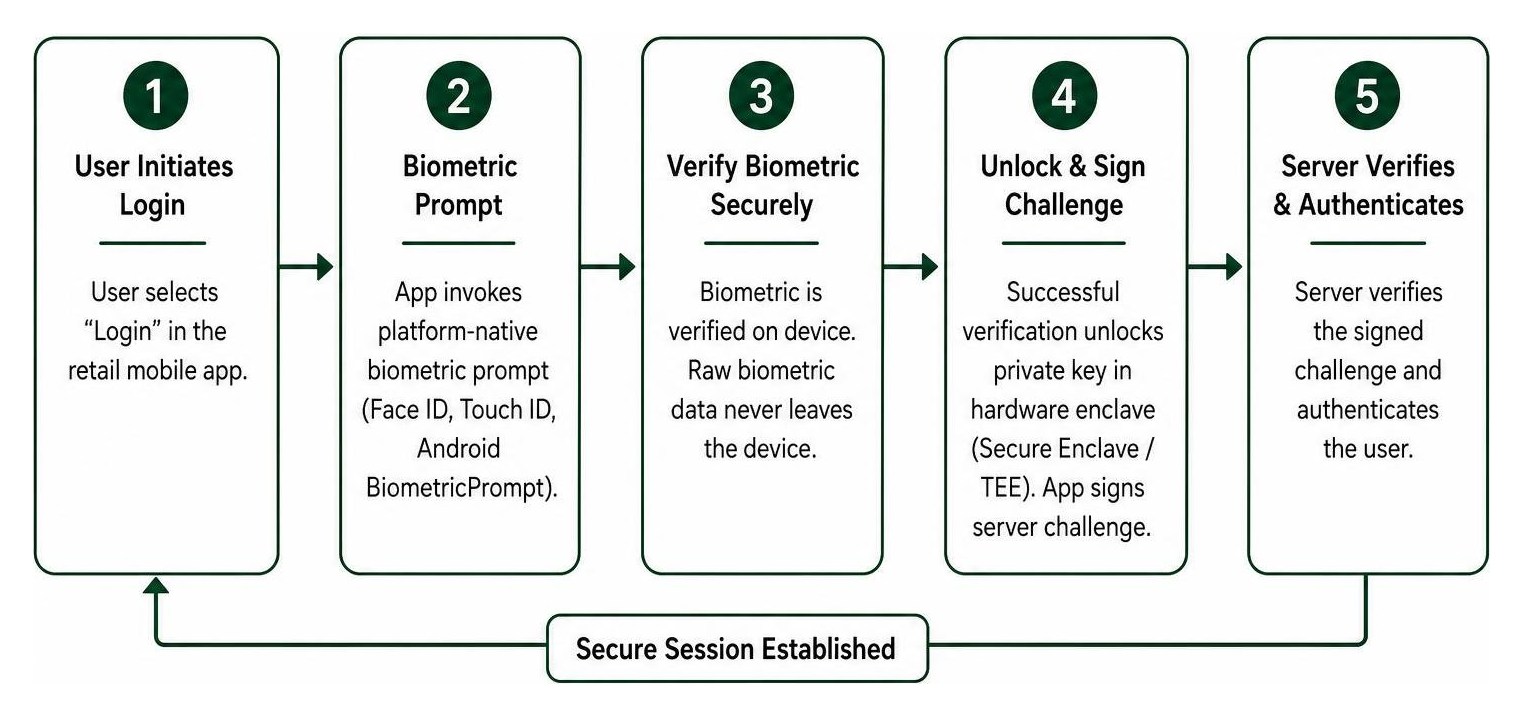
Modern commerce architectures resolve this friction by shifting toward passwordless and biometric authentication mechanisms. Integrating platform-native biometric prompts (Face ID, Touch ID, and Android BiometricPrompt) allows shoppers to authenticate securely in milliseconds. Under the hood, successful biometric verification unlocks cryptographic private keys stored inside the device's hardware enclave, signing authentication challenges without ever transmitting raw biometric data across the network.
When passwords are required during initial onboarding, retail apps should enforce NIST SP 800-63B guidelines, prioritizing length over arbitrary symbol complexity and checking inputs in real time against known breached credential databases. Research published on authentication mechanisms in mobile applications emphasizes that adopting standardized, predictable login and recovery workflows significantly reduces human error while cutting account takeover incidents. Furthermore, risk-based step-up authentication should be applied dynamically, triggering a secondary multi-factor verification factor only when anomalous behavior is detected, such as changing delivery addresses or executing high-value checkouts from an unfamiliar network.
Regulatory Compliance and Rigorous Penetration Testing
Operating a global mobile storefront mandates strict adherence to complex international regulatory frameworks. Non-compliance exposes enterprises to massive financial liabilities, brand erosion, and potential ejection from major application distribution platforms.
- PCI DSS v4.0.1 Alignment: Payment card industry standards prohibit the storage of sensitive authentication data (such as card verification values) on mobile devices post-authorization. Mobile apps must utilize client-side tokenization SDKs, passing raw cardholder data directly to compliant payment gateways so that card details never touch local app storage or internal commerce servers.
- Global Privacy Standards: Under GDPR and CCPA, personal data collection must adhere to strict data minimization. Retailers must audit third-party analytics SDKs, eliminate unauthorized location or device fingerprinting trackers, and provide transparent in-app data deletion controls.
- Secure Engineering Standards: Frameworks such as the Safe App Standard 2.0 establish formal engineering baselines for high-risk mobile transactions, requiring verifiable anti-tampering, robust transport cryptography, and structured privilege containment.
To validate compliance, automated static code analysis is insufficient. As detailed in the mobile app penetration-testing guide for e-commerce, enterprises must conduct continuous, manual penetration testing as a service (PTaaS). Manual penetration testers systematically test complex business logic, simulating price manipulation, coupon stacking, race conditions, and broken object-level authorization (BOLA) flaws that automated vulnerability scanners routinely miss. Coupling manual testing with proactive app security patch maintenance ensures that newly discovered CVEs are remediated before they can be exploited in production.
Frequently Asked Questions About eCommerce Mobile App Security
Why do standard web application firewalls fail to fully protect retail mobile applications?
Traditional web application firewalls (WAFs) inspect incoming HTTP/HTTPS traffic at the network edge, matching payloads against signatures designed to catch common web attacks such as SQL injection and cross-site scripting (XSS). However, mobile retail applications introduce an entirely different attack surface. The mobile client binary executes on an untrusted device where threat actors can reverse engineer the code, inspect private endpoints, and manipulate local application memory.
Furthermore, mobile threats often consist of legitimate API calls executed at high volumes by automated scripts or tampered application clones. Standard WAFs lack visibility into client-side binary integrity, root/jailbreak status, or mobile runtime environments. Comprehensive protection requires mobile-specific API attestation and runtime application self-protection (RASP) working in tandem with backend telemetry to verify that requests originate from legitimate, unmodified mobile applications.
How can retail apps maintain PCI DSS compliance while optimizing checkout conversion?
Retail applications achieve both frictionless conversion and strict PCI DSS compliance by keeping cardholder data completely out of scope on the mobile device. This is accomplished through client-side tokenization. When a consumer enters their payment details, the mobile app utilizes a specialized payment processor SDK to transmit the sensitive card details directly from the user interface to an encrypted, PCI-compliant vault.
The payment gateway returns an encrypted payment token that the mobile app attaches to the checkout payload. At no point are primary account numbers (PANs) or CVV codes written to local device storage, caches, or application logs. For recurring transactions, the app pairs this token with platform-native biometric authentication (such as Apple Pay or Google Wallet), allowing shoppers to complete purchases with a single biometric prompt without violating strict cardholder data storage rules.
What is the most effective defense against automated credential stuffing in retail apps?
Mitigating automated credential stuffing requires a multi-layered defense strategy that targets bot automation at both the client and network layers. The most effective approach combines platform integrity attestation, behavioral biometrics, and adaptive authentication.
First, implement hardware-backed device attestation—such as Google Play Integrity on Android and App Attest on iOS—to ensure authentication requests originate solely from genuine, untampered mobile applications rather than emulators or headless automation scripts. Second, deploy behavioral biometrics to differentiate human interactions (accelerometer movement, touch pressure, typing cadences) from automated bot scripts injecting stolen credentials. Finally, backend authentication gateways must monitor credential attempt velocity and anomaly metrics, automatically invoking step-up multi-factor challenges or CAPTCHAs when repeated login failures or distributed IP clusters are detected.
Engineering Resilient Retail Applications with Synergy Labs
Building secure, high-performing mobile commerce applications requires far more than patching vulnerabilities after launch. It demands a secure-by-design engineering philosophy that integrates binary hardening, cryptographic data protection, robust authentication, and resilient API architectures into every stage of development. In an increasingly hostile mobile threat landscape, customer trust and brand equity depend directly on your platform's ability to protect transactions without compromising user experience.
At Synergy Labs, we engineer custom, scalable, cross-platform mobile commerce solutions that combine intuitive, conversion-focused design with enterprise-grade security. Our unique delivery model pairs dedicated in-shore CTO oversight with an elite offshore dev team. We operate on a transparent fixed-budget model with milestone-based payments that ensure projects are completed efficiently, guaranteeing that your application launches on schedule, within scope, and fully hardened against modern threats.
Contact Synergy Labs today to build an exceptional, secure mobile retail platform tailored to scale your business.